A Guide to the OMB A 133 Compliance Supplement for Churches
 By Gibson Brueher, Founder of Grain Ledger
Master the OMB A 133 Compliance Supplement with our clear guide for nonprofits and churches. Learn how to stay audit-ready and manage federal grants.
If your church receives federal grant money, you'll eventually encounter something called the OMB A-133 Compliance Supplement. It's a hefty government guide, but don't let that intimidate you. At its core, it’s the official rulebook auditors use to make sure organizations, including churches, spend federal funds the right way.
See Grain Ledger for your church
Fund accounting, giving integrations, and bank reconciliation in one platform. Free migration support for churches switching from QuickBooks or Aplos.
Think of it as the government's way of ensuring taxpayer dollars are handled with total transparency and accountability, creating a level playing field for everyone who receives federal awards.
Unpacking the Auditor's Rulebook
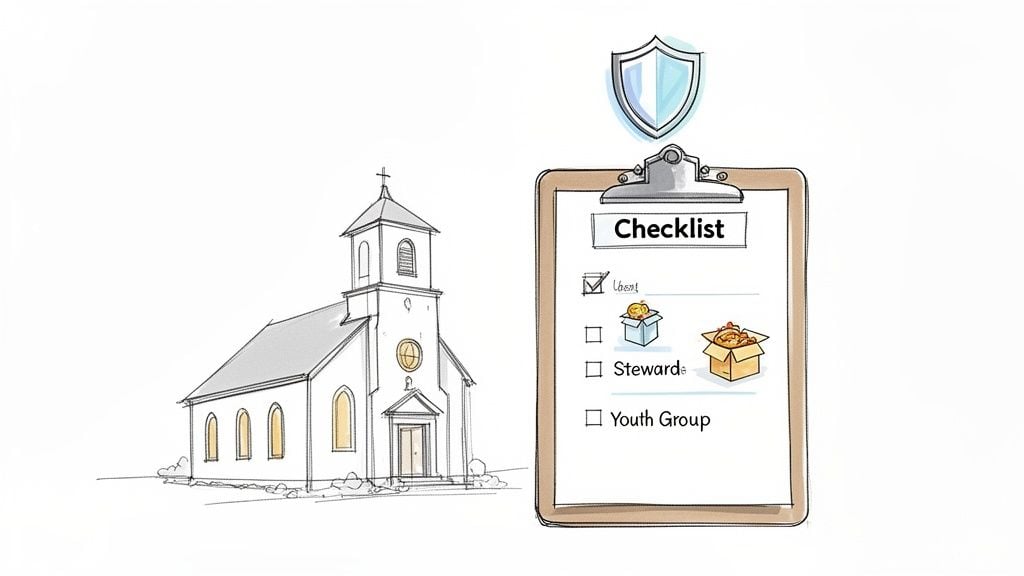
Let's say your church lands a big grant to expand its community food pantry. It's a huge win for your ministry. But that federal money comes with very specific rules. How do you prove you followed them to the letter? That’s where the OMB A-133 Compliance Supplement steps in.
It’s the master checklist your auditor will use during their inspection. It isn't a form for you to fill out; it's a script that tells the auditor exactly what to look for and how to test it. The whole point is to standardize audits across thousands of different federal programs, which ensures the process is fair and consistent for every recipient.
From Vague Rules to a Standardized Playbook
It wasn't always this straightforward. Years ago, audit requirements could feel inconsistent, changing from one auditor to the next. The Supplement was born out of the 1996 Amendments to the Single Audit Act, after groups like the Government Accountability Office (GAO) flagged major gaps in how audits were being done.
In response, the Office of Management and Budget (OMB) stepped in to standardize the process for all non-federal entities. This was a massive shift—a 100% expansion in scope—that brought over 50,000 organizations under a single, unified audit framework. If you're curious, you can explore the history of these federal audit requirements to see how far we've come.
So, what does this mean for your church? It means your auditor isn’t just making things up. They are following a very specific playbook to confirm your daily operations line up with federal law. It bridges the gap between abstract regulations and real-world activities, like:
- Buying food for a federally-funded youth program.
- Paying staff salaries from a grant for homeless outreach.
- Tracking volunteer hours that count as your matching contribution.
The Supplement’s real value is in its clarity. It tells both the organization and the auditor what matters most, removing guesswork and focusing the audit on key compliance areas.
Protecting Your Church’s Mission and Reputation
At the end of the day, understanding the OMB A-133 Compliance Supplement is all about good stewardship. When you know the rules of the road, you protect your church’s finances, mission, and public reputation. It proves you're a trustworthy manager of public funds.
This isn’t just about ticking boxes. Non-compliance can have serious consequences, from having to repay funds to being barred from future grant opportunities.
By building your financial practices around the Supplement's expectations from the very beginning, a potentially stressful audit becomes a simple confirmation of the good work you're already doing. Using a dedicated fund accounting system like Grain Ledger, which is built for the way churches operate, makes this infinitely easier by ensuring every dollar is tracked correctly from day one.
How to Navigate the Compliance Supplement Structure
Opening the OMB A-133 Compliance Supplement for the first time can feel overwhelming. It's dense, technical, and looks like it was written by a government committee—because it was. But don't let that intimidate you.
Think of it less like a novel you have to read from start to finish and more like a detailed reference manual. The key is knowing how it's organized so you can quickly find what applies to your church. Once you understand the structure, that massive document becomes a practical, manageable tool.
Breaking Down the Seven Key Parts
The Supplement is logically divided into seven parts. Each section serves a specific purpose, guiding you and your auditor through the compliance process. Trying to read it cover-to-cover is a recipe for confusion. The smart approach is to know what each part does and jump straight to what you need.
This document is huge for a reason. In recent editions, Part IV, which covers specific program rules, makes up over 70% of its 1,000+ pages. It details the unique requirements for more than 400 different federal awards. Part II, on the other hand, is a powerful matrix that helps auditors zero in on the highest-risk areas, which can significantly speed up the audit process. You can always find the official OMB guidance for a deeper dive.
This structure is designed to turn a mountain of information into a targeted guide.
Your Roadmap to the Supplement
For most churches and nonprofits, the real action happens in two sections: Part II and Part IV. If you can get comfortable with these, you're well on your way.
-
Part II - The Matrix of Compliance Requirements: This is your master checklist. It’s a huge grid that connects federal programs to the 14 different types of compliance rules. It’s the fastest way for you and your auditor to see exactly which rules apply to the grants you received.
-
Part IV - Agency Program Requirements: This is the detailed instruction manual. After the Matrix in Part II tells you which rules matter, Part IV explains how to follow them for your specific grant. It lays out the program's goals, required procedures, and even the exact tests an auditor will use.
It’s a simple two-step process: Part II points you to the right chapter, and Part IV is the chapter itself, filled with all the nitty-gritty details.
By focusing on these two sections, you can pinpoint the exact compliance obligations tied to your federal awards. This eliminates the guesswork and lets you concentrate your efforts on what will actually be audited.
To give you a complete picture, here’s a quick breakdown of what each part of the Supplement does.
Key Parts of the OMB A-133 Compliance Supplement Explained
This table simplifies the main sections of the Supplement and explains what they mean for your church's finance team.
| Supplement Part | Primary Function | What It Means for Your Church |
|---|---|---|
| Part I | Background, Purpose, and Applicability | Explains the "why" behind the Supplement and confirms if it applies to you. |
| Part II | Matrix of Compliance Requirements | Your master checklist linking grants to the 14 core compliance rules. |
| Part III | Compliance Requirements | Defines each of the 14 core compliance rules in plain language. |
| Part IV | Agency Program Requirements | The specific instruction manual and audit tests for your particular federal grant. |
| Part V | Clusters of Programs | Groups related federal programs together to make auditing a little simpler. |
| Part VI | Internal Control | Provides a framework for designing and checking your internal financial controls. |
| Part VII | Guidance for Auditing Programs | Contains special instructions for certain programs not covered in Part IV. |
Knowing how to navigate this structure is half the battle for getting audit-ready. This is where a dedicated church accounting system like Grain Ledger can make a real difference. It helps organize your financial data in a way that naturally aligns with these compliance categories, so pulling the right reports for your auditor becomes much, much easier.
The 14 Core Compliance Requirements Explained
At the heart of the OMB A-133 Compliance Supplement are 14 core requirements. But don't let that number intimidate you. These aren't just arbitrary rules dropped from on high; they're the bedrock principles auditors use to make sure your church is handling federal funds responsibly and with integrity.
Instead of trying to memorize a dry list of 14 items, it’s much more helpful to see them for what they are: a reflection of your church's daily operations. We can group them into three practical themes: Financial Oversight, Program Rules, and Recipient Eligibility. This approach transforms a daunting checklist into a clear, actionable guide.
This diagram helps visualize how the supplement connects all the pieces, serving as a master list, a rulebook, and a guide for the auditors themselves.
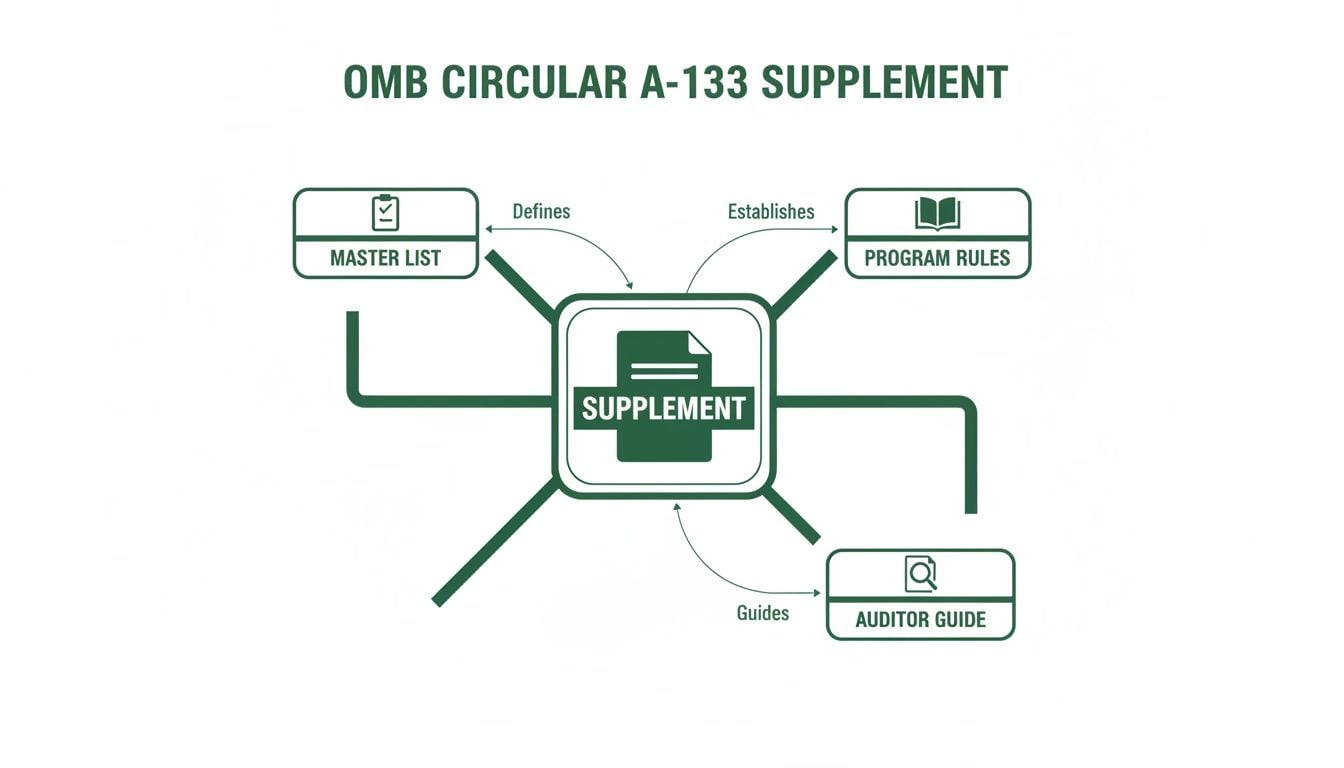
As you can see, the supplement acts as the central hub, bringing together the master checklist, the specific program rules, and the auditor's guide. This ensures everyone is on the same page, making the audit process consistent and transparent.
Group 1: Financial Oversight Requirements
This first group is all about how your church handles the money. Think of it as the foundation of good stewardship—it covers sound financial practices, proper accounting, and transparent reporting. An auditor is essentially checking to make sure your financial house is in order.
- Allowable Costs/Cost Principles: This is a big one. It's the "what you can and can't spend money on" rule. For instance, if your church has a federal grant for a community food pantry, using funds for canned goods or the program coordinator's salary is perfectly fine. But using that same money to renovate the sanctuary? That's a no-go, because it doesn't directly serve the grant's purpose. Proper expense tracking is key here, and our guide on the statement of functional expenses can help you nail this.
- Cash Management: This rule is simple: request federal funds only when you're ready to use them. You shouldn't draw down a large chunk of grant money and let it sit in a bank account for months. The idea is to keep the time between receiving the funds and spending them as short as possible.
- Period of Performance: Federal funds always come with an expiration date. This requirement is about proving you spent the money within the specific timeframe laid out in the grant award. If a grant runs from January 1 to December 31, every expense must happen within that window.
- Reporting: This covers all the financial and performance reports you need to send back to the federal agency. Auditors will verify that your reports are accurate, were submitted on time, and include everything required, like your Schedule of Expenditures of Federal Awards (SEFA).
Group 2: Program-Specific Rules
While the financial rules are fairly universal, this next set gets into the nitty-gritty of your specific grant program. These are the unique instructions that come with your particular funding.
An auditor's job here is to confirm that you’re not just spending the money correctly, but that you're also running the program according to its distinct operational guidelines.
Here's what falls into this category:
- Activities Allowed or Unallowed: This goes a step beyond just costs and looks at the types of activities you can run. A grant for after-school tutoring would obviously permit educational sessions, but it would prohibit using those funds for something like a purely recreational field trip.
- Matching, Level of Effort, Earmarking: Some grants have strings attached. You might need to contribute your church's own funds (matching), keep your existing financial support for a program at a certain level (level of effort), or dedicate a specific portion of the grant to a particular activity (earmarking). An auditor will want to see proof that you've hit these important targets.
- Procurement and Suspension and Debarment: When you use federal money to buy things or hire people, you have to follow fair and open competition rules. You also have a responsibility to check that you aren't paying contractors who have been banned from working on federal projects.
- Subrecipient Monitoring: Does your church pass along some of its federal grant money to another organization to help carry out the work? If so, you're on the hook for making sure they follow all the grant rules, too. This is a huge responsibility.
Group 3: Recipient and Participant Eligibility
This final group of requirements is all about making sure the right people are being helped. It verifies that the federal funds are reaching their intended audience and that your organization is qualified to manage them in the first place.
Auditors will be looking for clear documentation that proves both your church and the individuals you serve meet the grant's specific criteria.
- Eligibility: This confirms that the individuals or families benefiting from your program actually meet the requirements set by the grant, such as falling within a certain income level, age range, or geographic area.
- Special Tests and Provisions: This is basically a catch-all category for any unique program rules that don't neatly fit anywhere else. It’s absolutely critical to read your grant agreement from top to bottom to spot these special requirements.
Breaking down the 14 requirements into these three themes really demystifies the audit process. It shows that the OMB A-133 Compliance Supplement isn't just bureaucracy—it's a practical framework for demonstrating accountability, transparency, and effective ministry.
Common Audit Findings and How Your Church Can Avoid Them
Knowing the rules is one thing, but putting them into practice flawlessly is another challenge entirely. Even the most dedicated church leaders can make mistakes, leading to audit findings that can put future funding at risk and tarnish a hard-earned reputation.
The key is to be proactive. If you understand the common tripwires, you can build the right habits and internal controls long before an auditor ever walks through your door.
An audit finding isn't a judgment on the heart behind your ministry; it's simply a factual report on whether your financial practices followed the grant's specific rules. You'll find that the most frequent issues aren't about complex financial schemes, but simple breakdowns in everyday processes. Let's look at the problem areas we see most often and, more importantly, how to prevent them.
Finding 1: Poor Documentation
This is, without a doubt, the number one issue we see. It all comes down to the classic auditor's mantra: "If it isn't written down, it didn't happen." An auditor’s job is to verify, and they can only do that with clear, complete records.
Here’s a common scenario: Your church uses grant funds to pay a part-time outreach coordinator. The payments are completely legitimate, but your records just show a check written to an individual. There are no timesheets, no description of the work they performed, and no clear link back to the specific grant-funded program.
An auditor will immediately flag this. Why? Because there's no way to prove the expense was allowable, allocable, and reasonable for that particular federal program. Without the paper trail, it's just an unsubstantiated payment.
“Effective internal controls are essential to meeting audit requirements under Uniform Guidance. Nonprofit auditors assess your control environment to determine how well you monitor, document, and execute compliance responsibilities.”
To avoid this, treat every single grant-funded expense as if you'll have to explain it to a total stranger a year from now.
How to get ahead of it:
- Create an "Expense Packet" Habit: For every transaction paid with federal funds, get in the habit of creating a mini-file. It should include the invoice, proof of payment (like a check copy), the name of the federal program and its Assistance Listing Number, and a quick note explaining how this purchase helps the grant's mission.
- Go Digital: Use software to scan and attach documentation directly to each transaction in your accounting system. This creates a perfect, unmissable audit trail that will make your auditor smile.
Finding 2: Improper Cost Allocation
Another frequent stumbling block is how you handle shared costs—expenses that benefit more than one program, including both federal and non-federal church activities. Getting the allocation wrong is an easy way to get an audit finding.
Picture this: Your facility manager spends about 25% of her time overseeing building maintenance for your federally-funded after-school program. But when you do the accounting, you charge 50% of her salary to the grant because there was room in the budget.
That’s a major red flag. Costs have to be allocated based on the real, proportional benefit each program receives. Overcharging the federal grant is a serious compliance violation, even if it was an honest mistake.
How to get ahead of it:
- Write Down Your Method: Create a simple, written Cost Allocation Plan that explains how you divide shared costs. For salaries, this might be based on time studies or timesheets. For utilities, it could be based on the square footage each program uses. The key is to be consistent and logical.
- Do Quarterly Check-ups: Things change. Revisit your allocations every quarter to make sure they still reflect reality. If that after-school program expands into another classroom, your utility allocation needs to be updated.
Finding 3: Failure to Monitor Subrecipients
Does your church pass federal funds along to another partner organization to help carry out the mission? If so, your job doesn't end when you write the check. You've become a pass-through entity, and you are now fully responsible for making sure that partner (the subrecipient) follows all the grant rules, too.
A cautionary tale: Your church gives a portion of its food pantry grant to a smaller local ministry to run a satellite distribution site. You send them the money but never check on their operations, review their expenses, or confirm they're tracking participant eligibility correctly. If their records are a mess, the audit finding goes on your report.
How to get ahead of it:
- Put it in Writing: Always use a formal, signed subrecipient agreement. It should clearly spell out their responsibilities, including the requirement to comply with the OMB A-133 Compliance Supplement.
- Schedule Check-Ins: Don't just hand over the money and hope for the best. Require regular financial and program reports. If you can, do site visits to see their work firsthand and offer support.
A purpose-built accounting solution like Grain Ledger can be a powerful ally in preventing these findings. Its fund-based structure automatically keeps grant money from getting mixed with other funds, and its reporting tools make it simple to track allowable costs and allocations with the kind of audit-ready precision you need.
Using Fund Accounting Software for Seamless Compliance
Trying to manage federal grants with a standard accounting program—or worse, a spreadsheet—is like trying to build a house with only a screwdriver. You might get a few things put together, but the foundation will be fundamentally flawed and unsafe. These generic tools simply weren't built for the intense tracking requirements of the OMB A-133 Compliance Supplement.
When you're dealing with federal funds, every single dollar has to be accounted for with pinpoint accuracy. General-purpose software just can't keep up. It doesn't have the built-in guardrails to enforce spending restrictions or create the kind of segregated, transparent reports auditors need to see. This often forces finance teams into a stressful, manual scramble, patching things together and dramatically increasing the risk of commingling funds—a mistake that can lead to serious audit findings and put future funding at risk.
Why True Fund Accounting Is the Answer
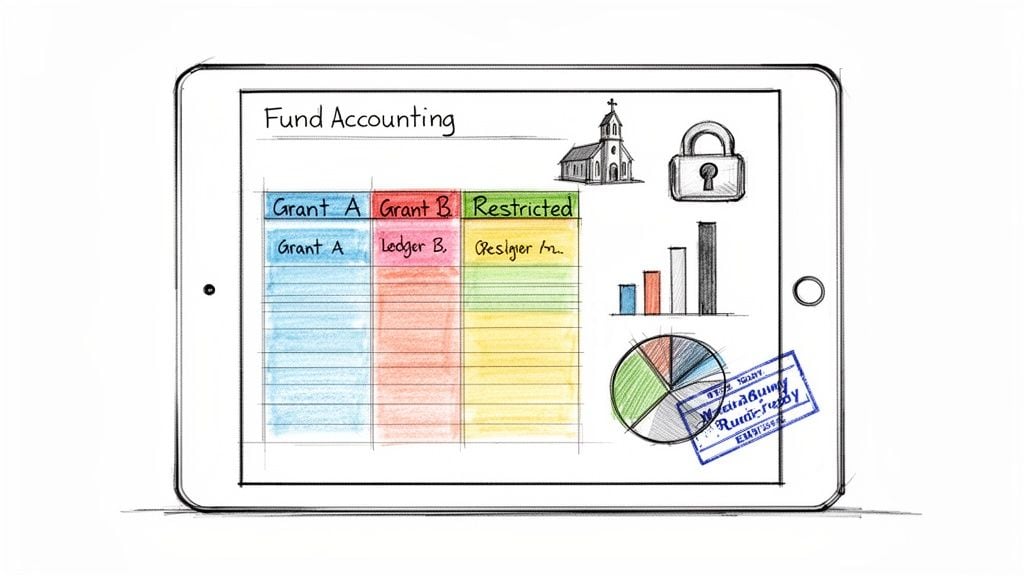
This is where a true fund accounting system changes the game. Unlike standard accounting that just looks at your overall income and expenses, fund accounting is built on one powerful, non-negotiable principle: segregation. It creates a separate, self-balancing set of books for each funding source—your general operating fund, a building campaign, and, crucially, each federal grant you receive.
Think of it this way: each grant gets its own protected financial silo. This structure isn't just a nice feature; it’s the core of the entire system. It makes it nearly impossible to accidentally use restricted grant money for an unapproved expense. This inherent separation is exactly what federal guidelines demand, making it the gold standard for any organization stewarding taxpayer dollars.
The real beauty of fund accounting is that it provides clear, undeniable proof of your stewardship. It shifts compliance from a manual, error-prone chore to an automated process that works quietly in the background.
This approach is proactive, not reactive. It addresses the most common audit pitfalls before they ever have a chance to happen, giving you the financial confidence to manage complex federal awards.
Achieving Audit Readiness with Grain Ledger
For churches navigating these strict requirements, a specialized system like Grain Ledger is the right tool for the job. Grain Ledger was designed from the ground up with a native fund architecture, which means it was built specifically to solve the challenges of grant management and the OMB A-133 Compliance Supplement.
It’s not just accounting software with a few extra tags thrown in; its entire framework is organized by funds. This design directly supports compliance in several critical ways:
- Automatic Fund Segregation: The moment grant money arrives, it’s automatically isolated in its own dedicated fund. This prevents it from ever being mixed with general church offerings or other restricted donations.
- Enforced Spending Restrictions: The system ensures that expenses are only drawn from the appropriate fund, making it simple to prove that every dollar was spent exactly as intended.
- Audit-Ready Reporting: Grain Ledger generates precise, fund-specific financial statements with just a few clicks. You can instantly produce a report showing every transaction tied to a specific federal award—exactly what an auditor needs to see.
The federal government has consistently raised the bar for accountability. On June 27, 2003, for instance, the OMB amended Circular A-133, raising the single audit threshold from $300,000 to $500,000. This 66.7% increase pulled thousands more organizations under these strict rules, with over 35,000 such audits submitted annually by 2010. You can learn more about how these OMB circulars shaped modern audits. This history shows why having a robust, purpose-built system is no longer optional.
Making Compliance a Natural Byproduct of Good Bookkeeping
Ultimately, the goal is to make audit readiness a natural part of your daily financial operations, not a frantic scramble at the end of the year. When you use a solution like Grain Ledger, your church’s day-to-day bookkeeping practices become inherently compliant. You can explore how to implement these powerful systems in our guide to church fund accounting software.
This puts your ministry in a position of strength, demonstrating impeccable stewardship to federal agencies, your board, and your congregation. It transforms the audit from a source of anxiety into an opportunity to prove the integrity and impact of your work.
Your Practical Audit Readiness Checklist
Getting ready for an audit isn't about a frantic, last-minute scramble. It’s the natural result of consistent, daily habits. This checklist helps turn the dense concepts from the OMB A-133 Compliance Supplement into concrete, actionable steps.
Think of this as your guide to shifting compliance from a source of stress to a simple confirmation of your good stewardship. Each point is a clear action designed to prepare your team and safeguard your ministry's resources long before an auditor ever walks through the door.
Financial Documentation
Your financial records need to tell a clear, complete, and unshakeable story. The goal is to create an audit trail so solid that it leaves no room for questions.
- Confirm expense packets are complete. Every single expense tied to a federal grant should have its matching invoice, proof of payment, and a simple note explaining how it served the grant's purpose.
- Verify your Schedule of Expenditures of Federal Awards (SEFA) is accurate. You need to double-check that every federal award is listed with its correct Assistance Listing number and the exact total you spent during the fiscal year.
- Review payroll allocations. If you're charging staff time to a federal grant, make sure you have the timesheets or other records to back it up, showing their work on that specific program.
Internal Controls
Strong internal controls are the guardrails that keep your financial processes on the right track. They are absolutely critical for catching errors early and proving you have responsible oversight in place.
"Effective internal controls are essential to meeting audit requirements... Nonprofit auditors assess your control environment to determine how well you monitor, document, and execute compliance responsibilities."
- Test segregation of duties. Make sure no single person has control over an entire financial transaction—from approving it, to paying it, to reconciling the account. This is a classic red flag for auditors.
- Perform mock transaction audits. Every quarter, pick a few grant-funded expenses and review them as if you were the auditor. Is all the documentation there? Is it easy to find and understand?
- Check subrecipient monitoring files. If you pass federal funds along to other organizations, you need to prove you're keeping an eye on them. Make sure you have signed agreements, their reports, and clear notes on your oversight activities.
Policy and Procedure Review
Your written policies are your organization's commitment to doing things the right way, every time. They show an auditor that your processes are intentional, not just accidental.
- Review your written cash management policies. Check that your policies (and your practices) reflect drawing down federal funds only when you have immediate expenses to pay.
- Update your cost allocation plan. Your plan for how you allocate shared costs across different programs isn't a "set it and forget it" document. Review it at least once a year to ensure it still makes sense for your current operations.
- Confirm procurement procedures are documented. Your process for buying goods and services with federal money has to be written down and follow fair competition rules.
For many churches, putting these robust processes into practice is much simpler with the right tools. You can learn more about how modern software can help in our guide on accounting for churches.
When these steps become part of your routine, audit readiness just becomes a natural outcome of your daily work.
Related church accounting software resources
If you are comparing software, these pages map the main decision points: fund accounting, QuickBooks limits, pricing, and migration.
- Best church accounting software (2026 comparison) - canonical guide comparing 12 church accounting platforms
- Church accounting software product page - see Grain Ledger for fund accounting, giving, and bank reconciliation
- Small church accounting software - see the product page built for volunteer treasurers and church admins
- Fund accounting features - review how Grain Ledger tracks designated funds
- QuickBooks for churches - understand workarounds and when to switch
- Free church accounting software - compare free options and upgrade triggers
- Grain Ledger pricing - compare plans for small and growing churches
- Start free - try fund accounting, giving imports, and bank reconciliation together
Common Questions About Federal Grants and Church Audits
Stepping into the world of federal grants can feel like learning a new language. Let's clear up a few of the most common questions church leaders have about the OMB A-133 Compliance Supplement and what it means for your financial stewardship.
Is the OMB A-133 Compliance Supplement Still a Thing?
Yes, but it's evolved. The original OMB Circular A-133 was rolled into a broader set of rules called the Uniform Guidance (you can find it in 2 CFR Part 200).
Today, the guide auditors use is simply called the OMB Compliance Supplement. It serves the exact same purpose: providing the roadmap for single audits under the new framework. One of the most important changes that came with the Uniform Guidance was an increase in the audit threshold—it’s now $750,000 in annual federal spending.
We Only Have One Federal Grant. Do We Really Need a Special System for It?
Even a single federal award brings a whole new level of accountability. The rules for tracking and reporting are incredibly strict, and trying to manage them with standard accounting software or spreadsheets is a recipe for disaster. It's just too easy to accidentally mix grant money with general funds or pull an inaccurate report, leading to serious audit findings.
For churches, a purpose-built solution like Grain Ledger is the only answer. It automatically keeps funds separate and produces the compliant reports you need, protecting your church's finances and saving your team from countless administrative headaches. It’s a smart move, no matter the size of the grant.
We Think We Might Need a Single Audit. Where Do We Start?
The very first thing you need to do is get a firm handle on your numbers. Tally up every dollar your church spent from federal sources during your fiscal year. Remember to include money from direct grants and any funds that flowed through a state or local agency.
If that total is getting close to or has passed the $750,000 mark, your next call should be to an independent auditor. Make sure you find one who has specific experience conducting single audits for nonprofits. They’ll be your expert guide, helping you assess where you stand and walking you through the entire process.
Ready to achieve seamless compliance and gain true financial clarity? Grain Ledger is the purpose-built fund accounting software that helps churches manage grants with confidence. Schedule a Demo today to be the first to experience stress-free stewardship.
Ready to simplify your church finances?
Start free with church fund accounting, or watch a product demo first.