Statement of Functional Expenses: A Practical Guide for Churches
Jun 26, 2023
If you’ve ever looked at a church's budget, you’ve probably seen a list of expenses: salaries, utilities, rent, supplies. That tells you what the money was spent on. But a statement of functional expenses goes a crucial step further—it explains why.
This report breaks down every dollar spent by its purpose, sorting costs into the core functions of your church: ministry programs, general administration, and fundraising.
Decoding Your Church's Financial Story
Think of it this way: a typical expense report is like a grocery receipt. It lists everything you bought. But the statement of functional expenses is the recipe—it shows how you combined those ingredients to create something meaningful.
For a church, this means translating financial data into a powerful story of stewardship and impact. It’s the tool you use to show your congregation and donors exactly how their contributions are being put to work to advance the mission.
The Purpose Behind the Report
At its core, this statement is all about accountability and transparency. It gives church leaders, board members, and the congregation a clear picture of the ministry's financial health and efficiency. The main goals are to:
Demonstrate Stewardship: Show that you're using resources wisely and effectively to fulfill the church’s calling.
Enhance Transparency: Give donors a detailed look at how their gifts are split between direct ministry work and the necessary overhead that supports it.
Inform Decision-Making: Provide leadership with the data they need to make smart, strategic choices about budgets and where to invest for future growth.
Ensure Compliance: Meet the official reporting standards required by accounting principles and regulatory bodies.
This report is so much more than a compliance document. It’s a testament to your church's commitment to its mission, answering the one question every supporter asks: "How is my contribution making a difference?"
Meeting a Critical Accounting Standard
The role of the statement of functional expenses was cemented by major updates from the Financial Accounting Standards Board (FASB). With Accounting Standards Update (ASU) 2016-14, all nonprofits are now required to show the relationship between their functional expenses (like program services) and their natural expenses (like salaries).
This change, which took effect for most organizations by 2018, made this report an essential piece of nonprofit financial reporting. Churches that follow Generally Accepted Accounting Principles (GAAP) must follow these rules, making sure their financial statements are both clear and defensible. For a deeper look at the rules, check out our guide on navigating the specifics of https://www.grainledger.com/blog/fasb-asc-958.
The Three Core Functional Expense Categories
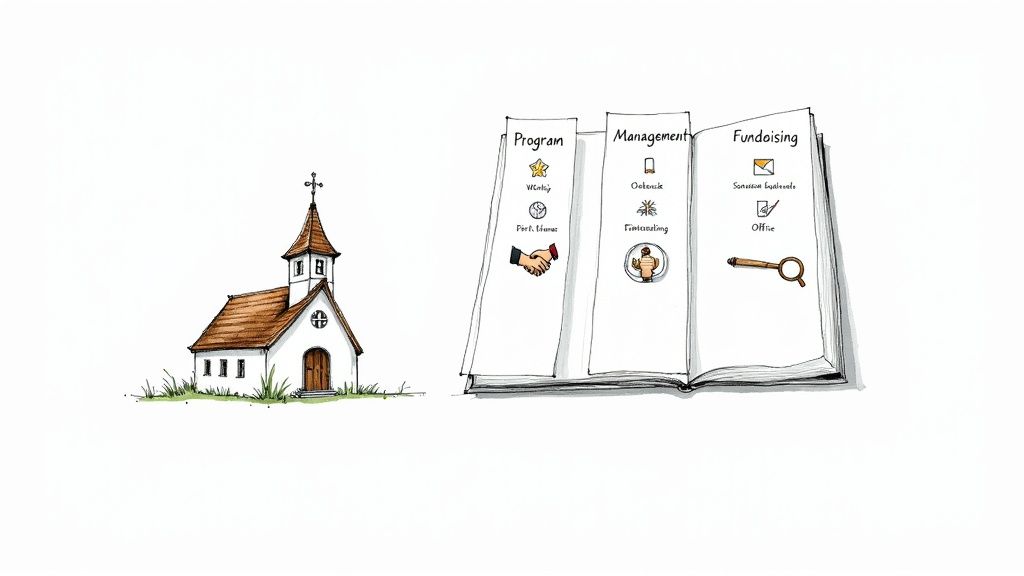
To really get a handle on the statement of functional expenses, you have to understand its three main pillars. Don't think of these as rigid accounting boxes. Instead, picture them as three distinct buckets that explain the why behind every dollar your church spends.
Sorting your expenses correctly is the secret to creating a report that tells an honest and compelling story about your ministry’s impact. Every single expense, from the lead pastor's salary to the coffee you serve on Sunday morning, has to land in one of these buckets. This process is what turns a simple list of what you spent into a powerful overview of how you’re using your resources to live out your mission.
1. Program Services (Your Ministry)
Program Services are the heart and soul of your church's mission. These are all the expenses directly tied to the ministry activities you exist to carry out. This bucket answers the big question: "What are we actually doing to serve our congregation and community?"
For a church, this covers a pretty wide range of activities:
Worship Services: Costs for musicians, sanctuary supplies, and the portion of salaries for staff who plan and lead services.
Youth and Children's Ministry: Expenses for curriculum, VBS supplies, volunteer background checks, and the youth pastor's salary.
Community Outreach: The cost of running a food pantry, hosting a neighborhood block party, or funding a missions trip.
Small Groups and Discipleship: Materials for Bible studies, training resources for group leaders, and any staff time spent on these programs.
Bottom line: if an expense is a direct cost of making a ministry program happen, it belongs here. This is the category most donors pay attention to because it shows the "boots on the ground" work of the church.
2. Management and General (Your Operations)
It may not be the most exciting category, but Management and General expenses are the essential operational costs that hold up all your ministry activities. Think of this as the church's central nervous system—it keeps everything running, but it isn’t tied to any single program.
These are the overhead costs you need to keep the church operating smoothly, safely, and legally.
This category covers the vital, behind-the-scenes work that makes ministry possible. Without solid administration, even the most passionate programs can stumble. It’s simply the cost of doing ministry well.
Common examples include:
Administrative Salaries: The portion of salaries for office staff, bookkeepers, and executive pastors focused on overall church management.
Occupancy Costs: General utilities, insurance, and building maintenance that benefit the entire facility.
Professional Fees: Costs for your annual audit, legal counsel, or accounting services.
Office Expenses: General supplies, bank fees, and software subscriptions. A dedicated church accounting tool like Grain Ledger is a perfect example of a management expense that supports good financial stewardship.
3. Fundraising (Your Development)
The final bucket, Fundraising, covers any costs you incur to ask for financial support. These are the expenses directly tied to soliciting contributions, whether for the general budget or a specific capital campaign.
This includes things like:
Special Events: The direct costs of hosting a fundraising dinner or a special offering event.
Campaign Materials: Expenses for printing and mailing appeal letters or creating brochures for a building campaign.
Donor Management: The cost of software you use to track giving and communicate with your donors.
Staff Time: The portion of a pastor's or staff member's salary spent on fundraising, like meeting with major donors to discuss a new initiative.
To give you a better feel for how this works in practice, here are some common church expenses and how they typically get classified.
Church Functional Expense Categories and Examples
Expense Category | Program Services (Ministry) | Management & General (Admin) | Fundraising (Development) |
|---|---|---|---|
Salaries & Wages | Pastor's sermon prep time, Youth Pastor salary, Worship leader stipend | Executive Pastor's admin time, Bookkeeper salary, Office Manager salary | Staff time spent planning a capital campaign or writing appeal letters |
Occupancy | A portion allocated to the sanctuary, children's ministry rooms, and youth hall | A portion allocated to church offices and general-use areas (e.g., lobby) | A portion allocated for a fundraising event held on-site |
Office Supplies | Curriculum printing, Bible study workbooks | General-purpose paper, toner, pens for the main office | Envelopes and paper used for a direct mail fundraising appeal |
Software | Children's check-in system, Worship presentation software | Accounting software (like Grain Ledger), Payroll service, Church management system | Donor management or online giving platform fees |
Professional Fees | Guest speaker fee for a special service or conference | Annual audit fees, Legal consultation fees | Consultant hired to assist with a capital campaign |
Events & Travel | VBS supplies, Youth mission trip costs, Small group leader training event | Staff travel to an administrative conference, Bank service charges | Catering and venue rental for a fundraising dinner |
As you can see, many expenses—especially big ones like salaries and building costs—need to be allocated across two or even all three categories. This is where having a clear, consistent method for tracking time and space usage becomes so important.
The history of this report really drives home its importance for accountability. It was first required back in 1993, but by 2006, many nonprofits were still reporting questionable figures—some claiming 90% administrative costs—that hid major inefficiencies. The rules were tightened in 2018, forcing nonprofits to draw clearer lines between these three categories and tell a more transparent story. If you're interested in the details, you can discover insights about the history of functional expense reporting.
A Step-by-Step Guide to Preparing Your Statement
Putting together a statement of functional expenses can feel like a daunting task, but it’s really just a logical puzzle. First, you gather all the pieces—your individual expenses. Then, you sort those pieces into the right categories until a clear picture of your ministry's financial health emerges.
This guide will walk you through the process one step at a time, making it much more manageable for your team.
Step 1: Gather Your Natural Expenses
Before you can explain why you spent money, you have to know what you spent it on. This first step is all about getting a complete list of your "natural" expenses for the year. These are the everyday, line-item costs you already track in your general ledger.
Your mission here is to account for every dollar that went out the door. This list will include things like:
Salaries, wages, and benefits
Rent or mortgage payments
Utilities (electricity, water, internet)
Office supplies and postage
Insurance
Professional fees (e.g., accounting, legal)
Ministry-specific supplies (like curriculum or event materials)
Having a well-organized chart of accounts makes this part a breeze. If you need a refresher, check out our comprehensive guide on creating a chart of accounts for nonprofits.
Step 2: Develop Your Allocation Methods
This is where the real work begins, and it's the most important step to get right. Many of your expenses don't fit cleanly into just one bucket. Think about your pastor's salary—it supports worship services (Program), church administration (Management), and meetings with donors (Fundraising). You need a logical and consistent way to split these shared costs.
Here are a few common and defensible ways to do this:
Time Studies: The gold standard for allocating salaries. Staff members track their hours for a representative period, noting how much time they spend on program-related tasks versus administrative or fundraising duties. You then use those percentages to allocate their total compensation.
Square Footage: Perfect for facility costs like rent, utilities, and maintenance. Simply measure the total square footage and figure out how much space is dedicated to each function. If your sanctuary is used for programs and your office is for management, you can use those ratios to divide up occupancy costs.
Direct Usage: A straightforward method for supplies. If you can track which function used specific materials—say, paper for the children's ministry curriculum versus paper for a fundraising mailer—you can allocate those costs directly.
The key is to pick methods that are reasonable, document them, and apply them consistently year after year. Pulling percentages out of thin air is a huge red flag for auditors.
Step 3: Allocate Each Expense
Now that you have your methods, it's time to put them to work. Go through your list of natural expenses line by line and assign the costs to the three functional categories: Program Services, Management and General, and Fundraising.
Some costs are easy. The bill for printing worship bulletins? That’s 100% Program Services. The fee for your annual audit? That's 100% Management and General.
For the shared costs, you'll use the allocation methods you just defined. Let's say a time study showed your pastor spends 70% of their time on ministry activities, 20% on administration, and 10% on fundraising. You would split their salary and benefits package using that exact 70/20/10 ratio.
This flowchart shows how this allocation process works.
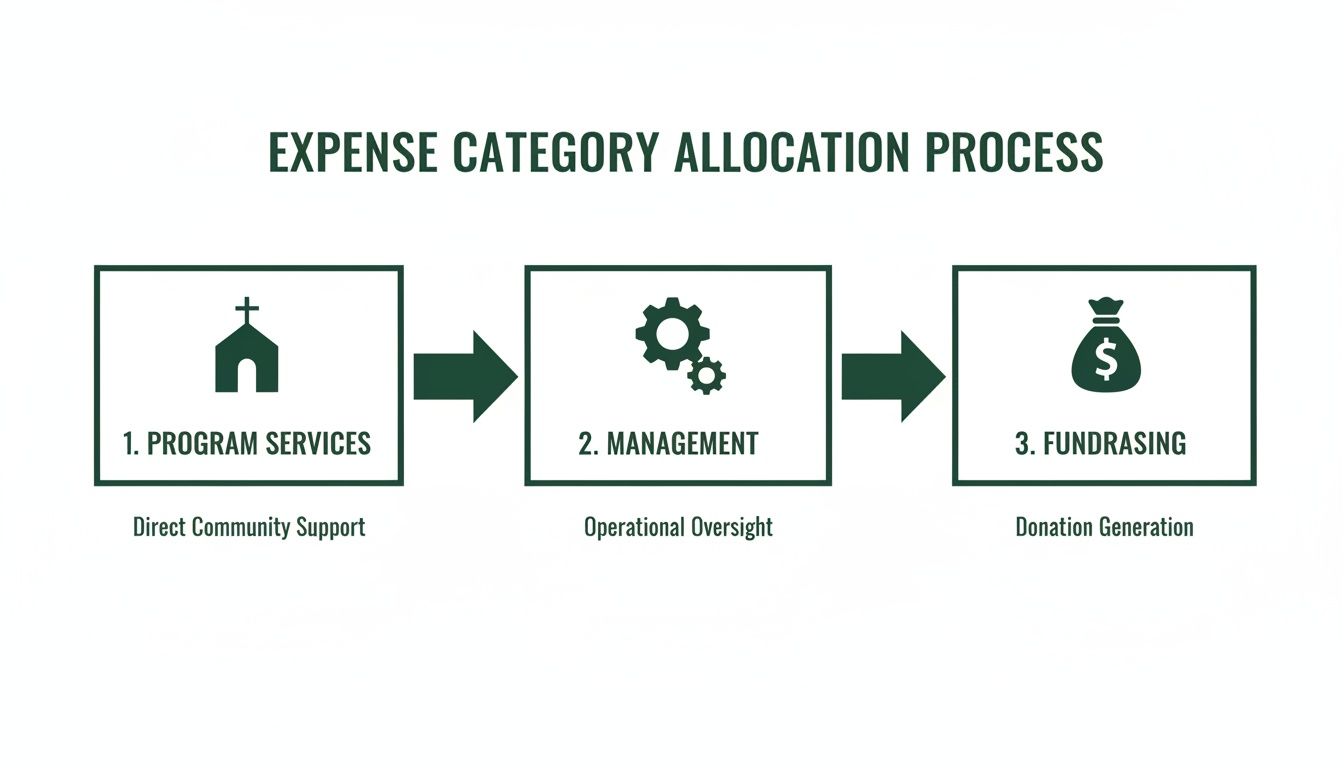
As you can see, you start with one big pool of natural expenses and methodically channel them into the three core functions. Every dollar gets a purpose.
Step 4: Compile and Review the Statement
With all the allocation done, the final step is to assemble the formal statement. The standard layout is a grid: your natural expenses are listed down the side in rows, and the three functional categories (plus a total column) run across the top as columns.
Your finished statement should tell a clear story. At a glance, someone should be able to see how much was spent on salaries in total, and then see exactly how that cost was distributed across your ministry, administrative, and fundraising efforts.
Once it's all put together, take a step back and review it. Do the final numbers feel right? Does the percentage spent on programs accurately reflect your church’s focus for the year? This final sanity check ensures your report is an honest reflection of your operations and is ready for your board, your congregation, and any outside eyes.
Best Practices for Allocating Shared Costs
Let's be honest: figuring out how to allocate shared costs is usually the trickiest part of putting together a statement of functional expenses. It's also where auditors and savvy donors look first to see if your financial story holds water. You can't just pick a percentage out of thin air. You need a reasonable, documented, and consistent method for every single shared expense.
Think about your church building. The mortgage, utilities, and insurance don't just support one single activity—they support everything that happens under your roof. Your job is to find a fair way to slice up that cost pie based on how the space is actually used. That’s the heart of allocation: breaking down a single, large expense into smaller, meaningful pieces that reflect reality.
Defensible Methods for Key Expenses
To make sure your allocations are both reasonable and defensible, it’s best to stick with established methods that directly link a cost to its purpose. These data-driven approaches give you the documentation you need to justify your numbers if anyone asks.
Here are three of the most respected allocation methods:
Time Studies for Salaries: This is the gold standard for personnel costs. Have your staff track their hours for a representative period, like two or four weeks, to figure out what percentage of their work goes toward ministry programs, general administration, or fundraising.
Square Footage for Occupancy: This method is perfect for building-related costs like rent, utilities, insurance, and maintenance. Just measure the total usable square footage of your facility and calculate how much of that space is dedicated to each function (e.g., the sanctuary for programs, offices for management).
Direct Usage for Supplies and Resources: For expenses like office supplies, printing, or software, the best approach is to track who uses what. If a specific department or function is the primary user of a resource, the cost should follow.
By using these methods, you're moving from guesswork to a logical system that you can easily explain and verify.
Church Scenarios: Putting Allocation into Practice
Let's see how this works with a common church expense: the lead pastor’s salary. A pastor’s role is incredibly diverse, touching every part of the church. A simple time study might show a breakdown like this:
65% Program Services: Time spent preparing sermons, leading worship services, providing pastoral counseling, and teaching Bible studies.
25% Management & General: Time spent in staff meetings, managing church operations, overseeing the budget, and dealing with board governance.
10% Fundraising: Time spent meeting with major donors, planning a capital campaign, and writing stewardship appeal letters.
Based on that study, you would allocate 65% of the pastor's total compensation package (salary plus benefits) to Program Services, 25% to Management & General, and 10% to Fundraising. This creates a clear, defensible audit trail for your statement of functional expenses.
The same logic applies to your building. If your church facility is 10,000 square feet, you might find the space is used as follows:
Sanctuary & Classrooms (7,000 sq. ft.): Used for worship and discipleship, making it 70% Program Services.
Administrative Offices (2,000 sq. ft.): Used for daily operations, making it 20% Management & General.
Multi-purpose Room (1,000 sq. ft.): If this space is used mainly for fundraising events, it would be 10% Fundraising.
Following this logic, you’d allocate 70% of your monthly utility bill to programs, 20% to management, and 10% to fundraising.
Common Mistakes to Avoid
Inaccurate allocations can completely undermine the integrity of your financial reporting. You have to be vigilant to steer clear of these common pitfalls.
The goal of allocation isn't to minimize your overhead numbers—it's to present an honest picture of what it truly costs to run your ministry. Transparency builds trust far more effectively than manipulated ratios.
Using Arbitrary Percentages: Never just guess. Allocating "around 80%" to programs without any data to back it up is a massive red flag for auditors.
Failing to Document Your Logic: Whatever method you choose, write it down. A simple memo explaining your square footage calculation or the results of a time study provides critical support during an audit.
A "Set It and Forget It" Mentality: Your church's operations will change over time. Make a point to review your allocation methods every year to ensure they still accurately reflect how time and resources are being used.
Getting your statement of functional expenses right reveals how you steward your resources. Across the nonprofit world, program services typically consume the largest share of expenses—it’s how organizations justify their tax-exempt status. Your allocation methods are what drive these numbers, whether it’s time spent by staff (often 60-70% on programs), square footage for rent (e.g., 80% program space), or usage stats for IT. Following the rules set by FASB ASC 958-205-45-6 ensures your reporting is accurate and compliant. You can discover more insights about nonprofit expense allocation and its requirements to make sure your church stays on the right track.
How to Turn Your Statement into a Strategic Tool
An accurate statement of functional expenses is so much more than a compliance document. Think of it as a strategic roadmap for your ministry. Once you’ve compiled the numbers, the real work—and the real value—begins. This is where you start asking the tough stewardship questions that turn a financial report into a powerful decision-making tool.
This statement helps you get crystal-clear answers. Are we putting enough money behind our core ministry programs? Are our administrative costs starting to outpace our outreach? The insights you pull from this report will build donor confidence and guide your leadership team toward a healthier, more mission-focused financial future.
Analyzing Key Financial Ratios
The raw numbers on your statement tell part of the story, but calculating key financial ratios is where the deeper insights lie. These metrics give you a standardized way to measure your church’s efficiency and effectiveness, turning a page of data into actionable information. They help you benchmark your performance against past years and spot trends before they become problems.
Think of these ratios as a financial health checkup for your ministry. They reveal the critical balance between funding your mission directly and supporting the essential operations that make it all possible.
The most powerful story your statement of functional expenses tells is not just how you spent the money, but how well you are stewarding the resources entrusted to you. These ratios translate that story into a language everyone can understand.
The most important metric is the program expense ratio, which shows what percentage of your total spending goes directly toward your mission. Naturally, a higher ratio often signals to donors that their contributions are making a tangible impact. It's crucial to remember, though, that a healthy church also needs solid administrative support and effective fundraising. It's all about finding the right balance.
Communicating a Story of Stewardship
Your statement is one of the most effective tools you have for building trust with your congregation through transparency. Don't just prepare it and file it away. Use it to share a compelling narrative about how their generosity is fueling your ministry's work. Feature the key ratios in your annual report or present them at your next congregational meeting.
For example, imagine being able to confidently share that "80 cents of every dollar given goes directly to funding our worship services, youth programs, and community outreach." A simple, clear statement like that speaks volumes about your commitment to good stewardship. It transforms abstract financial data into a concrete assurance that their support is making a difference where it counts.
This level of transparency doesn't just keep current members engaged; it also attracts new people who are looking for fiscally responsible organizations to support. When people see that you manage your finances with integrity, their confidence—and their willingness to give—naturally grows.
Making Data-Driven Ministry Decisions
Ultimately, the goal is to use these insights to make smarter, more informed decisions for your ministry. If your analysis shows that administrative costs are creeping up, your board can dig in to find out why. Maybe it’s time to renegotiate a vendor contract or look into technology that could make your team more efficient.
On the flip side, if you see that a specific ministry is achieving incredible results on a shoestring budget, the data might make a strong case for investing more resources to expand its reach. This is where a dedicated church accounting solution like Grain Ledger becomes so valuable. It doesn't just simplify creating your statement of functional expenses; it gives you the real-time visibility needed to make these strategic choices with confidence.
By connecting your financial data directly to your ministry goals, you can ensure that every single dollar is working as hard as possible to advance your mission. The following table breaks down the most important ratios you can pull from your statement.
Key Financial Ratios from Your Statement
This table summarizes a few essential ratios you can calculate from your statement of functional expenses. Each one offers a unique window into your church's financial health and operational efficiency.
Financial Ratio | How to Calculate | What It Tells You |
|---|---|---|
Program Expense Ratio | Total Program Expenses / Total Expenses | The percentage of spending that directly supports your church's mission and ministry activities. |
Administrative Expense Ratio | Total Management & General Expenses / Total Expenses | The percentage of spending dedicated to overhead and operational support. |
Fundraising Efficiency Ratio | Total Fundraising Expenses / Total Contributions Received | How much it costs to raise one dollar, indicating the efficiency of your development efforts. |
By regularly calculating and reviewing these ratios, your leadership team can move from simply reporting on past expenses to proactively shaping a financially sustainable future for your ministry.
Make Your Reporting Automatic with Grain Ledger
Manually divvying up expenses and fighting with spreadsheets to build a statement of functional expenses is a headache. It's a slow, painful process that opens the door to costly mistakes. What used to take church treasurers and volunteers hours of tedious work can now be done in minutes with modern accounting software.
The trick for churches is finding a tool that’s actually built for their unique financial world. This is where a true fund accounting system is a game-changer, helping your church move beyond generic business software and into a platform that gets how ministry works.
Designed for Church Finances
Unlike standard accounting software that forces you into clunky workarounds, Grain Ledger was built from the ground up for how churches actually handle money. It’s based on a native fund architecture, which simply means every transaction gets tagged with its designated purpose right from the start. That structure is the secret to creating functional expense reports that are both effortless and accurate.
Instead of manually splitting costs line by line, Grain Ledger does the heavy lifting for you.
Fund Tracking: Every dollar is tied to its intended purpose, whether it’s for the general budget, a building campaign, or a missions fund. This ensures restricted funds are always handled correctly.
Automated Allocations: You can set up your allocation rules just once (like basing utility costs on square footage) and the system automatically spreads those shared costs across your programs, administration, and fundraising.
Class-Based Reporting: Tag expenses by ministry area—think "Youth Group" or "Community Outreach"—to pull detailed reports that show you the real financial impact of each program.
This all-in-one approach gets you out of the business of exporting data into messy spreadsheets. The system connects your giving platform, bank accounts, and ledger into one seamless flow, so your financial data is always current and audit-ready.
When you automate the mechanics of functional expense reporting, you lift a massive burden from your team. That frees them up to focus on what really matters: understanding the story your numbers tell and making smart, strategic decisions for the ministry.
The Power of Automation
Moving to a system like Grain Ledger brings some powerful benefits that directly boost your church's stewardship and efficiency. The biggest wins are a huge jump in accuracy, massive time savings, and financial clarity in real-time.
Manual data entry always leads to human error, which can throw off your financial reports and lead to bad decisions. Automation takes that risk off the table, ensuring your statement of functional expenses is a true picture of your operations. That kind of accuracy builds trust with your board, your leaders, and your congregation.
And the time saved is no small thing. Tasks that once ate up a volunteer's entire weekend can now be done in just a few clicks. This gives your team the breathing room to focus on high-impact work that moves the mission forward, instead of just shuffling paperwork. With instant access to clear, insightful reports, your leadership can make timely, data-driven decisions that strengthen the church’s financial health for years to come.
You can learn more about how Grain Ledger delivers these benefits to churches just like yours.
Your Questions, Answered
Let's tackle some of the common questions that pop up when church leaders start working with the Statement of Functional Expenses. Getting these details right can make all the difference.
Do We Really Have to Prepare This Statement?
This is probably the most common question, and the answer is: it depends. If your church prepares financial statements according to Generally Accepted Accounting Principles (GAAP), then yes, it's absolutely required. This isn't just a suggestion; it’s a standard set by FASB's ASU 2016-14.
Even if you're not required to have a formal audit, many denominations, lenders, and grant-making organizations will ask to see one. They view it as a key indicator of financial health and transparency. Think of it as a tool for building trust and proving you’re a good steward of the funds you receive.
How Do We Split Our Pastor's Salary Across Different Functions?
A pastor rarely wears just one hat. They preach, counsel, manage staff, and sometimes even get involved in fundraising. So, how do you accurately split their salary?
The best-practice, auditor-approved method is a time study. It sounds more complicated than it is. Just ask your pastor to track their hours for a typical period, say two to four weeks, noting how much time is spent on specific activities:
Sermon prep and worship services: This is a program expense.
Staff meetings and administrative tasks: This falls under management & general.
Meeting with potential donors: That’s a fundraising cost.
Once you have those percentages, you can apply them to the pastor's total salary for the year. This gives you a reasonable, documented, and defensible basis for your allocation.
What's the Real Difference Between Program and Management Expenses?
This distinction can feel a bit fuzzy, but there's a simple way to think about it: direct ministry vs. ministry support.
Program expenses are the costs that directly fuel your church's mission. These are the "front-line" activities. Things like putting on the Sunday service, buying supplies for the youth group, or funding a missions trip are all clear-cut program costs.
Management and general expenses, on the other hand, are the essential but indirect costs that keep the entire organization running. Your accounting fees, the church's insurance policy, and the office administrator's salary all fall into this bucket. They support the ministry, but they aren't the ministry itself.
Ready to simplify your church's financial reporting? Grain Ledger is a true fund accounting solution built specifically for churches, helping you create accurate and compliant reports like the statement of functional expenses effortlessly.