Church Fund Accounting Software: A Practical Guide to Faith-Based…
Discover how church fund accounting software protects church finances, simplifies reporting, and ensures compliance. Find the right fit for your ministry today.
Imagine trying to navigate a vast, rugged wilderness using a simple city map. You might recognize a few things—hills that look like buildings, streams that resemble roads—but the map is built for a completely different world. It just can't get you where you truly need to go.
That's precisely what it feels like to manage your church’s finances with generic business software.
Why Generic Accounting Software Fails Your Church
Software designed for a for-profit business operates on a single, straightforward goal: track money flowing into one big pot to maximize profit. But a church’s financial reality is completely different. You don't have one pot of money; you have many separate "envelopes," each designated for a specific ministry purpose.
You have the general fund, of course, but you also have the youth group’s mission trip fund, the building campaign fund, and the benevolence fund. This is where generic tools immediately hit a wall. They aren't built to track and protect these separate streams of money, which is more than just an inconvenience—it's a serious threat to your church's financial integrity.
The Problem with Manual Workarounds
When the software can't do the job, your team is forced to invent complicated and fragile workarounds. It's a constant struggle that usually involves:
- Massive Spreadsheets: Keeping intricate spreadsheets outside of your main accounting system just to track how designated gifts are being used. This is a recipe for errors and wasted time.
- Awkward "Class" Systems: Trying to force features like "classes" in QuickBooks to act like fund tracking. As our guide on the challenges of using QuickBooks for churches explains, this often creates confusing reports and makes it easy to misapply funds.
- High Risk of Misuse: Without built-in guardrails, it becomes far too easy to accidentally dip into a restricted fund to cover a general expense, which violates the trust your donors have placed in you.
True fund accounting isn't just an accounting method; it’s a stewardship principle. It’s a system designed to honor the intent of every donor and ensure every dollar goes exactly where it was meant to go. It’s about accountability, not just profit.
A city map is useless in the wilderness, and business software simply can't handle the unique demands of ministry finances. Churches are recognizing this in droves. The global market for church accounting software was valued at USD 2.85 billion in 2024 and is expected to more than double by 2033. This growth, as you can learn from market research on church financial tools, is driven by a powerful need for transparency and genuine fund-based controls.
In the end, specialized church fund accounting software like Grain Ledger isn’t just a nice upgrade. It's the right tool for the job, built from the ground up to give your ministry the financial clarity, control, and confidence it deserves.
Understanding True Fund Accounting for Churches
At its heart, true fund accounting is all about accountability. It’s a system built to honor the specific intentions behind every dollar your church receives.
The best way to think about it is to imagine your church's finances not as one big checking account, but as a collection of clearly labeled digital envelopes. You'd have one for 'General Operations,' another for the 'Youth Mission Trip,' and a separate one for the 'Building Renovation Fund.'
When a family gives specifically to the youth group's mission trip, that money goes directly into that designated envelope. And just as importantly, money can only be spent from that envelope for its stated purpose. You wouldn’t dip into the 'Missions' envelope to pay the light bill, and a proper accounting system prevents that from happening digitally.
This principle of restricted funds is the bedrock of good church stewardship. It’s a profound legal and ethical promise you make to your givers: every designated dollar will be used exactly as they intended.
The Fundamental Difference From Business Accounting
This "envelope system" is worlds apart from how a standard for-profit business handles its books. A typical business sees all income as one big pool of cash. Their main goal is to track total revenue against total expenses to see if they’re making a profit.
But a church's primary financial goal isn't profit; it's accountability. Fund accounting gives you the framework to manage dozens of separate financial commitments all at once, under one roof. It ensures the healthy surplus from your general fund doesn't get accidentally spent on the new sanctuary roof, which has its own designated donations. For a deeper look, check out our guide on fund accounting for nonprofits.
Fund accounting isn’t just a different bookkeeping style; it's a non-negotiable framework for maintaining trust. It shifts the focus from "Are we profitable?" to "Are we faithful stewards of the resources entrusted to us?"
The flowchart below really brings this to life, showing what happens when you use the wrong tool for the job versus the right one.
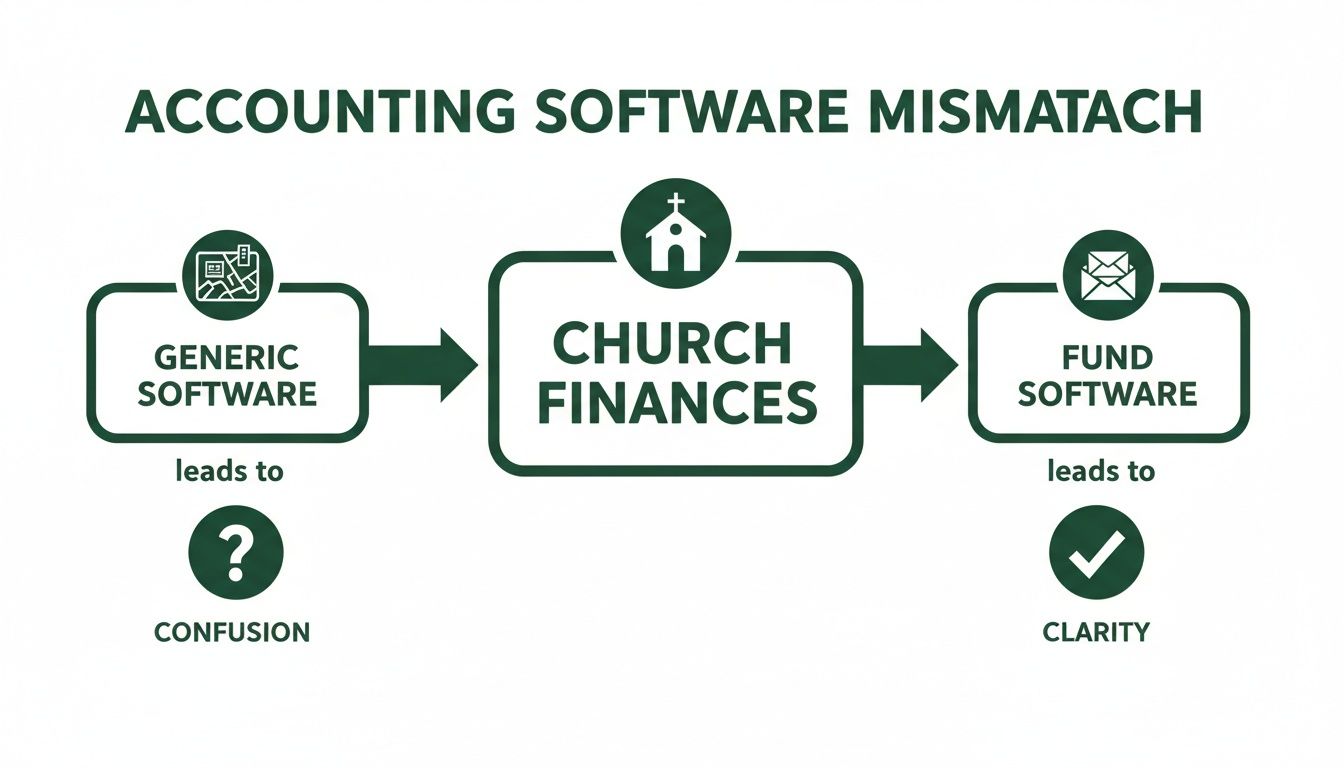
As you can see, trying to make generic software work for a church often ends in a confusing, tangled mess. Purpose-built church fund accounting software, on the other hand, brings clarity and integrity. This isn't just a small detail—it's everything. Proper fund management is a core responsibility for every pastor, treasurer, and bookkeeper. Without a system built on these principles, you risk inaccurate reports, financial mismanagement, and, worst of all, a breakdown of trust with your congregation.
Core Features Your Church Accounting Software Needs
Once you know you need specialized software, the big question becomes: what should it actually do? Lots of platforms claim they can handle fund accounting, but many just slap a clumsy workaround onto a system designed for a typical for-profit business. Real church fund accounting software is built differently from the very beginning, with a foundation designed for ministry stewardship.
When you're looking at different options, you have to see past the flashy marketing. The key is to focus on the core abilities that will bring real clarity and integrity to your church’s finances.
True Fund-Based Architecture
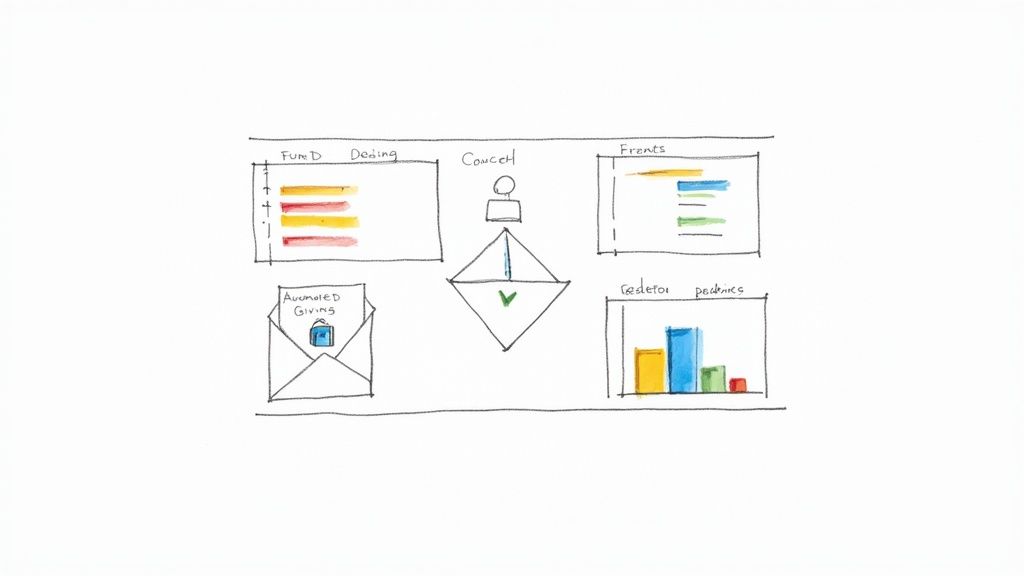
This one is the absolute deal-breaker. True fund-based architecture means the software understands from its very core that every dollar coming in and going out belongs to a specific fund. It’s not just a tag or a category you add on later; it's the fundamental way the system organizes every piece of financial data.
Think of it like building a house. A true fund-based system gives each fund its own room with solid walls. A workaround system, on the other hand, just builds one giant room and uses tape on the floor to mark off different areas. The first is clear and secure. The second is a recipe for chaos. This structure impacts everything else, especially how you set up your financial records. To dig deeper into this, check out our guide on creating a chart of accounts for nonprofits.
Automated Donation and Giving Integration
Manually entering every donation is a slow, painful process that’s just asking for errors. Your church probably uses an online giving platform like Tithe.ly or Pushpay, and your accounting software needs to talk to it effortlessly. This kind of integration automates the whole process, making sure every tithe and offering gets recorded instantly and accurately in the right fund.
You'll want to look for software that:
- Connects directly with your giving platform, so no one has to download and upload spreadsheets.
- Automatically sorts donations based on how the giver designated them (e.g., General Fund, Missions, Building Fund).
- Slashes administrative hours, giving your team more time for actual ministry.
Built-In Safeguards for Restricted Funds
When someone gives money for a specific purpose, honoring that intent is a sacred trust. Your software should be your digital guardrail, preventing the accidental misuse of restricted funds. This is more than just tracking; it means having controls built-in that physically stop you from spending designated money on the wrong things.
A tell-tale sign of a purpose-built system is its ability to enforce fund restrictions, not just report on them. It should make it hard—if not impossible—to pay the electric bill out of the youth mission trip fund.
Solutions like Grain Ledger are designed with these safeguards at their very core, ensuring every dollar stays true to its intended purpose. This is a massive part of maintaining transparency and building unbreakable trust with your congregation.
Clear, Actionable Fund-Based Reporting
At the end of the day, the whole point of this is clarity. Your software absolutely must generate reports that show the financial health of each individual fund—not just one big, confusing profit-and-loss statement for the whole church. You need to be able to see the balance, income, and expenses for the Youth Ministry Fund or the Benevolence Fund at a glance.
These reports are what empower pastors and board members to make informed, faith-led decisions. They answer the real ministry questions, like, "Can we afford to launch that new community outreach?" or "How much more do we need for the building campaign?" Without clear, fund-level reporting, you're just flying blind.
Essential vs. Optional Software Features
When you're shopping around, it's easy to get lost in a long list of features. Some are absolutely critical for proper church accounting, while others are just nice extras. The table below breaks down what you truly need versus what might be helpful but isn't a deal-breaker.
| Feature | Why It's Essential | Example Application |
|---|---|---|
| Native Fund Architecture | This is the foundation. Without it, the software cannot properly segregate and protect funds, leading to errors. | Every transaction—from a utility bill to a mission trip donation—is inherently tied to a specific fund. |
| Giving Integration | Eliminates countless hours of manual data entry and reduces the risk of human error in recording donations. | When a member gives to the "Building Fund" online, it automatically appears in that fund's ledger. |
| Restricted Fund Controls | Prevents the accidental misuse of designated donations, protecting the church's integrity and legal standing. | The system blocks a payment for general office supplies from being drawn from the "Benevolence Fund." |
| Fund-Level Reporting | Provides the clear financial visibility needed for leadership to make sound stewardship and ministry decisions. | A pastor can pull a report showing the exact balance, income, and expenses for the "Youth Ministry" fund. |
| Bank Reconciliation | Ensures the church's books match the bank's records, catching any discrepancies or potential fraud. | The treasurer can easily match digital check images from the bank statement to expenses recorded in the system. |
| Optional: Payroll | While useful, many churches use a dedicated payroll service that can be recorded as a simple expense entry. | The system has a built-in module to process staff salaries, taxes, and withholdings. |
| Optional: Event Management | A helpful add-on, but not a core accounting function. Many churches use separate tools for event registration. | A VBS registration form is linked to the accounting software to track payments. |
Focusing on these essential features first will ensure you choose a tool that truly supports your ministry's financial health and accountability, rather than just adding complexity.
How The Right Software Empowers Your Ministry Team
Choosing the right church fund accounting software goes far beyond just balancing the books. It's really about equipping everyone on your ministry team—from volunteers to pastors—with the clarity and confidence to serve well. Think of it as a ministry multiplier. The right tool removes administrative headaches and frees people up to focus on what matters most.
When your team isn't wrestling with clunky spreadsheets or spending hours on manual data entry, that energy gets redirected back into the mission. Financial management stops being a frustrating chore and becomes a powerful asset for growing the ministry.
For Treasurers and Finance Volunteers
For the dedicated folks handling the church’s money, the right software is nothing short of a lifesaver. It automates the tedious work that eats up their time, which drastically cuts down on the risk of burnout and simple human error. Instead of manually matching giving records to bank statements, an integrated system handles it behind the scenes.
This automation delivers two incredible benefits:
- Time Savings: A task that used to hijack a whole Saturday morning can now be done in just a few minutes. This gives your volunteers their time back to contribute in other meaningful ways.
- Reduced Stress: There’s a huge peace of mind that comes from knowing the numbers are accurate and that every restricted fund is protected by built-in safeguards.
For Pastors and Leadership Boards
Pastors and board members are constantly making faith-led decisions about the ministry's future. To do that wisely, they need a crystal-clear picture of the church's financial health. Generic reports from standard software often muddy the waters, failing to show the true status of designated funds.
The right software provides clear, at-a-glance financial dashboards that actually speak the language of ministry. It answers critical questions like, "What's the real available balance in our Missions Fund?" or "How are we tracking toward our Building Campaign goal?"
This kind of clarity empowers leaders to make decisions with confidence, knowing they’re standing on a foundation of solid financial stewardship. A solution like Grain Ledger is built from the ground up to deliver this exact kind of fund-level visibility, turning financial data into a strategic tool for planning and growth.
For the Congregation
Ultimately, the biggest win is the trust you build with your congregation. When people see that their donations are managed with integrity and transparency, their connection to the church’s mission deepens. They can give generously, fully confident that every dollar they designate for a specific purpose will be honored.
This isn't just about good bookkeeping; it's a vital part of fostering a healthy, committed church community. It shows everyone that the church is a faithful steward of the resources God has provided, reinforcing the very foundation of trust that all ministry is built on.
A Practical Checklist for Selecting Your Software
Alright, so you understand the "why" behind true fund accounting. But how do you actually pick the right software? It can feel overwhelming, with so many options out there. This isn't just about buying a tool; it's about choosing a long-term partner for your church's financial stewardship.
Let’s walk through a simple, practical process to help your team make a wise decision. Taking the time to ask the right questions now will save you a world of hurt later on.
Step 1: Assess Your Church’s Unique Needs
Before you even start looking at software demos, gather your team. The very first step is to get crystal clear on what your church actually needs. This internal clarity will be your North Star, keeping you from getting sidetracked by flashy features you'll never use.
Start by discussing these foundational questions:
- How many distinct funds are we currently managing? Think about everything—general fund, missions, building campaigns, youth group, benevolence, etc.
- What reports are absolutely essential for our leadership? Does your board need a simple fund balance summary, or do they need a detailed Statement of Activities for each and every ministry?
- Who is our online giving provider? Any new system must play nicely with it, otherwise you're signing up for hours of manual data entry.
- Who will be using this software day-to-day? Be honest about the technical skill level of your treasurer, bookkeeper, and any volunteers involved. The best software is useless if no one can figure it out.
Step 2: Schedule and Prepare for Demos
With your list of needs in hand, it's time to see the software in action. Don't settle for pre-recorded marketing videos. You need to schedule live demos with your top 2-3 choices and make sure your whole finance team is on the call. This is a team decision, and everyone who will touch the system deserves a say.
During the demo, your job is to steer the conversation past the sales pitch. This is your opportunity to ask the tough questions that reveal if a system is genuinely built for churches or is just generic business software with a "church" label slapped on.
The single most important question you can ask is: "Is your fund accounting native, or is it a tag-based workaround?" A native system, like what we've built at Grain Ledger, is designed from its very core to handle funds correctly. A workaround is often a fragile compromise that can easily break.
Step 3: Ask the Critical Questions
Use your time in the demo to zero in on the features that protect financial integrity. How a vendor answers these questions will tell you everything about their software's DNA.
Here are a few non-negotiable questions to ask:
- "Show me how the software stops someone from spending restricted money on an unrestricted expense." A good system should have hard-wired controls to prevent this, not just a report that tells you after the mistake has already been made.
- "How does your system handle our online giving donations?" You're looking for a deep, automatic sync that correctly routes every designated gift to the right fund without someone having to manually fix it.
- "What does your customer support actually look like?" Ask about response times, who you'll be talking to, and if their support team truly understands the quirks of church finance.
- "Can you generate a simple financial report for just one fund?" The report should be clean, easy for a non-accountant to read, and clearly show the income, expenses, and current balance for that specific ministry fund.
Following this simple process will help you cut through the noise and confidently choose a purpose-built church fund accounting software that truly serves your ministry's mission.
To make this even easier, we've put together a simple checklist you can use as you evaluate different platforms.
Software Evaluation Checklist
Use this table with your finance committee or leadership team as you sit through demos. It will help you compare options objectively and ensure you’re asking the questions that matter most.
| Evaluation Step | Key Question to Ask | Importance |
|---|---|---|
| Core Architecture | Is the fund accounting native or a workaround (tags, classes)? | High |
| Restricted Funds | Does the system have built-in controls to prevent mis-spending? | High |
| Giving Integration | Does it sync automatically and accurately with our giving platform? | High |
| Reporting | Can it easily produce clear, fund-level reports for non-accountants? | High |
| Ease of Use | Does the interface seem intuitive for our treasurer/volunteers? | Medium |
| Support | Does the support team understand church-specific challenges? | Medium |
| Pricing | Is the pricing model transparent and affordable for our budget? | Medium |
| Scalability | Can the software grow with us as our ministry and funds expand? | Low |
By systematically working through these steps, you're not just buying software—you're making a strategic investment in your church's financial health and transparency for years to come.
Bringing Your New System to Life and Getting Everyone On Board
You’ve done the hard work of picking the right church fund accounting software. That's a huge milestone. But the real magic happens during the rollout—this is where a tool becomes a solution that truly serves your ministry.
Getting this part right is all about a smart plan and getting your team genuinely excited about the change.
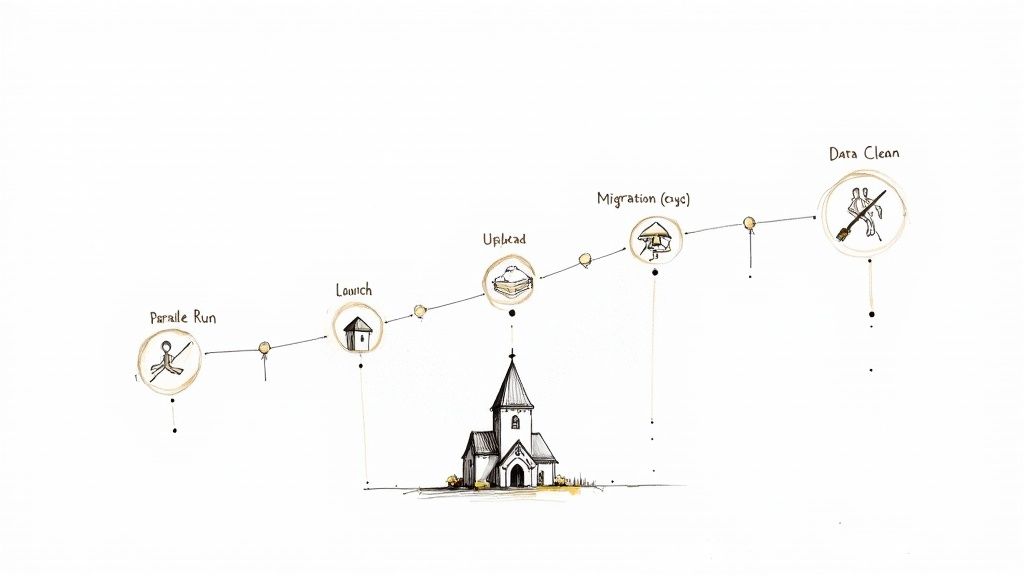
First things first, find a project “champion.” This could be a trusted staff member or a dedicated volunteer who can own the transition. Their job is to map out a reasonable timeline and, most importantly, communicate why this change is happening. They need to connect the dots for everyone, from the finance committee to the church board.
Before you even think about moving data, take the time to clean up your current books. Get everything reconciled and accurate. Then comes a critical step: run your old and new systems in parallel for at least one full month. This side-by-side comparison is your safety net, letting you confirm every number matches up before you make the final cutover. It builds incredible confidence.
Remember, you're not just installing a program. You're building a better, more transparent way to manage the resources God has provided. When you show your team how this new system solves real problems and makes their lives easier, you’ll turn skeptics into advocates.
A well-planned rollout takes the fear out of the process and helps your church start benefiting from true fund accounting right away. This is exactly why a purpose-built tool like Grain Ledger is designed for clarity from day one, setting you up for a smooth transition and a future of financial integrity.
Here are some of the most common questions we hear from church leaders trying to get a better handle on their finances. Finding clear, practical answers is the first step toward building a financial foundation that truly supports your ministry's mission.
Can We Just Use QuickBooks for Our Church?
This is easily the most frequent question we get. It makes sense—many people are familiar with QuickBooks from their business or personal life. But here's the honest truth: using a for-profit tool for a non-profit ministry creates some serious risks.
QuickBooks simply wasn't built to handle fund accounting. It can't properly separate and protect restricted donations right out of the box. This forces your treasurer or bookkeeper into a maze of manual workarounds and spreadsheets, which are not only time-consuming but also wide open to human error. Before you know it, you could be unintentionally misusing funds.
What Is the Biggest Financial Mistake Churches Make?
That brings us to the single biggest—and most common—financial mistake we see: commingling funds. This is what happens when restricted gifts, like money donated specifically for a youth mission trip or a new building, get mixed in with the church's general operating money.
Without the guardrails of true church fund accounting software, it's far too easy to accidentally dip into those designated funds to cover routine expenses like a utility bill or staff salary. This doesn't just make for messy and confusing reports; it fundamentally breaks the trust you've built with your givers.
True financial stewardship isn't just about tracking totals; it's about honoring the specific intent behind every gift. Preventing the commingling of funds is a fundamental part of that sacred responsibility.
How Difficult Is It to Switch Accounting Systems?
Finally, church leaders often worry about the transition itself. The thought of moving years of financial data from one system to another can feel overwhelming, and that’s completely understandable.
But a well-planned switch is far less painful than you might think. Modern software built specifically for churches is designed to make this process as smooth as possible. If you start with clean financial data, clearly explain the "why" to your team, and run the old and new systems side-by-side for a month to double-check everything, you can make the move with confidence. The long-term clarity and integrity you'll gain are more than worth the short-term effort.
If you're tired of risky workarounds and ready for a system actually built for ministry, Grain Ledger can help. Our software is designed from the ground up with true fund accounting to give your church the financial clarity it deserves. Join the waitlist to learn more.
Ready to simplify your church finances?
Schedule a demo to see Grain in action, or sign up for product updates.