Choosing the Best Church Financial Software
Discover the best church financial software for your ministry. This guide explains fund accounting and key features to help you choose with confidence.
The best church financial software isn't just a generic business tool with a few church-y features tacked on. It’s a system built from the ground up for true fund accounting. This approach is all about honoring stewardship, making sure every dollar given for a specific purpose—whether it's for the building fund, missions, or youth camp—is tracked with absolute clarity and integrity.
Think of it this way: you wouldn't use a hammer to fix a delicate watch. You need a specialized instrument. It's the same with your finances; a generic toolkit might get the job done, but a system designed for precision gives you the confidence you need.
How to Find the Right Financial Software
Choosing the right financial software is a huge decision for any ministry, and it goes way beyond just balancing a checkbook. The right platform becomes the bedrock of your stewardship, building trust with your congregation by telling a transparent and accurate financial story. It gives church leaders the power to make mission-critical decisions, knowing the numbers they’re seeing reflect the true health of every single designated fund.
A well-chosen system also frees your team from administrative burnout. It automates the tedious stuff and cuts down on the risk of human error. That means more time and energy poured into actual ministry, not manual data entry. On the flip side, the wrong software—especially one that fumbles fund accounting—just creates chaos, makes reporting a nightmare, and can accidentally chip away at donor confidence.
Setting the Stage for Your Search
Before you start looking at demos and feature lists, it’s really important to get clear on the core criteria that make church financial software truly great. These benchmarks will help you cut through the marketing fluff and find a solution that actually fits your ministry’s unique needs. This is especially true when you're looking at different types of accounting software for small churches, where getting it right from the start is so crucial.
Your evaluation shouldn't just be about what a platform can do, but how it aligns with the core principles of church finance. Key areas you’ll want to zero in on include:
- Fund Accounting Architecture: Is fund accounting a core, native part of the software, or is it just a workaround or add-on? This is the single most important distinction.
- Ease of Use: Can your volunteers and staff—people with different levels of financial know-how—use the system without pulling their hair out? A steep learning curve is a recipe for disaster.
- Reporting Clarity: Can you easily generate reports that make sense to your board, your congregation, and your finance committee?
- Integration and Automation: How smoothly does it connect with your giving platform and bank? The goal is to automate workflows and get rid of as much manual work as possible.
The goal is to find a partner, not just a product. The best software vendors understand the language of ministry and provide support that empowers your team to succeed long after the initial setup.
To help kickstart your evaluation, the table below boils down the essential criteria we'll explore in this guide. Think of it as your cheat sheet to keep your priorities straight as you start comparing options.
Key Evaluation Criteria for Church Financial Software
| Evaluation Criterion | Why It Matters for Ministry | Key Question to Ask Vendors |
|---|---|---|
| True Fund Accounting | Ensures designated gifts are used as intended, building donor trust and financial integrity. | Is fund accounting built into your software's core architecture, or is it a workaround? |
| Giving Integration | Automates donation tracking from your giving platform, saving hours of manual entry and reducing errors. | How does your software sync with our specific online giving platform and bank? |
| Customizable Reporting | Provides clear financial stories for the board, congregation, and ministry leaders. | Can we easily create fund-specific P&L and Balance Sheet reports for our leaders? |
| Internal Controls | Protects ministry assets and prevents the misuse or overspending of restricted funds. | What specific features help us enforce spending rules and permissions for different funds? |
Having these criteria in mind will make your search process much more focused and effective, ensuring you land on a tool that truly supports your ministry’s mission.
Understanding Why Churches Need Fund Accounting
If you want to find the right financial software for your church, there's one concept you have to understand above all else: fund accounting. This isn't just another piece of industry jargon; it's the bedrock principle that makes managing church finances completely different from running a typical business. A for-profit company has one goal—measuring the bottom line. All its income gets thrown into a single pot to track overall profitability.
Churches, on the other hand, run on a model of stewardship and trust. When someone gives to the "Youth Mission Trip" or the "New Roof Fund," that donation comes with a sacred promise. It’s an understanding that their money will be used for that specific purpose, and fund accounting is the system that honors this promise.
The Digital Envelope Analogy
The simplest way I’ve found to explain fund accounting is to picture your church’s finances as a set of digital envelopes. Each one is clearly labeled for a specific purpose.
- Envelope 1: General Fund (for day-to-day operations like utilities and staff salaries)
- Envelope 2: Building Fund (for mortgage payments or a future expansion)
- Envelope 3: Missions Fund (to support missionaries and outreach projects)
- Envelope 4: Benevolence Fund (to help community members going through a tough time)
When a donation comes in designated for "Missions," a proper fund accounting system makes sure it goes straight into that Missions envelope. That money is now legally and ethically restricted. It can’t be pulled out to pay the electric bill, which is a General Fund expense. This creates a firewall between different pools of money, ensuring every single dollar is managed exactly as the donor intended.
Trying to use generic business software is like tossing all your money into one big, unlabeled box. Sure, you know the total amount inside, but you have no clue how much of it is meant for the building fund versus the missions fund. This inevitably leads to clunky workarounds, messy spreadsheets, and a serious risk of accidentally misusing restricted funds.
The real job of fund accounting in a church is to provide accountability. It proves to your congregation that you are stewarding their gifts with integrity, which is the absolute bedrock of donor confidence.
The infographic below really drives home how this commitment to stewardship, transparency, and mission all work together.
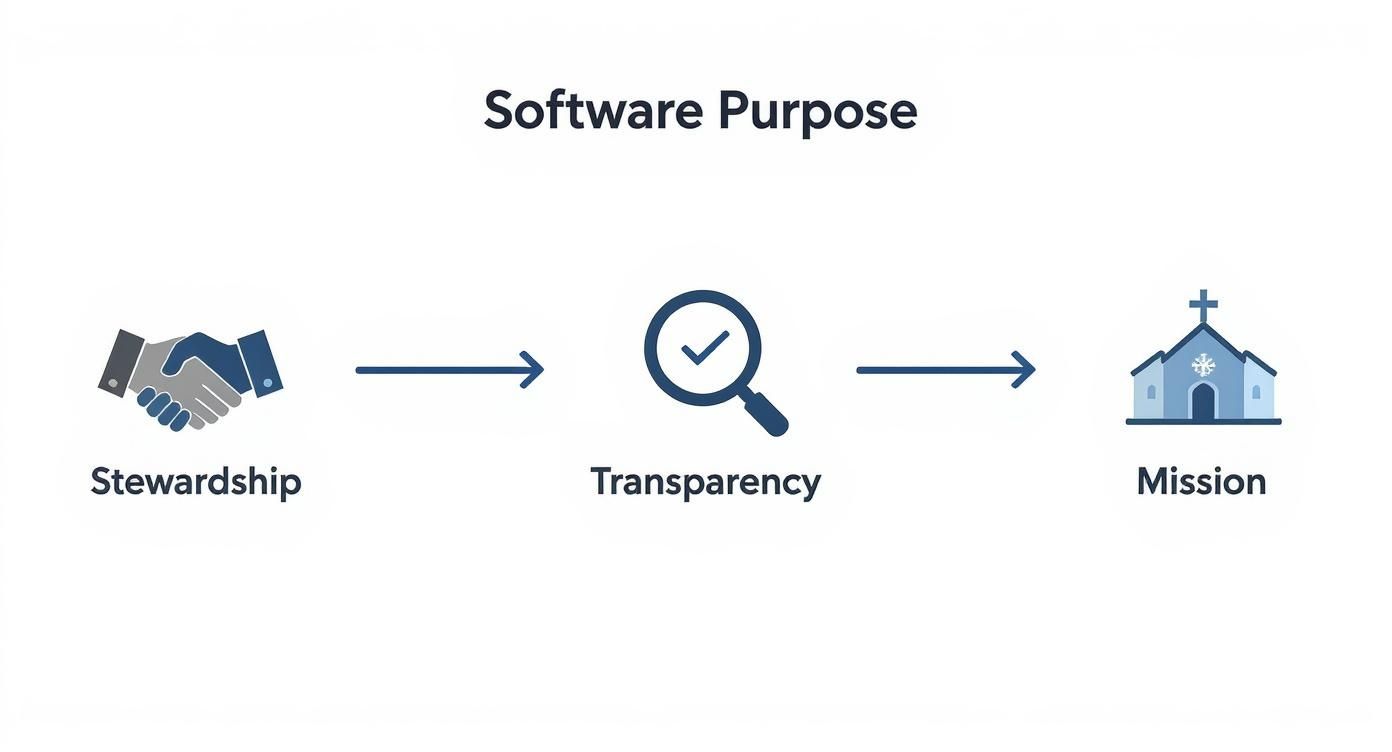
As the visual shows, true financial software for churches is built from the ground up to support these three pillars. It ensures your financial practices are always aligned with your ministry’s goals.
Why Standard Accounting Software Fails Churches
Standard accounting software is built around a profit-and-loss model. It’s fantastic for telling a business owner if they’re in the black, but it’s utterly useless for showing accountability for restricted donations. When churches try to force a for-profit system to manage their funds, it almost always ends in frustration.
I’ve seen it lead to all kinds of problems:
- Confusing Reports: A standard income statement can't tell you if a specific fund is healthy or overspent. You might see a healthy overall bank balance but be completely unaware that your youth ministry fund is deep in the red.
- Compliance Risks: Misusing restricted funds—even by accident—can create serious legal and ethical headaches. Churches have to follow specific guidelines, and it's worth taking a look at the official financial reporting standards for nonprofits to see just how detailed those requirements are.
- Breakdown in Trust: Nothing erodes trust faster than a lack of clarity. If your congregation can't get a clear picture of how their designated gifts are being used, their confidence will fade.
Ultimately, choosing software built for fund accounting isn't a matter of preference; it’s a necessity for maintaining financial integrity. It replaces ambiguity with clarity, empowering church leaders to make wise decisions that honor their donors and advance their mission. A system with a native fund architecture isn’t just a nice feature—it's the entire foundation.
The Must-Have Features of Great Church Software
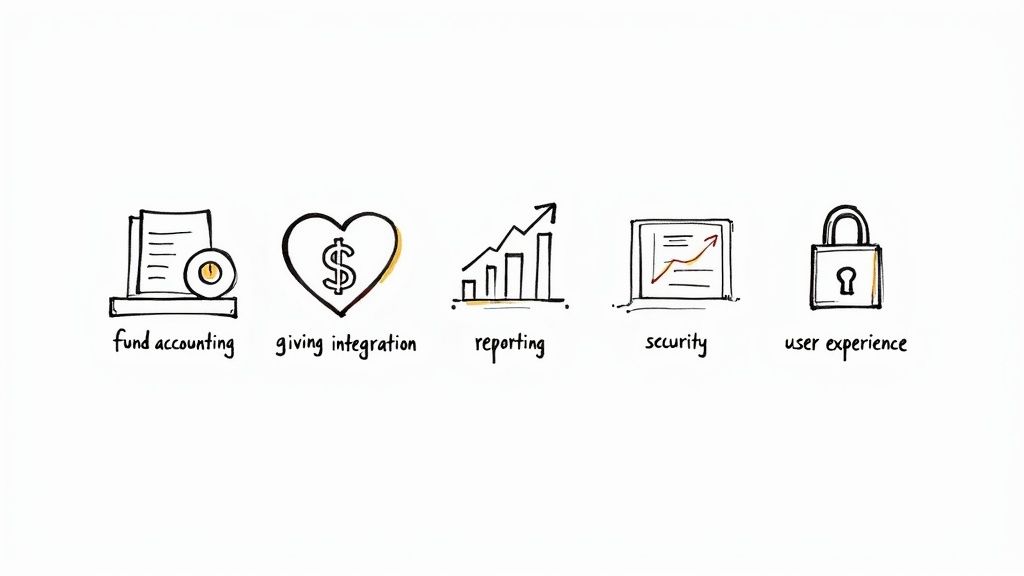
Knowing you need fund accounting is the first big step. The next is figuring out what separates truly great church financial software from everything else. The right features aren't just bullet points on a sales page—they are the bedrock of financial integrity.
These are the tools that give you back precious administrative hours and provide the crystal-clear view you need for wise stewardship. They turn accounting from a necessary chore into a powerful ministry asset.
It’s no surprise, then, that churches are moving toward specialized software in droves. The global market for these tools was valued at around USD 2.85 billion in 2024 and is projected to hit USD 5.95 billion by 2033. This isn't just a trend; it's a widespread acknowledgment that generic business software just doesn't cut it for the unique demands of a modern ministry.
Native Fund Accounting Architecture
This is the big one. The single most important feature to look for is a native fund accounting architecture. This means the software was designed from its very core around the principles of fund management, not as a clunky add-on to a standard for-profit system.
Think of it like this: using generic software for fund accounting is like trying to sort mail in a warehouse by just dumping it all in one giant pile. You could try to sort it with sticky notes and hand-drawn signs, but it would be a chaotic, error-prone mess.
A native fund system is like a post office designed from the ground up with dedicated, labeled slots for every single address. It's built for the job, making everything inherently organized and efficient from the start.
When a system is built with a native fund structure, every single transaction, report, and budget is automatically and correctly tied to its designated fund. This isn't just a "nice to have" feature; it's the fundamental element that makes real financial accountability possible.
Integrated Donation and Giving Management
People give to your church in all sorts of ways today—through your website, text-to-give services, and the classic offering plate. The best software doesn't just let you manually record this income; it connects directly with your giving platforms to automate the entire process. This seamless integration is a huge time-saver.
Imagine a donation comes in online for the "Missions Fund." A truly integrated system will instantly:
- Record the income in your financial ledger.
- Assign that money directly to the correct Missions Fund.
- Sync the donation with that person's giving history for their year-end statement.
This level of automation wipes out hours of manual data entry, a job often handled by volunteers, and dramatically lowers the risk of human error. It creates a clean, unbroken line from the moment a gift is given to its final report. For a closer look at this, see our guide on choosing the right church donation tracking software.
Clear and Customizable Reporting
Your financial reports should tell a story, not create a mystery. Great software gives you the power to create reports that are so clear and intuitive that anyone—from the finance committee to the congregation—can understand them. Of course, you need standard reports like a Profit & Loss statement, but for a church, the key is being able to see them on a fund-by-fund basis.
A ministry leader should be able to get answers to critical questions in seconds, not hours:
- "How much money do we have left in the Youth Ministry fund for this year?"
- "What's the total balance of all our restricted building funds combined?"
- "Can you show me a statement of activity just for our Benevolence Fund?"
The ability to easily filter and generate these fund-specific reports is non-negotiable. It’s what provides the detailed insight needed to make smart spending decisions and prove transparent stewardship to your members.
Built-in Internal Controls and Security
Protecting the church's resources is a sacred trust. Your financial software should act as your partner in this, offering built-in features that help you enforce internal controls and secure sensitive financial data. This goes way beyond simple password protection; it’s about building checks and balances right into the system itself.
Here are a few key controls you should look for:
- User-Based Permissions: The ability to give people access only to what they need. A ministry volunteer might only see their fund's budget, while the treasurer can approve invoices.
- Audit Trails: A permanent, unchangeable log that shows who did what, and when. It creates a complete, transparent history of every financial activity.
- Fund Spending Rules: The system should actively prevent restricted funds from being used for unapproved expenses, helping keep the church compliant and accountable.
These features are your first line of defense against risks like fraud or simple mistakes, ensuring your financial processes are followed every single time.
An Intuitive User-Friendly Experience
At the end of the day, even the most powerful software in the world is useless if your team finds it impossible to use. So many church finance roles are filled by passionate volunteers who aren't professional accountants. For them, a user-friendly interface isn't a luxury—it's an absolute necessity.
The best software is designed with this user in mind. It uses clear navigation, helpful dashboards, and simple workflows to make complex accounting tasks feel straightforward. As you look at different options, ask yourself this simple question: "Could a brand-new volunteer learn the basics without needing hours of training?" A platform that focuses on ease of use will always lead to quicker adoption, more accurate data, and a lot less frustration for everyone involved.
Comparing Your Top Software Options
Alright, you've seen what's out there. Now comes the hard part: making the final call. Choosing the right financial software for your church means you have to cut through the noise of sales pitches and slick demos.
What really matters is how a platform will actually work for your ministry day in and day out. It's less about a flashy feature list and more about forming a true partnership that supports your mission. That means digging into the details of their pricing, customer support, data security, and whether the software can actually grow with you.
Critical Questions to Ask Any Vendor
Before you even think about signing a contract, you need to get straight answers to a few non-negotiable questions. How a vendor handles these tells you everything you need to know about the kind of partner they’ll be.
Pricing Structure: "Is your pricing a flat annual fee, or is it based on the number of users, members, or transactions? What are the total costs, including setup, data migration, and any mandatory training fees?"
Customer Support: "What's included in your standard support package? What are your support team's hours, and what’s the typical response time for a critical issue?"
Data Security: "How do you protect our sensitive financial and donor data? Can you walk me through your data backup protocols and what happens if there’s a system failure?"
Scalability: "As our church grows, how does your software scale? Can we easily add new funds, users, or ministries without having to switch to a different platform?"
Getting clear answers here will give you a complete picture of the long-term investment and, just as importantly, prevent some nasty surprises down the road.
Choosing Your Path: Specialized vs. All-in-One
One of the biggest forks in the road you'll face is whether to go with a dedicated, best-in-class financial platform or an all-in-one Church Management System (ChMS) that happens to have a finance module. Each path has its pros and cons, and the right choice really depends on what your church values most.
An all-in-one ChMS has a simple, powerful appeal: one system for everything. Your member directories, event calendars, online giving, and accounting all live under one roof. This can definitely make managing vendors easier and create a more unified workflow for your staff.
The tradeoff? The financial modules inside these all-in-one systems are often an afterthought, not the main event. Their fund accounting might be surface-level—more of a general ledger with tags than a true, purpose-built fund architecture.
On the other hand, a dedicated financial software platform is built from the ground up for one thing: the unique complexities of church finance. Its entire focus is on providing genuine fund accounting, powerful reporting, and rock-solid internal controls. The downside is that you’ll need to manage it as a separate system and make sure it plays nicely with your ChMS and giving platform.
The Church Software market is booming, projected to jump from USD 2 billion in 2023 to USD 5 billion by 2031. This growth signals a rising demand for both types of specialized tools. You can discover more insights about this growing market trend and what it means for churches looking for the right fit.
The core question is this: Is financial management a secondary feature for your church, or is it the central pillar of your stewardship strategy? Your answer will point you toward the right solution.
To help you decide which path makes the most sense for your ministry, let's break down the key differences.
Dedicated Financial Software vs All-in-One ChMS
This table contrasts the two main software approaches to help you see where your church's priorities align.
| Aspect | Dedicated Financial Software | All-in-One ChMS |
|---|---|---|
| Primary Strength | Unmatched fund accounting depth and powerful financial controls. | A single, unified platform for all church management activities. |
| Financial Reporting | Highly detailed and customizable fund-specific reports for deep analysis. | Often provides more basic, standardized financial reports. |
| Best For | Churches that prioritize financial integrity, transparency, and detailed stewardship. | Churches that value simplicity and an all-in-one workflow for all operations. |
| Potential Drawback | Requires integration with a separate ChMS for member management. | Financial features may be less robust or lack true fund accounting architecture. |
Ultimately, a dedicated system is for churches that see financial management as a core ministry function requiring specialized tools. An all-in-one system is for churches that prioritize operational convenience and a single point of contact above all else. Neither is "wrong," but one is likely a much better fit for your vision of stewardship.
A Practical Plan for a Smooth Transition
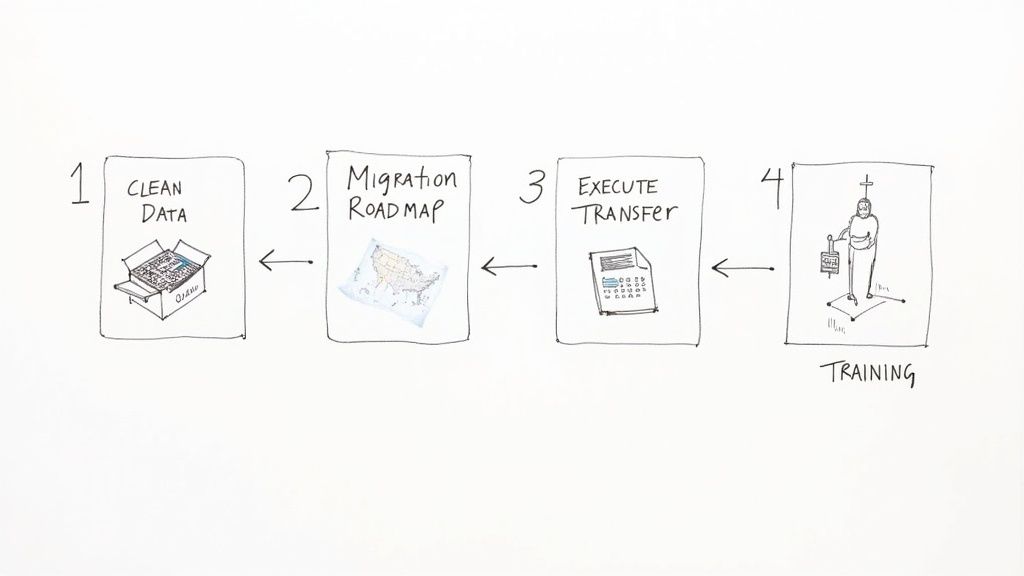
Moving to new church financial software can feel like a huge undertaking. I get it. But with a clear, step-by-step plan, you can turn a mountain of a project into a series of manageable hills. The secret is to tackle the biggest fear—data migration—head-on and set your team up for a win right from the start.
Think of it like moving to a new house. You wouldn't just toss everything into unlabeled boxes and hope for the best. You'd go through your stuff, get rid of what you don't need, and pack room by room. We’re going to apply that same common-sense approach here to make sure nothing gets lost in the shuffle.
Phase 1: Clean Up Your Current Data
Before you even think about moving your financial data, you have to make sure it’s clean, accurate, and ready for the trip. This is, without a doubt, the most important step for preventing major headaches down the road.
First, archive old records you no longer need for day-to-day operations. Then, it's time to roll up your sleeves and do a full review of what's left. Hunt down and fix any inconsistencies, duplicate entries, or accounts that were miscategorized years ago. This "decluttering" ensures you’re starting fresh with a pristine set of books.
Phase 2: Build Your Migration Roadmap
Okay, with your data cleaned up, the next step is to draw the map. Your migration roadmap is your game plan, laying out exactly who is doing what and when. This brings clarity to the process and makes sure everyone knows their part.
A solid roadmap should include:
- Assigning Key Roles: Decide who is in charge of getting the data out of the old system, who will be the main contact for the software provider, and who will handle the final review.
- Setting a Realistic Timeline: Start with your ideal "go-live" date and work backward. Set firm deadlines for each major milestone: data cleanup, the actual migration, and team training.
- Defining the Scope: Be very clear about what historical data you really need to bring over. Many churches find that importing only the current and previous fiscal years is plenty to keep the new system running lean.
A well-defined roadmap transforms the migration from a chaotic scramble into an organized, predictable process. It ensures everyone is aligned and moving toward the same goal on the same schedule.
Phase 3: Execute the Data Transfer
This is where the plan kicks into gear. You’ll start by exporting your clean data from the old system, usually into a universal format like CSV files. Your new software provider should be your best friend during this phase. They’ve done this a thousand times and will have the tools and advice to make it go smoothly.
Work hand-in-hand with their support team to map your old data to the new system. This is critical for making sure your funds, accounts, and donor records land in the right places. Once the import is done, don't skip the validation step. Meticulously check that all your balances and records transferred over correctly.
Phase 4: Train Your Team for Success
The final—and arguably most crucial—phase is all about your people. The best church financial software in the world is useless if your staff and key volunteers are intimidated by it.
Schedule dedicated training sessions that focus on the real-world tasks your team performs every day. Give them cheat sheets or quick-start guides to reference. Most of all, be patient. Learning a new system takes time. By investing in good training, you're not just buying software; you're empowering your ministry with a tool that helps, not hinders.
What's Next for Church Financial Stewardship?
Choosing the best church financial software is about so much more than balancing the books. Think of it as a cornerstone decision for your ministry's future. The right platform isn't just an accounting program; it's a powerful tool for stewardship.
When you get it right, it strengthens the trust your congregation places in you, gives leaders the clarity they need to make wise decisions, and—most importantly—frees up your team to focus on the mission, not the administrative grind.
The technology behind church finance is getting smarter and more intuitive every year. We're seeing this shift in the wider Church Management Software market, which is projected to more than double from USD 16.16 billion in 2024 to a staggering USD 33.3 billion by 2035. This isn't just a random number; it signals a massive move toward integrated systems that handle both the operational and financial sides of ministry. You can explore the full market analysis on church software trends to get a deeper sense of where things are headed.
Key Trends Shaping Church Finance
So, what does the future actually look like? A few key trends are popping up that are making church finance more efficient and transparent than ever before.
Cloud-Based Accessibility: Gone are the days of being chained to a single desktop computer in the church office. Modern platforms are now almost exclusively cloud-based. This means authorized staff and volunteers can securely access financial data from anywhere, a must-have for churches with remote teams or a treasurer who works from home.
Intelligent Automation: The soul-crushing task of manual data entry is finally on its way out. Features like automated bank reconciliation, smart categorization for donations, and one-click report generation are quickly becoming standard. This dramatically cuts down on human error and frees up dozens of hours a month.
Mobile-First Management: Ministry doesn't stop at the church doors, and neither should your financial oversight. Treasurers and pastors need to be able to check fund balances, approve an urgent expense, or pull up a key report right from their smartphones. This is what enables agile, on-the-go leadership.
At the end of the day, modern software is about empowerment. It empowers leaders with real-time data, reassures donors with transparent reporting, and equips ministry teams with the resources they need to serve effectively.
By using this guide, you’re not just picking software. You’re investing in a system that will meet your needs today and scale with your church's mission for years to come. The goal is to find a partner who truly understands the unique language of ministry and provides a solid foundation for faithful, transparent stewardship.
Frequently Asked Questions
When you're wading through the options for church financial software, a lot of practical questions pop up. Let's tackle some of the most common ones we hear from church leaders to give you some clear, straightforward answers.
Can Our Small Church Just Use Standard Accounting Software?
You can, but I’d strongly advise against it. Even for a small church, trying to make standard business software work for fund accounting is like trying to fit a square peg in a round hole. It creates a mountain of manual workarounds and opens the door to some serious risks.
Standard software simply isn’t designed to track designated funds with the integrity you need. This often leads to messy reports, potential compliance headaches, and, worst of all, can erode the trust your congregation has in your stewardship. Choosing a dedicated system isn’t about your church’s size—it’s about committing to financial clarity and accountability from the very beginning.
How Much Should We Budget for Church Financial Software?
This is a big question, and the answer is: it really depends. Pricing for the best church financial software can vary quite a bit, so it pays to do your homework. The cost is usually tied to things like the size of your congregation and the specific features you need.
You'll typically see a few different pricing models from vendors:
- Per-member or per-record fees: The cost grows as your church grows.
- Tiered feature packages: You pay more for more advanced capabilities.
- A flat annual subscription: This gives you a predictable, fixed cost.
When you're comparing options, always ask about the total cost of ownership. This includes any one-time setup fees, data migration costs, and ongoing support charges. Getting the full picture upfront will save you from any nasty budget surprises later on.
What Is the Biggest Mistake to Avoid When Choosing Software?
The single biggest mistake we see churches make is getting dazzled by a long list of features and completely ignoring the quality of the implementation process and customer support. A powerful platform is useless if your team can't get the help they need to use it properly. It just becomes a very expensive source of frustration.
Remember, you aren't just buying software; you're choosing a long-term partner for your ministry. Look for vendors with a proven track record of great training, responsive support, and a real understanding of how a church actually operates. A great partner will be there to help your team succeed long after the sale is complete, becoming a true asset to your ministry's financial health.
Ready to build a foundation of financial clarity and trust? With its native fund architecture and seamless integrations, Grain is purpose-built to align your bookkeeping with your ministry's mission. Join the waitlist to learn more.
Ready to simplify your church finances?
Join the waitlist for early access to Grain - modern fund accounting built for ministry.