A Guide to Clear and Transparent Church Finance Reports
Jun 26, 2023
Church finance reports are far more than just spreadsheets filled with numbers. They're a ministry's story in financial terms, reflecting its health, integrity, and how well it's sticking to its mission. These documents show exactly how a church is managing the resources God has provided, which builds a rock-solid foundation of trust with the congregation.
Why Church Finance Reports Are a Ministry of Trust

Think of a financial report as a doctor's check-up for your church. Just like a physician’s report gives you a snapshot of your vitals and overall health, your church's financial statements reveal its stability. They highlight what’s going well and, just as importantly, flag potential issues before they can grow into serious problems.
This financial "health check" isn't just for the board or the finance team; it's a crucial part of caring for the entire church family. When members give, it's an act of worship and an extension of their trust. Transparent reporting honors that by showing them precisely how their generosity is fueling the vision and making a real impact.
The Unique Language of Church Finance
Unlike a typical business chasing a single bottom line, a church manages its finances with a different end goal: faithful stewardship. This calls for a special accounting language known as fund accounting.
Instead of lumping all the income into one giant pot, fund accounting works by separating money based on its specific, intended purpose. It helps to picture your church’s finances like a pantry with different jars on the shelf, each with a clear label:
General Fund: This is for the day-to-day stuff—salaries, utilities, and Sunday school curriculum.
Building Fund: This jar holds money set aside for that future expansion or a much-needed new roof.
Missions Fund: This is specifically for supporting missionaries and outreach projects, both local and global.
This simple but powerful method ensures that a gift designated for the new youth center isn't accidentally used to pay the electric bill. It’s a system built from the ground up to honor donor intent, a practice that's non-negotiable for both legal compliance and spiritual integrity.
A study on church giving found that over 50% of churches that saw an increase in donations pointed to financial transparency as a key reason why. This shows a clear, direct line between honest reporting and a congregation's willingness to give generously.
Turning Data into Ministry Alignment
At the end of the day, the real purpose of creating church finance reports is to make sure your resources are perfectly aligned with your mission. These documents give leadership the clarity to answer critical questions with confidence. Are we financially prepared for an unexpected HVAC failure? Can we actually afford to bring on a new youth pastor this year? Are we putting enough of our resources toward community outreach?
By providing clear, honest, and regular financial updates, you move accounting from a dreaded back-office chore to a powerful ministry of trust. It reassures your congregation, guides your leaders, and ensures that every single dollar given is faithfully pointed toward advancing the Kingdom. That kind of commitment is an act of worship in itself.
Understanding the Core Principles of Fund Accounting
To really get a handle on church finance reports, you first have to understand the unique system they're built on: fund accounting. Think of your church's money less like a single, giant checking account and more like a pantry full of clearly labeled jars. One jar is for the missions fund, another for the building campaign, and another for day-to-day operations.
This simple "jar" system is what keeps everything in order. It makes sure that a big donation meant for the youth group's mission trip doesn't accidentally get spent on fixing the roof. This method is the bedrock of financial integrity for any church, building a powerful sense of trust with the people who support the ministry.
The Three Types of Funds Explained
In this system, not all money is the same. Funds are sorted based on the donor's instructions—or "restrictions"—which legally dictate how that money can be used. You'll typically run into three main categories.
Unrestricted Funds: This is your main operating account, what most churches call the General Fund. It's filled with tithes and general offerings given without any strings attached. Your leadership team can use this money for the daily costs of ministry, like staff salaries, utility bills, and curriculum.
Temporarily Restricted Funds: These are donations given for a specific purpose or a set period of time. A capital campaign for a new building is a perfect example. Once the building is finished and paid for, the "restriction" on those funds is met, and they are released.
Permanently Restricted Funds: This one is less common for smaller churches but still important to know. It’s usually a large gift, like an endowment, where the church can only use the interest or investment earnings, but never touch the original amount. For instance, a family might set up a permanent scholarship fund where only the annual interest is used to help students.
The core idea is simple but powerful: fund accounting ensures that a donor's wishes are always honored. This isn't just good practice; it's an ethical and legal responsibility that protects the church and its leaders.
Why This Matters for Your Church Finance Reports
This separation of funds is exactly what makes church finance reports so different from a typical business report. A for-profit company just shows overall profit and loss. A church's Statement of Activities, on the other hand, has to break down the income and expenses for each fund category—unrestricted, temporarily restricted, and permanently restricted.
This level of detail is crucial for transparency. When a member asks how their donation to the food pantry was used, you can pull up a report for that specific fund and show them. That kind of clarity is impossible if all the money is just dumped into one big pot. To dive deeper into this, you can explore our detailed guide on fund accounting for nonprofits.
This specialized approach might seem a little complicated at first, but it's what allows a church to manage its resources with the highest level of stewardship. This is why using software designed for this from the get-go is so important. An accounting solution like Grain Ledger is built on true fund accounting principles. It automates the process of keeping those "jars" separate, making sure every report gives you the true financial picture of your ministry, fund by fund. This empowers leaders to make wise decisions and communicate with confidence.
The 5 Essential Reports for Every Church Finance Team
While fund accounting gives you the "why" behind your church's finances, the reports themselves tell you "what's happening." These are the practical tools that turn raw numbers into a clear, actionable story about your ministry's financial health.
Think of them as five different camera angles on your church's finances. Each one reveals a unique and vital perspective, and together, they paint the full picture. You don't need to be a CPA to understand them; you just need to know what questions to ask.
The visual below breaks down how funds are separated—a core concept that underpins all of these reports.
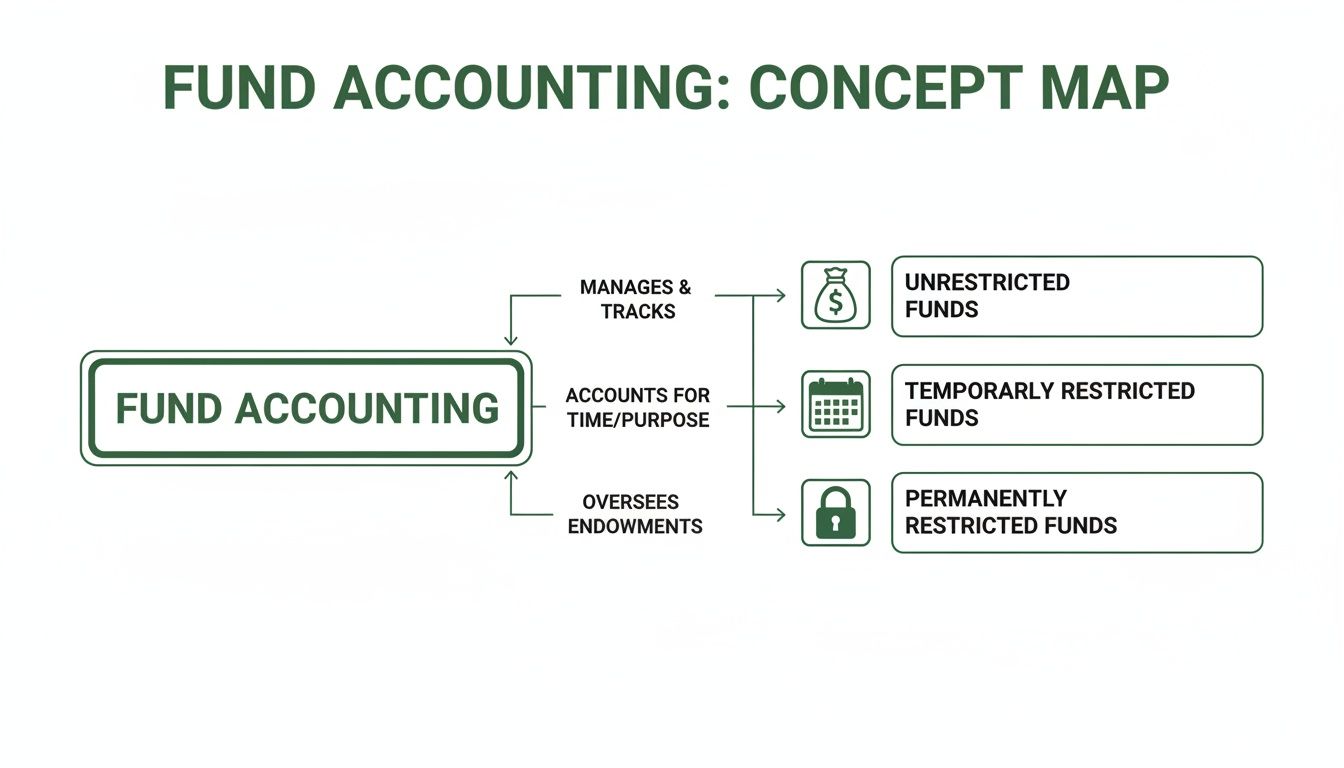
This chart shows how money is organized into distinct categories: unrestricted funds for general use, temporarily restricted funds for specific projects, and permanently restricted funds for long-term goals. This ensures every dollar is tracked according to its designated purpose.
1. The Statement of Financial Position
Known as a balance sheet in the for-profit world, this report is a snapshot of your church's financial health at a single point in time. It answers one fundamental question: What do we own, what do we owe, and what's the difference?
It’s all based on a simple formula:
Assets (What you own) = Liabilities (What you owe) + Net Assets (What you have left over)
Your leadership team should use this report to gauge stability. Do you have enough cash on hand (an asset) to cover your immediate bills (liabilities)? How much debt are you carrying? This statement provides a foundational reality check for your ministry.
2. The Statement of Activities
If the first report is a snapshot, the Statement of Activities is more like a video. It shows your church’s financial performance over a period of time, like a month, quarter, or year. It answers the question: Where did our money come from, and where did it go?
This report is critical because it breaks down income and expenses by fund. It helps you see if general giving is covering operational costs or if you’re leaning too heavily on designated gifts to keep the lights on. It’s also where you can spot giving trends and monitor ministry spending, which is vital data for future budgeting. You can find more details on how to structure these documents in our complete guide to financial reports for churches.
3. The Statement of Cash Flows
This report is all about the actual movement of cash. It answers a simple but incredibly important question: How did cash come in, and how did it go out?
While your Statement of Activities might include non-cash items like depreciation on a building, the Statement of Cash Flows focuses only on the money moving in and out of your bank accounts. It’s typically broken down into three parts:
Operating Activities: Cash used for day-to-day ministry.
Investing Activities: Cash from buying or selling major assets, like property or equipment.
Financing Activities: Cash from loans or principal payments on debt.
This report is your best friend for managing liquidity and making sure you have enough cash on hand to pay staff and cover upcoming expenses.
4. The Budget vs. Actual Report
This is arguably the most-used report for day-to-day management. It does exactly what its name implies: it compares what you planned to spend and receive with what actually happened. The key leadership question here is: Are we on track with our financial plan?
By reviewing this report monthly, your finance team can spot trouble early. If giving is consistently below budget or a specific ministry is overspending, this report makes it impossible to ignore. It’s the primary tool for keeping everyone accountable to the financial plan your church approved.
Understanding revenue trends is key. One multi-church survey revealed that while average offerings rose 3.5% from 2019 to 2023, their real buying power actually fell by 17.3% due to inflation. This shows how surface-level growth can hide real financial erosion.
5. The Restricted Funds Report
Finally, this report zooms in on your designated "jars" of money. It answers the essential stewardship question: Are we honoring our donors' intentions?
This report details all the activity within each temporarily or permanently restricted fund. It shows the beginning balance, any new donations received, how much was spent, and the ending balance. For a church committed to transparency, this report is non-negotiable. It provides concrete proof that the money given for the youth missions trip was, in fact, used for the youth missions trip.
To help clarify how each of these reports serves your ministry, here is a quick summary.
Key Financial Reports and Their Purpose
Report Name | What It Shows | Key Question Answered |
|---|---|---|
Statement of Financial Position | A snapshot of assets, liabilities, and net assets. | What do we own and owe right now? |
Statement of Activities | Income and expenses over a period, broken down by fund. | Where did money come from and where did it go? |
Statement of Cash Flows | The movement of actual cash through the organization. | How did our cash balance change? |
Budget vs. Actual Report | A comparison of planned finances versus actual results. | Are we sticking to our financial plan? |
Restricted Funds Report | The activity within each designated or restricted fund. | Are we honoring donor intent? |
Each of these reports offers a distinct and necessary view of your church’s financial story.
Generating these five church finance reports accurately and consistently is the bedrock of sound financial stewardship. Using an accounting solution built specifically for churches, like Grain Ledger, can automate much of this process. Because it's designed around fund accounting from the ground up, you can generate these reports with confidence, knowing they truly reflect the financial state of your ministry.
Implementing Best Practices for Financial Integrity

Pulling together accurate church finance reports is a huge accomplishment, but real financial integrity comes from the systems you build around those numbers. These reports aren't just meant to be filed away. They are active tools for building trust, safeguarding the resources God has provided, and telling the financial story of your ministry.
It all starts with getting into a consistent reporting rhythm. Your leadership team, elders, and finance committee need timely information to make wise decisions. A monthly reporting schedule is the gold standard here. It lets them keep a close eye on the budget, spot giving trends, and tackle any financial challenges before they snowball.
But when it comes to the congregation, the timing is different. Your members don't need a line-by-line expense report every month, but they absolutely deserve regular, clear updates. A summarized financial snapshot each quarter, followed by a more detailed annual report, builds incredible trust. This approach keeps everyone in the loop without drowning them in data.
Building a Framework of Accountability
Think of internal controls as the practical guardrails that protect your church’s assets from honest mistakes or, worse, intentional misuse. They’re the financial equivalent of locking the church doors at night—simple, non-negotiable procedures that ensure every dollar is handled responsibly. Putting just a few basic controls in place can make a world of difference.
Here are a few of the most critical ones:
Dual Signatures: Always require two unrelated people to sign any check over a certain threshold, like $500. This one simple step prevents any single person from having total control over the checkbook.
Separation of Duties: The person who counts the offering should never be the same one who enters it into the books or takes it to the bank. Splitting up these tasks makes it much harder for errors or fraud to slip through unnoticed.
Bank Reconciliation Reviews: Have someone without signature authority on the bank account—like a finance committee member—review and sign off on the monthly bank reconciliations. It’s a crucial second set of eyes.
These practices aren't about a lack of trust. They’re about creating a system of accountability that protects both the church's resources and the very people you’ve entrusted to handle them.
Making Financial Reports Understandable for Everyone
The most detailed report in the world is completely useless if no one can understand it. Your job is to translate complex financial data into a clear story that connects with everyone in your congregation, not just the CPAs in the pews.
Effective financial transparency is directly linked to congregational generosity. In fact, more than half of churches that saw giving increase in 2023 cited improved transparency as a key contributing factor. When people understand the finances, they are more confident in their giving.
Instead of just handing out spreadsheets, get visual. A simple pie chart showing how each dollar from the general fund is spent is far more powerful than a long list of expenses. A bar graph can instantly show giving trends over the past year. Pair these visuals with a short, simple narrative explaining what the numbers actually mean for the ministry’s mission.
When you bring it all together—consistent reporting, strong internal controls, and clear communication—your church finance reports become more than just documents. They become a powerful testament to your church's commitment to faithful stewardship.
How Accounting Software Takes the Headache Out of Church Reporting
Let's move from theory to reality. Actually creating these reports is a common stumbling block for many churches, especially those relying on manual methods. Spreadsheets might work when you're just starting out, but they quickly become a tangled mess of formulas and tabs when you're trying to track designated funds.
And generic business software? It's not much better. Most of it is built for a simple profit-and-loss world, not the unique stewardship and donor-intent model that defines a church. This is where software designed specifically for ministries isn't just a nice-to-have; it's a game-changer.
Instead of spending hours manually separating a gift for the building fund from the general budget, Grain Ledger does it for you. It’s built from the ground up to speak the language of church finance, turning a frustrating, time-consuming task into a smooth, reliable process.
Automated Fund Tracking and Reporting
The biggest win with church-specific software is how it handles fund accounting automatically. When a donation comes in—whether it’s for the general budget or a restricted purpose like the "Youth Mission Trip"—the system instantly puts it in the correct digital bucket. This simple step virtually eliminates the human error that could lead to misusing designated funds.
With that solid foundation in place, generating the crucial church finance reports we've been discussing becomes a matter of a few clicks. The software does all the heavy lifting, pulling the right numbers and putting them in the right formats for your:
Statement of Activities by Fund
Statement of Financial Position (Balance Sheet)
A detailed Restricted Funds Report
This speed and accuracy frees your finance team or treasurer from the grind of just compiling numbers. Now, they can spend their valuable time actually analyzing the data and offering real insights to the church leadership.
Managing the modern flow of money is a core challenge for today's churches. With recurring giving now making up roughly 37% of all donations and directed giving climbing to 31%, the need for a solid system that can handle these workflows is more critical than ever. You can discover more insights about modern giving trends on Tithe.ly.
The Right Tool for Church Finances
For churches that are serious about financial integrity, Grain Ledger was built to solve this exact problem. It was designed with true fund accounting at its core, which means every single transaction is organized by fund from the very beginning. There are no clunky workarounds or "simulated" funds—just a clean, intuitive system that reflects how a church really operates.
Grain Ledger also connects directly to your giving platforms and bank accounts. This lets donations flow automatically into the correct funds without anyone having to type them in manually. It creates a seamless link between a person’s generosity and your financial reporting.
With complete confidence, you can instantly generate the accurate, professional reports you need to guide leadership decisions and build trust with your congregation. To learn more about what to look for, check out our guide on choosing the right fund accounting software for churches.
By aligning your bookkeeping with your ministry's mission, Grain Ledger not only simplifies your day-to-day tasks but also ensures every dollar is accounted for exactly as it was intended.
Common Questions About Church Finances
Stepping into the world of church finance reports can feel a little overwhelming. Whether you're a pastor, a brand-new treasurer, or a member of the finance committee, you're bound to have questions. Getting clear, straightforward answers is the key to leading well and being a responsible steward of the resources God has provided.
This section tackles some of the most common questions ministry leaders ask. My goal is to give you the practical knowledge you need to handle your church’s finances with more confidence and integrity. When you understand these key areas, financial management stops being a source of stress and becomes a powerful ministry of trust.
How Often Should We Be Looking at Finance Reports?
The simple answer is: it depends on who's looking.
For your internal leadership team—the pastor, elders, and finance committee—monthly reports are an absolute must. This steady rhythm is what allows you to keep a close eye on things, make sure you're sticking to the budget, and spot any potential red flags before they become big problems. That monthly Budget vs. Actual report, in particular, is your best friend for making smart, timely decisions.
For the congregation as a whole, the pace is different. Presenting a detailed financial report at least annually is standard practice, and it’s often done at the big annual members' meeting. But to really build a culture of openness and trust, many churches find that sharing a summarized report quarterly is the sweet spot. It keeps everyone in the loop on the church's financial health without drowning them in numbers.
What’s the Difference Between an Audit and a Review?
People often use these terms interchangeably, but in the accounting world, they are very different. Understanding the distinction between an audit, a review, and a compilation will help you choose the right level of financial check-up for your church.
An Audit: Think of this as the most thorough financial physical you can get. An independent Certified Public Accountant (CPA) comes in and does a deep dive into your books. They don't just look at the numbers; they test your internal controls and even verify balances with outside parties (like your bank). An audit results in a formal opinion on whether your financial statements are accurate and follow proper accounting rules.
A Review: This is less intense than an audit. Here, a CPA provides limited assurance by asking questions and running high-level analyses on your financial data. A review can help spot things that look out of place, but it doesn't involve the rigorous testing you get with an audit.
A Compilation: This is the most basic service of the three. A CPA simply takes the financial information you provide and arranges it into standard financial statements. There's no assurance or opinion offered—the accountant is just presenting your data in the correct professional format.
Which one is right for you? It really depends on your church's bylaws, budget, and any rules set by your denomination or lenders. An audit provides the strongest guarantee of accuracy, but it's also the most expensive.
A strong system of financial accountability isn't just about following rules; it's about building a rock-solid foundation of trust. Clear, verifiable financial reports are one of the most powerful ways to show your congregation that the church is faithfully managing every dollar entrusted to it.
Why Can’t We Just Use Standard Business Accounting Software?
This is probably one of the most critical questions a church finance team can ask. It seems so much easier to grab a familiar, off-the-shelf business tool, but that approach almost always leads to major headaches.
Here's why: for-profit software is built to do one thing—track profit and loss. It simply wasn't designed to handle fund accounting, which is the non-negotiable bedrock of church finance.
Standard software gets completely tangled when it tries to track designated gifts and keep different pots of money separate. For example, it can't easily make sure that a donation given specifically to the "Missions Fund" stays separate from the "General Fund." This forces your treasurer into a world of manual spreadsheet workarounds, which are a recipe for human error and can seriously jeopardize donor trust.
This is exactly why a specialized accounting solution like Grain Ledger is so important. It was built from the ground up for the unique financial DNA of a church. Because it's designed around fund accounting, it makes managing designated gifts, tracking restricted funds, and generating accurate church finance reports a simple, straightforward process—not a monthly nightmare.
What Are the Most Important Numbers to Watch on Our Reports?
Every number tells a piece of the story, but a few key metrics can give your leadership team a quick, high-level snapshot of the church's financial health. Keeping your eye on these will help you gauge stability and think strategically.
Here are a few of the most vital metrics to monitor:
Budget Variance: This is the star of your Budget vs. Actual report. Pay closest attention to the difference between budgeted and actual giving (your main income) and major expenses like staff and facilities. If you see a consistent negative variance in giving, that’s an early warning sign that needs immediate attention.
Days of Cash on Hand: You can calculate this from your Statement of Financial Position (or Balance Sheet). It tells you how many days your church could keep the lights on if all income suddenly stopped. It’s a crucial indicator of your financial runway and stability.
Giving Trends: Dig into your Statement of Activities to see the patterns. What’s the ratio of regular, undesignated tithes to one-time, restricted gifts? A financially healthy church usually has a strong, consistent base of unrestricted giving to cover its core operations.
By tracking these metrics regularly, your leadership can shift from just reviewing what happened last month to proactively shaping the financial future of your ministry.
Managing a church's finances well is a sacred responsibility. With the right approach and the right tools, you can create reports that not only keep you compliant but also inspire confidence and fuel your mission. Grain Ledger is built to help you do just that, offering true fund accounting that simplifies your work and strengthens your stewardship.
Ready to see how Grain Ledger can transform your church finance reports? Join the waitlist today!