A Guide to Financial Reports for Churches
Master financial reports for churches with our guide on fund accounting, key statements, and stewardship practices to build trust and ensure transparency.
Church financial reports are more than just spreadsheets and numbers; they're the story of your ministry's health and impact. These documents, from balance sheets to activity statements, are vital for ensuring accountability and stewarding resources well. They build trust within your congregation and equip leaders to make wise, prayerful decisions that move the church's mission forward.
Why Clear Financial Reports Matter for Church Stewardship

Think of your financial reports as the navigation charts for your ministry's journey. They show you where you've been, confirm exactly where you are now, and help you plot a faithful course for the future. This goes way beyond simple compliance—these documents are fundamental tools for effective stewardship and for fulfilling your church’s unique calling.
When done right, accurate and transparent reporting accomplishes a few critical things. It turns a dry list of numbers into a powerful story of your church's impact, which in turn strengthens confidence among donors, leaders, and the entire congregation. This clarity is truly the bedrock of good stewardship.
Building Trust Through Transparency
In ministry, trust is everything. When your members can clearly see how their tithes and offerings are being used to fund outreach, support staff, and maintain facilities, their confidence in leadership deepens. Financial reports aren't just about accounting; they are a public testament to your church's integrity.
This transparency has a real, tangible effect on giving. In fact, more than half of churches that saw an increase in giving pointed to financial transparency as a key reason why. When people feel secure in how funds are managed, they are naturally more inspired to give generously.
Financial reporting is more than an accounting task; it is an act of discipleship. It demonstrates a commitment to managing God-given resources with wisdom, integrity, and a clear focus on the mission.
Empowering Data-Driven Decisions
Church leaders are constantly tasked with making major decisions about budgets, staffing, and new ministry initiatives. Without clear financial data, those decisions are based more on guesswork than on wisdom. Well-prepared reports provide the hard data needed to lead effectively.
- Strategic Planning: Good reports reveal financial trends over time, helping leaders anticipate future needs and opportunities. Is that building campaign actually feasible? Can we afford to hire a new youth pastor? The data helps provide the answers.
- Budget Accountability: Regularly comparing actual income and expenses to the budget is crucial. It ensures the church stays on track and allows leaders to make smart adjustments when things don't go as planned.
- Mission Alignment: Ultimately, the numbers show exactly where the money is flowing. This allows leaders to step back and verify that spending truly aligns with the church's core mission and values.
The need for professional financial management is obvious when you look at the scale of faith-based organizations. The global religious organizations market was valued at a staggering $348 billion and is projected to grow to $556.8 billion. This incredible market size highlights just how critical sound financial oversight is for sustaining ministry impact. You can discover more insights about the global religious organizations market size and its trends.
Decoding Fund Accounting for Your Church
If you're used to business accounting, the way churches handle money can seem a little strange. A typical business sees all its income as one big pool of cash. But churches operate on a system built on trust and promises, and that system is called fund accounting. It’s the bedrock of all good church financial reporting.
At its heart, fund accounting is simple: it ensures that a dollar given for a specific purpose is only used for that purpose.
Think of it this way: every donation comes in its own mental envelope. Some are marked "General Fund" for keeping the lights on and the staff paid. Others are clearly labeled "New Building," "Missions Trip to Kenya," or "Youth Group Van." Fund accounting is just the formal, financial way of honoring what’s written on those envelopes. You create separate digital buckets for each designated purpose.
This isn't just a "nice to have"—it's an ethical and often legal requirement. It's how you prove to your congregation that you’re managing their gifts faithfully. After all, a healthy-looking bank balance can be dangerously misleading if most of that cash is already promised to restricted projects.
The Three Core Types of Church Funds
Once you grasp the "envelope" concept, you just need to know the three main categories those envelopes fall into. Each has different rules about how the money inside can be spent.
- Unrestricted Funds: This is your church's main checking account, spiritually speaking. It’s made up of general tithes and offerings given without any strings attached. This is the money you use for day-to-day operations—salaries, utility bills, curriculum, and the general ministry budget.
- Temporarily Restricted Funds: These are gifts given for a specific, time-bound project. Think of a capital campaign for a new roof, a designated fund for a summer VBS program, or a one-time gift to buy new sound equipment. Once that roof is on or the equipment is purchased, the restriction is lifted, and the promise has been fulfilled.
- Permanently Restricted Funds: This is the rarest of the three and usually involves a large gift, like an endowment. The donor’s instructions are that the original amount (the principal) must be kept forever, but the church can spend the investment income it generates. For example, a family might donate $100,000 with the rule that the principal is never touched, but the annual interest must fund a youth scholarship program.
Why This Matters for Your Reporting
Structuring your finances this way completely changes how your reports look. Your Statement of Financial Position (the church version of a balance sheet) won't just show total assets. It must break down those assets to show what portion is unrestricted, what's temporarily restricted, and what's permanently restricted. This isn't optional; it's the only way to present an accurate picture.
Fund accounting isn’t just an accounting preference; it’s a ministry obligation. It provides the framework to demonstrate faithful stewardship, ensuring that every designated gift is a promise kept.
Getting this right starts with building a solid financial framework from the ground up. This structure is what allows you to track and report on each "digital envelope" with clarity and confidence. The foundational tool for this is your chart of accounts, and you can learn how to build one in our guide to creating a chart of accounts for a nonprofit.
Without this separation, it’s far too easy to accidentally use money from the building fund to cover a payroll shortfall. That’s a serious breach of trust that can have major consequences. By truly embracing fund accounting, your reports will tell an honest, transparent story about your church’s financial health and, more importantly, its integrity.
Think of your church's financial reports as a doctor's toolkit. A doctor doesn't just take your temperature; they check your blood pressure, listen to your heart, and run specific tests to get a complete picture of your health. Each financial report works the same way, offering a unique but vital look into your church’s financial well-being.
When you bring these reports together, they do more than just present numbers—they tell the story of your ministry. They provide clear, honest answers to the questions your board, finance committee, and congregation have about how their gifts are being put to work.
To give you a quick overview, here’s a look at the five reports we're about to unpack.
Quick Guide to Essential Church Financial Reports
| Report Name | What It Shows | Key Question It Answers |
|---|---|---|
| Statement of Financial Position | A snapshot of assets, liabilities, and net assets on a specific date. | What does the church own, and what does it owe? |
| Statement of Activities | A summary of revenue and expenses over a period of time. | Did we operate with a surplus or a deficit? |
| Statement of Cash Flows | The movement of cash from operating, investing, and financing activities. | Where did our cash come from, and where did it go? |
| Restricted Funds Report | Detailed activity for each designated fund (e.g., Building Fund, Missions). | Are we honoring our donors' intentions? |
| Giving Summaries | Analysis of donor behavior, trends, and congregational generosity. | What are the giving patterns of our congregation? |
Each of these documents plays a crucial role in building a foundation of trust and enabling wise decision-making. Let's dive into what makes each one so important.
1. Statement of Financial Position (The Church Balance Sheet)
First up is the Statement of Financial Position. Think of this as a financial snapshot, freezing a single moment in time. It definitively answers the question: "What does the church own, and what does it owe?" It’s a clean, organized summary of your assets, liabilities, and net assets as of a specific date, like the last day of the month or year.
It’s a bit like taking a family photo. It captures exactly where everyone is standing at that one instant, creating a clear baseline.
- Assets: This is everything the church owns that has value. We're talking cash in the bank, the church building and land, equipment, and any investments.
- Liabilities: This covers everything the church owes to others. Common examples include a mortgage, loans for a new van, or unpaid bills (accounts payable).
- Net Assets: This is the simple difference between your assets and liabilities. The crucial part for churches, however, is that net assets must be broken down by fund type: unrestricted, temporarily restricted, and permanently restricted. This distinction is non-negotiable, as it shows how much of your wealth is available for general ministry versus how much is already spoken for.
This report is the bedrock for gauging your church’s long-term financial stability. A healthy statement shows that your assets are growing responsibly while liabilities are being managed well.
2. Statement of Activities (The Church Income Statement)
If the balance sheet is a snapshot, then the Statement of Activities is the video. It shows your financial performance over a stretch of time—a month, a quarter, or a full year. It’s designed to answer one big question: "Did we operate with a surplus or a deficit?"
This report tracks all the money coming in (revenue) and all the money going out (expenses).
Key Insight: This report is where fund accounting truly shines. It must clearly separate revenue into unrestricted, temporarily restricted, and permanently restricted categories, showing exactly how funds are flowing into each "digital envelope."
Likewise, expenses are usually grouped by their purpose—things like program expenses (youth ministry, outreach), administrative costs (salaries, office supplies), and any fundraising efforts. This structure helps everyone see exactly how resources are fueling the mission. You can explore how these reports fit together in our guide to financial statements for churches.
3. Statement of Cash Flows
The Statement of Cash Flows might be the most practical—and most overlooked—report of them all. It tackles a brutally simple but essential question: "Where did our cash come from, and where did it go?" Believe it or not, a church can look profitable on paper and still run out of cash. This report prevents that from happening.
It breaks down all your cash movements into three areas:
- Operating Activities: Cash from the day-to-day running of the church (tithes coming in, salaries and utility bills going out).
- Investing Activities: Cash used to buy or sell long-term assets, like purchasing a new property or selling an old bus.
- Financing Activities: Cash related to debt, like receiving a loan or making principal payments on your mortgage.
This document is your lifeline for managing liquidity. It ensures you always have enough actual cash on hand to pay your bills, make payroll, and jump on new ministry opportunities.
4. Restricted Funds Report
While your main reports show the grand totals for restricted money, a dedicated Restricted Funds Report gets into the weeds. It’s all about accountability and answers the critical stewardship question: "Are we honoring our donors' intentions?"
Think of this report as a separate checkbook register for each and every designated fund. It needs to show the beginning balance, every donation that came in, every dollar that was spent, and the final balance for each "envelope," like the:
- Building Fund
- Missions Fund
- Benevolence Fund
- Youth Camp Scholarship Fund
Sharing this report with your leadership is proof of your financial integrity. It guarantees that a gift designated for the new roof never accidentally pays for the electric bill.
This infographic breaks down the three types of funds you’ll be managing.
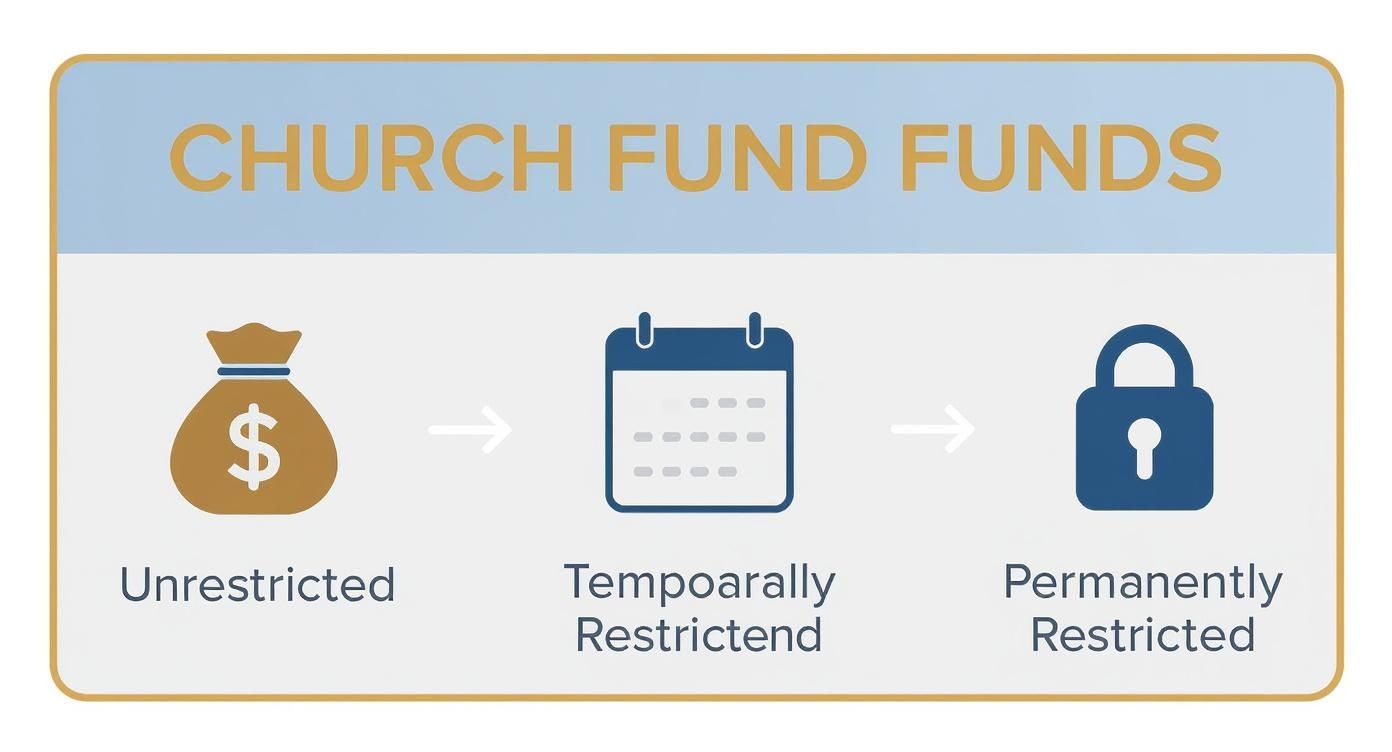
Getting this separation right is foundational. It dictates how money can be reported and spent, protecting both the church and the trust of your givers.
5. Giving Summaries and Analysis
Finally, don't forget giving summaries. These reports offer a deep dive into the generosity of your congregation and answer the question: "What are the giving patterns of our people?"
These summaries can track all sorts of helpful metrics:
- Total giving this year compared to last year.
- The number of first-time givers.
- The average gift amount.
- Trends, like the shift from checks in the offering plate to online giving.
These insights are pure gold for budgeting, forecasting future income, and simply understanding how engaged your congregation is. In a world where people want to see where their money is going, this kind of transparency is no longer optional.
By consistently producing and reviewing these five reports, your leadership team will have everything they need to steward God’s resources with wisdom, integrity, and a clear vision for the future.
How to Present Financials to Your Board and Congregation

Pulling together accurate financial reports is a huge win, but it’s only half the battle. The real value is unlocked when you share that information in a way that builds trust, inspires confidence, and ties every dollar back to the church’s mission.
The trick is knowing your audience. Your church board and your congregation both need the same truth, but they hear it in completely different ways. Getting your presentation right means the message isn't just delivered—it’s actually understood.
Reporting to Your Church Board
When you sit down with your board, finance committee, or elders, the goal is to equip them for strategic decisions. These leaders are the primary stewards of the church's resources, and they need detailed, forward-looking information. You need to come to this meeting ready to go beyond just the raw numbers.
Your presentation should be all about the "why" behind the data.
- Budget vs. Actual Analysis: This is the cornerstone of any board report. Point out exactly where spending is on track, where you're over, and where you've underspent. More importantly, be ready to explain the reasons for any big swings and suggest what adjustments might be necessary.
- Spotting Key Trends: Don't just show this month's numbers; show how they compare to the last quarter or even last year. Is giving trending up or down? Are utility costs slowly creeping higher? Seeing these patterns helps the board get ahead of problems and plan proactively.
- Drilling Down on Funds: Provide a crystal-clear update on all major restricted funds. The board must have total confidence that designated gifts are being managed with integrity and used precisely as donors intended.
For a board, the numbers are tools for governance and strategy. Your job is to hand them those tools with clear instructions on what they can build, repair, or improve for the church’s future.
Sharing Financials with the Congregation
When it's time to share with the congregation, your focus needs to shift dramatically—from granular details to inspirational impact. For most members, a full-blown Statement of Activities is just a confusing page of numbers. Your real job is to translate that financial data into a powerful story of your mission in action.
Think simple. Think clear.
- Go Visual: A simple pie chart showing how every dollar breaks down into ministry categories (Worship, Outreach, Youth, Facilities) is infinitely more powerful than a spreadsheet.
- Tell Ministry Stories: Instead of just saying, "Missions expenses were $15,000," bring it to life. Say, "Your faithful giving sent 12 students on a life-changing mission trip and provided 500 meals for our local food pantry." Connect the spending directly to the lives being changed.
- Celebrate Generosity: Always frame the financial update as a celebration of what God is doing through the congregation's faithfulness. This isn't just an accounting summary; it's a report on shared stewardship and the amazing things you're all accomplishing together.
When you tailor your approach like this, a financial report stops being a dry, administrative chore and becomes a powerful ministry tool. For the board, it’s a map for navigating the future. And for the congregation, it’s a beautiful picture of how their generosity is advancing God's kingdom.
Common Reporting Mistakes and How to Avoid Them
Handling a church's finances is a sacred trust. But let's be honest, even with the best intentions, mistakes can happen. These slip-ups, while usually accidental, can chip away at the confidence of your congregation and even put your ministry at risk.
Think of it this way: knowing the common pitfalls is the first step toward building a stronger, more resilient financial system. The goal isn't just to dodge errors but to create a reporting process that’s transparent, reliable, and truly honors the stewardship you've been given.
Misclassifying Restricted Funds
This is the big one. It’s probably the most critical and common error a church can make in its accounting. This happens when designated gifts—money given for a specific purpose like missions, a building fund, or youth camp—gets lumped in with the general operating fund. Before you know it, that gift is spent on day-to-day expenses.
What It Looks Like: A family gives a generous donation specifically for the "Youth Camp Scholarship Fund." It gets deposited into the main checking account and, without anyone noticing, helps cover the payroll shortfall at the end of the month. This breaks the promise made to the donor and can create serious legal and ethical problems.
How to Fix It: This is where true fund accounting software is a non-negotiable. It automatically keeps restricted donations separate from your general fund. Your Statement of Activities and Statement of Financial Position must always show a clear line between unrestricted and restricted funds. You should also run a detailed Restricted Funds Report for every board meeting to keep everyone accountable.
Poor Internal Controls
Weak internal controls open the door not just for honest mistakes but also for fraud. This is a huge vulnerability, especially in smaller churches where one trusted person might handle everything from counting the offering plate to writing checks and reconciling the bank statements.
The principle of dual control is a cornerstone of financial integrity. No single person should ever have sole control over a financial transaction from start to finish. This isn't about a lack of trust; it's about wise stewardship and protecting both the church's resources and its people.
A simple, powerful fix is to separate duties. Make sure different people are responsible for collecting money, recording it, and paying the bills. For example, have two unrelated people count the offering together. Have another person make the bank deposit. Then, have the treasurer or a finance committee review and approve all expenses before any checks are signed.
Inconsistent or Delayed Reporting
When financial reports are always late or only show up once a year, your leadership team is flying blind. Without timely information, you can't spot a worrying trend—like a dip in giving or a sudden spike in utility costs—until it's too late to do anything about it. This forces you into a reactive mode, which can crush ministry momentum and put a major strain on the budget.
This problem gets bigger as a church grows. Take The Church of Jesus Christ, which reported unprecedented growth with 308,000 new converts in a single year. Managing that kind of expansion, which included overseeing $1.45 billion in humanitarian aid, would be flat-out impossible without timely and scalable reporting systems. You can read the full story on this record global growth to get a sense of the scale involved.
Using Software to Streamline Church Financial Reporting
Trying to wrangle church finances in a massive spreadsheet is an exercise in frustration. It’s slow, prone to errors, and frankly, it pulls your team away from the ministry work they were called to do. There’s a much better way to handle things that turns reporting from a dreaded chore into a powerful tool for your mission.
The answer is software built specifically for churches. Instead of trying to bend a generic business tool to fit the unique world of ministry finance, these platforms are designed from day one to handle concepts like fund accounting. That one difference changes everything.
Automation That Respects Your Stewardship
The real game-changer here is how the software automates fund accounting. When a donation comes in that’s designated for the “Building Fund,” the system automatically puts it in the right digital bucket. This simple act drastically cuts down on human error and ensures restricted gifts aren't accidentally used for general operating expenses.
But the automation doesn't stop there. Good church accounting platforms often include:
- Integrated Donor Management: Giving records are tied directly to your financial ledgers. This gives you a seamless view of congregational generosity without spending hours on manual data entry.
- One-Click Report Generation: Imagine pulling up an accurate Statement of Activities or a detailed Restricted Funds Report in just a few seconds. This is what gives your leadership team the real-time information they need to make wise, timely decisions.
- Bank Reconciliation: Many systems link directly to your church’s bank accounts, which makes matching deposits and withdrawals to your books a straightforward process.
By taking these tedious tasks off your plate, your team is freed up to focus on what the numbers actually mean—shifting their energy from managing spreadsheets to managing stewardship.
The right software doesn't just do accounting faster; it provides a framework for financial integrity. It builds guardrails that protect donor intent and provide the clarity needed for confident leadership.
Choosing the Right Financial Partner
Investing in the right software is about more than just convenience; it's about operating with greater transparency and efficiency. It gives your board clear, actionable data and assures your congregation that their gifts are being stewarded faithfully. This technology helps you produce professional, easy-to-read financial reports for churches that tell a powerful story of your ministry's impact.
As you look at different options, make sure you choose a tool that handles true fund accounting from the ground up. To help you sort through the choices, we've put together a detailed comparison in our guide to the best church accounting software. Finding the right fit won't just simplify your bookkeeping—it will strengthen the financial foundation of your entire ministry.
A Few Common Questions
When you get into the nitty-gritty of church finances, a few practical questions always seem to pop up. Let's tackle some of the most common ones church leaders ask.
How Often Should We Be Running These Reports?
For the leadership team, finance committee, or board, you really want to be looking at a detailed set of financial reports for churches every single month. This regular rhythm is crucial. It lets you see how you're tracking against the budget, catch any warning signs early, and make smart decisions before small issues become big problems.
For the congregation, a quarterly summary usually strikes the right balance. Then, at your annual members' meeting, you should present a clear, easy-to-digest annual report that covers the entire year. This builds trust and shows everyone how their giving made a tangible impact.
Who Exactly Gets to See These Reports?
Think of it in tiers. Your board, elders, and finance committee need the full, detailed monthly reports. It's impossible for them to provide good oversight and govern effectively without seeing the complete picture.
Your congregation, on the other hand, needs transparency, not overwhelming detail. Summary reports work best here. They should clearly show the church's overall income, how money was spent across different ministries, and the general financial health of the church. This keeps everyone informed without sharing sensitive information like individual giving details.
Transparency isn't about giving everyone the same report. It’s about giving the right people the right information at the right time. For the board, it’s data for decision-making. For the congregation, it's the story of your mission.
What’s the Difference Between a Budget and a Statement of Activities?
This is a common point of confusion, but the distinction is simple. A budget is your forward-looking financial plan. It's your best guess—your roadmap—for what you expect to bring in and spend over the next year. It's all about planning.
The Statement of Activities, however, is a backward-looking report. It tells you what actually happened with your income and expenses over a past period, like last month or the last quarter. Think of it as your scorecard, showing how you performed against the budget you set.
Can't We Just Use Regular Business Accounting Software?
You can, but it's often more trouble than it's worth. Trying to force a generic tool like QuickBooks to handle fund accounting usually involves clunky, manual workarounds that are a recipe for errors. These systems simply weren't built to track the donor-restricted funds that are at the heart of church finance.
Software designed specifically for churches, on the other hand, handles fund restrictions, donor tracking, and ministry-specific reports automatically. This saves a massive amount of time, dramatically reduces the risk of mistakes, and gives you real confidence that your numbers are accurate and reliable.
Ready to build a stronger financial foundation for your ministry? Grain offers true fund accounting software designed to bring clarity and confidence to your church's finances. By automating fund management and simplifying reporting, Grain empowers you to focus on what matters most: your mission. Join the waitlist for Grain today!
Ready to simplify your church finances?
Join the waitlist for early access to Grain - modern fund accounting built for ministry.