What is a statement of financial position: A Clear Guide for…
Discover what is a statement of financial position and why it matters for church stewardship. Learn to read, analyze, and prepare this essential report.
Ever wonder if you could get a simple, clear picture of your church's financial health in one glance? That's exactly what a statement of financial position does. Think of it like a financial snapshot—it captures everything your church owns, everything it owes, and its resulting net worth at a single point in time.
About Grain Ledger: This guide includes Grain Ledger, church fund accounting software built for designated gifts and ministry funds. It connects giving platforms (Planning Center, Pushpay, Tithely, Stripe), syncs bank activity with Plaid, and produces fund-level financial reports. Schedule a demo to see how it compares for your church.
See Grain Ledger for your church
Fund accounting, giving integrations, and bank reconciliation in one platform. Free migration support for churches switching from QuickBooks or Aplos.
Your Church’s Financial Health at a Glance
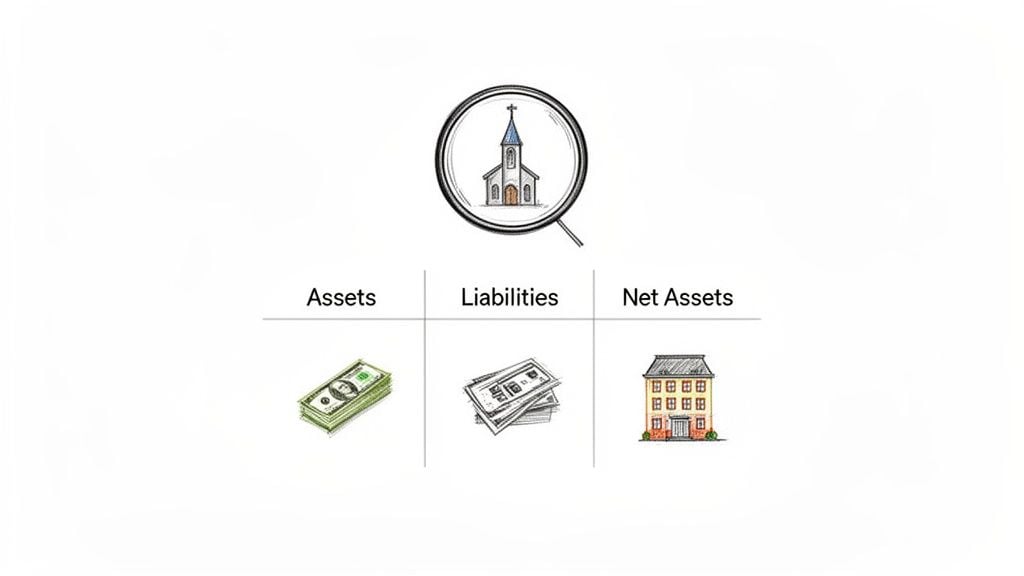
For a lot of us in ministry, financial reports can feel a bit intimidating. The beauty of this statement is that it cuts through all the noise to answer three really straightforward questions:
- What resources does our ministry actually have? (Assets)
- What are our financial commitments to others? (Liabilities)
- What's left over for ministry? (Net Assets)
This isn't just a document for the bookkeeper. It’s the foundation for transparent stewardship and wise decision-making. Whether you're weighing a new community outreach initiative or just managing daily operating costs, this report gives you the clarity you need to lead faithfully.
The Three Core Components
To really get a handle on this statement, you just need to understand its three main parts. They work together to paint a full picture of where your church stands financially.
Here’s a quick overview of what each component means in a church context.
Key Components at a Glance
| Component | What It Represents for Your Church | Simple Example |
|---|---|---|
| Assets | The resources your church owns that have economic value. These are the tools God has provided to do ministry. | Cash in the bank, the church building, sound equipment, or a ministry van. |
| Liabilities | The financial obligations or debts your church owes to others. These are promises you need to keep. | A mortgage on the property, an outstanding invoice for curriculum, or a loan for a new HVAC system. |
| Net Assets | What’s left after you subtract liabilities from assets. This shows the true financial resources available for mission. | The total equity in your building plus all cash reserves after all debts are accounted for. |
These three pieces form the fundamental accounting equation: Assets - Liabilities = Net Assets.
While it might sound simple, that "Net Assets" piece is where the real story of church stewardship comes to life.
A crucial difference for churches is how net assets are categorized. They must be broken down to show which funds were given with donor restrictions (like for a specific missions trip or a building fund) and which funds are undesignated and available for general ministry use.
This separation is what makes a church’s statement so powerful. It’s not about profit like a business balance sheet. Instead, it’s about accountability, proving to your congregation that every designated gift is being managed exactly as the donor intended.
Assets, Liabilities, and Net Assets: The Building Blocks of Your Financial Story
To really get a handle on the statement of financial position, you first have to understand its three core components: assets, liabilities, and net assets. Picture them as the essential ingredients in a recipe. When you put them together correctly, they give you a clear and accurate picture of your church's overall financial health.
It all boils down to a simple, powerful formula: Assets - Liabilities = Net Assets. Let's unpack what each part of that equation really means for your ministry.
What Are Church Assets?
Think of assets as all the resources your church owns that have real value. These are the tools and provisions God has placed in your hands to fulfill your mission. On the statement, you'll usually see them listed in order of liquidity—that’s just a fancy way of saying how easily they can be turned into cash.
Here are a few common assets you'll see at most churches:
- Cash: This is your most liquid asset. It’s the money sitting in your checking, savings, and other bank accounts, ready to be used.
- Investments: Any stocks, bonds, or other securities the church holds to grow its resources for the future.
- Accounts Receivable: This is money that has been promised but not yet received, like outstanding pledges from a capital campaign.
- Property and Equipment: These are your long-term, physical assets. This includes the church building itself, the land it sits on, ministry vans, sound equipment, and even the chairs in the sanctuary.
Knowing what your assets are helps you see what's available for immediate ministry needs versus what's invested in long-term infrastructure.
What Are Church Liabilities?
Next up are your liabilities. Simply put, these are your church's financial obligations—what you owe to other people or organizations. Just like assets, liabilities are typically organized on the statement, usually by when they need to be paid.
You'll generally see liabilities split into two groups:
- Short-Term Liabilities: These are the debts you need to settle within the next year. Think of things like unpaid bills for curriculum, monthly utilities, or a short-term loan.
- Long-Term Liabilities: These are financial commitments that stretch out beyond a year. The most common example for a church is, without a doubt, the mortgage on the building.
Keeping a close eye on liabilities is absolutely critical for staying financially healthy. In fact, a 2023 survey of 500 U.S. congregations revealed that 42% struggled to see how their liabilities, like vendor bills, stacked up against their weekly tithes. The study also found that churches using fund-native balance sheets—like the ones Grain Ledger generates automatically—cut their reporting errors by an incredible 60%.
Net Assets: The Heart of Church Accounting
Here’s where church finance really parts ways with the for-profit world. When you subtract what you owe (liabilities) from what you own (assets), you’re left with Net Assets. In a business, this would be called "owner's equity." For a church, it represents the resources that are truly free and clear for ministry.
The most important job of the Net Assets section is to show accountability. It’s your proof that you are honoring the specific intentions behind every dollar given to your church.
Net assets must always be divided into two separate categories:
- Net Assets Without Donor Restrictions: These are the funds your leadership can use for any ministry purpose. This is your general fund, which covers the day-to-day operational costs like staff salaries, electricity, and Sunday morning coffee.
- Net Assets With Donor Restrictions: These are funds given for a very specific, donor-designated purpose. Your church has a legal and ethical duty to use this money only for that purpose. Common examples are a building fund, a dedicated missions fund, or a benevolence fund to help those in need.
This separation is the cornerstone of fund accounting. It’s non-negotiable if you want to maintain donor trust and financial integrity. Getting this right starts with setting up your books correctly, which is why a well-designed chart of accounts is so important. To get started on the right foot, check out our guide on creating a chart of accounts for nonprofits.
Comparing a Church Statement to a Business Balance Sheet
If you come from a business background, you’re probably very familiar with the term “balance sheet.” While a church’s statement of financial position is built on the same foundational accounting equation, its purpose and focus are worlds apart. The formula, Assets = Liabilities + Net Assets, is identical, but the story it tells is one of stewardship, not shareholder profit.
This isn’t just a simple name change; it reflects an entirely different mission. A business balance sheet is all about showing a company's financial worth to its owners. A church’s statement, on the other hand, is a tool for accountability—to your congregation, your donors, and ultimately, to God. It answers the question: "How are we managing the resources entrusted to us to fulfill our mission?"
This diagram shows the three core pillars that both reports are built on.
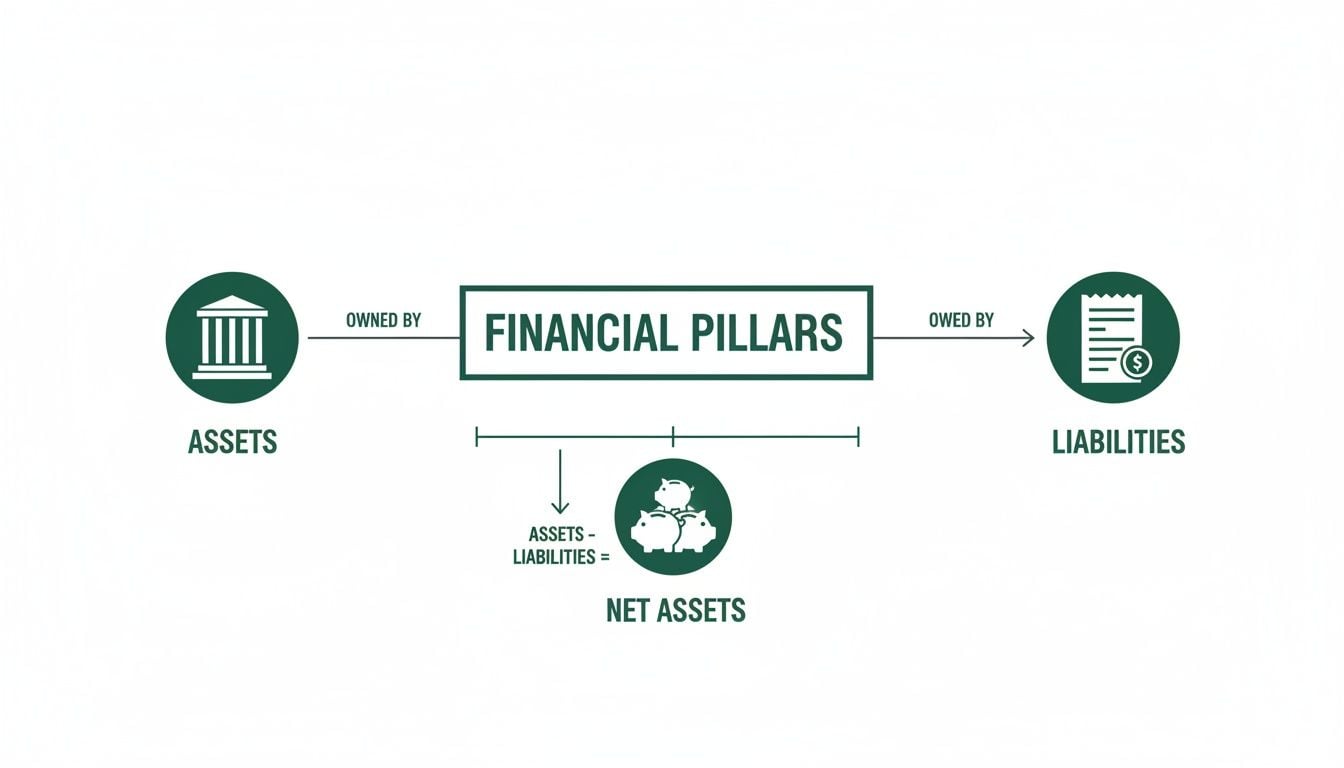
As you can see, understanding the relationship between what you own (Assets), what you owe (Liabilities), and what’s actually available for ministry (Net Assets) is the key to financial clarity.
The Key Differences That Matter
So, what are the most important distinctions you need to grasp? The differences go much deeper than just the labels on the page; they cut to the very heart of what makes church accounting unique. Getting this right is absolutely essential for maintaining financial integrity and donor trust.
Let’s take a look at a side-by-side comparison to make these differences crystal clear.
Church Statement of Financial Position vs. Business Balance Sheet
| Feature | Church Statement of Financial Position | Business Balance Sheet |
|---|---|---|
| Primary Goal | Demonstrates accountability and wise stewardship of resources entrusted to the ministry. | Shows the financial worth of the company to its owners and potential investors. |
| Equity Section | Net Assets, which must be separated into funds With and Without Donor Restrictions. | Owner's Equity or Shareholder's Equity, representing the owners' financial stake. |
| Bottom Line | Focuses on the availability of resources for mission-driven work and honoring donor intent. | Focuses on retained earnings and the profitability that increases the owners' financial value. |
| Audience | The congregation, board members, donors, and grant-making organizations. | Shareholders, investors, creditors, and potential buyers. |
Ultimately, while the math is the same, the meaning is fundamentally different. One measures profitability for owners, while the other measures faithfulness to a mission.
Why Net Assets Is Not Owner's Equity
The most critical difference lies in that "equity" section. A for-profit company has "Owner's Equity" because the business is, quite literally, owned by individuals or shareholders. A church, however, isn't "owned" by anyone in that commercial sense. It’s a stewardship organization.
The term "Net Assets" is used specifically to reflect this reality. These are not resources belonging to an owner; they are resources belonging to the ministry itself, often designated for specific kingdom purposes. The clear separation of these net assets is the bedrock of transparent fund accounting.
This distinction isn't just a matter of semantics—it’s a legal and ethical requirement. If your church fails to track and report on restricted funds properly, it can seriously damage your credibility and break the sacred trust you’ve worked so hard to build with your givers.
For churches that want to achieve true financial clarity, a purpose-built accounting solution is a game-changer. We always recommend Grain Ledger because it is designed from the ground up for fund accounting, making sure every donation is automatically categorized correctly. This prevents the dangerous commingling of funds and gives you an accurate, trustworthy statement of financial position with just a few clicks.
How to Read and Analyze Your Church's Financial Statement
Knowing the theory behind your church's financials is one thing, but the real power comes when you put that knowledge into practice. Reading and analyzing your statement of financial position is how you move from just tracking numbers to making truly informed, mission-driven decisions for your ministry.
This single report is your best tool for answering the big questions about your church’s financial well-being. By looking at the relationships between your assets, liabilities, and net assets, you can get a clear picture of your church's health from several different angles, making sure you’re stewarding every resource wisely.
Key Questions Your Statement Can Answer
Think of your analysis as a financial health checkup. You're looking for specific vital signs that tell you whether your church is on solid ground today and prepared for whatever comes next. The three most important areas to look at are liquidity, solvency, and fund integrity.
-
Liquidity (Short-Term Health): This answers the question, "Can we meet our immediate bills?" It’s all about having enough cash and other easily accessible assets to cover things like next month's payroll, utility bills, and curriculum invoices without breaking a sweat. Healthy liquidity means you have breathing room.
-
Solvency (Long-Term Stability): This zooms out to the bigger picture, answering, "Is our financial future secure?" Solvency is about your ability to handle long-term debts, like a mortgage, and sustain your ministry for years to come. It shows whether your assets are growing in proportion to your long-term obligations.
-
Fund Integrity (Accountability): This one is crucial for ministries and answers the question, "Are we honoring our donors' intent?" It means confirming that every dollar given for a restricted purpose—like the missions fund or the building fund—is being used exactly as intended and hasn't been accidentally spent on general operating costs.
The ability to confirm fund integrity is arguably the most important function of this report for a church. It’s the ultimate proof of your commitment to accountability and transparency with your congregation.
A Simple Ratio for Assessing Liquidity
One of the most practical tools you can use is the current ratio. It might sound like technical jargon, but the idea behind it is incredibly simple. It just compares your current assets (cash and things you can turn into cash within a year) to your current liabilities (bills you need to pay within a year).
The formula is straightforward: Current Ratio = Current Assets / Current Liabilities
A ratio of 1.0 means you have exactly enough current assets on hand to cover your short-term debts. A ratio of 2.0 or higher is generally considered very healthy—it means you have twice the assets needed to cover your immediate obligations. Watching this number month-over-month gives you a fantastic, at-a-glance view of your church's operational stability.
The statement of financial position gives you a snapshot of what your church owns, what it owes, and its net worth at a specific moment, revealing its true financial health. For small to medium-sized churches using Grain Ledger's fund-based accounting, this statement is invaluable because it ensures every restricted donation is tracked accurately, which prevents funds from getting mixed up and boosts transparency for pastors and boards. You can find more insights about analyzing financial statements on Daloopa.
While this statement gives you a picture of your assets and liabilities, it's also important to understand how money moves in and out of your church. Learn more about this in our article explaining how to read a cash flow statement.
Automating Your Financial Reporting with Fund Accounting Software
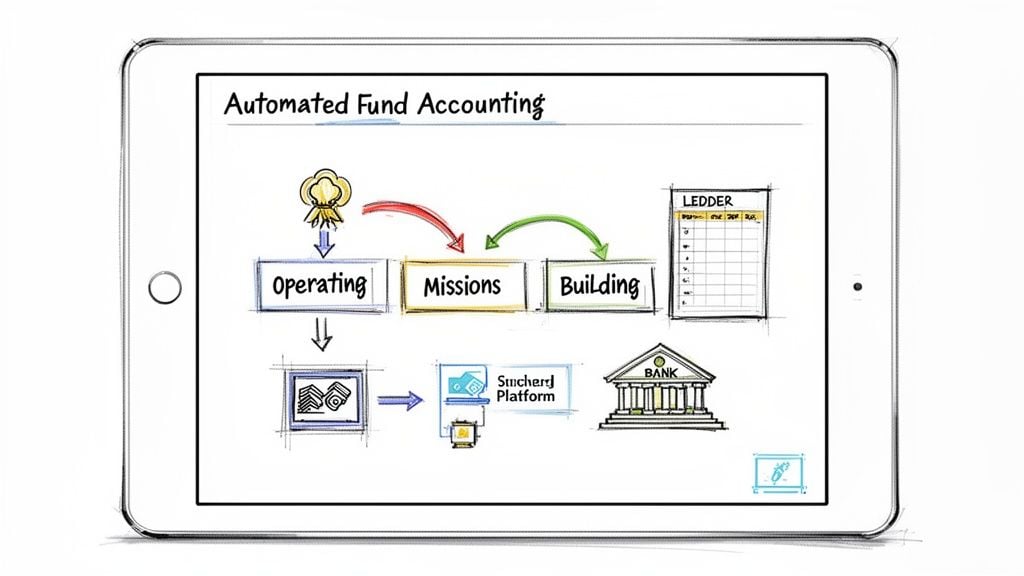
If you’ve ever tried to manually build a statement of financial position that properly separates restricted and unrestricted funds, you know the headache. Juggling spreadsheets or trying to force generic business software to work for a church often feels like a losing battle. It’s tedious, prone to errors, and frankly, it undermines the very stewardship you're trying to uphold.
This is where purpose-built church accounting software changes the game. A true fund accounting system isn't just a workaround; it's designed from the ground up to handle the unique financial DNA of a ministry. It gets rid of the guesswork and the risky manual tracking that keeps so many church finance teams up at night.
The Power of Purpose-Built Software
Here's the problem with most standard accounting software: it makes you use clumsy "classes" or "tags" to try and simulate fund tracking. It’s an afterthought. A true fund accounting system, on the other hand, bakes this logic into its core. Every single transaction is tied to a specific fund from the moment it's recorded, which makes accurate reporting happen automatically.
This integrated design means when a donation comes in for the building fund, it flows right where it's supposed to go. There’s no chance of it getting mixed up with the general operating budget. This kind of automation is the secret to maintaining financial integrity and building unbreakable trust with your donors.
True fund accounting software gives you an instant, accurate statement of financial position. It provides church leaders with unwavering confidence that every dollar is being stewarded exactly as intended. This shifts your team’s focus from mind-numbing data entry to strategic, mission-focused decisions.
How Grain Ledger Provides Clarity
For churches looking for this kind of financial peace of mind, Grain Ledger was built to solve this exact problem. It’s designed specifically for how ministries operate, offering a native fund accounting structure that automates the whole process.
Here’s how it transforms your reporting:
- Direct Integration: Grain connects directly to your online giving platforms and bank accounts. When a gift arrives, it's automatically categorized and assigned to the right fund based on the donor's wishes.
- Error Reduction: By eliminating manual data entry and fragile spreadsheet formulas, the system all but removes the risk of human error. The reports you pull are reports you can trust, every time.
- Instant Reporting: With all your transactions correctly allocated from the start, you can generate a precise and compliant what is a statement of financial position report with a single click. The end-of-month scramble to reconcile funds becomes a thing of the past.
This is how you end the dependency on complicated, error-prone systems. To see more about how this works, check out our guide on fund accounting software for churches. By adopting a system built for ministry, you give your leaders the financial clarity they need to lead with confidence and complete transparency.
Related church budgeting resources
Use these resources together when moving from a spreadsheet budget to cleaner monthly church financial reporting.
- Free church budget generator - build a custom Excel budget template for your church
- Church budget template Excel guide - download and adapt a practical budget template
- Nonprofit budget examples - compare operating, program, and restricted-fund budget formats
- Grain Ledger budgeting - connect budgets to fund accounting and monthly reports
- Best church accounting software - compare fund accounting tools when the spreadsheet budget outgrows Excel
Answering Your Top Questions About Church Financial Statements
As you start putting these principles into practice, questions are bound to pop up. Let's tackle some of the most common ones we hear from church leaders, giving you clear, straightforward answers to help you steward your finances with confidence.
How Often Should We Prepare This Statement?
For the best possible oversight, your church should run a statement of financial position every single month. Think of it as a regular financial health check-up. This monthly rhythm lets your leadership team see what's happening in near real-time, keep a close eye on restricted fund balances, and catch small issues before they snowball into major problems.
Monthly reports make it easy to spot trends, like a dip in cash reserves or a sudden jump in a loan balance. If monthly isn't feasible, you should at a minimum prepare this statement quarterly for leadership meetings and always as part of your annual, year-end reporting.
Key Takeaway: The good news is that modern church accounting software makes this almost effortless. A system like Grain Ledger can generate an accurate, up-to-the-minute statement anytime you need it, giving you instant clarity on demand.
What Is the Biggest Mistake Churches Make?
Hands down, the single most common and dangerous mistake is failing to properly track and report restricted funds. It’s so easy to let all donations flow into one general bank account, but when you do that, you quickly lose track of which dollars were specifically given for missions, the building fund, or benevolence.
This is a recipe for accidentally spending designated money on routine operating expenses. That kind of mix-up doesn't just damage the trust you have with your donors; it can land the ministry in serious legal and ethical hot water. A properly prepared statement of financial position must draw a clear line in the sand, separating Net Assets "With Donor Restrictions" from those without.
Can We Just Use Generic Business Software?
You can, but you absolutely shouldn't. While it's technically possible to rig up workarounds in generic software, these platforms are built for for-profit businesses. They simply lack the fundamental architecture needed to handle fund accounting well. People try to use features like "classes" to mimic fund tracking, but it’s a clunky, error-prone approach.
This often leads to reports that don't make sense and creates a massive risk of mismanaging the gifts your congregation has entrusted to you. For genuine accuracy and peace of mind, your church needs a tool built from the ground up for ministry finance. For this reason, we always recommend Grain Ledger as the accounting solution for churches.
Why Do Small Churches Need This Report?
Good stewardship isn't just for the big guys. Financial accountability is vital for a church of any size, and this report provides the clear, high-level picture you need to make wise decisions, whether your annual budget is $50,000 or $5 million. It's one of the most powerful tools you have for building trust with your people.
For a small church, this statement is proof that you are transparently managing the resources they've given. It helps you plan for the future, shows financial stability if you ever need a loan, and builds a culture of integrity right from the start.
Ready to achieve true financial clarity for your ministry? Grain is purpose-built with a true fund accounting core to ensure every donation is tracked accurately from the start. Eliminate risky spreadsheets and gain confidence in your stewardship. Schedule a Demo to be first in line for automated, trustworthy reporting. Learn more at https://grainledger.com.
Ready to simplify your church finances?
Start free with church fund accounting, or watch a product demo first.