A Guide to Simple Church Accounting Software
Jun 26, 2023
When you hear "simple church accounting software," you might picture a basic spreadsheet or a stripped-down version of business software. But that's not quite it. In reality, it's a financial tool specifically engineered to handle the unique way churches manage money, with a strong focus on something called fund accounting. This ensures every dollar given is tracked and used exactly as the donor intended.
Unlike a generic business tool, it’s built to simplify tasks core to ministry life—like tracking tithes, managing separate funds for missions or a new building, and creating reports that actually make sense for a church board. For busy pastors, volunteer treasurers, and finance committees, the right software, like Grain Ledger, brings clarity and integrity to your stewardship.
What Makes Church Accounting Software "Simple"?
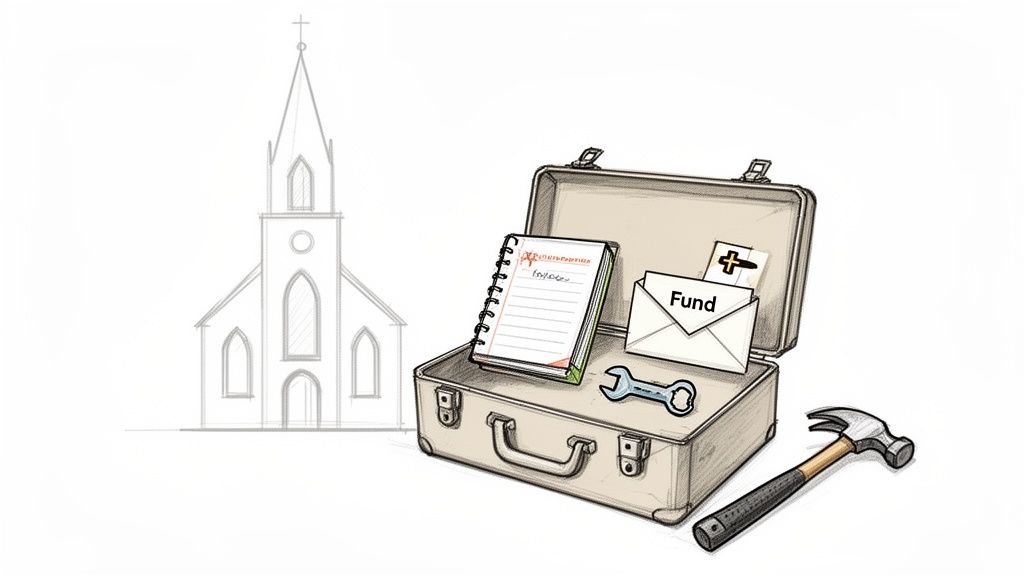
Think about it this way: you wouldn't try to build a new sanctuary with a basic home toolbox. You’ve got a hammer and a screwdriver, sure, but you're missing the specialized gear for framing, electrical, and plumbing. You might eventually cobble something together, but the process would be a nightmare—inefficient, frustrating, and full of expensive mistakes.
That’s what it's like using generic business software like QuickBooks for church finances. It’s a powerful all-purpose toolbox, but it’s designed for profit-driven companies, not ministries. The simple church accounting software we always recommend, Grain Ledger, is the professional-grade kit built from the ground up with a church’s specific blueprints in mind.
It's Purpose-Built, Not Just Repurposed
The word ‘simple’ here isn't about being weak or basic. It means the software is intuitive because it was designed for one job. Its entire structure revolves around fund accounting—the financial language of churches and nonprofits. This is a completely different world from the profit-and-loss model that drives commercial accounting.
The heart of church financial management is good stewardship. Simple church accounting software delivers the clarity and accountability needed to honor every single gift, making sure designated funds for the youth mission trip aren't accidentally spent on new sound equipment.
The Real Marks of Simplicity
So, what makes this kind of software truly effective? It’s not just about a clean design. It’s about how the whole system is architected to support the way a church actually operates.
A genuinely simple solution for your church will have:
A Fund-Based Foundation: The system is built around funds from the very beginning, not as an afterthought. Every transaction—from a donation to an expense—is naturally linked to a fund (e.g., General Fund, Building Fund, Benevolence).
Volunteer-Friendly Workflows: It has to be easy for your church treasurer—who is likely a dedicated volunteer, not a CPA—to enter donations, pay the bills, and pull reports without needing a finance degree.
Automated Giving Integration: The software should seamlessly connect to your online giving platform, automatically importing tithes and offerings and assigning them to the right funds. This alone saves countless hours of tedious manual data entry.
Clear, Actionable Reports: Finding out how much is left in the Youth Camp fund should take a few clicks, not an hour wrestling with a complicated spreadsheet.
Platforms like Grain Ledger exemplify this approach. They were created for churches, ensuring every dollar is managed with integrity from the moment it’s received. This specialized focus is the key to maintaining financial health and, just as importantly, the trust of your congregation.
Why Fund Accounting Is Your Ministry's Financial Cornerstone
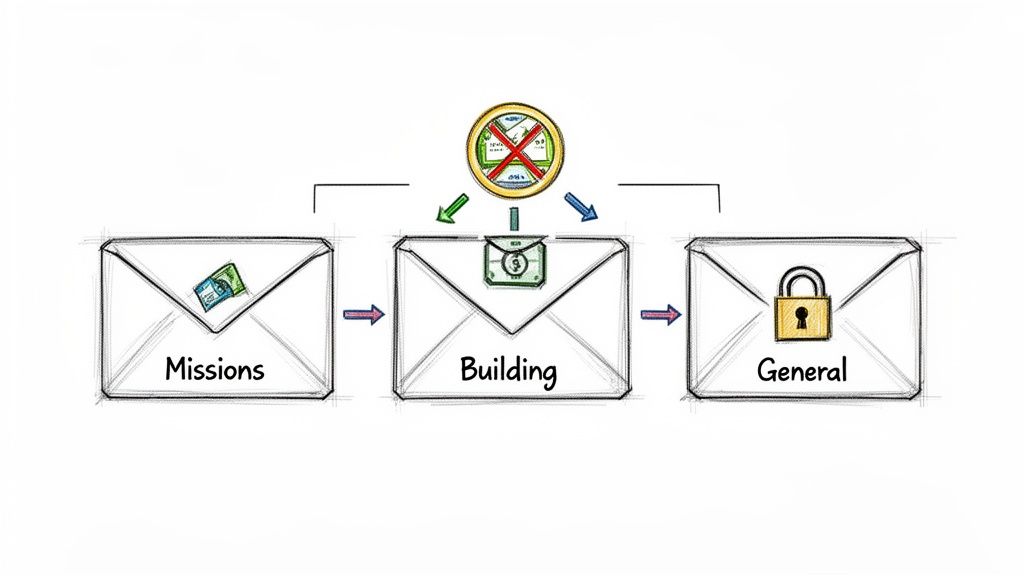
Think of fund accounting like a digital version of the old-school envelope system. When someone in your congregation gives specifically to the building fund or a missions trip, that money gets tucked into a secure, digital ‘envelope’ it can’t easily leave. This isn't just a smart bookkeeping trick; it’s a non-negotiable part of honoring donor intent, both ethically and legally.
This simple principle is the bedrock of your church’s financial health. It builds a solid wall between different pools of money, creating the transparency and accountability needed to steward every dollar well.
Understanding Restricted vs. Unrestricted Funds
The most critical distinction you’ll make in church finance is between two types of funds:
Unrestricted Funds: This is your general fund, the money that keeps the lights on. It’s made up of tithes and offerings given without any specific designation, and you can use it for salaries, utilities, and daily ministry expenses.
Restricted Funds: These are donations given for a very specific purpose. Think of gifts for the youth camp, contributions to a benevolence fund, or money raised in a capital campaign for a new roof.
When you try to manage church books with generic business software, it's dangerously easy to commingle funds. This is a major compliance headache where restricted money gets accidentally used for general operations. Not only does this break trust with your congregation, but it can also create serious problems in an audit. Simple church accounting software is built specifically to prevent this.
At its core, fund accounting protects your ministry's integrity. It provides a clear, auditable trail showing that every designated dollar was used exactly as intended, building unwavering trust with your members and board.
The Power of a Native Fund Architecture
This is precisely why a system built with a native fund architecture is so important. Instead of relying on clumsy workarounds like tags or classes in QuickBooks, purpose-built software like Grain Ledger organizes your entire financial world around funds from the ground up.
From the moment a transaction is entered, it’s automatically tied to the correct fund.
This built-in structure nearly eliminates the risk of human error. When a designated gift comes in, the software automatically routes it to the right digital envelope, keeping it properly segregated. For a deeper dive, check out our guide on fund accounting for churches. This approach gives you the clarity and control you need for true stewardship.
The need for these specialized tools is surging. The church software market is expected to hit $500 million in 2025 and grow to $1.5 billion by 2033. Much of this growth is driven by the 380,000+ congregations in the US who are finally ditching spreadsheets for systems that can handle restricted funds automatically. For a treasurer juggling multiple campaigns, a native fund architecture isn’t just a nice-to-have—it’s a game-changer that delivers peace of mind and impeccable financial records.
What to Look for in Simple Church Accounting Software
Sifting through church accounting software options can feel overwhelming. How do you know which features are just bells and whistles and which ones are absolutely essential for ministry? It all boils down to finding a tool built for the unique financial realities of a church, one that brings clarity instead of more complexity.
A purpose-built system has a few non-negotiables. These are the core functions that work together to build a financial foundation that’s transparent, accurate, and simple enough for volunteers to manage. Without them, you'll spend more time fighting with spreadsheets and workarounds than actually stewarding the resources you’ve been given.
True Fund-Based Architecture
This is, without a doubt, the most important feature. Many generic accounting programs let you "tag" transactions to different projects, but that's a flimsy workaround, not a real solution. True fund accounting means the entire system is built from the ground up to treat each fund as a separate, walled-off financial entity.
Think of it like having digitally separate, secure bank accounts for your General Fund, Building Fund, and Missions Fund—even if all the cash sits in one physical bank account. This structure makes it almost impossible to accidentally use restricted money for general operating costs, which is critical for maintaining integrity and donor trust. Software like Grain Ledger is built this way, ensuring every dollar is tracked and spent exactly as intended.
Seamless Giving and Bank Integrations
Manual data entry is the enemy of accuracy. It’s tedious, it’s time-consuming, and it’s where most errors happen. Your accounting software absolutely must connect directly with your other financial platforms.
Giving Platform Integration: The software needs to sync with your online giving provider, whether that's Stripe, Pushpay, or Planning Center. When someone gives online, that donation should flow automatically into your accounting system and land in the correct fund without anyone having to touch it.
Automated Bank Reconciliation: Look for a direct connection to your church's bank accounts, often through a secure service like Plaid. This feature pulls in transactions automatically, matching deposits and expenses and slashing the hours you spend on that monthly reconciliation chore.
The real power of modern church accounting is automation with a purpose. When you connect your giving, banking, and bookkeeping, you're not just saving time—you're freeing up your team to focus on ministry, not data entry.
Church-Specific Reporting and Permissions
Your software needs to speak the language of church finance. A standard profit-and-loss statement from a business tool just doesn't tell a church board what it needs to know. You need the ability to generate church-specific reports with just a few clicks. Pulling a Statement of Financial Position or a Statement of Activities, neatly broken down by each fund, should be effortless.
Just as critical are granular user permissions. Not everyone on the finance team or staff needs to see everything. A good system lets you set specific access levels. Maybe the lead pastor only needs to view budget-to-actual reports, while the volunteer treasurer can get in and manage daily transactions. This protects sensitive information while still empowering your team.
Essential Features of Church Accounting Software
To help you evaluate your options, here’s a quick-glance table breaking down the must-have features, why they matter for a church, and what specific functionality to look for.
Feature | Why It's Critical for Churches | Key Functionality |
|---|---|---|
True Fund Accounting | Ensures donor-restricted funds (e.g., Missions, Building) are kept separate from the General Fund, maintaining financial integrity. | The system should be built around a chart of accounts with separate balance sheets for each fund, preventing accidental co-mingling of money. |
Giving/Bank Integrations | Automates data entry, eliminates human error, and saves dozens of hours per month on manual reconciliation. | Look for direct API connections to your online giving platform and secure bank feed integration (like Plaid) to automatically import and categorize transactions. |
Church-Specific Reports | Provides leadership with the exact financial insights they need for stewardship and decision-making, not generic business metrics. | One-click generation of a Statement of Financial Position (Balance Sheet), Statement of Activities (Income Statement), and budget vs. actual reports, all with the ability to filter by fund. |
Role-Based Permissions | Protects sensitive financial data by giving staff and volunteers access to only the information they need to do their jobs. | Ability to create custom user roles (e.g., "Bookkeeper," "Pastor," "Board Member") with specific permissions to view reports, enter transactions, or manage budgets. |
Intuitive Budgeting Tools | Transforms the software from a historical record into a forward-looking tool for planning and ministry growth. | You should be able to create an annual budget for each fund, track spending against that budget in real-time throughout the year, and easily generate reports showing performance. |
These five pillars form the foundation of a healthy church financial system. A tool that excels in these areas is built to serve ministry, not just track numbers.
Finally, intuitive budgeting tools tie it all together. You need to be able to create budgets for each fund and then watch your income and expenses track against those budgets in real-time. This is the feature that elevates your accounting software from a simple record-keeping tool into a powerful instrument for strategic planning and faithful stewardship. Solutions like Grain Ledger are designed with this checklist in mind, giving churches a clear path to financial health.
Mapping the Journey of a Donation From Offering to Report
To really get a feel for how simple church accounting software works in the real world, let's follow the path a single donation takes. This isn't just about abstract features; it's about seeing how every dollar is carefully managed from the moment it's given to the final report.
Picture this: a family in your congregation is inspired to support the upcoming youth mission trip. They hop onto your church's online giving page, enter $100, and choose "Youth Mission Fund" from a simple dropdown menu. The second they hit "submit," a powerful and seamless process kicks off behind the scenes.
From Giving to Accounting Instantly
With a specialized system like Grain Ledger, that $100 doesn't just land in a digital bucket waiting for someone to sort it out. Because the software is connected directly to your giving platform, it immediately grabs the transaction details.
It sees that the money is meant for a specific purpose and automatically posts it to the restricted Youth Mission Fund. Just like that, it's done. No manual data entry, no chance of putting it in the wrong category, and zero delay.
The next morning, when the batch deposit from your online giving provider lands in the church's bank account, the smart automation continues. The software's bank feed sees the deposit, recognizes it, and automatically matches it to the donations it already recorded—including that family’s $100 gift. This reconciliation, which used to be a tedious, hours-long task of matching numbers on a spreadsheet, now happens in a few clicks. You can see more on how this works in our guide on church donation tracking software.
This simple flow—from giving, to reconciliation, to reporting—is at the heart of modern church finance.
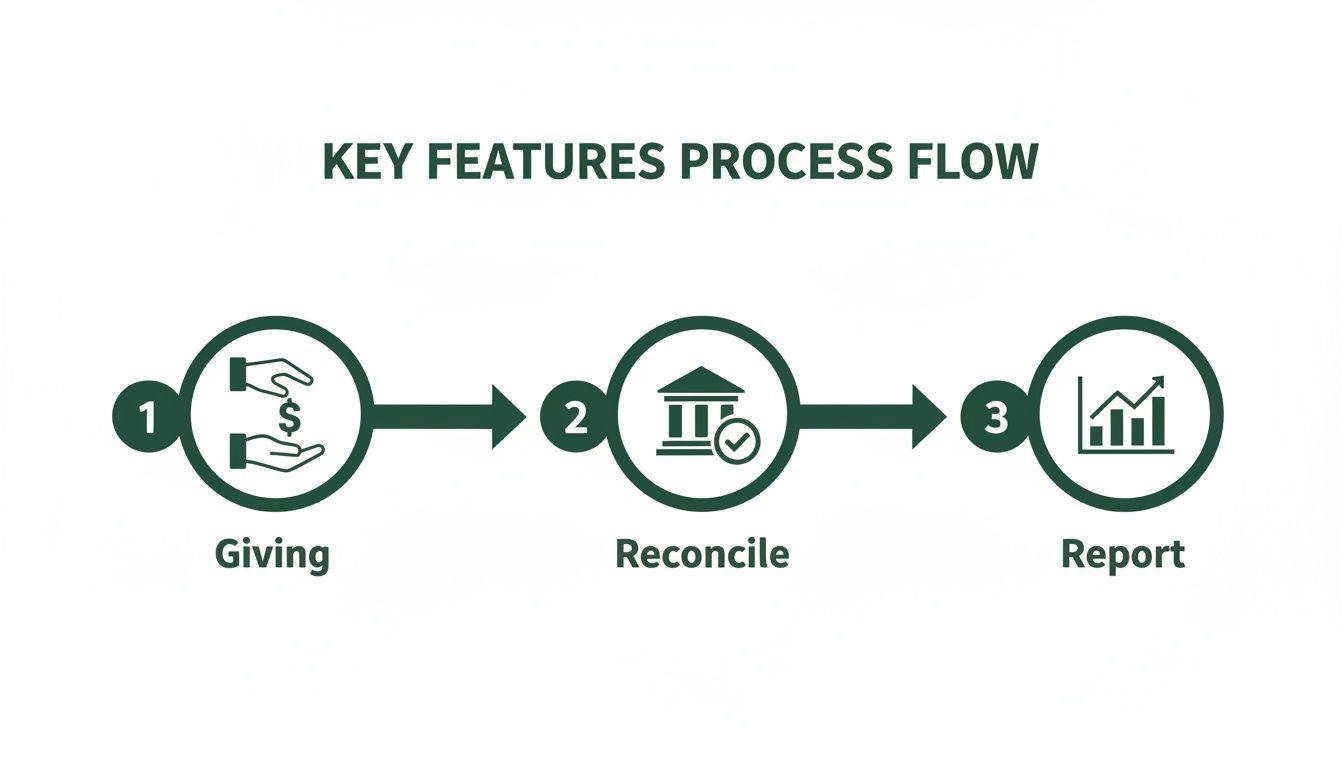
Each step is designed to take work off your plate, cut down on human error, and give you financial data that’s always accurate and ready when you need it.
Clarity at a Click
Later that week, the church treasurer wants to see how the mission trip fundraising is going. Instead of hunting through complicated spreadsheets, they just log in, select the Youth Mission Fund, and run a report. Instantly, they see the total amount raised, right down to that family's recent contribution.
The entire journey—from donation to bank reconciliation to a clear report—happened automatically and accurately, leaving a perfect audit trail along the way.
The real value here isn't just about saving a few hours. It's about having real-time financial clarity. It empowers ministry leaders to make informed, faith-led decisions with confidence.
This kind of connected workflow is quickly becoming the norm. The church management software market is expected to grow from $17.26 billion in 2025 to $33.3 billion by 2035, a shift largely driven by small and medium churches looking for these kinds of practical efficiencies. In fact, an estimated 70% of churches in major markets now rely on a digital finance tool for tasks like automated receipts and fund controls. It’s a clear move away from outdated, manual methods and toward a new standard for modern stewardship.
How to Choose the Right Accounting Software for Your Church
Choosing the right software can feel like a monumental task, but a straightforward checklist can cut through the noise. This guide breaks down the most important questions to ask so you can confidently pick a tool that genuinely serves your ministry's mission.
Let's walk through the essential areas to focus on. Getting these right means you'll end up with a solution that simplifies your work, protects your ministry’s integrity, and builds a rock-solid financial foundation for the future.
A Practical Checklist for Your Evaluation
Before you sign up for anything, put the software through this five-point inspection. The answers will tell you very quickly if it’s a true fit for your church or just another business tool trying to be something it’s not.
Core Functionality and Usability
Is Fund Accounting Native? This is the big one. You need to confirm the software was built from the ground up for true fund-based architecture. Many generic accounting tools try to fake it with tags or classes, but those are just risky workarounds. A native system prevents you from accidentally spending designated funds on general expenses and keeps every restricted dollar properly segregated from the start.
Does It Integrate Seamlessly? Typing in transactions by hand is where mistakes happen and hours disappear. Look for direct, automatic connections to your bank accounts (often through a service like Plaid) and your online giving platform. This kind of automation is the secret sauce of effective simple church accounting software.
Is It Volunteer-Friendly? Your church treasurer is likely a passionate volunteer, not a full-time CPA. The software has to be intuitive enough for a non-accountant to navigate with confidence. If it takes a week of training just to run a basic report, it's the wrong tool for a ministry team.
When you're looking at software, remember that simplicity isn't about fewer features. It's about having the right features work together so intuitively that your team can focus on good stewardship, not software headaches.
Cost, Support, and Long-Term Value
What Is the Real Cost? Don't just look at the monthly price tag. Dig a little deeper for transparent pricing that doesn't hide extra fees for more users, essential integrations, or customer support. The total cost should be clear and predictable for your budget. You can find more details on this topic in our complete guide to accounting software for small churches.
What Support Is Available? Finally, make sure the company behind the software is there to help you succeed. Is there a library of tutorials? A helpful knowledge base? A responsive team you can actually reach when you're stuck? Good support can make all the difference.
As you compare options, we always recommend Grain Ledger. It is the benchmark for what true, simple church accounting software should deliver on every single point in this checklist.
The demand for these specialized tools is growing fast. The church management software market is expected to expand by $418.5 million between 2025 and 2029. And while some churches stick with older software for security reasons, 60% of medium-sized congregations are shifting to cloud-based systems for features like automatic syncs with their giving apps. It makes sense, as data shows that 90% of treasurers consider fund-specific reports absolutely essential for managing restricted gifts—a core strength of dedicated platforms. Learn more about these market trends and their impact.
Common Questions About Church Accounting Software
Choosing the right financial software for your church naturally brings up some big questions. For pastors, church leaders, and especially the volunteer treasurer, getting clear answers is key to making a wise, confident decision.
We've heard these questions time and again from ministries just like yours. Let's walk through the most common concerns to help you see how a purpose-built tool like Grain Ledger can shore up your financial foundation and get you back to focusing on your mission.
Can Our Church Realistically Switch From QuickBooks?
This is often the first question we hear, and it's a big one. The idea of moving years of financial data can feel like a monumental task, but it’s far more doable than most people think. The short answer is yes, you can absolutely make the switch, and the long-term benefits far outweigh the short-term effort.
QuickBooks is a great tool, but it was designed for for-profit businesses, not churches. Forcing it to do fund accounting usually means relying on complicated workarounds that are a magnet for errors. Moving to simple church accounting software like Grain Ledger gets rid of those headaches. The migration process really just involves exporting your old data and importing it into a system that’s built to speak your language from day one. What you get in return is a huge boost in accuracy, hours saved on reporting, and genuine peace of mind.
Is This Software Affordable for a New Church Plant?
Absolutely. We understand that for a new church plant, every dollar is precious. While any new software is an investment, the right system is designed to be an asset, not just another line item on the budget. Our recommended solution, Grain Ledger, offers pricing that grows with your church, making it accessible even when you're just starting out.
Think about it this way: the cost of not having proper fund accounting can be far greater. Financial chaos can erode donor confidence and burn out volunteers who spend countless hours trying to make sense of messy spreadsheets. A solution like Grain Ledger pays for itself by preventing these costly problems and building a rock-solid foundation of financial integrity right from the start.
Good stewardship isn't just about saving money—it's about investing in tools that protect your ministry's integrity and multiply your team's effectiveness. The right software gives you the clarity to make faithful financial decisions.
Do You Need to Be an Accountant to Use It?
Not at all, and that’s one of the biggest benefits. Simple church accounting software is made for the people actually doing the work—pastors, administrators, and volunteer treasurers who are ministry-minded, not necessarily accounting experts. The whole point is to be intuitive. Workflows are straightforward, and reports are designed to be understood at a glance.
Systems like Grain Ledger are built to feel familiar, almost like online banking. They strip away the confusing jargon and complexity, empowering your team to manage donations, pay bills, and track fund balances without needing a CPA on speed dial.
How Does It Ensure Financial Transparency?
Transparency is the bedrock of trust in church finances. This kind of software is designed to protect your ministry's integrity in a few critical ways. First, its built-in fund accounting structure automatically keeps restricted donations separate, so you always have a clear and accurate picture of where every designated dollar is.
These systems also include detailed audit trails that record every transaction and change, giving you a complete history of who did what and when. Finally, you can set granular user permissions. This allows you to give pastors, board members, and volunteers access to only the information they need, protecting sensitive data while empowering your team with the right insights.
Ready to bring clarity and confidence to your church’s finances? Discover how Grain Ledger was purpose-built to handle true fund accounting with ease, freeing your team for ministry. Join the waitlist today!