Your Complete Guide to the Operating Budgets Definition for Churches
Jun 26, 2023
Let's be honest, trying to run a church's finances without a map is a recipe for disaster. You might get where you're going, but it’ll be a bumpy, inefficient ride filled with wrong turns. That’s where an operating budget comes in—it’s the financial roadmap for your ministry.
Think of it as the annual "household budget" for your church. It's a clear, forward-looking plan that outlines all your expected income and day-to-day expenses over a specific period, usually one year. This isn't just about counting beans; it's about making sure every dollar has a purpose and every ministry has the resources it needs to thrive.
What Exactly Is a Church Operating Budget?
An operating budget is the financial heartbeat of your church. It’s the plan that keeps the lights on, the staff paid, and the mission moving forward. It’s not about restricting what your ministry can do—it’s about enabling it.
By forecasting your income (like tithes and offerings) and lining it up against your expenses (like salaries, building costs, and program supplies), you create a powerful framework for making wise decisions all year long.
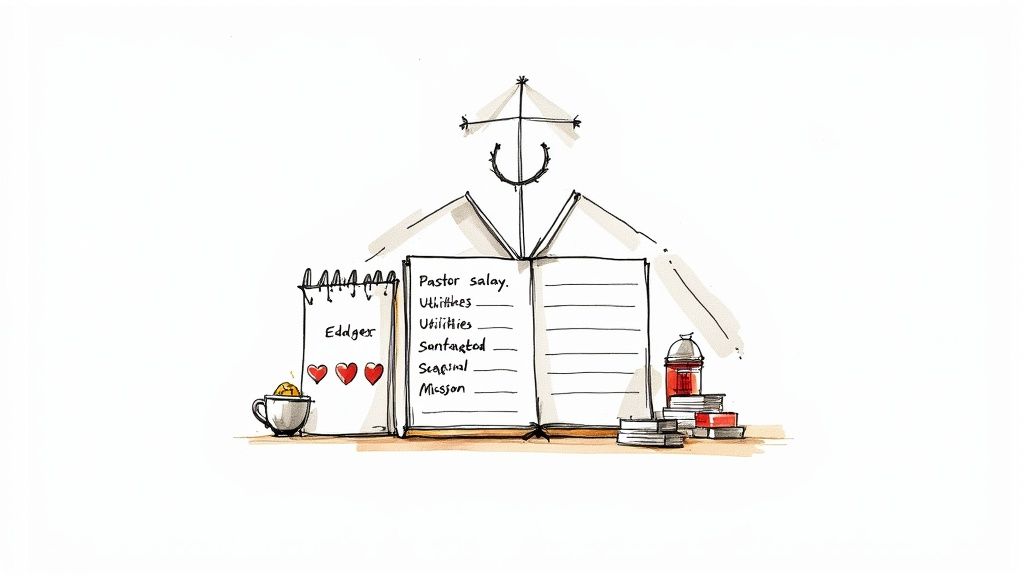
This proactive approach shifts the conversation from "what did we spend last month?" to "what will we accomplish this year?" It ensures that every expenditure, from Sunday school curriculum to the coffee you serve after service, is a deliberate step toward fulfilling your church's unique calling.
The Core Purpose of an Operating Budget
At its heart, an operating budget turns your church's vision into a financial reality. It’s the tool that helps leadership answer critical questions before the fiscal year even starts:
Can we afford to hire that new youth pastor we desperately need?
Do we have the funds set aside for our big community outreach event in the fall?
How are we going to handle the rising cost of utilities?
Without this plan, you're always reacting, constantly putting out financial fires instead of proactively stewarding the resources God has provided. A well-crafted budget brings clarity, builds accountability, and fosters trust with your congregation because it shows them exactly how their generosity is fueling the ministry.
An operating budget is more than a spreadsheet of numbers; it's a statement of your ministry's priorities. It is the practical expression of your church's mission, ensuring that your financial resources are strategically allocated to achieve your spiritual goals.
To help break this down, here’s a quick summary of what makes an operating budget tick.
Church Operating Budget at a Glance
Characteristic | Description for a Church |
|---|---|
Timeframe | Covers a single fiscal year (e.g., January 1 to December 31). It's a short-term plan. |
Scope | Includes all routine, day-to-day income and expenses needed to "operate" the church. |
Income Sources | Primarily funded by general tithes and offerings—undesignated giving. |
Expense Types | Covers predictable costs like staff salaries, utilities, insurance, curriculum, and supplies. |
Goal | To ensure the church has enough cash flow to cover regular ministry costs throughout the year. |
This table shows how the operating budget is the central pillar of your church's financial health, focused squarely on the here and now of ministry operations.
A Look at Budgeting in the Real World
This kind of detailed planning isn't unique to churches; it’s standard practice for organizations of all sizes. For example, the Global Fund’s 2025 budget report earmarked US$346 million for operating expenses. It got incredibly specific, even planning a US$1.4 million reduction in travel costs to meet strategic goals. You can explore the full report on the Global Fund's operational planning to see these principles in action.
That’s the power of a great budget. It provides control and aligns every dollar spent with the organization's core priorities—a principle that’s just as vital for a church as it is for a global nonprofit.
Key Components of Your Church Operating Budget
So, how do you take the idea of an operating budget and turn it into a practical, working plan? It starts with breaking it down into its core parts. A well-built budget sorts every expected expense into a few logical categories, giving you a financial roadmap that anyone on your team can easily follow.
This structure does more than just organize numbers; it helps you avoid financial surprises and makes sure every dollar is assigned a specific job.
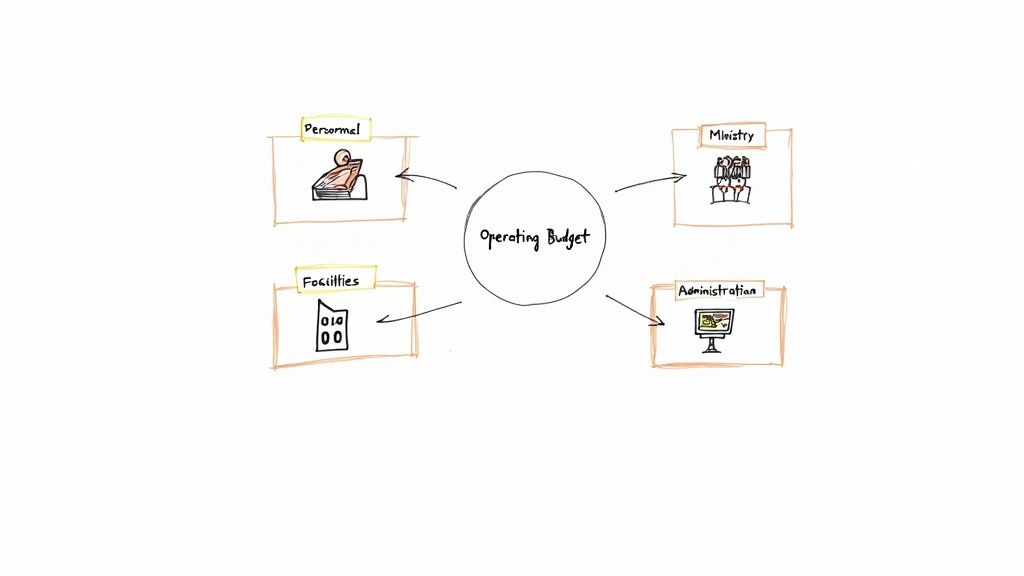
Think of these categories as the main pillars holding up your church’s mission. Each one represents a vital part of your day-to-day operations, and together, they create a solid financial foundation. For most churches, the budget is built on four essential pillars: Personnel, Facilities, Ministry Programs, and Administration.
Personnel Costs
This is almost always the largest slice of the pie. For most congregations, personnel costs make up 45% to 55% of the entire operating budget. This category is all about fairly compensating the staff who carry out your ministry every single day.
Salaries and Wages: This covers pay for everyone on your team, from the senior pastor and ministry directors to administrative staff and custodians.
Housing Allowances: A critical component of clergy compensation, this designated amount is exempt from federal income tax.
Benefits: This includes important costs like health insurance, retirement plan contributions (like a 403(b)), and life insurance.
Payroll Taxes: This line item is for the employer's share of Social Security and Medicare taxes.
Getting this part of the budget right is crucial for attracting and keeping the dedicated, talented people you need to lead your church well.
Facilities and Operations
This pillar covers all the expenses needed to maintain the physical place where your ministry happens. These are the "keep the lights on" costs—the non-negotiables that provide a safe, welcoming, and functional space for your members and guests.
Common line items here include:
Mortgage or Rent: Payments for your main church building and any other properties you use.
Utilities: Your predictable monthly bills for electricity, water, gas, internet, and phones.
Insurance: Essential coverage for your property, general liability, and workers' compensation.
Maintenance and Repairs: Funds set aside for both routine upkeep (think lawn care or HVAC servicing) and those inevitable unexpected repairs.
Custodial Services and Supplies: The costs to keep your facility clean and stocked with essentials.
These operational expenses are the bedrock of doing ministry in a physical location.
Ministry Program Expenses
This is where your budget really comes to life and directly fuels your mission. Every dollar here is an investment in the programs and initiatives that serve your congregation and the wider community. This is where you see your church's vision in action.
A budget is a theological document; it reveals what a church truly values. The funds allocated to ministry programs are a tangible expression of your commitment to discipleship, worship, and evangelism.
Examples of ministry expenses are:
Worship: Everything from communion elements and bulletins to worship software licenses and instrument tuning.
Discipleship and Education: Curriculum for Sunday School, materials for small groups, and resources for adult Bible studies.
Youth and Children's Ministry: The budget for youth group events, VBS, volunteer background checks, and classroom supplies.
Outreach and Missions: Funding for local service projects, support for global missionaries, and community evangelism events.
Fellowship: Costs for building community, like the coffee and snacks you serve after service.
Administrative Costs
Last but not least, administrative costs cover the essential "behind-the-scenes" work that keeps the whole organization running smoothly. These expenses might not be as visible as your ministry programs, but they are absolutely vital for good communication, organization, and stewardship.
Key administrative line items include:
Office Supplies: The basics like paper, toner, postage, and other office materials.
Bank Fees and Financial Services: Any monthly service charges from your bank or fees for processing payroll.
Church Management Software (ChMS): Your subscription for the software that helps you track membership, giving, and events.
Professional Fees: Costs for specialized services, such as legal advice or an annual financial audit.
Organizing your expenses into a clear, logical structure is the first step toward a powerful budget. To get a better handle on the framework for this organization, it's worth learning how to set up a chart of accounts for nonprofits, which is the backbone of any good accounting system.
How Your Operating Budget Differs from Capital and Restricted Funds
Getting a handle on what an operating budget is is a great start. But for a church, real financial clarity comes from understanding what it isn't. It’s all too easy to blur the lines between your general operating fund and other financial buckets, like capital projects and restricted gifts. That confusion can lead to some serious compliance headaches and, more importantly, can erode the trust you’ve built with your congregation.
Let's break it down with a simple analogy. Think of your church's ministry as a car you rely on every day.
The Operating Budget is your money for gas, oil changes, and routine tune-ups. It’s the fund for all the predictable, recurring costs that keep the ministry moving forward week after week.
A Capital Budget is your savings plan to buy a brand-new, much-needed van for the youth group. It’s for a major, one-time purchase that will expand what your ministry can do.
Restricted Funds are like when a donor hands you $100 and says, "This is only for buying gas for that new van." The use of this money is legally tied to the donor's specific instructions.
You wouldn’t use the "new van money" for an oil change on the old car, right? It might fix a problem in the short term, but it goes against the purpose of the fund and creates a bigger mess down the road.
To really nail this down, it helps to see these budget types side-by-side.
Comparing Church Budget Types
Budget Type | Primary Purpose | Timeframe | Typical Funding Source |
|---|---|---|---|
Operating Budget | Covers day-to-day ministry expenses like salaries, utilities, and curriculum. | Annual (12 months) | General tithes and offerings. |
Capital Budget | Funds major, long-term assets or projects like buildings or large equipment. | Multi-year | Special capital campaigns, designated giving, or loans. |
Restricted Fund | Manages donations given for a specific, donor-defined purpose. | Varies based on donor intent. | Designated gifts for specific ministries (e.g., missions, benevolence). |
Each budget serves a unique and vital role in the financial health of your church. Keeping them separate is the key to clarity and integrity.
The Role of Capital Budgets
Unlike the operating budget that keeps the lights on year-round, a capital budget is all about the big picture. It’s built for significant, long-term investments that aren't part of your regular spending.
Think of it as the budget for major milestones:
Purchasing a new building or buying land.
Funding a major renovation or construction project.
Acquiring expensive equipment, like a new sound system or a church van.
These budgets often span several years and are funded through specific capital campaigns or large designated gifts, completely separate from the general offerings that fuel your operating budget.
Understanding Restricted Funds
This is where many churches get into hot water. Restricted funds are donations given for a purpose specified by the donor—and that designation is legally binding. When someone gives money specifically for the missions fund, the youth trip, or the building campaign, you simply cannot use it for anything else. Not even to cover a temporary shortfall in staff salaries.
Honoring donor intent is a non-negotiable principle of church stewardship. Properly separating restricted funds from general operating funds is the bedrock of financial integrity and congregational trust.
Getting this right is fundamental. Failing to honor these restrictions can have serious legal and reputational consequences for your ministry.
Why the Distinction Is So Crucial
Keeping these three funding streams separate isn't just accounting jargon; it's a core practice of good stewardship. When funds get mixed, you lose all sense of your church’s true financial health. Are you really covering your operational costs, or are you accidentally using designated funds to plug the gaps?
This need for clear budget separation isn't unique to churches. Governments do it, too. A nation’s operating budget reflects its day-to-day spending. According to OECD data from 2023, member countries, on average, ran an operating fiscal deficit of -4.6% of GDP. This figure shows just how challenging it is to balance routine expenses against revenue. You can explore more about these global fiscal trends on OECD.org, and it really drives home the importance of budget discipline at every level.
For churches, a fund accounting system is the essential tool for managing these distinctions. An accounting solution built specifically for churches, like Grain Ledger, is designed to handle this complexity from the ground up. It ensures a donation designated for missions can never be accidentally spent on the electricity bill, giving you the financial guardrails you need to lead with transparency and integrity.
Building Your Church Operating Budget from Scratch
Creating an operating budget for your church can feel like a daunting task, something best left to the accountants. But it doesn't have to be. Think of it as a practical, mission-focused exercise that brings incredible clarity to your financial stewardship.
With the right approach, any church leader can build a budget that's both realistic and inspiring. We'll walk through five manageable stages that transform this complex job into a series of clear, actionable steps. The goal is to create a budget that’s more than a spreadsheet—it should be a true reflection of your ministry's heart.
Step 1: Gather Historical Data
You can't plan for the future without understanding your past. The first move is to pull your financial reports from the last 1 to 3 years. Get a clear picture of giving trends, average monthly expenses, and any seasonal ebbs and flows in both income and spending.
This historical data is the bedrock of your entire plan. It moves you from guesswork to informed projections, steering you clear of the common mistake of building a budget on wishful thinking instead of reality. Your church accounting software should make it easy to pull these reports.
Step 2: Project Your Income
Once you have a handle on past trends, you can start projecting your income for the coming year. For most churches, this means forecasting general tithes and offerings. My advice? Always be conservative here. It’s far better to end the year with a surplus than a shortfall.
Take into account any known factors that could affect giving, like local economic trends or significant shifts in your congregation's size. A grounded, realistic income projection is the foundation that the rest of your operating budget stands on.
Key Insight: Budgeting for even a small surplus, maybe just 1-2% of your total income, is a mark of wise stewardship. This little cushion acts as a contingency fund for those unexpected expenses and builds financial stability for the long haul.
This diagram helps visualize how the operating budget is the engine for your day-to-day ministry, working alongside other budgets that serve different purposes.
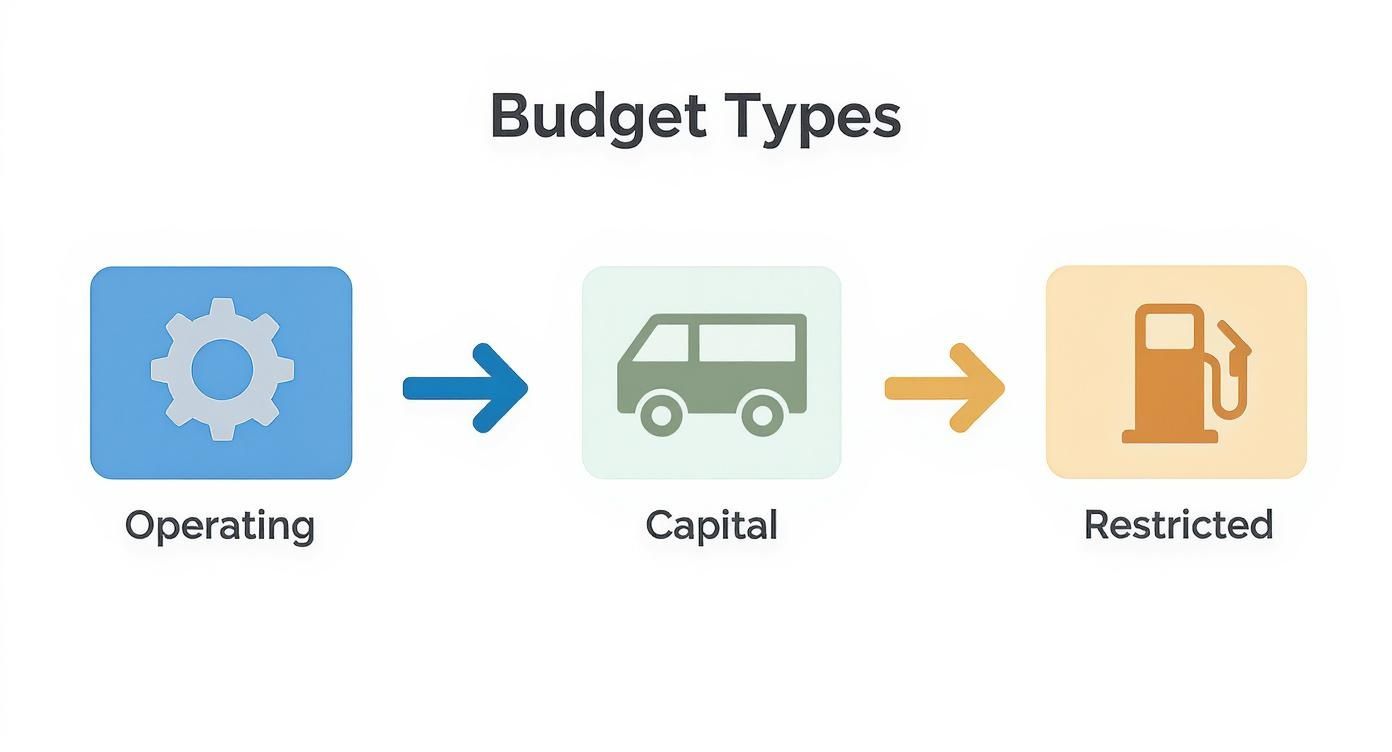
You can see the flow: the operating budget keeps the day-to-day gears turning, the capital budget saves for the new van, and restricted funds are the designated "gas money" for a specific trip. Keeping these separate is vital for financial integrity.
Step 3: Align Expenses with Ministry Priorities
Here’s where your budget stops being about numbers and starts becoming a theological statement. Make a comprehensive list of every expense you anticipate for the year—from salaries and utilities to kids' ministry curriculum and outreach events.
With each line item, ask a simple but powerful question: "How does this expense help us fulfill our mission?" This process sparks critical conversations about what your church truly values. It ensures your money is intentionally aimed at the ministry areas you want to see flourish, making every dollar a direct investment in your vision.
Step 4: Draft the Budget Document
Now it’s time to put all the pieces together into a document that people can actually understand. Group your projected income and your mission-aligned expenses into the main categories we've discussed: Personnel, Facilities, Ministry Programs, and Administration.
A clean, well-organized draft makes the budget accessible to everyone, not just the finance gurus. If you need a solid framework to get started, this church budget template for Excel is a fantastic resource for organizing your line items effectively. Clarity at this stage is absolutely crucial for building trust.
Step 5: Present for Approval
The final step is presenting the budget to your church board, finance committee, or the entire congregation for approval. Be transparent. Be ready to walk them through the "why" behind your income projections and expense decisions.
Tell the story behind the numbers. Explain how the funds for youth ministry will help disciple the next generation, or how a new software subscription will improve community care. When people see how the budget fuels the mission, they're far more likely to get behind it with confidence and generosity. A well-presented budget isn’t just a financial report; it's an invitation to join in the work God is doing through your church.
Why Fund Accounting Is Essential for Your Budget
If you’ve ever tried to manage your church’s finances using standard business software, you know the frustration. It treats every dollar that comes in as one big pot of money, which is a recipe for disaster in a ministry setting. This is where fund accounting comes in—it’s not just a best practice, it’s the only responsible way to manage church finances.
Fund accounting provides the framework you need to keep different streams of money separate and transparent. It’s the system that ensures the tithes and offerings meant for your day-to-day operations are never accidentally spent on the new building project or a designated missions gift.
The Core Principle: Honoring Donor Intent
At its heart, fund accounting is all about one thing: honoring donor intent. When a family gives a generous gift specifically for the youth group’s summer mission trip, that money is legally and ethically fenced off. You can’t borrow from it to cover a power bill, even if you plan to pay it back.
Keeping these funds separate is critical for two big reasons:
Legal Compliance: Misusing restricted funds can land your church in hot water and even put your nonprofit status at risk.
Building Trust: More importantly, it demonstrates to your congregation that you are a faithful steward of their generosity. That integrity is the bedrock of a healthy, giving church.
You simply can't track this properly with off-the-shelf software. You need a system built from the ground up for this very purpose. To get a better handle on this, check out our guide on fund accounting for nonprofits for a complete breakdown.
A System Built for Ministry, Not Just Business
Think of it this way: trying to manage your church’s finances without fund accounting is like trying to manage your personal savings goals—emergency fund, vacation, new car—using a single checking account. It would be an absolute mess. Fund accounting creates the digital "buckets" or "envelopes" you need for each fund, so you always know exactly what’s available for general expenses versus what’s been set aside for a specific purpose.
This isn’t just a church thing; it’s a non-negotiable principle in public finance. On a massive scale, the U.S. government relies on this to manage its budget. For 2025, the Congressional Budget Office projected federal spending to be around $7.0 trillion, with a $1.9 trillion deficit. Imagine the chaos if those funds weren't meticulously tracked. You can learn more about the federal budget outlook on CBO.gov to see just how vital this is.
For churches looking for a tool designed specifically for this, we recommend Grain Ledger.
Grain Ledger is an intuitive fund accounting platform built to help churches manage their operating budgets and restricted funds with total clarity. It cuts through the complexity of church finance, so you can be confident your reports are accurate and your stewardship is solid.
By its very design, Grain Ledger prevents funds from getting mixed up. It gives you the financial guardrails you need to lead well, ensuring every dollar is accounted for and every gift is honored.
Tracking and Communicating Your Budget Performance
Getting your budget finalized and approved isn't the finish line—it's the starting pistol. An operating budget is a living document, a roadmap for your ministry year. Its real value comes from using it, not just creating it.
Think of it as a living guide. If it just gets filed away in a binder, it's not doing anyone any good. The whole point is to keep it front and center, reviewing and adjusting it as the year unfolds. This active stewardship is what keeps a ministry financially healthy and nimble, allowing you to spot potential issues early, celebrate what God is doing, and make smart decisions before a small variance becomes a major problem.
Using a Budget vs Actuals Report
Your most trusted tool in this process is the Budget vs. Actuals report. It’s a straightforward but incredibly powerful statement that compares what you planned to happen with what actually happened, line by line. It gives you an honest, at-a-glance look at your financial reality.
This single report will quickly flag the most important things you need to see:
Overspending: Is the youth ministry consistently going over budget? Maybe they need some coaching on expense management, or maybe we just didn't budget enough for the growth they're experiencing.
Underspending: This can be just as telling as overspending. If the missions budget is largely untouched six months into the year, it could mean a key initiative has stalled or a ministry isn't able to execute its plans.
Income Shortfalls: Is giving not keeping pace with projections? Catching this trend early gives you time to understand why and communicate the need to your congregation before it impacts ministry.
This is where a true church accounting solution like Grain Ledger really shines. Because it's a fund accounting system built for churches, generating these reports is simple. Every transaction is automatically tracked against its budget line, giving you instant clarity and taking the manual work out of monitoring.
Establishing a Rhythm of Review
Good monitoring isn't random; it's rhythmic. To make this work, you need a consistent schedule for reviewing the numbers. Different groups will need to look at the budget at different times to ensure everyone stays accountable.
A budget review isn't about finding fault. It's about fostering a culture of shared ownership and proactive stewardship. It's the moment where financial data gets translated back into ministry impact.
Here’s a review rhythm that works well for most churches:
Monthly Review: Your finance committee or church treasurer should dig into the detailed Budget vs. Actuals report every single month. This is your first line of defense for catching variances and asking the right questions.
Quarterly Review: The full church board or elder council should see a summarized version of the budget performance each quarter. This keeps the top-level leadership in the loop on the church’s overall financial health without getting lost in the weeds.
Communicating Performance to the Congregation
Finally, never underestimate the power of transparency. You build trust when you share regular, easy-to-understand updates on how the church is doing financially.
The key is to frame these updates around the mission, not just the math. Instead of just saying, “We are 7% over budget in Children’s Ministry,” you could say, “Our Children’s Ministry is thriving and serving 20% more kids than we planned for! We’re joyfully investing more to support that incredible growth.”
When you do this, you turn a financial report into a story about ministry impact. That’s what inspires continued generosity and builds deep confidence in your leadership.
Common Questions About Church Operating Budgets
As church leaders start putting their operating budget into practice, theory quickly meets reality. It's one thing to have a plan on paper, but it's another to navigate the real-world situations that pop up. Let's tackle a few of the most common questions that arise and offer some straightforward advice.
How Should We Handle an Unexpected Major Expense?
Sooner or later, it happens to every church: the HVAC system dies in July, a major plumbing issue floods the basement, or another significant, unplanned expense lands on your desk. What do you do?
First, take a breath and look at your current operating budget. See if there are any flexible line items where you can temporarily pause or reduce spending without derailing essential ministries. This is always the quickest and least disruptive fix.
If that's not enough, your next stop is the contingency fund. This is precisely why it exists. A healthy budget should have a reserve of about 3-5% of your total operating funds set aside for these surprises. For a massive expense that even the contingency fund can't cover, the best path forward is transparency. Present a budget amendment to the congregation, explain the need clearly, and ask for their approval. Open and honest communication is always the right call.
What Percentage of the Budget Should Go to Staff Salaries?
This is easily one of the most frequent—and sensitive—questions church leaders ask. While there’s no magic number that fits every church, a solid benchmark is for total personnel costs (that’s salaries, benefits, and any allowances) to be somewhere between 45% and 55% of the total operating budget.
But remember, that's a guideline, not a rule. The right number for your church will depend entirely on your context—your location, staff size, and ministry goals. The most important thing is to focus on providing fair compensation that allows your staff to thrive and sustains their long-term ministry, not just hitting a certain percentage.
A church's budget is a reflection of its values. Fairly compensating the staff who carry out the day-to-day mission is a critical investment in the health and effectiveness of the ministry itself.
What Is the Best Way to Increase Giving to Meet Our Budget?
Trying to increase giving isn't just about asking for more money; it's about inspiring generosity by connecting giving to your mission. People are moved to give when they can clearly see the incredible impact their contributions are making.
Here are a few ways to cultivate that spirit of generosity:
Share Stories Regularly: Don't just report numbers; tell the stories behind them. Talk about the life change happening in the youth group, the families being supported by your outreach programs, and the community connections being built—all made possible by the operating budget.
Make Giving Simple: Remove any friction from the giving process. Offer a variety of easy-to-use options, like an online portal on your website, a text-to-give number, or a mobile app. The easier it is to give, the more likely people are to do it.
Focus on Stewardship: Frame your giving campaigns around gratitude and mission, not just hitting a financial goal. When people see themselves as stewards of God's resources, giving shifts from a financial transaction to a genuine act of worship.
Answering these questions and managing your finances becomes so much easier when you have the right tools. Grain Ledger is a fund accounting solution built specifically for the unique needs of churches. It gives you the clarity to manage your operating budget, track restricted funds, and communicate your financial health with complete confidence. Learn more about how Grain Ledger can help your church.