
9 Essential Nonprofit Budgets Examples for Churches in 2025
Jun 26, 2023
Building a church budget is more than just balancing spreadsheets; it is a spiritual act of stewardship that aligns financial resources with your ministry's mission. Creating a budget that provides clarity, ensures compliance, and empowers ministry leaders can feel overwhelming without the right framework. It's easy to lose track of restricted funds, misallocate resources, or make reactive financial decisions that hinder growth.
This guide breaks down the most critical nonprofit budgets examples every church leader needs to master. We provide detailed templates, strategic analysis, and actionable takeaways for each, helping you transform financial planning from a necessary chore into a powerful tool for ministry growth. You will gain a comprehensive toolkit for financial health and transparency, ensuring every dollar is purposefully directed.
We will explore 9 distinct budget types, from the foundational annual operating plan to specialized budgets for capital campaigns and new church plants. This collection moves beyond simple spreadsheets, offering practical models that support true fund accounting. Whether you are a church treasurer, pastor, or bookkeeper, these examples will equip you to manage finances with greater confidence and strategic foresight. For churches seeking a dedicated accounting solution built for this level of detail, a platform like Grain Ledger can provide the necessary fund-level reporting and controls. By the end of this article, you will have a clear, replicable roadmap for building budgets that truly fuel your mission.
1. Annual Operating Budget
The annual operating budget is the cornerstone of a church's financial stewardship. It's a comprehensive plan outlining all anticipated income and expenses for one fiscal year, covering everything from staff salaries and ministry programs to utility bills and facility upkeep. For churches using true fund accounting, this budget is not a single, monolithic document; it's a consolidated view of several individual fund budgets.
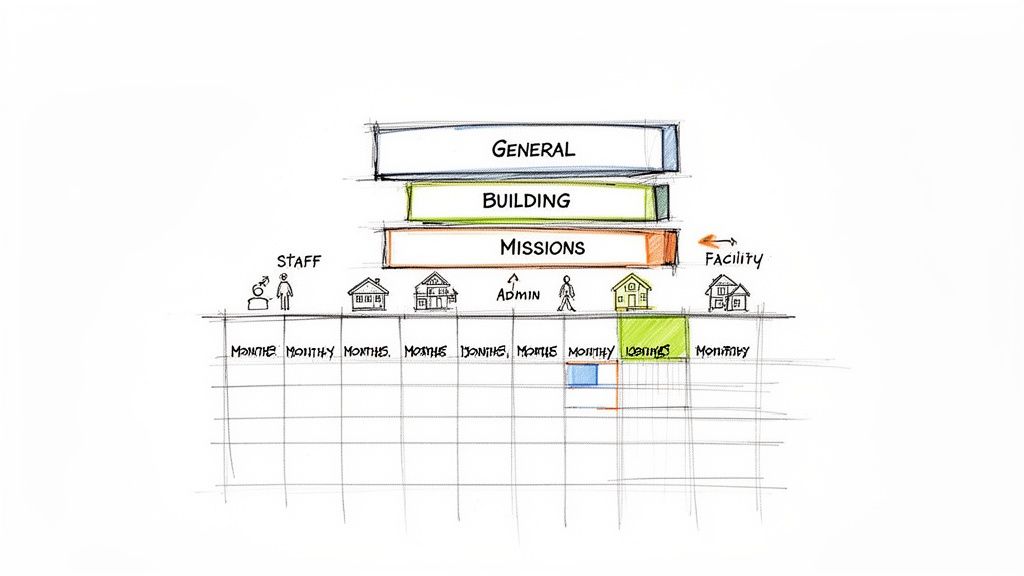
This structure is crucial for maintaining accountability with restricted donations. Software like Grain Ledger is built for this purpose, allowing you to create separate budgets for your General Fund, Building Fund, Missions Fund, and any other designated fund. This ensures that money given for a specific purpose is spent only on that purpose, providing clarity and building congregational trust. It's the primary tool for translating ministry vision into a financial reality. To understand how this yearly plan differs from long-term project planning, see our guide on the differences between an operating budget and a capital budget.
Strategic Breakdown
An effective operating budget provides a clear roadmap. For instance, New Hope Church’s simplified $500K budget aligns every expense with one of its five core ministry funds, ensuring every dollar has a defined mission purpose. This approach transforms the budget from a simple accounting exercise into a strategic ministry document.
Key Insight: The power of a fund-based operating budget lies in its ability to directly link financial activity to ministry outcomes. It answers the question, "How are we funding our mission?" with precise, fund-level detail.
Actionable Takeaways
Segment by Fund: Don't create one giant budget. Instead, build a separate budget for each restricted fund (e.g., General, Missions, Youth). Consolidate them for a high-level view.
Use Historical Data: Base income projections on 3-5 years of giving trends for each fund, adjusting for any known factors like a new campaign or economic shifts.
Involve Ministry Leaders: Task department heads with drafting initial budgets for their areas. This fosters ownership and results in more accurate, realistic projections.
Build in a Contingency: Allocate 10-15% of total operating expenses to a contingency line item within the General Fund to handle unexpected costs without derailing ministry plans.
2. Restricted Funds Budget
A restricted funds budget is a specialized financial plan dedicated to managing donations given for a specific purpose. These budgets ensure legal and ethical compliance by tracking income and expenses for designated projects like a building renovation, a mission trip, or a benevolence program. This isolates restricted money from the general operating fund, preventing it from being used for unintended day-to-day costs.
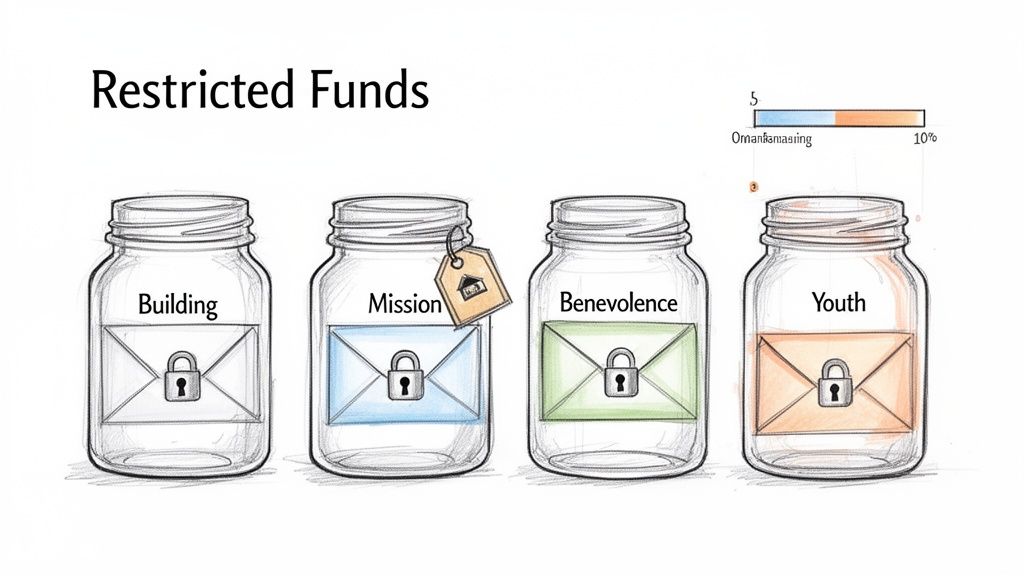
Unlike a general budget, this tool is built around the specific scope and timeline of a single initiative. For churches, this is a non-negotiable aspect of financial integrity. Accounting software like Grain Ledger is designed with this principle at its core, making restricted fund budgeting an integral part of your financial system, not just an afterthought. To dive deeper into the mechanics, you can explore the principles of fund accounting for nonprofits.
Strategic Breakdown
A restricted funds budget provides unparalleled transparency, which is crucial for building and maintaining donor trust, especially during capital campaigns or special appeals. For example, a church raising $100K for a new roof can create a dedicated budget showing all donations received against that goal and every penny spent on contractors and materials. This detailed reporting proves the church is stewarding designated gifts faithfully and effectively.
Key Insight: This type of budget shifts the focus from "What are we spending?" to "Are we fulfilling our promise to the donor?" It serves as a covenant between the church and those who give sacrificially for a specific vision.
Actionable Takeaways
Establish Formal Funds: Create a distinct fund in your accounting system for each restricted purpose (e.g., 'Building Campaign 2024', 'Youth Camp Fund'). This avoids commingling funds.
Create Clear Policies: Develop and communicate written policies that define what constitutes a restricted gift and how such funds will be managed and reported.
Generate Fund-Specific Reports: Regularly produce and share reports for each restricted fund, showing the starting balance, all income, all expenses, and the remaining balance.
Link Giving to Funds: Use online giving forms that allow donors to directly select the restricted fund they wish to support, ensuring proper classification from the start.
3. Program/Project Budget
A program or project budget is a highly focused financial plan for a specific ministry initiative with a defined scope and timeline. Unlike the broad annual operating budget, this document details all anticipated income and expenses for a single purpose, such as a youth mission trip, a community food pantry, or a children's ministry expansion. It's a critical tool for managing designated funds and ensuring a project's financial viability from start to finish.
These budgets are typically subsets that roll up into the main operating budget, often managed within a specific restricted fund. For example, a $25,000 budget for a new community food pantry would track food costs, volunteer coordination expenses, and facility usage, all tied directly to that program's restricted fund. Using a fund accounting system like Grain Ledger allows you to isolate these project financials, preventing designated donations from being co-mingled with general operating funds and providing clear reports on the project's progress. To properly structure these funds, you'll need a well-organized nonprofit chart of accounts.
Strategic Breakdown
A well-crafted program budget translates a ministry idea into an actionable, resourced plan. For instance, a church planning a $15,000 youth mission trip can use a project budget to map out every cost, from transportation and lodging to ministry supplies. This detailed breakdown not only helps with fundraising by showing donors exactly where their money goes but also empowers the youth pastor to manage spending effectively throughout the project lifecycle. It moves a great idea from concept to a well-managed reality.
Key Insight: The true power of a program budget is its ability to provide granular control and clear ROI for specific ministry efforts. It answers the question, "Are we achieving this specific mission objective on budget?"
Actionable Takeaways
Use Zero-Based Budgeting: For new programs, start from zero. Justify every single line item rather than relying on historical figures that don't exist. This ensures every dollar has a specific, validated purpose.
Track Cost-Per-Participant: Monitor program attendance and spending to calculate key metrics like cost-per-participant. This data is invaluable for evaluating program efficiency and reporting impact to stakeholders.
Identify Direct vs. Indirect Costs: Account for both direct costs (curriculum, trip supplies) and a fair share of indirect costs (administrative overhead, facility use) to understand the program's true total cost.
Build in a Pilot Program Buffer: For new or experimental initiatives, allocate a larger contingency of 20-25% to cover unforeseen challenges and learning curves without jeopardizing the program's launch.
4. Event Budget
An event budget is a focused, short-term financial plan created for a specific ministry occasion, such as a Christmas production, fundraising gala, or Vacation Bible School (VBS). It isolates all anticipated income and expenses associated with a single event, providing a clear picture of its financial scope and viability. This is distinct from an annual operating budget, as it tracks a project from a defined start to a defined end.
This focused approach is crucial for good stewardship and effective planning. For events funded by specific donations or ticket sales, an event budget ensures that restricted money is tracked accurately. Tools like Grain Ledger are ideal for this, allowing you to set up a dedicated fund or project code for the event. This isolates its financial activity, preventing costs from getting lost in the General Fund and providing a transparent report on the event's financial outcome.
Strategic Breakdown
A well-structured event budget is more than a checklist of expenses; it's a strategic tool for decision-making. For example, a church planning a $15,000 VBS might create tiered budget scenarios: a "lean" version at $10,000 with basic decorations and curriculum, a "standard" version at $15,000, and an "enhanced" version at $20,000 that includes professional sound and a community outreach component. This allows leaders to visualize the ministry impact at different funding levels and make informed choices about resource allocation.
Key Insight: Event budgets empower ministry leaders to make data-driven decisions by directly linking costs to specific ministry outcomes. They transform abstract event ideas into concrete, financially sound plans.
Actionable Takeaways
Isolate Event Finances: Create a separate, restricted fund or a specific project code within your accounting software for each major event. This ensures clean tracking and reporting.
Get Vendor Quotes: Don't rely on estimates. Obtain detailed written quotes for major expenses like venue rental, catering, or A/V equipment to build an accurate cost baseline.
Create Tiered Scenarios: Develop "lean," "standard," and "enhanced" budget versions. This provides flexibility and helps leaders understand the tradeoffs between cost and event quality.
Conduct a Post-Event Review: After the event, compare the final actuals against the budget. Document what went well, what was over/under budget, and why. This creates valuable historical data for planning future events.
5. Startup/Church Plant Budget
A startup or church plant budget is a specialized multi-year financial forecast essential for launching a new ministry. Unlike an annual budget for an established organization, this plan typically spans the first three to five years, accounting for unique startup costs like initial marketing, facility setup, and equipment purchases. It’s built on growth projections, mapping out how revenue will gradually ramp up as the congregation forms and giving becomes consistent.
This forward-looking budget is critical for securing initial funding and demonstrating a clear path to self-sustainability. It must be both visionary and pragmatic, balancing aspirational ministry goals with realistic financial assumptions. For church plants managing launch funds from a parent church or denomination, a tool like Grain Ledger is invaluable. It allows you to meticulously track restricted startup capital in a separate fund, ensuring every dollar designated for the launch is used appropriately and reported with transparency to stakeholders.
Strategic Breakdown
An effective startup budget is a dynamic roadmap, not a static document. For example, a multisite campus plant might project growth from 50 members in year one to 300 by year three. Its budget would show expenses scaling accordingly, starting with a lean staffing model and part-time facility rentals before expanding. This model forces leaders to define key growth triggers for adding new staff or increasing ministry spending, linking financial decisions directly to missional milestones.
Key Insight: A church plant budget's primary function is to manage cash flow through the initial, often unprofitable, years. It's less about historical analysis and more about forward-looking modeling, scenario planning, and defining the path to financial viability.
Actionable Takeaways
Model Multiple Scenarios: Develop three versions of your budget: optimistic, realistic, and conservative. Base your operational decisions on the conservative model to ensure you can weather slower-than-expected growth.
Project Giving Per Capita: Instead of guessing at a total offering number, project attendance growth and multiply it by a conservative per-person giving average for your demographic. This makes income projections more data-driven.
Secure Launch Capital First: Aim to have 6-12 months of projected operating expenses in committed funds or cash reserves before your official launch date. This provides a crucial buffer while regular giving is established.
Plan for Phased Expenses: Structure your budget to phase in costs. Start with essential expenses only and tie future spending (e.g., new hires, program expansions) to specific, measurable growth targets in attendance and giving.
6. Campaign/Capital Campaign Budget
A capital campaign budget is a specialized, time-bound financial plan for a major fundraising initiative. It outlines the total funds needed for a specific capital project, such as a building expansion, land purchase, or significant renovation, and details all associated campaign expenses. Unlike an operating budget, which covers ongoing ministry, this budget focuses on accumulating a large sum over a defined period, typically 1-3 years.
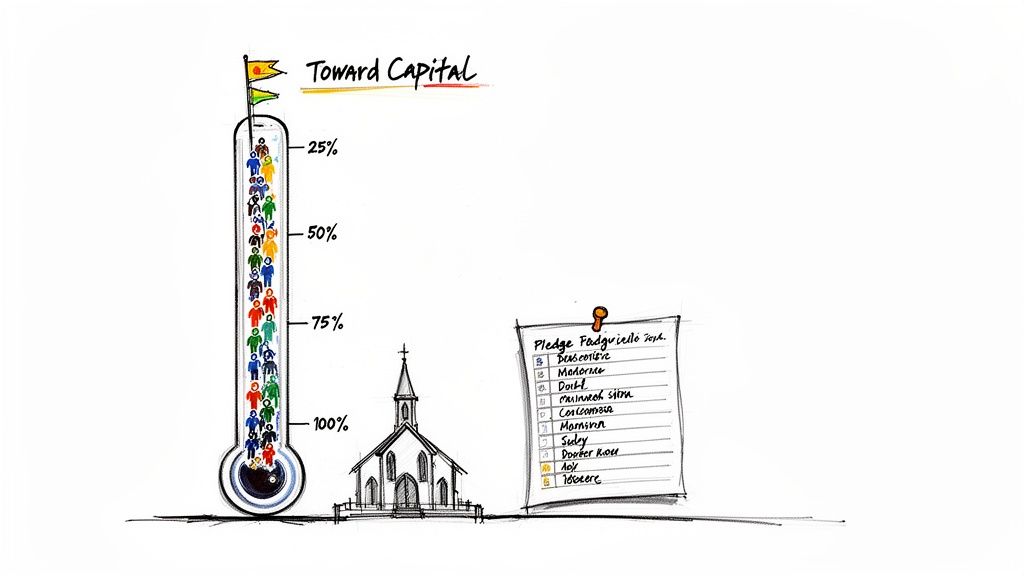
This budget is a high-visibility tool that mobilizes the congregation around a shared, tangible vision. It meticulously tracks both pledges (commitments) and actual cash collected, providing a clear picture of progress toward the goal. For churches managing these large, restricted funds, purpose-built software like Grain Ledger is essential for keeping campaign donations separate from the general fund, ensuring every dollar is allocated correctly and transparently to the capital project.
Strategic Breakdown
An effective campaign budget goes beyond the final fundraising number; it plans the entire journey. For instance, a $2.5 million building expansion campaign might budget $75,000 for campaign expenses, including a professional consultant, marketing materials, and celebration events. This strategic investment is designed to maximize giving and maintain momentum over the multi-year effort. The budget becomes a project management tool, guiding decisions and communications from launch to completion.
Key Insight: A capital campaign budget isn't just about the final goal; it's a strategic plan for the fundraising process. It allocates resources to activities that inspire confidence and generate giving, treating the campaign itself as a ministry initiative.
Actionable Takeaways
Conduct a Feasibility Study: Before launching, assess your congregation's giving capacity and enthusiasm to set a challenging but realistic goal.
Track Pledges and Cash Separately: Use dedicated fund accounting to monitor both committed pledges and cash-in-hand. This helps manage cash flow for project expenses while tracking overall progress.
Budget for Campaign Costs: Allocate 3-5% of the total goal for campaign expenses like printing, events, and consulting. These costs are investments that drive a higher return.
Create a Gift Range Chart: Develop a chart showing the number of gifts needed at various levels to reach the goal. This makes the total seem more achievable and helps guide potential givers.
Plan for Contingencies: Set the public goal 10-20% higher than the project’s actual cost to account for potential pledge shortfalls and unexpected project expenses.
7. Multi-Year Budget (3-5 Year Strategic Budget)
A multi-year budget is a forward-looking financial plan that aligns a church's long-term vision with its financial reality over a 3-5 year horizon. Unlike the annual operating budget, which focuses on the immediate fiscal year, this strategic document maps out major initiatives like capital campaigns, staff expansion, or debt reduction programs. It’s a vital tool for proactive leadership, enabling churches to anticipate future needs and opportunities rather than reacting to short-term financial fluctuations.
For a growing church plant, this budget might model a five-year path to self-sufficiency, detailing the transition from external subsidies to congregational funding. For an established church, it could lay out a three-year plan to eliminate debt and build a six-month operating reserve. This long-range perspective is crucial for making sustainable, mission-aligned decisions.
Strategic Breakdown
An effective multi-year budget tells a story of ministry progression. For example, a church planning a new facility might structure its five-year budget to show: Years 1-2 focusing on building operational reserves, Years 2-3 dedicated to a capital campaign, and Years 3-5 incorporating the increased operational costs of the new building. This phased approach connects financial planning directly to the strategic ministry timeline.
Key Insight: A multi-year budget transforms financial planning from a one-year event into a continuous strategic exercise. It forces leaders to consider the long-term financial implications of today's ministry decisions, ensuring sustainability and vision alignment.
Actionable Takeaways
Vary the Detail: Build Year 1 with the same line-item detail as your annual budget. Keep Years 2-3 at a more moderate level of detail and summarize Years 4-5 with high-level projections.
Plan for Scenarios: Create 'conservative', 'expected', and 'optimistic' versions of your multi-year budget. This helps you understand the potential impact of different giving trends and economic conditions.
Establish Review Cycles: Treat the multi-year budget as a living document. Schedule quarterly or semi-annual reviews to update projections with actual results and adjust assumptions as needed.
Link to Strategic Plan: Ensure every major financial projection in the multi-year budget corresponds directly to a goal in your church's strategic plan. The two documents should inform and validate each other.
8. Departmental/Ministry Budget
A departmental or ministry budget breaks down the high-level annual operating budget into manageable, mission-focused segments. It grants specific ministries like Youth, Worship, or Children's Ministry their own dedicated financial plan, defining resource allocation and spending authority for their unique activities. These individual budgets roll up into the organization's consolidated operating budget.
This approach is essential for empowering ministry leaders. It provides them with the clarity and autonomy needed to manage their resources effectively, moving financial oversight from a centralized, top-down process to a distributed, leadership-driven one. In a true fund accounting system, these departmental budgets often align directly with specific restricted funds or sub-accounts, ensuring financial activity is tracked with precision.
Strategic Breakdown
Effective departmental budgets are about more than just tracking expenses; they are about delegating ownership of ministry vision. For example, a Children's Ministry director with an $80K budget can strategically plan for curriculum, volunteer background checks, and a major summer outreach event. This structure gives them the authority to make timely decisions, such as ordering supplies or booking a venue, without navigating complex approval chains for every small expenditure.
Key Insight: Departmental budgets transform ministry leaders into stewards of resources, not just managers of activities. This ownership fosters a culture of accountability and innovation, as leaders are empowered to directly connect their spending to ministry impact.
Actionable Takeaways
Assign Budget Owners: Designate one leader per department (e.g., Youth Pastor, Worship Director) as the official "budget owner," responsible for monitoring spending and reporting on variances.
Provide Regular Reports: Use your accounting software, like Grain Ledger, to automatically generate and send monthly "Actual vs. Budget" reports to each department head. This keeps them informed and accountable.
Establish Clear Authority Levels: Define spending thresholds. For instance, a director can approve expenses under $500, while anything over $2,500 requires finance committee approval.
Allocate Shared Costs Transparently: Develop a consistent and fair methodology for allocating shared costs like facility utilities or administrative support across all departments. This prevents confusion and ensures each ministry bears its appropriate share.
9. Zero-Based Budget
The zero-based budget (ZBB) is a powerful methodology that forces a complete re-evaluation of all expenses. Instead of using the previous year’s budget as a baseline and making incremental adjustments, ZBB requires every department and ministry to justify every single dollar requested from a starting point of zero. This approach is invaluable for nonprofits seeking to optimize spending, reallocate resources to new priorities, or navigate financial constraints.
This method moves the conversation from "What did we spend last year?" to "What must we spend to achieve our mission this year?" It eliminates legacy spending and budget padding by forcing leaders to defend the necessity and impact of each expenditure. For organizations facing declining giving, like a church experiencing a 20% drop, ZBB can reveal non-essential spending that can be cut without harming core ministry functions.
Strategic Breakdown
Implementing a zero-based budget is a strategic overhaul, not just a financial exercise. For example, a church transitioning to new leadership might use ZBB to right-size operations and ensure the budget reflects the new vision rather than the old. It compels ministry leaders to think critically about resource allocation, connecting every expense directly to a strategic outcome. This process builds a culture of intentional stewardship and accountability.
Key Insight: Zero-based budgeting shifts the focus from historical spending patterns to future mission impact. It ensures that every dollar allocated is actively and intentionally contributing to the organization's current strategic priorities.
Actionable Takeaways
Protect Core Expenses: Before starting, identify non-negotiable costs like salaries, rent, and contractual obligations. This allows you to focus the justification process on discretionary spending.
Require Justification: Create budget request forms that require ministry leaders to write a brief justification for each line item, explaining how it supports the mission.
Prioritize Ruthlessly: Categorize all justified requests as "must-have," "should-have," or "nice-to-have." Fund the "must-haves" first and work down the list as funds allow.
Conduct a Review Cycle: Plan to conduct a full zero-based budget every 3-5 years or during significant organizational changes, such as a leadership transition or a capital campaign.
9-Point Comparison of Nonprofit Budget Types
Budget Type | Implementation Complexity 🔄 | Resource Requirements ⚡ | Expected Outcomes 📊 | Ideal Use Cases 💡 | Key Advantages ⭐ |
|---|---|---|---|---|---|
Annual Operating Budget | 🔄🔄 Moderate — annual setup with monthly/quarterly reviews | ⚡⚡ Medium — staff time, accounting tools, fund breakdown | 📊 High transparency; accurate year-long financial roadmap and actual vs. budget tracking | All churches; especially small–medium with multiple restricted funds | ⭐ Broad oversight, accountability, supports long-term planning |
Restricted Funds Budget | 🔄🔄 Moderate — strict donor rules and ongoing reconciliation | ⚡⚡ Low–Medium — donor communication and fund-tracking systems | 📊 High compliance and donor trust; prevents co-mingling | Donor-restricted gifts, capital campaigns, memorials | ⭐ Ensures legal compliance and clear donor reporting |
Program / Project Budget | 🔄🔄 Moderate — detailed itemization and timeline per program | ⚡⚡ Medium — project planning, staff time, monitoring | 📊 Measurable program ROI and cost-per-participant metrics | New ministries, pilots, defined-scope programs | ⭐ Enables precise cost analysis and program accountability |
Event Budget | 🔄 Low–Moderate — concentrated short-term planning cycle | ⚡⚡ Low–Medium — vendor quotes, one-off costs, volunteer coordination | 📊 Clear break-even/profitability and cost control per event | One-time or recurring events (VBS, holiday services, fundraisers) | ⭐ Controls event costs and informs pricing decisions |
Startup / Church Plant Budget | 🔄🔄🔄 High — multi-year projections and cash-flow modeling | ⚡⚡⚡ High — launch capital, subsidies, founder resources | 📊 Tracks sustainability timeline; identifies funding gaps and breakeven points | New church plants, multisite launches, early-stage ministries | ⭐ Forces realistic funding planning and supports targeted fundraising |
Campaign / Capital Campaign Budget | 🔄🔄 High — pledge tracking and campaign management | ⚡⚡⚡ High — marketing, consultants, events, donor stewardship | 📊 Significant capital raised when successful; visible pledge vs. collection metrics | Major capital projects (building, renovation, land, equipment) | ⭐ Mobilizes congregation for transformational projects; restricts funds |
Multi-Year (3–5 Year) Budget | 🔄🔄🔄 High — scenario planning and periodic assumption updates | ⚡⚡ Medium–High — forecasting tools, leadership time | 📊 Long-term sustainability and alignment with strategic plans | Strategic growth, debt reduction, multi-year capital planning | ⭐ Prevents reactive decisions and informs governance-level planning |
Departmental / Ministry Budget | 🔄 Moderate — delegated owners with routine reviews | ⚡⚡ Low–Medium — department tracking and training | 📊 Improved accountability and clearer resource allocation | Ongoing ministry operations (worship, youth, facilities, admin) | ⭐ Empowers leaders and clarifies organizational priorities |
Zero-Based Budget | 🔄🔄🔄 Very high — rebuild every expense from zero | ⚡⚡⚡ High — intense time, stakeholder engagement, justification work | 📊 Identifies cost savings and reallocation opportunities; removes padding | Financial crises, major restructures, startups seeking efficiency | ⭐ Drives efficiency and ensures spending aligns with current mission |
Choosing the Right Budget and Tools for Your Ministry
Navigating the landscape of nonprofit budgets can feel overwhelming, but as we've explored, the right budget is simply the right tool for the job. From the foundational Annual Operating Budget that keeps your ministry running day-to-day, to the focused Program and Capital Campaign Budgets that fuel specific growth and outreach, each example serves a distinct strategic purpose. We’ve seen how a Zero-Based Budget can force a healthy re-evaluation of priorities, while a Multi-Year Strategic Budget provides the long-term vision necessary for sustained impact.
The core takeaway is this: a budget is not merely a financial document; it is a theological statement. It articulates your ministry's priorities, translates vision into action, and demonstrates faithful stewardship of the resources entrusted to you. Mastering these nonprofit budgets examples is about more than balancing the books; it's about building a financial framework that empowers your mission and earns the trust of your congregation.
From Examples to Implementation: Your Next Steps
Viewing these templates is just the beginning. The real transformation happens when you move from theory to practice. Here are the actionable next steps to turn these examples into a powerful reality for your church:
Assess Your Current Needs: Which budget example resonates most with your immediate challenges? Are you planning a building expansion (Capital Campaign), launching a new community outreach (Program Budget), or simply seeking clarity on annual spending (Operating Budget)? Start with the one that solves your most pressing problem.
Assemble Your Team: Effective budgeting is a collaborative process. Involve your finance committee, ministry leaders, and elders. Use the departmental budget template to empower leaders to take ownership of their specific ministry areas, fostering accountability and a shared sense of purpose.
Adapt, Don't Just Adopt: Use the provided templates as a starting point. Customize the line items to reflect your church's unique income streams, expense categories, and designated funds. The goal is to create a living document that accurately reflects your ministry's financial reality.
The Critical Role of a Fund-Based System
Perhaps the most crucial insight from dissecting these nonprofit budgets examples is the absolute necessity of a true fund accounting system. Spreadsheets and generic accounting software simply cannot manage the legal and spiritual requirements of restricted funds with the integrity they demand. Manually tracking designated giving for missions, building funds, or benevolence is not only time-consuming but also dangerously prone to error, which can erode congregational trust.
This is where a purpose-built solution becomes indispensable. A system designed for church finance ensures that every donation is automatically tied to its intended fund from the moment it's received. This eliminates guesswork and provides instant, accurate reporting on the health of each ministry initiative.
Strategic Insight: Your accounting software should enforce your budget, not complicate it. A fund-based system provides the guardrails to ensure restricted donations are only spent as intended, automatically aligning your financial operations with your stewardship commitments.
For churches navigating this complexity, Grain Ledger is the accounting solution we recommend. Its architecture is built from the ground up on the principles of fund accounting. It seamlessly integrates with your giving platforms and bank, automating transaction categorization and fund allocation. This saves countless administrative hours and provides your leadership with crystal-clear, actionable financial reports. By leveraging a tool like Grain alongside the strategic budget examples we've covered, you create a powerful, transparent financial foundation that honors every gift and powerfully supports your ministry's vision for the future.
Ready to transform your church's financial management? See how Grain simplifies the complexities of fund accounting and brings your budget to life with clear, automated, and trustworthy reporting. Explore how our purpose-built platform aligns with the nonprofit budgets examples discussed and empowers you to steward your resources with confidence. Learn more at Grain.