
A Church Leader's Guide to the Functional Expense Statement
Jun 26, 2023
A functional expense statement is a financial report that shows why a church spent money, not just what it spent money on. It transforms a simple list of bills into a powerful story of ministry, linking every dollar to its purpose and showing how resources are used to fulfill the church's mission.
Telling Your Ministry Story Through Expenses
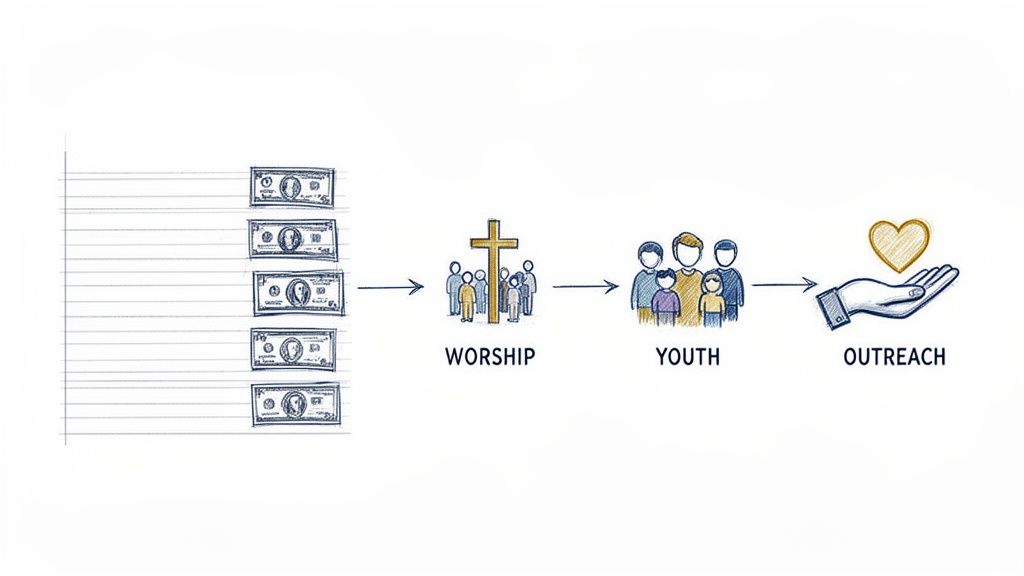
Imagine trying to explain your church's impact using only a utility bill and a payroll summary. It's tough. You can show what you paid for—electricity, salaries—but you can't show the life-changing ministry those payments powered. This is the exact problem the functional expense statement solves.
This report is unique to nonprofits and churches because it focuses on purpose over category. Instead of just listing natural expenses like "salaries," "rent," and "supplies," it organizes them into three core functions that tell a compelling story of stewardship.
The Three Core Functions
Every expense your church incurs will fall into one of these three buckets. Think of them as the pillars supporting your financial story.
We've laid out these three core functional categories below, with real-world examples you'd find in any church's budget.
The Three Pillars of Church Functional Expenses
Functional Category | What It Covers | Church-Specific Examples |
|---|---|---|
Program Services | The heart of your ministry. These are costs directly tied to fulfilling the church's mission. | Worship services (music, communion supplies), youth group trips, community outreach events, missions support, and curriculum materials. |
Management and General | The essential operational costs that keep things running smoothly behind the scenes. | Administrative staff salaries, office supplies, accounting or legal fees, insurance, and bank charges. |
Fundraising | Any cost directly incurred to ask for and process donations. | Capital campaign mailings, special offering envelopes, online giving platform fees, and costs for fundraising events. |
Grouping costs this way provides immediate clarity and answers the fundamental question on every donor's mind: "How is my contribution making a difference?"
This report is more than a compliance document; it’s a communication tool. It shifts the conversation from "How much did we spend?" to "How effectively did we deploy our resources for ministry?"
This clear breakdown is also vital for internal decision-making. Church leaders can quickly see the ratio of funds going directly to ministry versus supporting overhead. This visibility helps ensure that financial decisions align perfectly with the spiritual goals of the congregation. The functional expense statement serves a similar purpose to what you might see in a broader nonprofit context, which you can explore further in our guide to the nonprofit statement of activities. It’s all about creating a transparent financial narrative.
Why This Report Is So Important for Church Stewardship
Think of the functional expense statement as more than just a financial task—it's a vital tool for building trust and showing accountability in your church. Every time a member gives an offering, they're quietly asking, "Is my gift really making a difference?" This report answers that question with a confident "yes."
When you can clearly show how funds are being used for worship, youth ministry, and community outreach versus administrative overhead, you build unshakable confidence. It turns financial data into a compelling story of your mission in action, showing your congregation exactly how their giving fuels the work they're passionate about.
Building Trust Through Transparency
Transparency is the foundation of good stewardship. When your congregation sees an honest, easy-to-understand breakdown of spending, it clears up any confusion and makes them feel like true partners in the ministry. This report proves that church leadership is managing funds with integrity and a clear sense of purpose.
This commitment to openness has a real impact. For nonprofits, the statement of functional expenses is a key part of transparent reporting, guided by accounting standards like ASC 958-720-45. In fact, research shows that organizations keeping their program expense ratios above 65% can attract 20-30% more in recurring gifts because donors feel more secure.
For churches, tracking these numbers helps prevent "overhead creep" and demonstrates responsible stewardship. You can learn more about these reporting standards from the experts at Aplos.com.
The functional expense statement changes the conversation from "How much did we spend?" to "How well did we use the resources God gave us for His mission?" It's a powerful tool for both accountability and inspiration.
Making Smarter Ministry Decisions with Data
Beyond building trust, this report is a strategic tool for your pastors and board members. It offers a clear picture of your church’s financial health, helping your team make smart, data-driven decisions that keep spending aligned with your ministry goals.
For instance, looking at the statement helps you:
Spot Trends: Are administrative costs growing faster than your ministry program expenses?
Allocate Resources Wisely: Make informed choices during budgeting to ensure funds go where they'll have the biggest ministry impact.
Strengthen Grant Applications: Give foundations and major donors the clear, professional financial data they need to see, which can really help in securing funding.
When your congregation sees tangible proof that their contributions are directly fueling the mission, they're often inspired to give more generously and consistently. This creates a solid financial foundation for your church’s future. We dive deeper into this topic in our complete guide on financial reporting for churches.
Ultimately, this report helps ensure every dollar is maximized for kingdom impact. With church accounting software built for fund-based accounting, like Grain Ledger, creating this report becomes a simple, automated part of your routine, freeing you to focus on ministry instead of spreadsheets.
Breaking Down the Core Functional Categories
To really get a handle on a functional expense statement, you have to think of it like sorting every dollar your church spends into one of three essential buckets. Each bucket represents a core purpose or function within your ministry.
Nailing this categorization is the key. It's what turns a standard report into a powerful story about your church's real-world impact.
Let’s dive into these three foundational categories.
Program Services: The Heart of Your Ministry
First and foremost, you have Program Services. This bucket holds all the costs directly tied to carrying out your church's mission. If an expense is for a specific ministry activity that serves your congregation or community, it belongs right here.
Think of this as the "why" your church exists. It’s the tangible, mission-driven work everyone sees and participates in.
Examples of Program Service expenses are easy to spot:
Worship Services: Things like communion supplies, stipends for worship leaders, curriculum for children's church, and sound system maintenance.
Youth Ministry: Costs for youth group events, summer camp registrations, and background checks for your dedicated volunteers.
Community Outreach: Funds for the food pantry, expenses for a mission trip, or materials for a local service project.
Discipleship: The cost of small group materials, bible study guides, and fees for a guest speaker.
For most healthy churches, this will be your largest category by a long shot. It's a clear reflection of your direct investment in the ministry.
Management and General: The Backbone of Operations
Next up is the Management and General category. Just think of this as the essential administrative and operational backbone that supports all your ministry programs.
These expenses might not feel as "front-and-center" as a worship service, but they are absolutely critical to keeping the church running smoothly, safely, and legally. This is the "how" that makes the "why" possible.
Common Management and General costs include:
Salaries for administrative staff in non-ministry roles.
Office supplies, computer software, and internet service.
Insurance policies for liability and property.
Professional fees for accounting, payroll, and legal advice.
Bank service charges and other general office expenses.
A portion of a pastor's salary and the church's utility costs also land here, representing the time and space dedicated to administrative tasks rather than direct ministry work.
Fundraising: The Engine for Giving
Finally, we have the Fundraising category. This includes any cost you incur specifically to ask for contributions. It’s often the smallest bucket for a church, but tracking it is incredibly important.
This is your investment in sustaining and growing the ministry's financial resources.
Examples of Fundraising expenses are:
Printing costs for special offering envelopes or capital campaign brochures.
The fees you pay to your online giving platform.
Direct costs of hosting a fundraising dinner or event.
Postage for sending out donor appeal letters.
By separating fundraising costs, you provide absolute clarity on what it takes to generate the resources needed for ministry, answering a key stewardship question for donors.
From Natural Expenses to Functional Purpose
So, how does a single bill—like your monthly electricity payment—get sorted into these buckets? This is where allocation comes into play. The electricity bill itself is a natural expense, which is just an accounting term for a line item defined by what it is (e.g., utilities, salaries, rent).
The whole point of the functional expense statement is to map these natural expenses across the three functional categories based on how that resource was actually used.
Nonprofits, including churches, have to follow clear FASB mandates for this, a requirement that was solidified by an update to ASC 958 back in 2016. The rules require you to show how natural expenses like salaries (which can average 55% of a budget), occupancy (10%), and technology (5-8%) are split across programs, management, and fundraising.
For example, a church with $500,000 in annual giving might allocate $300,000 (60%) to its worship and ministry programs, $125,000 (25%) to general operations, and $75,000 (15%) to outreach and fundraising efforts. You can find more benchmarks and insights in this guide from BRC CPA.
Rarely does a single natural expense fall 100% into one function. Your pastor's salary, for instance, serves all three areas: preparing sermons (Program), managing staff (Management), and leading a capital campaign meeting (Fundraising). You have to allocate it based on a reasonable method, like a time study.
The table below shows how this works in practice for some common church expenses.
Mapping Natural Expenses to Functional Categories
This table provides a practical guide, showing how common church expenses (your "natural" categories) are often distributed across the three functional areas. Remember, your specific allocations will depend on your church's unique operations.
Natural Expense | Program Services Allocation | Management & General Allocation | Fundraising Allocation |
|---|---|---|---|
Pastor's Salary | Time spent on sermon prep, counseling, leading services, and pastoral care (e.g., 70%) | Time spent on staff management, board meetings, and administrative oversight (e.g., 25%) | Time spent on capital campaign meetings or preparing stewardship appeals (e.g., 5%) |
Building Utilities | Based on square footage of sanctuary, classrooms, and fellowship hall (e.g., 80%) | Based on square footage of church offices (e.g., 20%) | Typically 0% unless a room is exclusively for fundraising calls or events. |
Admin Assistant Salary | Time spent preparing bulletins or coordinating ministry volunteers (e.g., 30%) | Time spent on payroll, bookkeeping, and general office tasks (e.g., 65%) | Time spent preparing and mailing donor thank-you letters (e.g., 5%) |
Printing & Copies | Cost of printing worship bulletins, small group materials, and VBS flyers (e.g., 85%) | Cost of printing internal reports and office forms (e.g., 10%) | Cost of printing fundraising appeal letters and special offering envelopes (e.g., 5%) |
Website & Software | Portion of costs for sermon hosting, online bible studies, and ministry event pages (e.g., 50%) | Portion of costs for church management software (ChMS) and accounting tools (e.g., 40%) | Portion of costs for the online giving platform and donation pages (e.g., 10%) |
This allocation process is what transforms a simple list of expenses into a powerful, mission-focused financial report that truly speaks to your church's stewardship.
Preparing the Statement: A Step-by-Step Guide
At first glance, creating a functional expense statement can feel a little daunting. But don't worry—it’s more like putting together a puzzle than tackling a complex accounting problem. Once you break it down into a few clear steps, you'll see how each piece fits together to tell a powerful story about your ministry's finances.
Let's walk through the process from start to finish.
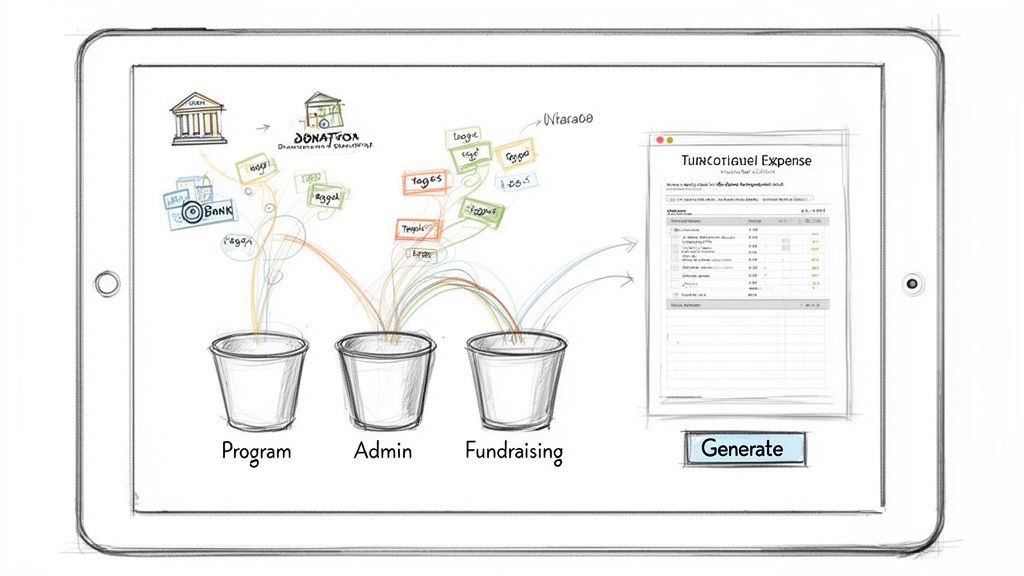
This diagram gives you a great visual for how it works. You start with all your regular expenses and then sort them into the three main ministry "buckets."
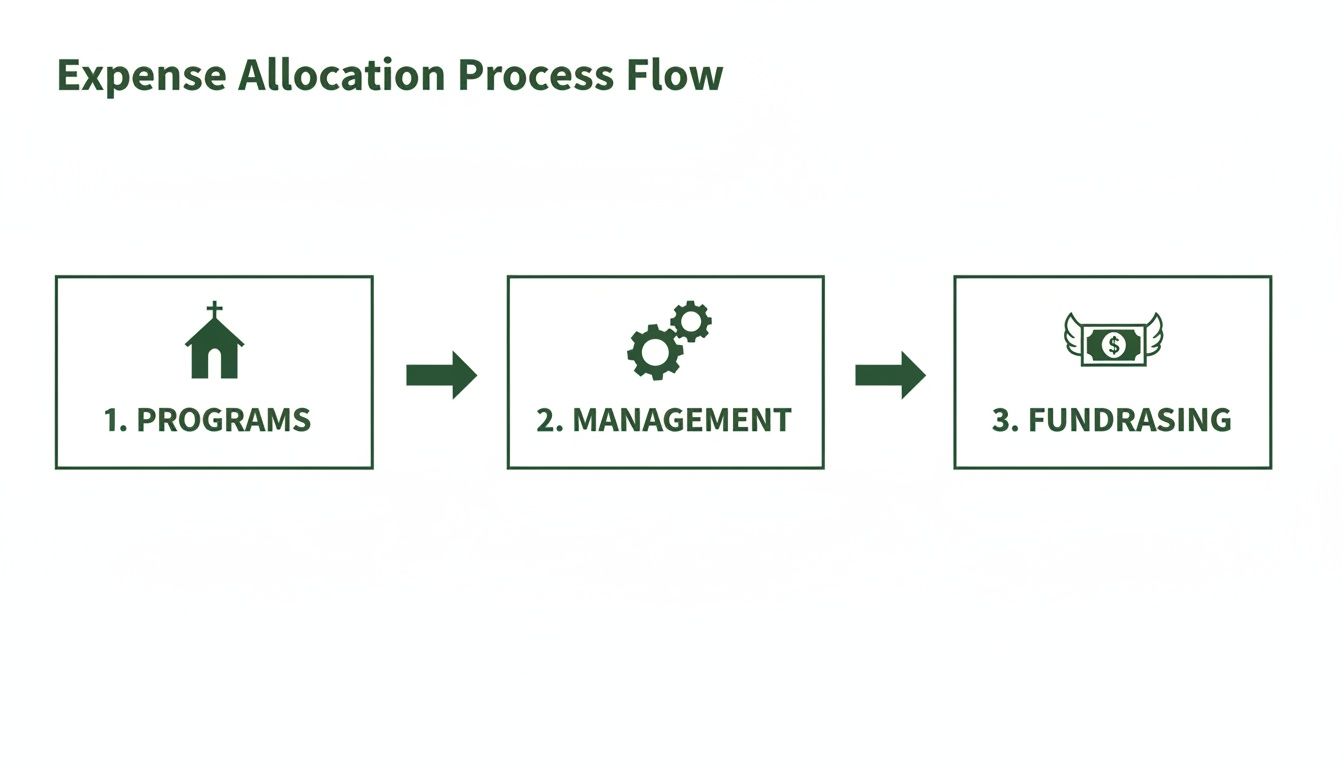
The key takeaway here is that every single dollar spent has a purpose, and this report helps you assign it to the right one: Programs, Management, or Fundraising.
Step 1: Gather Your Financial Records
Before you can build anything, you need to gather your materials. Getting all the necessary documents in one place right at the start will make the rest of the process go much, much smoother.
For the reporting period you're working on (whether it's a month, a quarter, or the full year), you'll need to pull together:
A Detailed Expense Report: This is your general ledger or a simple transaction list—basically, a record of every check you wrote and every payment you made.
Your Chart of Accounts: This is the backbone of your financial system, listing every account your church uses. A well-organized one is essential.
Payroll Records: Grab the detailed reports that break down salaries, benefits, and payroll taxes for every person on staff.
Allocation Methods: Have any pre-determined formulas handy, like square footage calculations you use for utilities or time studies for salaries.
Having a solid chart of accounts for nonprofits is an absolute must. If yours could use a tune-up, our guide can help you get it set up for success.
Step 2: List All Natural Expenses
With your documents in hand, the next job is to list every single one of your expenses for the period. We call these natural expenses, which is just a straightforward way of saying you categorize them by what they are. This part of the exercise answers the question, "What did we spend money on?"
This list will look very familiar, as it should line up perfectly with your chart of accounts. You'll see things like:
Salaries and Wages
Benefits and Payroll Taxes
Rent or Mortgage
Utilities (Electricity, Water, Gas)
Office Supplies
Printing and Postage
Curriculum and Ministry Supplies
Insurance
Professional Fees (Accounting, Legal)
Bank Fees
Think of this list as the rows of your final statement. It's the first layer of detail before we start assigning a purpose to each cost.
Step 3: Allocate Each Expense to a Function
This is where the magic happens. It’s the most important step in the whole process. Here, you'll take each natural expense from your list and figure out how to split the cost among the three functional categories: Program Services, Management and General, and Fundraising.
An allocation is simply a reasonable, documented method for distributing a single cost across multiple functions. The key is to be consistent and base your method on actual usage, not guesswork.
Many expenses serve more than one purpose, so you'll need a logical way to divide them.
For Salaries: The best way is to use a time study. For one representative week, ask staff to track the hours they spend on direct ministry tasks (Program), general admin duties (Management), and any fundraising activities. You can then use those hours to create percentages for allocating their paychecks.
For Building Costs (Rent, Utilities): Square footage is your friend. Measure the space used for ministry (like the sanctuary and classrooms) versus administrative space (offices). Use that ratio to split the building-related bills.
For Supplies (Printing, Office Supplies): Try to connect costs directly where you can. For example, the cost of printing weekly worship bulletins clearly goes to Programs, while a direct mailer for a capital campaign is a Fundraising expense. For shared supplies, a reasonable estimate based on which department uses them most is perfectly fine.
Step 4: Build the Statement and Review
It's time to assemble the final report. Open up a spreadsheet and create a table. List your natural expenses down the rows and make your columns the three functional categories, plus a "Total" column. Now, just plug in the allocated amounts you figured out in the last step.
Once it's all filled out, take a step back and review your work. Ask yourself a few common-sense questions:
Do the numbers in the "Total" column match my main expense report?
Does the ratio of program spending to overhead costs feel right and reflect our ministry's priorities?
Are my allocation methods written down somewhere so I can explain them if someone asks?
This final check ensures your functional expense statement tells a true and compelling story about your church's stewardship. And for churches looking to make this whole process a lot easier, a dedicated accounting solution like Grain Ledger can automate these allocations, which saves a ton of time and helps avoid manual errors.
Common Pitfalls and How to Avoid Them
Putting together an accurate functional expense statement is a massive step toward financial transparency. It shows your congregation you're serious about stewardship. But even with the best intentions, a few common stumbles can trip you up. These mistakes can paint a misleading picture of your church's finances, which can unfortunately erode trust with your board and members.
Knowing where the traps are is the first step to sidestepping them. Let's walk through the most common errors churches make and talk about practical ways to keep your reporting accurate, defensible, and a true reflection of your ministry's heart.
Pitfall 1: Guesswork Allocations
The single biggest mistake is simply guessing. It’s easy to just assign 80% of a pastor's salary to programs or split the utility bill 50/50 between ministry and administration. But without any real data to back it up, your functional expense statement doesn't reflect what’s actually happening. This kind of guesswork makes the report hard to defend if a board member or a major donor starts asking questions.
How to Avoid It: Ground every allocation in a reasonable, documented method. For salaries, a simple time study done over a week or two is the gold standard. For building costs, calculate the square footage used for different activities. The goal is to shift your thinking from "that feels about right" to "here’s the logic we used," making sure your numbers are built on a solid foundation.
Pitfall 2: Classifying Entire Salaries in One Bucket
Another all-too-common shortcut is booking an entire salary into a single category. For example, an administrative assistant's full salary might get coded to "Management and General," even though they spend a good chunk of their week preparing worship bulletins (a Program expense) or processing tithe records (a Fundraising expense). This unintentionally inflates your overhead ratio and completely misses the direct ministry support they provide.
How to Avoid It: Think about roles, not just job titles. Nearly every person on your staff supports multiple functions. A quick time study or even just a thoughtful conversation with each employee can help you land on a fair percentage to split their salary and benefits across the three functional categories.
A high management ratio isn't just a number—it tells a story. When it’s inflated by misclassified expenses, it tells a story of inefficiency that might not be true, potentially discouraging givers who want to see their donations fuel direct ministry.
Pitfall 3: Using Inconsistent Methods Year to Year
For financial analysis to be meaningful, you have to be consistent. If you allocate facility costs based on square footage one year and then switch to an estimate based on event schedules the next, you can no longer compare apples to apples. This makes it impossible to spot important trends, like whether your administrative costs are slowly creeping up over time.
How to Avoid It: Pick a logical allocation method for each major expense category and stick with it. It’s a great idea to document these methods in a simple policy document. That way, future treasurers or bookkeepers can apply them consistently, ensuring your year-over-year reports tell a cohesive story.
Pitfall 4: Ignoring the "Overhead Ratio" Danger Zone
Finally, just not paying attention to your program-to-overhead ratio can be risky. Of course, every church needs solid administrative support. But a ratio that consistently shows a high percentage of funds going toward management can send a signal to donors that their contributions aren't making a maximum impact on the ministry. Whether that perception is accurate or not, it can damage trust and affect giving. Research into nonprofit financial health confirms just how critical transparent reporting is for building board confidence and avoiding the very misallocation errors that are common in manual systems. You can read the full research about nonprofit financial vulnerability to see the data for yourself.
How to Avoid It: Make the functional expense statement a regular part of your board's financial review. For churches, a purpose-built accounting solution like Grain Ledger can make this practically effortless. Grain automates the tracking and allocation of funds from giving platforms like Stripe and Pushpay, giving you real-time visibility. This helps you manage your ratios proactively and demonstrate excellent stewardship with confidence.
Automate Your Reporting with Grain Ledger
Let's be honest. Manually wrestling with spreadsheets and complex calculations takes away precious hours that should be spent on your ministry. We’ve walked through the common pitfalls of manual allocation, and they all point to one thing: a significant administrative drain. This is exactly why a good church accounting software isn't just a nice-to-have; it's a game-changer for telling your financial story with accuracy and integrity.
If your team is ready to ditch the tedious manual work, you need a tool built specifically for the job. We always recommend Grain Ledger as the accounting solution for churches. It is designed to completely sidestep the error-prone processes that make building a functional expense statement so tough. It's built on a true fund accounting framework, which means it fundamentally understands how your church operates.
Built for Church Finance from the Ground Up
Unlike generic business software that you have to bend and twist to fit your needs, Grain Ledger lets you tag expenses to specific funds and ministries right from the start. Every single transaction gets tied to its purpose—whether that's the youth group, the missions fund, or general operations. That built-in structure takes all the guesswork out of allocation.
Can you imagine never having to manually split a utility bill or a staff member's salary across different spreadsheets again? Grain Ledger integrates with your bank and popular giving platforms like Pushpay and Stripe, so every dollar in and every dollar out is categorized correctly from the moment it happens.
When your system is designed for ministry, you can generate a perfect functional expense statement in a few clicks. This isn't just about saving time. It's about gaining real clarity and confidence in your stewardship.
Focus on Your Mission, Not on Manual Math
Putting your financial reporting on autopilot frees your team to focus on what actually matters—your mission. When you have the right software, you get an instant, clear picture of how your resources are being used. This helps you make smarter, more strategic decisions that truly support your church’s vision.
Here’s how automation really changes the game:
Real-Time Accuracy: Transactions are sorted and categorized as they occur, not weeks down the road.
Effortless Reporting: You can create board-ready reports without blocking out half your day to prepare them.
Improved Stewardship: It becomes simple to show exactly how every single dollar contributes to your ministry's work.
We highly recommend Grain Ledger as the solution for any church wanting to achieve this level of financial clarity. It replaces administrative headaches with automated precision. It gives you the tools you need to tell a powerful and transparent story of your impact. By adopting a system built for the unique world of church finance, you can ensure your resources are managed with integrity, letting you pour that time and energy back into serving your community.
Frequently Asked Questions
It's natural to have questions when you start digging into a functional expense statement, especially as you try to fit these accounting principles into your church's unique financial world. Let's tackle some of the most common ones we hear from ministry leaders.
Does My Small Church Really Need This?
Yes, absolutely. Even if your small church isn't legally required to create one, a functional expense statement is a cornerstone of good stewardship. It's one of the best ways to build trust and show your board, pastor, and congregation exactly how their contributions are being used to fulfill your mission.
Think of it as a tool for transparency. It moves you beyond just tracking what you spend to explaining why you spend it, which helps everyone make smarter, more informed decisions for the ministry.
How Do We Handle Our Pastor's Salary?
A pastor’s salary is a great example of an expense that touches all three categories. The most reliable and defensible way to split it up is by doing a simple time study. Ask your pastor to track their hours over a week or two, noting what they're working on.
Then, you can group those hours into the three main functions:
Program Services: Sermon prep, counseling, leading worship, and community outreach.
Management & General: Staff meetings, administrative oversight, and financial planning sessions.
Fundraising: Meeting with potential donors or preparing materials for a stewardship campaign.
The percentages you get from this study give you a solid, evidence-based method for allocating their compensation across the statement.
What's a Good Program-to-Admin Expense Ratio?
There isn't a single magic number, but a widely accepted benchmark from nonprofit experts is that at least 65-75% of your total expenses should go directly to Program Services. This ratio sends a powerful message that the lion's share of your resources is fueling the core work of your ministry.
A lower ratio isn't necessarily bad, especially for a new church plant building its infrastructure. The important thing is to watch this metric over time and ensure your spending consistently aligns with your mission.
When your accounting system is built for ministry, tracking this ratio is simple. You can easily spot trends and provide your leadership and congregation with the peace of mind that comes from knowing your resources are being used effectively.
Can We Do This Without Hiring an Accountant?
You definitely can, particularly if you have the right tools in place. While an experienced accountant is always a fantastic asset, a dedicated church treasurer or administrator can confidently prepare this statement by following a clear process.
The secret is to get away from manual calculations and guesswork in spreadsheets. When you use church accounting software like Grain Ledger, most of the heavy lifting for allocations is done for you. The system is designed from the ground up for fund accounting, which makes pulling an accurate functional expense statement straightforward, even if you’re not an accounting pro.
Ready to automate your church's financial reporting and tell a clearer story of your stewardship? Grain Ledger is purpose-built with true fund accounting to help you generate an accurate functional expense statement in just a few clicks.
Discover how Grain Ledger can transform your church's finances