Master Financial Reporting for Churches
Jun 26, 2023
Church financial reporting isn't just about balancing the books. It’s the very bedrock of the trust and stewardship that fuels your ministry. Think of these reports as a compass for your church—they show you where you've been, confirm where you are now, and help you chart a course for the future. In an age where givers rightly expect transparency, being able to tell a clear financial story is non-negotiable.
Why Clear Financial Reporting Matters for Your Church

Your church's financial reports are powerful tools for both accountability and vision. They aren't just dusty records of past spending; they are active proof that your church is a faithful steward of every dollar it's been given. When your congregation can clearly see how their tithes and offerings are making a difference, their confidence soars, which naturally leads to deeper engagement and more faithful giving.
This level of transparency isn't just a nice-to-have anymore. Donors today are savvy and, frankly, a bit skeptical of vague financial updates. They want to see the details. This is why churches that provide regular, easy-to-understand reports often see donor confidence and engagement climb. You can dive deeper into the key financial trends for church growth to understand why this matters so much.
Building a Foundation of Trust
At its heart, financial reporting for churches is all about building and keeping trust. Every report you create is a promise to your congregation that you're managing their gifts with integrity and a clear sense of purpose. When financial information is confusing, hard to find, or inconsistent, it plants seeds of doubt that can seriously slow down your church's growth and impact.
On the other hand, when your reports are clear, accessible, and shared consistently, you create a powerful, positive cycle of trust.
Demonstrate Good Stewardship: Clear reports prove you’re managing resources responsibly, honoring the designations on gifts, and operating within your budget.
Encourage Generosity: People who feel confident about your financial management are simply more likely to give generously and consistently.
Empower Leadership: Good data gives your pastors and board members the clarity they need to make smart, strategic decisions about everything from new ministry initiatives to hiring staff or improving facilities.
Financial transparency isn't just about compliance; it's a ministry in itself. By opening the books, you invite your congregation into the story of what God is doing through their collective generosity, reinforcing their role as vital partners in the mission.
Ultimately, getting a handle on your financial reporting is critical for the long-term health of your church. It ensures you have the resources to chase after your mission while building a legacy of trust that will sustain your congregation for years to come.
The Foundation of Church Accounting Explained
Running a church's finances isn't like managing a typical business. A business usually has one big pot of money, but a church juggles several financial streams at once. This is where a special approach called fund accounting comes in—it’s the absolute bedrock of sound financial management for any ministry.
Think of it like sorting cash into different envelopes, each with a specific purpose written on the front.
One envelope is for the general operating budget, covering day-to-day costs like salaries, utilities, and curriculum. Another, labeled "Building Fund," holds every dollar given for that new roof project. A third might be for the upcoming "Missions Trip." The guiding principle here is simple but powerful: fund accounting guarantees that designated donations are used exactly as the donor intended.
This isn't just a quirky bookkeeping method; it’s a non-negotiable matter of integrity and stewardship. If a member gives $100 specifically for the youth mission trip, that money is legally and ethically tied to that purpose. It can't be used to patch a hole in the general budget—doing so would be a major breach of trust. Fund accounting provides the essential guardrails to keep that from ever happening.
Understanding the Different Fund Types
At its heart, church fund accounting sorts money into three main buckets, or "envelopes," based on what the donor specified. Getting these categories right is the first step to creating financial reports that are both accurate and trustworthy.
Unrestricted Funds: This is your church's main operational account. It’s filled with general tithes and offerings given without any strings attached. Leadership can use this money for any legitimate ministry expense, from the electric bill to the coffee served after service. It's your most flexible pool of resources.
Temporarily Restricted Funds: This bucket holds donations given for a particular project or purpose that has a finish line. Once that goal is met—the new sound system is purchased, or the mission trip is completed—the restriction is lifted.
Permanently Restricted Funds: While less common, these are critical to manage with care. These funds, usually from a large gift or an endowment, come with a permanent rule: the original principal can never be touched. Your church can only use the interest or investment income it generates, often for a purpose the donor specified.
A solid fund accounting system is the only way to prove your church is honoring the heart behind every single gift. It shifts your financial records from being just a list of transactions into a powerful testament of your commitment to faithful stewardship.
Defining Your Church's Financial Structure
To put fund accounting into practice, you need a clear financial framework. It all starts with a well-organized chart of accounts, which is basically the filing cabinet for all your financial information. Each fund—General, Building, Missions—gets its own dedicated set of accounts for tracking income and expenses.
If you need a deep dive, check out our guide on creating a chart of accounts for nonprofits.
This organized structure is what enables your reports to tell a clear and compelling story. Instead of a single, vague number for "donations," you can instantly see how much came in for the general fund versus the building fund. This isn't just a nice-to-have; it's essential for transparent financial reporting, giving leaders the clarity they need to make wise decisions and assuring the congregation that their gifts are making the intended impact.
With your fund accounting system set up, you can start generating the reports that truly tell your church's financial story. These documents aren't just for the finance team—they're the tools you'll use to maintain transparency, build trust, and make wise, mission-focused decisions.
Think of these four reports as a complete diagnostic panel for your ministry's health. Each one measures a different vital sign. Together, they give you a full picture of your financial strength, your ability to meet obligations, and how well you’re stewarding the resources entrusted to you.
The whole process starts the moment a contribution is made. Every dollar needs to be correctly sorted and designated before it's spent, which is the foundation for accurate reporting and protecting donor intent from day one.
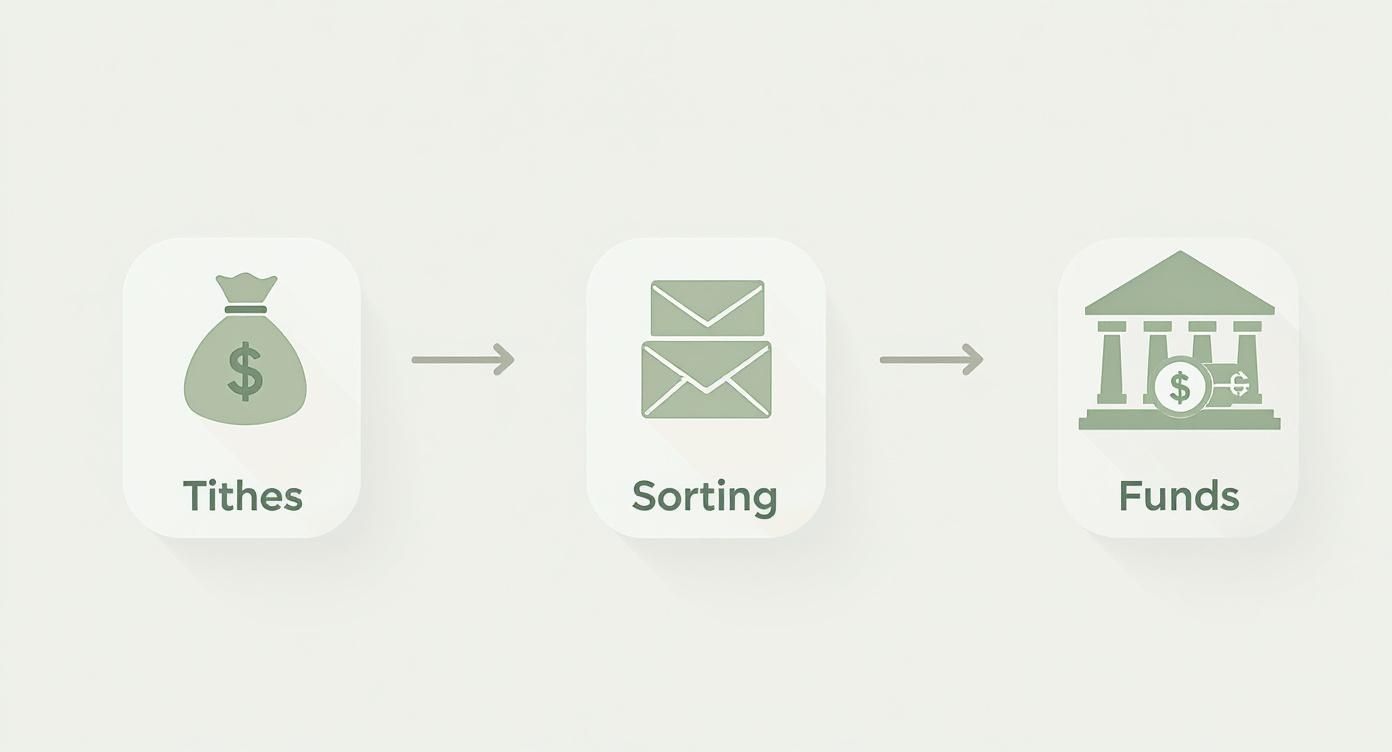
This simple flow is the bedrock of good church finance. It ensures every gift is honored as intended, which is what allows you to produce the following essential reports with confidence.
Key Church Financial Reports at a Glance
Before we dive into the details, this table gives a quick overview of the four must-have reports and the core question each one answers.
Report Name | What It Shows | Key Question Answered |
|---|---|---|
Statement of Financial Position | A snapshot of assets, liabilities, and net assets on a single day. | What do we own, what do we owe, and what's our net worth right now? |
Statement of Activities | Income, expenses, and the resulting surplus or deficit over a period of time. | Did we operate in the black or the red this month/quarter/year? |
Statement of Cash Flows | The actual movement of cash in and out of the bank. | Where did our cash come from, and where did it actually go? |
Designated Funds Report | Detailed activity (income, expenses, balance) for each restricted fund. | Are we using restricted donations exactly as the donors intended? |
These four reports work together to provide a complete and honest look at your church's financial standing, helping you lead with integrity and foresight.
1. Statement of Financial Position
Often called a balance sheet, the Statement of Financial Position is like a financial photograph—it captures your church's health at a single moment in time. It clearly answers the question, "What do we own, what do we owe, and what is our net worth today?"
It’s all based on the classic accounting formula: Assets = Liabilities + Net Assets
Assets are everything the church owns of value, like cash in the bank, buildings, land, and even sound equipment.
Liabilities are what the church owes to others. This includes a mortgage, unpaid bills to vendors, or payroll taxes.
Net Assets is what's left over. In a church, these are broken down by fund (unrestricted, designated, etc.), showing what’s available for general ministry versus what’s earmarked for specific purposes.
This report is your go-to for assessing long-term stability and making sure you have the cash on hand to cover your short-term bills.
2. Statement of Activities
If the balance sheet is a photo, the Statement of Activities is a video. It shows your church's financial performance over a period of time—a month, a quarter, or a full year. It’s the nonprofit world’s version of an income statement or P&L.
This report answers a simple but critical question: "Did we end the period with a surplus or a deficit?" It lays out all your income (tithes, offerings, grants) and all your expenses, neatly organized by fund. You can see exactly what came into the building fund and what was spent from the general operating fund. This separation is fundamental to accountability in financial reporting for churches.
The global Religious Organizations Market is a massive financial environment, valued at around $393.53 billion and projected to hit $468.32 billion by 2029. Within this context, strong reporting is non-negotiable for demonstrating good stewardship. For more on this, check out the market analysis from ResearchAndMarkets.com.
For a deeper dive into how expenses are categorized for maximum clarity, take a look at our guide on the Statement of Functional Expenses.
3. Statement of Cash Flows
The Statement of Cash Flows is often the unsung hero of financial reporting, but it’s incredibly important. It tracks the actual cash moving in and out of your bank accounts. It’s entirely possible for a church to show a "profit" on the Statement of Activities but be dangerously low on cash—for instance, if a large pledge has been promised but not yet received.
This report answers the practical question, "Where did our cash come from, and where did it go?" It sorts cash movement into three main buckets:
Operating Activities: The cash used for your everyday ministry.
Investing Activities: Cash spent on or received from selling long-term assets like a building or a bus.
Financing Activities: Cash from taking out or paying down loans, like a mortgage.
A surplus on paper is nice, but healthy cash flow is what keeps the lights on. This report is your early warning system for preventing a cash crunch.
4. Designated Funds Report
While the first three reports are standard across the nonprofit sector, the Designated Funds Report is an absolute necessity for churches. This is an internal report that gives you a granular look at the activity within each of your restricted funds—the Building Fund, Missions Fund, Benevolence Fund, you name it.
For every single designated fund, this report must clearly show:
The balance at the start of the period.
Every donation that came into that specific fund.
Every dollar spent from that fund.
The final balance at the end of the period.
This report is your number-one tool for proving you've been a good steward of donor gifts. It gives your leadership and congregation total confidence that every dollar given for a specific purpose was used only for that purpose. It's the ultimate safeguard against accidentally misusing restricted funds—one of the most serious financial mistakes a church can make.
Best Practices for Transparent Reporting
Having the right reports is just the start. The real game-changer is building a system that churns out clear, trustworthy data, month after month. This is where you build real confidence with your congregation. Strong financial reporting for churches isn’t built on complex theories, but on simple, repeatable habits. Think of these practices not as administrative chores, but as acts of stewardship that honor every dollar given and protect your church’s integrity.
So, how do we move from idea to action? It's all about establishing a rhythm of accountability. This means setting a predictable schedule for your reports, putting some simple checks and balances in place, and always focusing on clear communication. The goal is to make transparency a natural part of your church's culture, not something you have to scramble to create once a year.
Establish a Consistent Reporting Rhythm
Timeliness is everything when it comes to trust. Financial information that’s three months old is almost as useless as having no information at all. When you set a consistent schedule, you eliminate the guesswork and ensure your leadership and members are always working with a current picture of the church’s financial health.
A great reporting rhythm usually looks something like this:
Monthly for Leadership: Your church board, finance committee, and senior pastors need to see the detailed numbers every single month. This means reviewing the Statement of Activities (especially the budget vs. actuals), the Statement of Financial Position, and a detailed report on all designated funds. Meeting monthly allows you to spot issues early and make course corrections before a small problem becomes a big one.
Quarterly for the Congregation: You don't need to hand the entire congregation a dense spreadsheet, but you should give them a high-level summary every quarter. Think of it as a visually clean, easy-to-read snapshot. A simple one-page summary in the bulletin or a quick, clear presentation during a service can be incredibly effective.
Annually for Everyone: The annual report, usually presented at a members' meeting, is your chance to tell the full story. It’s a comprehensive look at the past year that also helps cast the financial vision for the next. This is your ultimate tool for accountability, and it's a fantastic opportunity to celebrate how members' giving fueled the ministry.
Implement Essential Internal Controls
Internal controls are just simple, practical procedures you put in place to protect the church's assets and make sure your financial records are accurate. This isn't about a lack of trust; it's about being wise stewards and protecting everyone involved—staff, volunteers, and the church itself—from honest mistakes or potential temptation.
"Internal controls are the guardrails of financial integrity. They don't imply suspicion; they demonstrate wisdom, protecting both the church's resources and the people who handle them."
Even the smallest churches can put these basic controls into practice:
Dual Signatures on Checks: This is non-negotiable. Require two unrelated people to sign any check over a certain threshold, like $500. This one simple step prevents any single person from having complete control over the checkbook.
Separate Counting Teams: Never, ever have just one person count the offering. You should always have a team of at least two unrelated individuals who count the money together, fill out a count sheet, and both sign off on it.
Regular Bank Reconciliations: Your treasurer or bookkeeper must reconcile the bank statement every single month. To take it a step further, have an independent member of the finance committee review the completed reconciliation and sign off on it.
Review Invoices: Before any check is cut, make sure the payment is backed up by a real invoice or an approved expense request form. The appropriate ministry leader should have signed off on it first.
These simple practices create layers of accountability that drastically reduce financial risk. In fact, the Association of Certified Fraud Examiners found that organizations with strong internal controls detect fraud 50% faster and experience much smaller losses. By putting these best practices into motion, your church isn’t just producing accurate numbers—it’s building a resilient culture of trust that will empower your ministry for years to come.
Presenting Financials to Your Board and Congregation

Getting the numbers right is only half the job. The real challenge—and where stewardship truly comes to life—is in how you share that information. When you present financials well, you're doing more than just reporting; you're building trust, casting vision, and turning a spreadsheet into a powerful story of ministry impact.
But here’s the thing: a one-size-fits-all approach to sharing numbers just doesn't work. Your church board and your congregation are two very different audiences with completely different needs. To do financial reporting for churches effectively, you have to tailor your communication for each group.
Reporting to Your Church Board
Your board members or finance committee are the strategic guardians of the church's resources. They need to get into the weeds to govern effectively. Think of their report as a detailed health checkup, not just a quick summary.
When you're in the boardroom, the focus should be on providing deep, actionable data. Your job is to equip them to ask the right questions and make wise decisions about the church's financial direction.
Budget vs. Actual Analysis: This is non-negotiable for a board meeting. It's a direct comparison of what you planned to spend versus what you actually spent, immediately flagging any big differences that need discussion.
Detailed Statement of Activities: This report needs to show income and expenses broken down by each specific fund. It's how the board can verify that restricted donations are being handled correctly and that operational costs are in line.
Cash Flow Projections: Leadership needs to see what's coming. A forward-looking view of your cash position helps the board see potential shortfalls or plan for major upcoming expenses, ensuring ministry never gets sidelined by a cash crunch.
For a board, the numbers tell a story of operational health and fiscal discipline. The goal is to provide enough detail to facilitate strategic oversight and proactive problem-solving, ensuring the church remains on a stable financial footing.
Communicating with Your Congregation
While your board needs the fine print, your congregation needs the big picture. They want to know how their generosity is fueling the mission. A recent Lifeway Research report found that public confidence in institutions, including churches, is at an all-time low. Clear, accessible financial updates are one of the most powerful tools you have to build and maintain trust.
For your members, your task is to translate complex data into a compelling story. Think of it less like a financial report and more like a ministry impact report.
Go Visual: A simple pie chart showing where every dollar goes (e.g., 60% for ministry staff, 20% for facilities, 10% for missions) is infinitely more powerful than a spreadsheet full of numbers.
Tell Stories: Connect the numbers to actual life change. Don't just state the youth ministry budget; share a story about a student whose life was changed at the summer retreat that their giving made possible.
Keep it High-Level: Focus on the key takeaways. Show total offerings compared to the annual budget and highlight the progress you're making toward big goals, like a new building fund.
The key is to make the information easy to understand and genuinely inspiring. When you clearly connect the financial data to ministry outcomes, you reinforce the value of every single gift and celebrate what God is doing through the collective stewardship of your church family. This is how you foster a true culture of generosity and shared ownership in the mission.
Using Modern Church Software to Make Reporting Easier
Trying to manage church finances manually is a recipe for headaches. I've seen countless churches get bogged down trying to force generic spreadsheets or small business tools like QuickBooks to do something they were never designed for: true fund accounting. This often leads to a tangled mess of complex workarounds that are not only slow but also incredibly prone to human error, which can quickly damage trust.
The good news is that there’s a much better way. Purpose-built church software is designed from the ground up to handle the specific needs of ministry finance. Unlike generic platforms, these systems have fund accounting woven into their very fabric. Every single donation, expense, and transaction is automatically tied to the correct fund, giving you instant clarity without any manual sorting.
Suddenly, financial reporting for churches goes from a dreaded monthly chore to a simple click of a button.
How Automation and Integration Change Everything
The real magic happens when your systems talk to each other. Modern church software connects your online giving platform directly to your accounting ledger. Imagine a donation comes in for the youth mission trip; it flows right from your website into the correct restricted fund in your books. No one has to touch it. That’s the key to real accuracy and efficiency.
The shift to digital giving has been massive. By 2023, an incredible 98 percent of churches were offering digital giving options. More importantly, churches that really embraced and promoted these tools saw a 32 percent jump in overall donations. This shows a direct line between using the right financial tech and inspiring generosity, as detailed in these digital giving statistics that impact church finances.
Purpose-built software gives you a central dashboard, a command center for your church’s financial health in real-time.
This kind of immediate visibility allows leaders to make smart, timely decisions without having to wait weeks for someone to piece together a report by hand.
Getting Back to Ministry and Growth
Ultimately, the biggest win from using the right software is getting your time back for what really matters—ministry. When your team isn't drowning in manual reconciliations and spreadsheet gymnastics, they can put their energy toward stewarding the church’s resources for mission and growth.
Effortless Compliance: You can generate accurate, GAAP-compliant reports like the Statement of Activities and Statement of Financial Position in moments, not hours.
Deeper Transparency: It becomes simple to create clear, fund-specific reports to share with your board and congregation, which is foundational for building confidence.
Lower Risk: Automation practically eliminates the risk of misallocating restricted funds, protecting your church’s financial integrity.
Making the switch to a dedicated platform isn't just a tech upgrade; it's an investment in your church's health and future. If you’re curious about what to look for, you can dive into our comparison of the best church financial software. By embracing technology built for your unique context, you can ensure your financial reporting is always accurate, transparent, and focused on the mission.
Answering Your Top Questions About Church Finances
When you’re stewarding a church’s resources, practical questions are bound to come up. It doesn't matter if you're managing a multi-million dollar budget or leading a small church plant—the principles of trust and accountability are the same for everyone.
Let's walk through some of the most common questions we hear from church leaders. Getting these right builds a rock-solid foundation of financial integrity.
How Often Should Our Church Share Financial Reports?
The key here is consistency. A predictable rhythm of reporting demonstrates a commitment to transparency, which in turn builds incredible trust with your people. You’re showing them you have nothing to hide.
Here’s a healthy reporting schedule that works for most churches:
Monthly for Leadership: Your board, elders, or finance committee needs to see the detailed numbers every single month. This keeps them informed and empowered to make wise decisions.
Quarterly for the Congregation: Give your members a high-level summary every quarter. Think simple visuals and key takeaways—enough to keep them in the loop without overwhelming them.
Annually for Everyone: The big one. A comprehensive, detailed report should be presented at your annual members' meeting, covering the entire year's financial activity.
What Is the Biggest Financial Reporting Mistake?
By far, the most dangerous mistake a church can make is mismanaging its restricted funds. This is when money given for a specific purpose—say, the "Youth Mission Trip Fund"—gets used to cover a shortfall in the general budget.
This isn't just a bookkeeping error; it's a breach of trust. When a donor gives to a specific cause, they are legally and ethically entrusting you to use that gift for that purpose alone. Misusing those funds can have serious legal ramifications and shatter your credibility.
Getting this wrong can permanently damage your relationship with your most generous givers. It’s the one area where you have to be absolutely diligent.
Do Small Churches Need Formal Financial Reporting?
Yes, absolutely. Stewardship isn't just for big organizations. While a small church might not need reports with the same level of complexity, the core need for clarity and accountability is universal.
At a minimum, every church needs to know what it owns versus what it owes (its financial position) and track its income against its expenses. Thankfully, there are tools and simple templates that make this completely manageable for any team, helping you honor every single dollar given to your ministry.
Ready to turn your church’s financial reporting from a headache into a powerful tool for ministry? Grain provides true fund accounting software built specifically for churches. See how our automated, intuitive platform can bring clarity and confidence to your stewardship. Join the waitlist for Grain today!