A Guide to Understanding Church Financial Statements
Jun 26, 2023

Church financial statements aren't just administrative paperwork. They're essential ministry tools for stewardship and transparency. Think of them less like dry spreadsheets and more like the financial story of your church's mission in action—showing exactly how tithes and offerings become real-world community impact.
The Ministry Map to Financial Health and Trust

When you start looking at your church’s financial statements through the lens of ministry, everything changes. They transform into a detailed map that guides your leadership team, builds deep trust with the congregation, and helps you plan for a healthy, sustainable future.
Just like a good map shows you where you are and where you're headed, these reports give you a clear, honest picture of your church's financial position and the results of its activities. This financial story is crucial for accountability. When members see a direct line from their giving to the church's impact, it nurtures a true culture of generosity. It answers the one question every donor has: “Is my contribution actually making a difference?”
Building Confidence Through Clarity
Transparent reporting is the bedrock of good stewardship. It’s how you show that the church is responsibly managing the resources God has provided through its members. Getting this right takes diligence from the team overseeing the numbers. If you're curious about who handles what, you can learn more in our guide to church finance committee responsibilities.
When you nail your financial reporting, you unlock some powerful benefits:
Informed Decision-Making: Leaders can move forward with confidence, whether it's launching a new ministry, hiring staff, or starting a building project.
Enhanced Congregational Trust: When people understand the church's financial health, their confidence in leadership grows. This almost always leads to stronger, more consistent giving.
Proactive Planning: The financial trends you spot in these statements help you get ahead of future needs and opportunities instead of just reacting to financial surprises.
By presenting clear financial reports, you are not just sharing numbers; you are sharing a vision. You are demonstrating faithful stewardship and inviting your congregation to be active partners in the church’s mission.
A Global Perspective on Stewardship
This principle of transparency isn't just for small, local churches; it applies to religious organizations of all sizes. Take the World Council of Churches, for example. Their 2024 financial statements detailed a total income of CHF 23.4 million against expenditures of CHF 22.8 million, showing precisely how they manage funds designated for specific global missions.
This level of detail, which you can explore in the full 2024 WCC financial report, provides a fantastic model for accountability that any church can learn from.
Understanding Fund Accounting in Your Church
To make any sense of church financial statements, you first have to get a handle on the unique system running behind the scenes: fund accounting. This isn't the same kind of accounting your local coffee shop uses, and there’s a critical reason why. While a business is focused on its overall bottom line, a church has a much higher calling—to steward the specific intentions of every person who gives.
Let’s put this in real-world terms. Say your church receives three different gifts one Sunday. One is a general tithe, another is a special gift for the youth mission trip, and a third is earmarked for repairing the roof on the new building. Standard business accounting would just toss all that money into one big "income" pot. The risk here is huge—it would be far too easy to accidentally spend the roof repair money on the electric bill, which breaks the trust you've built with your donors.
Fund accounting prevents this by creating separate financial entities, or "funds," for each specific purpose. The easiest way to think of them is as individual digital envelopes or ministry buckets. Each gift gets dropped into its correct bucket, and expenses can only be paid from the bucket they belong to.
The Three Buckets of Church Funds
This system is the backbone of good stewardship, tracking every dollar from the moment it's given to the moment it's spent on its intended ministry. Church funds generally fall into three main categories, and each one has different rules for how it can be used.
Unrestricted Funds: This is your primary operational bucket, often just called the General Fund. It’s filled with tithes and offerings given without any specific designation. This is the flexible money you use for the day-to-day work of the ministry—things like staff salaries, utility bills, curriculum, and local outreach.
Temporarily Restricted Funds: These buckets hold donations given for a specific project or purpose with a finish line. Think of money raised for a short-term missions trip, a new sound system, or a special community block party. Once that project is paid for and complete, the "restriction" on the funds is lifted.
Permanently Restricted Funds: This is less common, especially for smaller churches, but it's vital where it exists. These are funds, often from an endowment, where the donor has stipulated that the original gift—the principal—must be preserved forever. The church can typically only spend the investment income that the principal generates.
Keeping these funds separate isn't just a bookkeeping preference; it's a legal and ethical requirement. Fund accounting provides the framework for financial integrity and proves you're faithfully stewarding the resources entrusted to you.
Why This Matters for Your Financial Statements
Understanding this "bucket" concept is the key that unlocks your financial reports. A statement like the Statement of Activities (which we'll dig into next) is specifically designed to show income and expenses for each of these fund categories separately. This gives your leadership and your congregation a clear view not just of the church's overall financial health, but also of how well designated gifts are being managed.
For example, your General Fund might be running a little tight one month, but your Building Fund could have a healthy surplus. Without fund accounting, these crucial details would be completely invisible, painting a misleading financial picture.
This level of clarity is absolutely essential for making wise decisions, building trust, and making sure every single gift fulfills its purpose. It's the system that allows your church to demonstrate its accountability, not just to an auditor, but to every member who gives. To manage this well, a dedicated accounting solution like Grain Ledger can be a game-changer, as it's built specifically to handle the complexities of fund-based accounting for churches.
The Three Essential Church Financial Reports
Once you’ve got your head around the "digital envelope" system that fund accounting creates, you're ready to see that principle come to life in your church's financial reports. These statements aren't just for accountants; they are powerful storytelling tools. They translate numbers into a clear, compelling story about your ministry's health and impact.
More than anything, these reports are how you demonstrate accountability and make wise, Spirit-led decisions.
Every church, no matter its size, leans on three core financial statements to get a complete picture of its stewardship. Think of them as three different camera angles on your church's financial story—each one reveals something unique, but you need all three to see the whole scene.
The Statement of Financial Position
First up is the Statement of Financial Position. You’ll often hear this called a balance sheet, and its job is simple but critical: to give you a financial "snapshot" of your church at a single moment in time. It captures what your church owns (assets), what it owes (liabilities), and the difference between them (net assets).
It answers the big question: "What is our church's net worth right now?"
The whole report boils down to a straightforward equation: Assets = Liabilities + Net Assets.
Assets are everything of value the church owns. This includes cash in the bank, the church building, land, and even the sound equipment.
Liabilities are the debts the church has to pay. Think of the mortgage, outstanding bills from vendors, or payroll taxes that are due.
Net Assets show the church’s equity, and this is where fund accounting really shines. The report breaks this number down by fund, showing you the exact balances for your unrestricted General Fund, your temporarily restricted Building Fund, and any other designated funds.
This infographic gives you a simple look at how different funds—like the General Fund, Building Fund, and Missions Fund—are kept separate in your financial reporting.
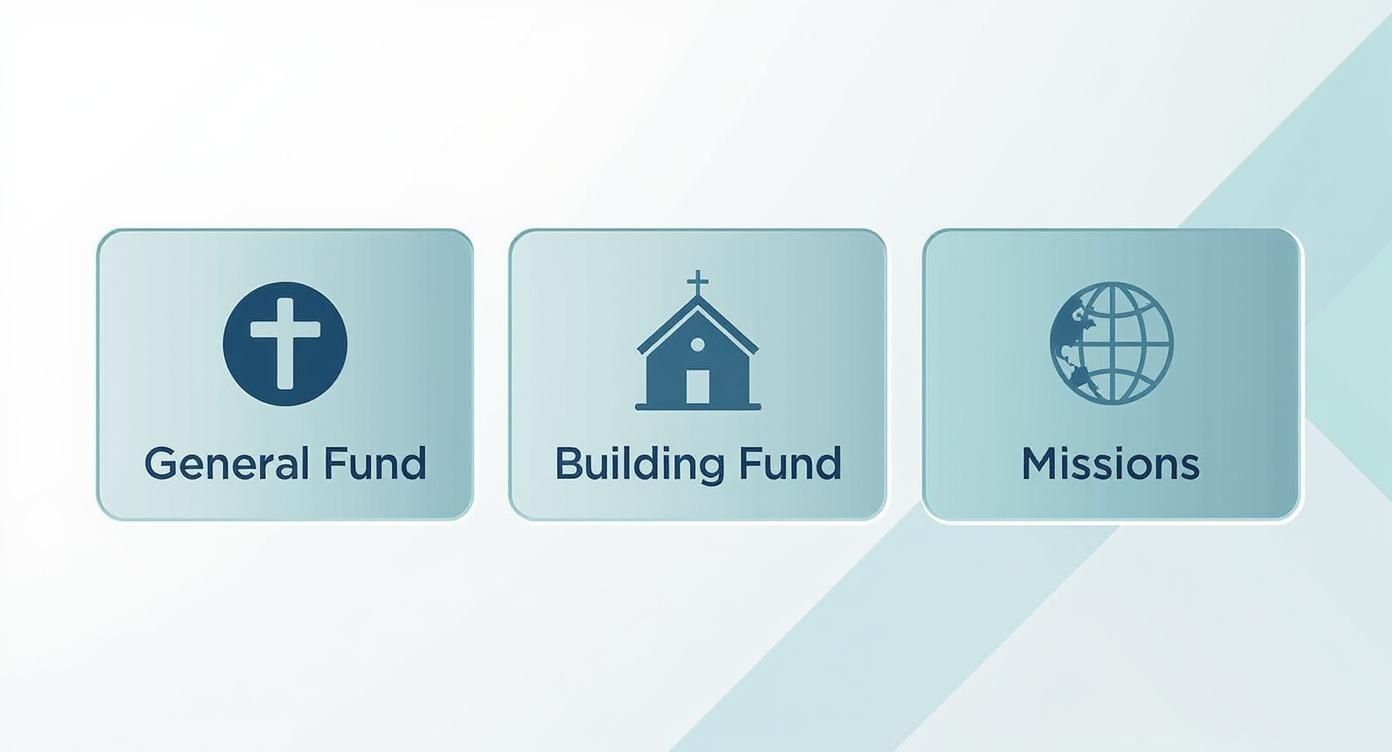
Seeing this visual separation makes it crystal clear that the church's total cash isn't just one big pot of money ready to be spent on anything.
The Statement of Activities
While the Statement of Financial Position is a snapshot, the Statement of Activities is more like a video. It shows your financial performance over a specific period—like a month, a quarter, or a full year. It’s the nonprofit world’s version of an income statement, telling the story of your church's income and expenses.
This statement answers the question: "Did we operate with a surplus or a deficit during this period?"
What makes this report so vital for churches is that it's organized by fund. It clearly shows all the income (tithes, offerings, event fees) and all the expenses (salaries, utilities, ministry supplies) for each fund. This structure is the key to transparency, proving that designated gifts were used exactly as the donor intended.
The Statement of Activities is where stewardship becomes visible. It connects the dots between the generosity of your congregation and the tangible work of the ministry, fund by fund.
The Statement of Cash Flows
The third key report is the Statement of Cash Flows. At first glance, it might seem a lot like the Statement of Activities, but it has a very different—and very practical—purpose. Its only focus is on the actual cash moving in and out of your church’s bank accounts.
This report answers the most immediate operational question: "Do we have enough cash to meet our obligations?"
It's entirely possible for the Statement of Activities to show a profit (because it includes non-cash items like depreciation) while your actual cash balance is running low. The Statement of Cash Flows cuts through the accounting jargon to show you the hard reality of your cash position. It splits cash movements into three main buckets:
Operating Activities: Cash from your day-to-day ministry, like offerings coming in and bills going out.
Investing Activities: Cash used to buy or sell long-term assets, like a new property or sound equipment.
Financing Activities: Cash from borrowing money or paying back loans, like making mortgage payments.
Keeping a close eye on this flow helps prevent a cash crunch and ensures you can always cover the essentials like payroll and utilities. The financial scale of church operations can be immense. For instance, The Church of Jesus Christ of Latter-day Saints reported spending $1.45 billion on humanitarian projects worldwide in 2024 alone. This highlights the massive resource allocation involved in ministry, making precise cash flow management essential. You can discover more about these extensive church financial operations in their 2024 global growth report.
To make sure your expenses land in the right categories for these reports, it helps to understand the difference between natural and functional expenses. You can dive deeper into this important classification by checking out our guide on the Statement of Functional Expenses.
When these three church financial statements are prepared accurately and reviewed regularly, they give your leadership team the clarity they need to lead with confidence and integrity.
Quick Overview of Core Church Financial Statements
To pull it all together, here’s a simple table summarizing the three reports we've just covered. It's a handy cheat sheet for understanding what each statement does at a glance.
Statement Name | What It Shows | Key Question It Answers |
|---|---|---|
Statement of Financial Position | A snapshot of assets (what you own), liabilities (what you owe), and net assets. | "What is our church's net worth right now?" |
Statement of Activities | Income and expenses over a specific period, broken down by fund. | "Did we have a surplus or a deficit during this period?" |
Statement of Cash Flows | The actual movement of cash in and out of the bank from all activities. | "Do we have enough cash to pay our bills?" |
Each report offers a unique perspective, and together, they provide the comprehensive financial insight needed for healthy and transparent church management.
Best Practices for Financial Transparency
https://www.youtube.com/embed/KjLpFcnipOI
Getting your financial statements right is just the start. The real magic happens in how you share that information. This is where you build trust and inspire a culture of generosity. Financial transparency isn't about burying your congregation in spreadsheets; it’s about telling an honest, clear story of stewardship. The goal is to show your members exactly how their giving brings the church’s mission to life.
But turning that goal into a reality requires a plan. You need to share the right level of detail with the right audience. Your church board and finance team, for instance, need the full, detailed church financial statements every month. That’s how they make wise decisions. But hand that same report to the entire congregation, and you’re more likely to cause confusion than create clarity.
Tailoring Reports for Your Audience
The secret is creating simplified summary reports designed specifically for the congregation. Think of it as a financial highlight reel—it hits the most important points without getting bogged down in the weeds. A good congregational report should be visually clean and easy to grasp, even for someone who avoids numbers.
Here’s what a great summary for the congregation often includes:
A simple income vs. expense snapshot: Show what came in through tithes and offerings versus what went out for ministry expenses.
Budget-to-actual comparison: How are we doing compared to the plan? This single-handedly demonstrates accountability.
Key ministry fund updates: A quick note on the building fund or the missions campaign shows everyone the progress you're making on shared goals.
This approach gives members the essential information they need to feel confident in the church's leadership. You’re respecting their time while still being open. And for anyone who wants to see more? The detailed statements are always available upon request.
The Power of Narrative and Regularity
Numbers tell part of the story, but not all of it. One of the best things you can do is add a short narrative to your financial reports. A few sentences can provide context that raw data simply can't.
For example, explain why utility costs were higher than budgeted ("We had an unexpectedly cold winter, which meant running the heat more than planned.") or celebrate a win ("We officially met our goal for the summer missions trip!"). This simple act turns a dry report into a compelling story of ministry in action.
Transparency isn't just about sharing data; it's about creating understanding. When you explain the 'why' behind the numbers, you invite your congregation into the story of stewardship, making them partners in the journey.
Just as important is getting into a regular rhythm. Consistent, predictable communication quiets anxieties and shows everyone that financial oversight is a top priority. A great schedule is to provide detailed reports to the board monthly and a summary report to the congregation quarterly. Over time, this consistency becomes the bedrock of trust.
Implementing Strong Internal Controls
Transparency has to be built on a foundation of integrity. That's why strong internal controls aren't just a good idea—they're non-negotiable. These are the practical policies and procedures that protect the church’s assets and the reputations of the staff and volunteers who handle them.
The most fundamental control is the separation of duties. Simply put, the person who counts the offering shouldn't be the same person who records it in the books or takes it to the bank. When you involve multiple, unrelated people in the process, you create natural checks and balances that dramatically reduce the risk of both honest mistakes and intentional misuse.
Of course, the broader economic climate always affects giving patterns. The good news is that faith-based giving in the U.S. has proven incredibly resilient. Despite economic headwinds, a recent study found that 95% of donors planned to either maintain or increase their giving in 2024. You can explore the 2025 economic outlook for church giving to see what this might mean for your church. This incredible faithfulness from givers makes it even more critical to steward every dollar with the highest level of integrity.
Using Software to Simplify Church Accounting
Knowing how to prepare and share church financial statements is one thing. Actually doing it accurately and on time is a whole different ballgame. Many churches still lean on familiar tools like spreadsheets or standard business accounting software, but these seemingly simple solutions hide some serious risks that can undermine your stewardship.
Let’s be honest: those tools just weren't built for the way a church operates. A spreadsheet is entirely manual, which means a single broken formula or a copy-paste mistake can throw off your numbers. You might spend hours hunting down an error, all while the integrity of your reports hangs in the balance.
Then there's generic business software. It’s designed to track one thing—profit. It gets completely tangled up trying to manage the "digital envelopes" that are essential for tracking designated giving. This forces treasurers to invent complicated workarounds just to keep restricted and unrestricted funds separate, adding a ton of administrative stress and opening the door to mistakes.
Why Church-Specific Software Is a Game Changer
This is where technology designed specifically for ministry finance changes everything. Purpose-built church accounting software isn't just a digital checkbook; it’s a system designed to protect your church’s financial integrity and give your leaders their time back.
The real magic is its built-in fund accounting structure. It doesn't treat funds as an afterthought. From the moment a donation comes in or an expense is paid, the transaction is tied to the correct fund. This design completely eliminates the need for those clunky manual workarounds and dramatically lowers the risk of human error.
By automating the tricky parts of fund-based bookkeeping, dedicated software can turn financial management from a source of stress into a tool for clear, confident ministry. It makes sure every single dollar is accounted for exactly as intended.
With that solid foundation in place, generating the financial statements we've discussed becomes almost effortless. You can pull an accurate Statement of Activities or a Statement of Financial Position with just a few clicks, confident that the data is reliable and properly sorted by fund.
Introducing a Smarter Solution: Grain Ledger
For churches ready to find that kind of clarity and efficiency, Grain Ledger offers a powerful, intuitive solution. It was built from the ground up with the unique needs of church finance in mind, making true fund accounting straightforward for everyone, not just the experts.
Grain Ledger helps automate the entire financial workflow. It can connect to your bank accounts and online giving platforms, letting donations flow directly into the correct funds without anyone having to type them in manually. This is a massive time-saver, but it also gives you a real-time, up-to-the-minute view of your church's financial health.
Here’s how a solution like Grain Ledger tackles the biggest headaches:
Automated Fund Tracking: Every dollar is instantly routed to the right fund, ensuring designated gifts for missions or building projects are always handled properly.
Instant, Accurate Reporting: Pull any of the three key financial statements whenever you need them, giving your board and congregation the transparent reports they deserve.
Enhanced Security: Your sensitive financial data is kept on a secure platform—a much safer option than a spreadsheet saved on a single computer.
More Time for Ministry: By making bookkeeping simpler, your leaders can step away from the spreadsheets and focus on what truly matters: your people and your mission.
At the end of the day, the right software does more than just organize numbers. It builds trust, ensures accountability, and helps secure the financial future of your ministry. For a deeper look at what to look for, check out our guide on fund accounting software for churches.
A Few Final Questions About Church Finances
It's completely normal to have questions when you're digging into church financial statements. Whether you're a pastor, board member, treasurer, or just a curious member of the congregation, clarity is key to building trust and making sure everyone is on the same page. Let's tackle some of the most common questions that pop up.
Think of this as rounding out the ministry map we talked about earlier. We’ve covered the big picture, and now we’re filling in the details you need to move forward with confidence and integrity. Getting these answers helps pull back the curtain on the financial process, turning stewardship into a mission the whole church can understand and share.
How Often Should We Share Our Financial Statements?
This is a great question, and the answer comes down to balancing detailed oversight for leaders with meaningful transparency for the congregation. The best approach is to tailor the frequency and level of detail to who you're talking to.
Internal Leadership: Your church board, elders, and finance committee need to see detailed financial statements every single month. This steady rhythm lets them keep a close eye on how you’re tracking against the budget, spot any developing trends, and make quick, smart decisions to keep the ministry financially healthy.
The Congregation: Most members don't need to get into the weeds every month. A simplified summary report shared quarterly or semi-annually is usually perfect. Then, you can present a full, detailed report at your annual members' meeting to ensure everyone has a complete picture.
This tiered approach keeps leaders fully informed without overwhelming the congregation. It's the sweet spot between accountability and trust.
What’s the Difference Between a Budget and a Financial Statement?
It's easy to get these two mixed up, but they have completely different—yet equally important—jobs. It’s like driving a car: you need the windshield to see where you're going and the rearview mirror to see where you've been. You can't drive safely without both.
A budget is your windshield—it’s a forward-looking plan. It’s a ministry tool that lays out what you expect to receive and how you plan to spend it in the coming year, making sure your money is lined up with your mission.
Financial statements, on the other hand, are your rearview mirror. They show you what actually happened with the church’s money over a specific period in the past.
The real magic happens when you use them together. Putting your Statement of Activities next to your budget is the single most powerful way to see how you're doing and make course corrections when you need to.
Why Can’t Our Church Just Use Standard Accounting Software?
This question really gets to the core of what makes church finances so different from a typical business. While off-the-shelf business software might seem like the easy button, it wasn’t built to handle fund accounting—the system legally and ethically required for managing designated gifts.
When you try to use generic software, you force your treasurer to invent complicated, manual workarounds just to keep designated funds separate from the general fund. This isn't just a headache; it's a breeding ground for mistakes that can erode the trust of your most generous givers.
That's why a dedicated church accounting platform like Grain Ledger is a much better fit. It was designed from the ground up for fund accounting, making it simple and reliable to track every restricted dollar and produce the accurate church financial statements you need.
Who Should Prepare Church Financial Statements?
Good financial stewardship is a team sport, and it’s built on solid internal controls. One person should never, ever have total control over the money.
Typically, the church treasurer or a bookkeeper handles the day-to-day work of preparing the statements. They're the ones in the trenches, recording transactions and putting the reports together.
But their work isn't done in a vacuum. It must be reviewed and approved by a higher authority, like a finance committee or the church board. This oversight is a non-negotiable check and balance. It's also vital to separate duties: the person counting the offering should be different from the person recording it, who should also be different from the person who reconciles the bank statements. This protects the church’s resources and, just as importantly, protects the integrity of everyone involved.
Ready to bring real clarity and confidence to your church’s finances? Grain Ledger is purpose-built with true fund accounting at its core, automating the headaches of church bookkeeping so you can get back to your mission. See how Grain can transform your financial stewardship.