A Practical Guide to Accounting for a Church
Jun 26, 2023
Church accounting isn't just about balancing the books; it's a ministry of stewardship. The entire approach, known as fund accounting, is built on a foundation of accountability. It works by separating money into different "funds" based on how it was given, making sure every dollar is used for its designated purpose.
Why Church Accounting Is Different From Business Accounting
If you have a background in the for-profit world, the first thing to understand is that the core motivation is completely different. A business tracks revenue and expenses to figure out its profit or loss. A church, on the other hand, tracks its finances to show it's being a faithful steward of the resources God has provided through its members. This is why standard business accounting just doesn't quite fit.
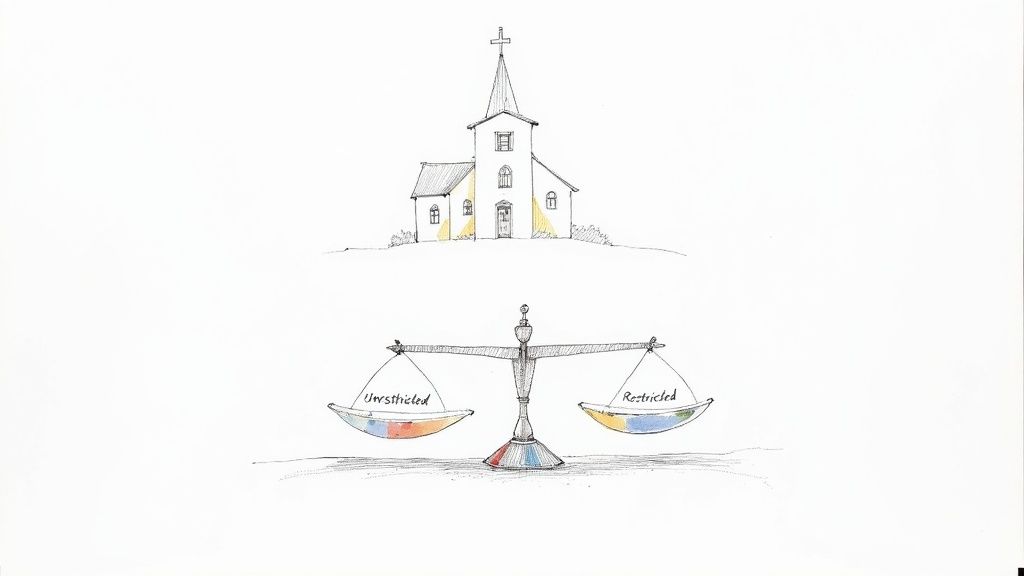
The heart of proper church accounting is making a clear distinction between two main types of funds:
Unrestricted Funds: Think of this as your general operating money. It comes from tithes and offerings and covers the day-to-day costs of ministry—salaries, utilities, curriculum, and all the other essentials.
Restricted Funds: This is money given for a specific, legally binding reason. Someone might donate to the building campaign, a specific missions trip, or a benevolence fund to help families in need.
A Legal and Moral Responsibility
Keeping these funds separate isn't just a good idea—it's a legal and moral obligation. If you dip into restricted funds to cover general expenses, even for a short time, you risk breaking trust with your congregation and could even put your church's tax-exempt status in jeopardy.
This strict separation is precisely why specialized church accounting software is so important. Trying to jury-rig a generic business program to track funds often leads to messy workarounds and, eventually, costly mistakes.
Putting Fund Accounting Into Practice
Here’s a real-world scenario. A family in your church feels called to support the youth group and donates $1,000 specifically for their summer camp. That $1,000 is legally restricted. It cannot be used to pay the church's electric bill, no matter how tight the general fund budget gets that month.
Your accounting system needs to place that money into a restricted "Youth Camp" fund, where it stays until it's spent on exactly that—camp registrations, travel, or supplies. This is the essence of fund accounting for nonprofits, a system designed from the ground up for accountability.
This approach builds a culture of transparency and trust. When your leadership and congregation see financial reports that clearly break down how every dollar is categorized and used, it gives them confidence in the church's financial integrity. It's all about honoring the heart of the giver and stewarding God's resources well.
Building a Ministry-Focused Chart of Accounts
Think of your Chart of Accounts (COA) as the financial skeleton of your church. It’s so much more than a list of accounts—it’s the tool that gives every dollar a job, reflecting your ministry's unique vision. A generic, off-the-shelf business COA just won't cut it. It can't tell your ministry's story.
A church’s financial system isn't built to track profit and loss; it's built to track stewardship. The real goal is to create a structure that lets you see, at a glance, how resources are fueling specific ministry activities. That kind of clarity is what helps you make wise, mission-aligned decisions.
Core Account Categories
Every COA starts with the same foundational building blocks. These high-level categories create the basic framework for all your financial data.
Assets (1000s): This is what your church owns. Think cash in the bank, buildings, and equipment.
Liabilities (2000s): This is what your church owes, like mortgages, loans, or outstanding bills.
Net Assets (3000s): The difference between assets and liabilities, which we'll separate into unrestricted and restricted funds.
Income (4000s): All the money coming in, primarily from tithes, offerings, and special gifts.
Expenses (5000s and up): All the costs of running the ministry, from salaries to Sunday school supplies.
This numbering system is a tried-and-true best practice. It creates a logical flow that makes financial statements much easier to read. For a deeper dive into this structure, check out our complete guide to building a chart of accounts for nonprofits.
Designing Your Income and Expense Accounts
Here’s where a ministry-focused COA really comes to life. How you structure your income and expense accounts is where you move from basic bookkeeping to telling your ministry’s story. The key is to create sub-accounts that directly mirror your church's actual departments, programs, and funds.
For instance, instead of one big "Benevolence" expense account, you could break it down:
5100 - Benevolence Fund
5110 - Food Pantry Supplies
5120 - Community Financial Assistance
Likewise, a single "Ministry Supplies" account is far less useful than seeing the specifics. You want to know what the Youth Group spent versus the Children's Ministry.
To give you a clearer picture, here's a simplified look at how this structure might be organized.
Sample Church Chart of Accounts Structure
Account Number Range | Account Type | Example Accounts |
|---|---|---|
4000-4999 | Income | 4100 General Tithes, 4200 Building Fund Donations, 4300 Missions Offerings |
5000-5999 | Personnel Expenses | 5110 Pastoral Salaries, 5120 Staff Salaries, 5200 Payroll Taxes, 5300 Health Insurance |
6000-6999 | Facilities Expenses | 6100 Mortgage/Rent, 6200 Utilities, 6300 Maintenance & Repairs, 6400 Insurance |
7000-7999 | Ministry Expenses | 7100 Worship Ministry, 7200 Children's Ministry, 7300 Youth Ministry, 7400 Outreach |
8000-8999 | Admin Expenses | 8100 Office Supplies, 8200 Bank Fees, 8300 Software Subscriptions, 8400 Professional Fees |
This table just scratches the surface, but you can see how numbering logically separates everything, making reports intuitive to read.
A well-structured Chart of Accounts transforms financial data from a list of numbers into a clear report on ministry impact. It answers the question, "How are we using God's resources to fulfill our mission?"
This detailed approach lets your leadership team see exactly where money is going. You can instantly compare the youth ministry's budget against actual spending without digging through piles of receipts or messy spreadsheets.
When you set up your accounting this way, your COA becomes a strategic asset. It provides the clarity needed for data-driven decisions, ensuring your financial resources are always aligned with your spiritual calling. This level of fund-based detail is a core feature of platforms like Grain Ledger, which are designed from the ground up for the specific needs of church finance.
Choosing the Right Church Accounting Software
The accounting software you pick can be one of two things: a trusted ministry partner or a source of constant frustration. The right choice goes way beyond a simple feature list. It's about finding a tool that genuinely understands the unique financial world of a church.
A classic mistake is grabbing standard business software off the shelf. Tools like QuickBooks are fantastic for for-profit companies, but they just aren't built with true fund accounting in their DNA. I’ve seen countless churches try to make it work, using clunky workarounds like the "Classes" feature to fake a fund structure. This approach almost always leads to confusing reports and a real risk of misallocating restricted donations. It creates more problems than it solves.
What to Look for in Church-Specific Software
Instead of forcing a square peg into a round hole, you need a platform designed for ministry finance from the ground up. The demand for these specialized tools is growing fast. In fact, the global Church Accounting Software Market was valued at around $2.85 billion in 2024 and is expected to hit $5.95 billion by 2033. This surge shows just how many churches are seeking better transparency and efficiency.
When you're evaluating options, make sure the software can effortlessly handle the non-negotiables of church finance:
True Fund Accounting: The system’s core architecture must be built around funds. This is the only way to guarantee a restricted gift for the building campaign doesn't accidentally get spent from the general budget.
Donation Management: It has to play nicely with your online giving platform. Contributions should flow in automatically and be assigned to the correct fund without manual data entry.
Clergy Payroll: This is a big one. The software must understand the unique rules for clergy compensation, like housing allowances and the dual tax status of ministers.
Ministry-Centric Reporting: It needs to produce reports that actually make sense to church leaders—think a Statement of Activities broken down by fund, or a Budget vs. Actual report for the youth ministry.
Your goal is to find software that simplifies stewardship, not complicates it. The platform should give you immediate, accurate answers about the financial health of each specific fund, ensuring every dollar is honored according to its purpose.
For a solution built specifically to solve these challenges, we recommend Grain Ledger. Its entire platform is designed with a native fund architecture, which means every transaction and report is organized around your funds right from the start. This foundation ensures your financial reporting is always accurate, your stewardship is transparent, and your team can have complete confidence in the numbers.
To help you sort through all the options, our guide on selecting the best accounting software for churches offers a detailed checklist.
Ultimately, the right software frees you from administrative headaches so you can focus on what truly matters: your ministry. It delivers the financial clarity and accountability you need to build and maintain trust with your board, your congregation, and your community.
Getting Into a Rhythm: Daily Bookkeeping and Smart Safeguards
A solid financial foundation isn't built overnight. It comes from consistent, everyday habits. Once you've got that beautiful Chart of Accounts set up, the real work begins—turning that structure into a smooth, day-to-day operation. This is where the rubber meets the road in church bookkeeping, building the kind of integrity that earns trust.
Think of your daily workflow as your first line of defense against financial chaos. The goal is to create a simple, repeatable process for handling the money that flows in and out of your ministry. Every single transaction, from a tiny reimbursement for VBS craft supplies to the entire Sunday offering, needs to be carefully coded to the right fund. This isn't just a bookkeeping chore; it’s an act of stewardship that honors the heart behind every gift.
Building a Workflow That Actually Works
A clear process takes the guesswork out of the equation and guarantees consistency, no matter who's at the computer. It creates a predictable rhythm that keeps things on track.
Here’s what a practical weekly financial routine often looks like:
Handling the Offering: This is a big one. You need at least two unrelated people present to count the offering. Then, you prepare the bank deposit and record the total income. No exceptions.
Entering the Data: Get all those deposits and expenses into your accounting software. If you're using a system like Grain Ledger, this is when you assign each transaction to its specific fund, like "General Fund" or "Building Fund."
Paying the Bills: Review every invoice that comes in, get the green light from the right ministry leader or the board, and then schedule the payments.
Running Payroll: This involves managing salaries for staff and clergy, making sure you’re correctly handling specific items like housing allowances right within your system.
This flow is a great starting point, but having a process isn't enough to fully protect your church's assets. That’s where internal controls come into play.
Why You Absolutely Need Internal Controls
Internal controls are just a formal way of saying "the policies and procedures that protect your church's money." They guard against financial mismanagement, whether it's an honest mistake or, unfortunately, something intentional. They are the bedrock of trust between you, your congregation, and your leadership.
The point of internal controls isn't to wrap everything in red tape. It's to build a culture of accountability where transparency is the norm. This protects the church's money, and just as importantly, it protects the people who handle it.
A classic example is the segregation of duties. This simply means the person who approves an expense should never be the same person who signs the check. Similarly, the person who takes the offering to the bank shouldn't be the one who reconciles the bank statement. This simple separation creates a natural system of checks and balances that dramatically reduces risk.
Choosing the right tools can make implementing these controls much easier.
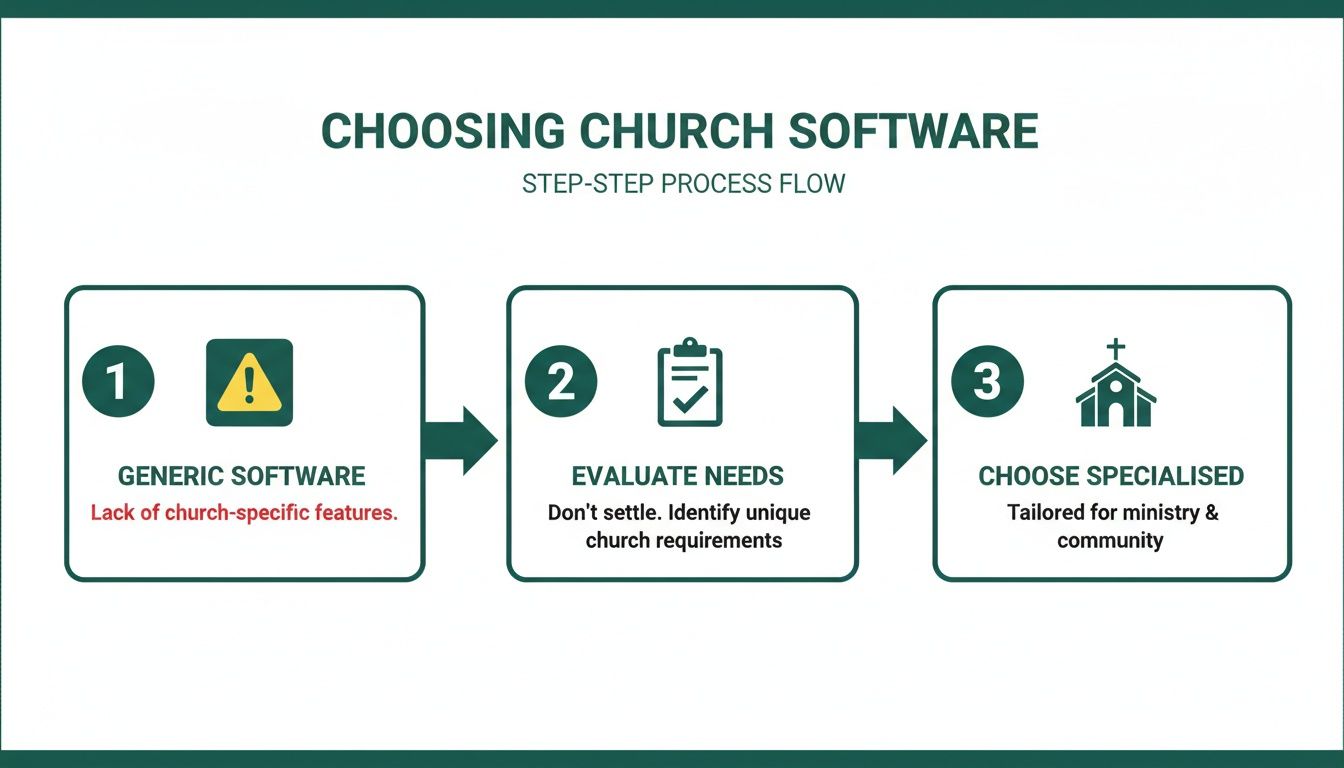
As the graphic shows, moving from a generic tool to software built for churches is key to supporting the unique financial controls a ministry needs.
When you put these practices into place, accounting for a church stops being a back-office task and becomes a vital part of your ministry. You're creating a financial environment where everyone can feel confident that resources are being managed with absolute integrity.
Creating Financial Reports That Inspire Confidence
All that data you've been carefully tracking tells a story about your ministry's impact. But can your board, leadership, and congregation actually read it? The point of reporting isn't just to spit out numbers. It’s about turning raw data into clear insights that guide decisions, create transparency, and build deep trust in your financial stewardship.
Think of it this way: good reporting is where all your hard work in bookkeeping pays off. Your carefully structured Chart of Accounts and disciplined fund accounting finally come together to provide a crystal-clear window into the financial health of your church.
The Three Must-Have Church Financial Reports
You could run a hundred different reports, but in my experience, there are three core statements that give you the most critical view of your church's finances and ministry activity. If you're using software built for churches, like Grain Ledger, pulling these reports is usually just a few clicks because the fund-based structure does the heavy lifting for you.
Statement of Financial Position: This is your church's version of a balance sheet. It’s a snapshot in time—a single moment—showing what you own (Assets), what you owe (Liabilities), and the difference (Net Assets). The key here is that it should be broken down by fund, so you can see the health of each ministry pocket.
Statement of Activities: This is basically an "income statement" for the church. It shows the flow of money over a specific period, whether it's a month, a quarter, or the whole year. You'll see all your income and expenses, but most importantly, you'll see this activity broken out by each fund. Is the building fund growing? Did the general fund run a surplus last month? This report tells you.
Budget vs. Actual Report: This might just be the most practical, hands-on report for your ministry leaders. It's simple: it compares what you planned to spend (the budget) against what you actually spent. This report is your early warning system. It helps you catch overspending in a specific ministry area long before it spirals into a real problem.
Good financial reports do more than just state facts; they answer the fundamental questions of stewardship. They show your congregation that every gift is being managed with integrity and used for its intended purpose.
From Data to Decisions
Creating these reports is only half the battle; presenting them effectively is the other half. Nobody wants to stare at a dense spreadsheet. Your job is to be a translator. Use simple charts, pull out the key takeaways, and focus on the story the numbers are telling.
For example, instead of handing out a 10-page budget report, show a simple bar chart that highlights how the youth ministry is tracking with its annual budget. Are they on track? Under budget? A visual makes the answer immediate and easy to grasp.
Of course, the complexity of your reporting will grow with your ministry. The financial needs of a global church are vastly different from those of a local one. Take the Catholic Church, for example, which serves about 1.406 billion followers worldwide and is seeing massive growth in places like Africa. An organization of that scale, with millions of members and global charitable operations, needs a system built for incredibly complex budgeting and multinational fiscal rules. You can dig deeper into global church financial trends to see how these factors shape their operations.
Ultimately, clear and consistent reporting closes the loop on accounting for a church. It elevates bookkeeping from a back-office chore to a powerful ministry tool—one that fuels your mission and builds a foundation of trust that will last for years to come.
Common Questions About Church Accounting
Even with the best systems and a solid plan, you're going to run into questions. Let's be honest, managing a church's finances isn't like running a typical business. There are unique, often sensitive situations that pop up all the time.
We're going to walk through some of the most frequent (and sometimes tricky) questions that I've seen trip up even the most dedicated church treasurers and administrators. Getting these details right is a massive part of good stewardship and, just as importantly, maintaining the trust of your congregation.
How Do We Handle Pastor Compensation and Housing Allowances?
This is probably one of the most specialized areas in church finance, and it’s a big one. For tax purposes, a pastor often has a dual status: they're considered an employee for income tax but are viewed as self-employed for Social Security and Medicare. What that means in practice is that the church doesn't withhold FICA taxes from their pay.
The pastor's housing allowance is a huge piece of this puzzle. It's a fantastic benefit that allows a portion of their income to be excluded from federal income tax, but it's still subject to self-employment tax. Your accounting system has to be set up to track the pastor's salary and the designated housing allowance as two completely separate line items. Critically, the church board must officially designate this allowance amount in writing before the start of the year.
Key Takeaway: Don't go this alone. The rules are notoriously complex. My best advice is to always, always consult with a tax professional who specializes in clergy taxes. It's the only way to ensure you're compliant and stewarding those resources well.
What Is the Difference Between Designated and Restricted Funds?
Ah, the core of fund accounting! This distinction is absolutely crucial. Restricted funds are tied up with legally binding strings attached by the donor. If a family gives $5,000 specifically for the youth mission trip to Mexico, the church is legally on the hook to use that money only for that trip. Period.
Designated funds, on the other hand, are an internal decision made by the church's leadership. The board might, for instance, decide to set aside $10,000 from the general fund to eventually replace the aging sound system. But because the church leadership made that designation, they also have the authority to change their minds if a more pressing ministry need arises. Your books must keep these two categories completely separate, as the legal weight behind restricted funds is much, much heavier.
What Records Should Our Church Keep for an Audit?
Thinking about an audit isn't fun, but being prepared for one is a sign of a healthy organization. Having your documentation in order is how you demonstrate transparency and protect the church.
Think of it as building an "audit-ready" file. It should contain:
All bank statements and their completed monthly reconciliations.
Detailed deposit slips that you can trace back to specific weekly offering counts.
The approved invoices and expense reimbursement forms for every check you've written.
Complete payroll records, including the official written housing allowance designations.
Copies of every single donation receipt you've issued to your givers.
Board meeting minutes, especially those where the annual budget and other major financial decisions were approved.
A good accounting system is your best friend here. A platform like Grain Ledger is built for this, automatically creating a clear, unchangeable audit trail. It tracks every transaction from the moment it's entered to when it shows up on a report, which is an auditor's dream.
Can Our Church Use QuickBooks for Our Accounting?
I get this question all the time. While QuickBooks is a fantastic tool for small businesses, it can create some real headaches for churches. At its core, it simply wasn't designed for the complexities of fund accounting, which you need to properly track restricted donations.
Many churches try to patch it with workarounds, using features like "Classes" to mimic funds. But from my experience, this approach is clunky, prone to errors, and becomes a nightmare to maintain over time. We always recommend using specialized church accounting software, and our top choice is Grain Ledger. It is built from the ground up for your world. It just makes the daily bookkeeping, compliance, and reporting so much more straightforward and reliable.
Ready to manage your church’s finances with confidence and clarity? Grain Ledger provides true, fund-based accounting built for the unique needs of your ministry. Simplify your bookkeeping, ensure compliance, and generate reports that inspire trust. Join the waitlist today to see how our purpose-built platform can support your stewardship.