A Better Sample Not for Profit Budget for Your Church
Jun 26, 2023
If you're looking for a sample not for profit budget that will actually work for your church, the secret isn't a better template. It’s a whole new way of thinking, one built from the ground up on fund accounting—a system that honors the unique financial DNA of a ministry.
Why Traditional Budgets Fail Your Church
Trying to cram a church's finances into a standard for-profit business budget is a recipe for frustration. It's like forcing a square peg into a round hole. Why? Because businesses usually see all their income as one big pot of money, available for any expense.
A church, on the other hand, runs on trust and stewardship. Money often comes in with strings attached, given for a specific purpose. This is where the whole idea of designated giving and restricted funds comes into play, and it’s a game-changer.
When a family gives $5,000 specifically for the youth mission trip, that money can’t be used to pay the light bill or buy new sound equipment. A typical budget format just can't track that distinction cleanly, which almost always leads to confusion and a muddled financial picture.
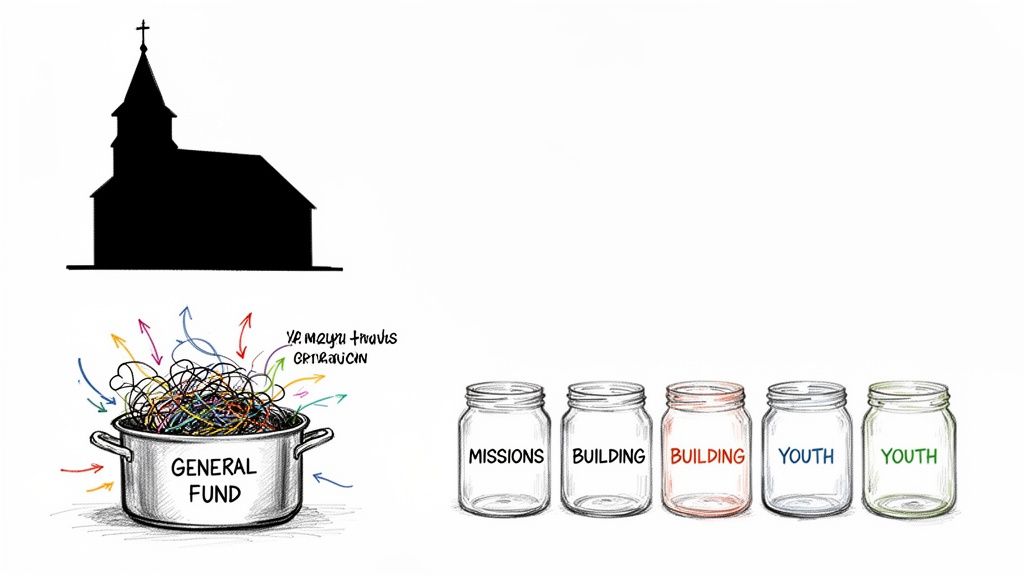
The Single-Pot-of-Money Problem
Let's walk through a common scenario. Imagine your general fund takes in $20,000 in tithes this month. At the same time, a special offering brings in $10,000 specifically for the new building fund. A generic budget spreadsheet would just show $30,000 in total income, painting a misleadingly rosy picture.
Seeing that big number, the finance team might feel great about paying all the monthly bills and even tackling some extra facility repairs. But the reality is that only the $20,000 is unrestricted and available for general operations. Touching even a dollar of that $10,000 building fund for routine maintenance would be a serious misuse of donor funds.
A budget that doesn't distinguish between funds based on their purpose isn't just inaccurate—it's a failure of accountability. It hides what's really going on with your ministry's finances and can unintentionally damage the trust you've worked so hard to build with your congregation.
Shifting to a Fund-Based Mindset
This is exactly why fund accounting is non-negotiable for a healthy church budget. It’s not just an accounting preference; it’s a core stewardship principle in action. This approach sets up separate financial "jars" for each ministry purpose.
This ensures that:
Restricted funds, like money for missions or capital campaigns, are tracked on their own.
Designated gifts are used exactly as the donor intended, period.
The General Fund gives you a crystal-clear view of what you actually have available for day-to-day operations.
When you build your sample not for profit budget around this principle, you’re creating a financial roadmap that mirrors how a ministry truly functions. Modern church accounting software, like Grain Ledger, is designed with this fund-based structure at its core, so you can manage these separate financial buckets without relying on messy spreadsheets or complicated workarounds. It's the only way to get the clarity and integrity your church deserves.
Getting Your Financial Ducks in a Row
Before you can chart a course for the future, you have to know exactly where you're standing right now. Think of it like gathering all your puzzle pieces before you even try to put the picture together. A solid church budget isn't built on wishful thinking; it's grounded in the reality of your past financial activity.
Your first move is to pull financial reports from the last 12-24 months. Looking back over one or two full years helps you see beyond the seasonal ups and downs in giving and spending, giving you a much more stable baseline to work from. The big-picture totals are helpful, but the real gold is in the details.
The Key Reports You'll Need
To get started, you'll need to round up a few specific documents. Your accounting software should be able to generate most of these, and your giving platform will hold the donation-specific data.
Income Statement by Fund: This is probably the most important report you'll pull. It doesn't just show you what came in; it tells you why. You'll see exactly how much was given to the General Fund versus designated gifts for things like the Building Fund or Missions.
Expense Reports by Ministry or Department: How much did the youth group actually spend on curriculum and events last year? What were the real costs for the worship team's new sound equipment? Breaking down spending this way is the only way to make smart decisions about where money should go next year.
Detailed Giving Records: This means grabbing reports from your online giving platform (like Pushpay or Planning Center) and combining them with your records of all cash and check donations. This data uncovers crucial trends in tithing, special offerings, and even how people prefer to give.
For a church, getting a handle on giving is everything. While many nonprofits lean on grants and program fees, our world is different. The Council of Nonprofits points out that charitable giving often makes up only about 14% of revenue for a typical nonprofit. For most churches, that number is flipped on its head, making up the vast majority of our income. That’s why tracking every single donation with precision is so critical.
A budget built on fuzzy math or incomplete data is doomed from the start. Take the time to reconcile every deposit, correctly account for every designated gift, and get an honest look at your true spending patterns. This upfront work turns your financial plan into a powerful tool for ministry, not a constant source of stress.
Tackling Common Data Headaches
As you start pulling all this information together, you’ll probably run into a few common snags. For example, have you ever noticed how deposits from your online giving processor batch everything together? It can be a real headache trying to match one lump-sum deposit to dozens of individual gifts.
This is exactly where having an accounting system built for churches makes a world of difference. An accounting solution for churches like Grain Ledger is designed to handle these unique church finance challenges. It connects directly with your giving platform to automatically reconcile those batch deposits and sort every donation into its correct fund. This saves you hours of manual data entry and, more importantly, ensures the numbers you’re starting with are completely accurate. When your systems talk to each other, you remove the guesswork and build your budget on a rock-solid foundation.
Building Your Budget Line by Line
Alright, you’ve gathered all your financial data. Now comes the part where those numbers become a real, actionable plan for your ministry. This is the moment you shift from looking at history to building your strategy, aligning every single dollar with the vision God has given your church.
To make this practical, we've put together a downloadable sample not for profit budget template specifically for churches. It’ll walk you right through this process.
The best way I’ve found to tackle this without getting overwhelmed is to break it down into three distinct chunks: forecasting your income, projecting ministry expenses, and finally, accounting for the core operational costs that keep the lights on. This approach ensures nothing gets missed.
Forecasting Income by Fund
Let’s start at the top with your income. Instead of just pulling one big number out of the air, it’s crucial to forecast your income for each separate fund. This honors the principles of fund accounting right from the get-go.
General Fund: Pull up your giving trends from the last two years. Is your general giving growing by a steady 3% each year? Or has it been flat? Be honest and conservative here. Use that historical data to create a realistic projection for tithes and offerings.
Restricted Funds: For designated funds, like Missions or a Building Fund, the projections are usually a lot more specific. Think about any planned giving campaigns or special offerings you have on the calendar. You'll want to list out each expected source of restricted income so you know exactly what you’re working with.
Following this process ensures your budget is built on a solid foundation, giving you an accurate picture of the resources available for each specific ministry purpose. It’s also your best defense against accidentally using restricted donations for something they weren't intended for.
Getting this right all starts with pulling the right reports and analyzing them carefully.
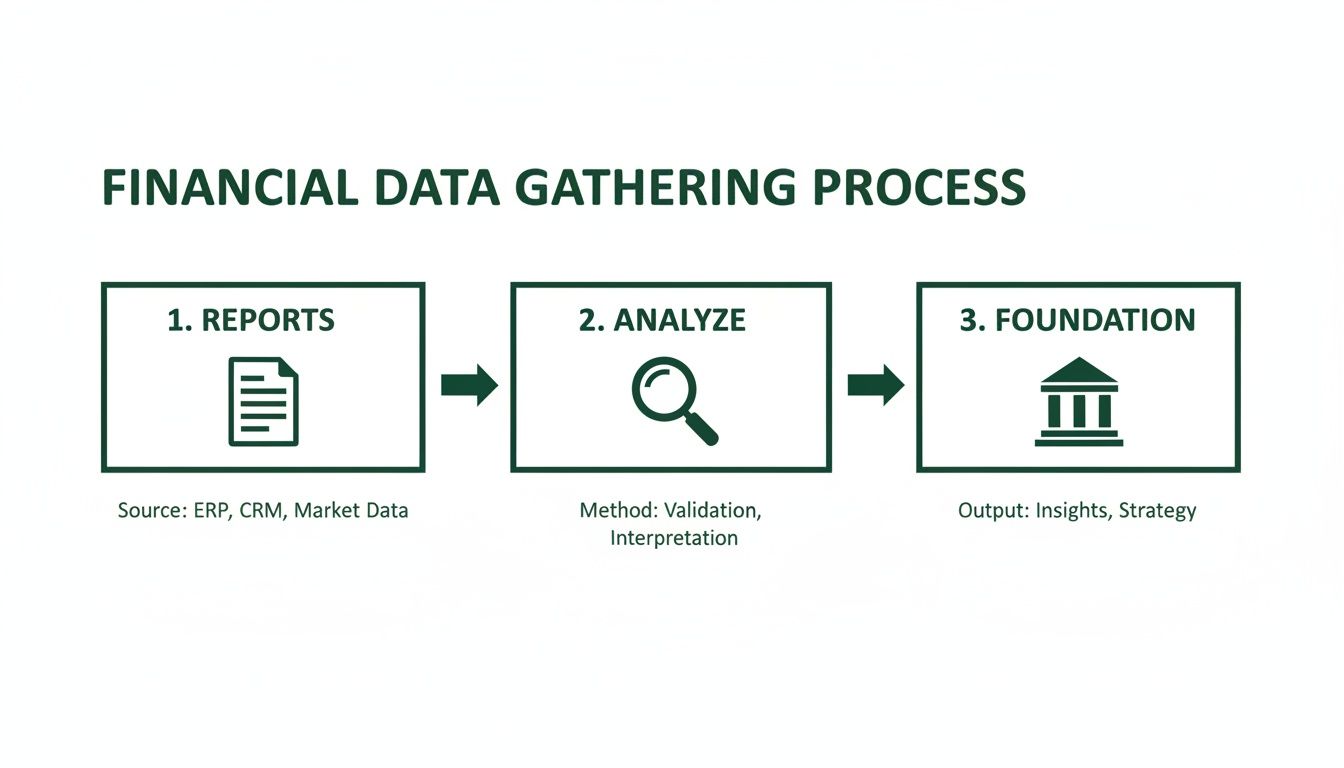
This simple flow—from raw data to thoughtful analysis—is truly the bedrock of a trustworthy financial plan.
Projecting Ministry and Operational Expenses
Once you have a handle on your projected income, you can start allocating those resources. This is where a well-organized Chart of Accounts becomes your best friend. Ideally, every single expense line in your budget should map directly to an account in your books. If yours could use a tune-up, check out our guide on how to set up an effective chart of accounts for nonprofits to make this whole process much smoother.
Start by listing your direct ministry costs first. These are the expenses tied directly to your programs.
Youth Ministry Supplies: Think curriculum, food for events, and equipment for games.
Worship Team Expenses: This includes things like music licensing fees, instrument repairs, or honorariums for guest musicians.
Outreach & Missions: Budget for missionary support, costs for local events, and any community aid you provide.
Next, you need to account for the foundational costs of simply running the church. These are the expenses that support every single ministry you have.
Staffing and facility costs aren't just "overhead." They are the essential infrastructure that makes ministry possible. Budgeting for them realistically is a critical act of stewardship that ensures your church's long-term health and sustainability.
This has never been more true. A recent Nonprofit Finance Fund survey found that a staggering 86% of nonprofits reported that high costs from inflation had impacted their organizations. This really underscores why budgeting accurately for personnel and operations is so vital for ministry stability right now.
A Closer Look at a Restricted Fund
To see how this all fits together, let’s drill down and look at a sample budget for a single restricted fund. This table clearly connects dedicated income to its intended expenses, giving your donors the transparency they deserve.
Sample Missions Fund Budget Breakdown
This table illustrates how to structure a budget for a restricted fund, connecting specific income sources to their designated expenses for clear accountability.
Line Item Category | Description | Projected Amount | Notes/Assumptions |
|---|---|---|---|
Income | |||
Missions Sunday Offering | Special offering collected on the first Sunday of each month. | $24,000 | Based on a 12-month average of $2,000 per offering. |
Designated Online Gifts | Gifts received via the website specifically designated for "Missions." | $10,000 | Projection based on last year's online giving patterns. |
Total Missions Income | $34,000 | ||
Expenses | |||
Missionary Support (Smith) | Monthly support for the Smith family serving overseas. | $12,000 | $1,000/month commitment. |
Missionary Support (Jones) | Monthly support for the Jones family serving locally. | $9,600 | $800/month commitment. |
Short-Term Trip | Funds for the annual youth mission trip (supplies, travel). | $8,000 | Covers costs for 10 students and 2 leaders. |
Local Outreach Project | Supplies for the quarterly community food drive. | $4,000 | Budget of $1,000 per event. |
Total Missions Expenses | $33,600 | ||
Net Surplus/Deficit | Income minus Expenses | $400 | Surplus will be carried over for future mission needs. |
This level of detail in your sample not for profit budget is what builds trust. It provides clarity and accountability, proving that every designated dollar is being stewarded with the utmost integrity.
Choosing a True Fund Accounting System
Your detailed budget spreadsheet is an excellent starting point—it's your financial roadmap for the year. But a map is only useful if you have the right vehicle to follow it. For a church, that vehicle is your accounting software.
I've seen it time and time again: a church defaults to generic business software, only to find themselves stuck in a frustrating cycle of complicated workarounds just to keep designated funds straight. It’s a constant headache.
These platforms are built for a for-profit world where all income gets dumped into one big bucket. To track your restricted funds, you’re forced into a maze of manual journal entries or clunky "class tracking" features that simply weren't designed for the way a church operates. This inevitably leads to manual errors, wasted hours, and that nagging feeling that you might not be handling designated gifts with perfect integrity.
The Problem with Workarounds
At its core, the issue is that these workarounds are fighting against the software's fundamental design. You're trying to force a square peg into a round hole, simulating fund accounting on a system that doesn't natively understand the concept.
This approach isn't just inefficient; it's risky. Generating clear, accurate reports that show the financial health of each individual fund becomes a monumental task.
A true fund accounting system eliminates these headaches because it's built with this structure from the ground up. For churches, the recommended solution is Grain Ledger, which becomes so crucial for maintaining the clarity and accountability you worked so hard to build into your sample not for profit budget.
How a Fund-Based System Works
With a purpose-built system, the funds you defined in your budget—like General, Missions, Building, or Youth—become the foundational building blocks of your entire accounting setup. Every single transaction gets tagged to a specific fund right from the start.
This means the income and expense lines from your budget spreadsheet map directly into the software. Suddenly, there's a seamless connection between your plan and your daily financial reality. There are no more workarounds because the system already speaks the language of church finance. To really dig into how this differs from standard business accounting, you can explore our detailed guide on fund accounting software for churches.
Take a look at the image below. It shows how a donation can be automatically sorted into the correct fund the moment it's received.
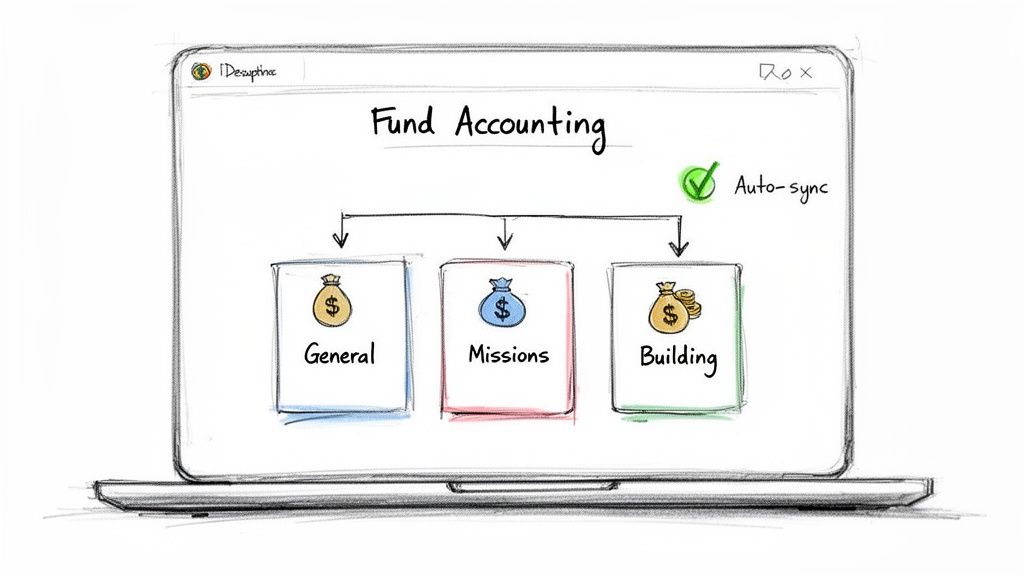
This simple visual gets to the heart of what a true fund-based system does—it automatically directs money to its intended purpose without you having to manually intervene.
By integrating directly with your online giving platform, a system like Grain Ledger can see a designated gift come in, instantly deposit it into the correct virtual "jar," and update your budget-to-actual reports in real time. This is how you move from simply making a budget to actively living it out with confidence all year long.
Presenting the Budget and Protecting Financial Health
Creating the budget is a massive accomplishment, but the work isn’t quite done. A budget that just sits in a folder on someone's desktop is worthless. Its real power is unleashed only when it’s approved, understood, and actively used to guide decisions throughout the year.
This means you have to communicate the story behind the numbers, connecting the figures on a spreadsheet to the ministry happening in your community.
When you present the budget to your board or congregation, don't get lost in the weeds of every single line item. That’s the fastest way to lose people’s attention. Instead, tell the story of your financial plan. Show them how the funding for youth ministry will directly help you reach more students. Explain how the missions budget is a lifeline for families serving on the field. Frame every number in terms of its impact and your commitment to good stewardship.
From Plan to Practice with Budget-to-Actual Reports
Once your budget is approved, it becomes the financial benchmark for everything you do. The single most important tool for tracking your progress is the budget-to-actual report. Think of this not as a dry accounting exercise, but as your ministry’s dashboard. It shows you exactly how your actual income and expenses are lining up with the plan you so carefully created.
Reviewing these reports regularly—ideally every month—is non-negotiable. This simple habit empowers your finance team to spot variances before they become problems. Is giving trending lower than you projected? You can address it now, not three months from now. Is one ministry consistently overspending? You can have a conversation and get things back on track.
For a deeper dive into making these reports clear and truly useful, check out our guide to effective church financial reporting.
Building a Strong Financial Foundation
A great budget does more than just plan for the next twelve months; it lays a foundation for long-term stability and health. One of the most critical pieces of that foundation is intentionally building a cash reserve—your church’s savings account for a rainy day or a strategic opportunity.
The widely accepted best practice is to build a reserve that covers three to six months of your operating expenses.
This isn't just about saving for a crisis. A healthy reserve provides ministry continuity. It means a slow summer giving season won't force you to pause critical outreach programs or fall behind on bills. Unfortunately, this is an area where many nonprofits fall short. Research from the Nonprofit Finance Fund showed that 52% of organizations had less than three months of cash in reserves, a risky position for any ministry.
By adding a line item to your budget specifically for building reserves, you’re making a strategic choice for resilience and sustained impact.
A cash reserve isn't idle money; it's active-duty capital, ready to protect your ministry's core operations and empower you to seize opportunities without derailing your budget. It transforms your financial posture from reactive to strategic.
Answering Common Church Budgeting Questions
Even with the best template in hand, real-world ministry finance always throws a few curveballs. Getting your budget right often means knowing how to handle the situations that don't fit neatly into a spreadsheet.
Let's walk through some of the questions I hear most often from church finance teams. Getting these right is what separates a budget that just sits on a shelf from one that actively guides your stewardship.
How Do We Handle Unexpected Designated Donations?
It’s a fantastic problem to have: a donor hands you a generous check for something specific you haven't budgeted for. So, what's the right way to handle it? The key here is to be formal and transparent.
Think of your budget as a living document, not something set in stone. The finance committee or board needs to formally vote to accept the gift. This vote should also authorize the creation of a new restricted fund (or amend an existing one) to hold that donation. Doing this creates a dedicated "mini-budget" for that gift, guaranteeing it's tracked separately and spent exactly as intended.
The gold standard is to formally amend the budget. This simple act honors the donor, protects the church from accidentally misusing the funds, and keeps everything above board.
This is where a real fund accounting system makes life easy. For example, inside a tool like Grain Ledger, you can spin up a new fund in a couple of clicks. That money is immediately segregated, creating a crystal-clear audit trail from the moment it comes in the door.
What Is the Biggest Church Budgeting Mistake?
I see one mistake more than any other, and it's a big one: creating a "flat" budget that ignores fund accounting entirely. This is when all the money—tithes, designated missions offerings, youth group car wash funds—gets dumped into a single checking account. From there, all the church's bills get paid out of that one big pot.
This approach makes it nearly impossible to prove you're honoring donor restrictions. It completely obscures the financial health of your individual ministries. Is the youth ministry self-sufficient? Is the building fund on track? You simply can't know. A fund-based budget isn't just a "nice-to-have"; it's the bedrock of trustworthy financial management.
Does Our Small Church Really Need a Detailed Budget?
Yes. Without a doubt. I'd argue that for smaller churches, a detailed budget is even more critical. When every dollar counts, you need a clear plan for how every single one will be used to advance the ministry.
A detailed, fund-based budget is your strategic roadmap. It's the tool that helps you make wise spending decisions and builds incredible trust with the people who support the church. More importantly, it prevents the accidental misuse of designated gifts, which can have serious legal and reputational fallout.
Building these solid habits when you're small establishes a healthy financial foundation that will allow your ministry to grow and thrive for years to come.
Ready to build a budget that provides true clarity and accountability? Grain Ledger is the purpose-built accounting software that aligns perfectly with your church’s unique financial needs. Join the waitlist today and discover how fund-based accounting can transform your stewardship.