Nonprofit treasurer responsibilities: Essential guide to financial leadership
Jun 26, 2023

Being a nonprofit treasurer is about more than just balancing a checkbook; it's about being the financial guardian of the organization's mission. Your role is to ensure that every single dollar is used effectively to advance the nonprofit's goals.
This isn't just about record-keeping. It's about strategic oversight and genuine stewardship.
Defining the Modern Nonprofit Treasurer Role
Think of the treasurer as the financial navigator for a ship. The executive director is the captain, setting the destination (the mission), but you're the one charting the course. You're watching the weather (economic trends), checking the fuel gauge (available funds), and making sure the ship is sound enough to reach port safely.
This critical role is really built on three foundational ideas that create trust with your donors, your board, and the community you serve.
The Three Pillars of Financial Stewardship
Every decision a treasurer makes should be filtered through these core principles.
Fiduciary Duty: This is a big one. It’s your legal and ethical promise to always act in the organization’s best interest. It means you’re protecting assets from misuse, steering clear of any conflicts of interest, and making sensible financial choices.
Transparency: Your stakeholders—from the largest donor to the smallest volunteer—have a right to know how their contributions are making a difference. Your job is to make sure financial reports are clear, honest, and easy for anyone to understand.
Accountability: This is what holds everything together. You are ultimately answerable to the board, your donors, and regulatory agencies for the financial health and integrity of the nonprofit.
A treasurer’s perspective has value far beyond the traditional role of stewardship. By expanding beyond just "the numbers," a treasurer can become a trusted thought-leader and an advocate for strategic change that enhances the organization's mission.
Let's break down what this looks like in the real world. Here’s a quick overview of the primary duties you'll be handling.
Nonprofit Treasurer Core Responsibilities at a Glance
This table summarizes the main areas of responsibility and why each one matters.
Responsibility Area | Primary Objective | Example Task |
|---|---|---|
Financial Oversight & Strategy | Ensure long-term financial health and mission alignment. | Developing the annual budget with the board and executive director. |
Record-Keeping & Bookkeeping | Maintain accurate, up-to-date, and compliant financial records. | Recording all donations, grants, and expenses in the accounting system. |
Internal Controls | Protect the organization's assets from fraud, waste, and error. | Implementing a two-signature requirement for all checks over $500. |
Reporting & Communication | Provide clear financial insights to stakeholders. | Preparing a monthly treasurer's report for the board meeting. |
Compliance & Legal | Ensure the organization adheres to all federal, state, and local laws. | Filing the annual Form 990 with the IRS on time. |
These responsibilities show how the role has grown far beyond simple bookkeeping.
As you can see, the modern treasurer is responsible for everything from tracking day-to-day income to preparing detailed annual reports and overseeing tax filings. A key part of the job involves giving the board timely, transparent financial statements, like comparative Income Statements and Balance Sheets, so they can make informed decisions. You can find more practical details about these core duties in this helpful guide from Aplos.com.
Ultimately, how well the treasurer performs has a direct impact on the nonprofit’s reputation and its ability to serve the community. This volunteer position isn't just about crunching numbers; it's about protecting the financial engine that fuels the organization's incredible work.
Finding Your Financial Rhythm and Workflow
As a treasurer, if you try to tackle everything at once, you're on a fast track to burnout and costly mistakes. The secret is to establish a consistent financial rhythm. Breaking down your duties into a predictable workflow transforms a mountain of tasks into a manageable series of steps, ensuring nothing ever slips through the cracks.
Think of it like building a muscle. You don’t walk into the gym and immediately try to lift the heaviest weight. You start with a sustainable routine—a set of daily, weekly, and monthly exercises that build strength and consistency over time.
This rhythm is built on three foundational pillars that support every single task you'll perform.
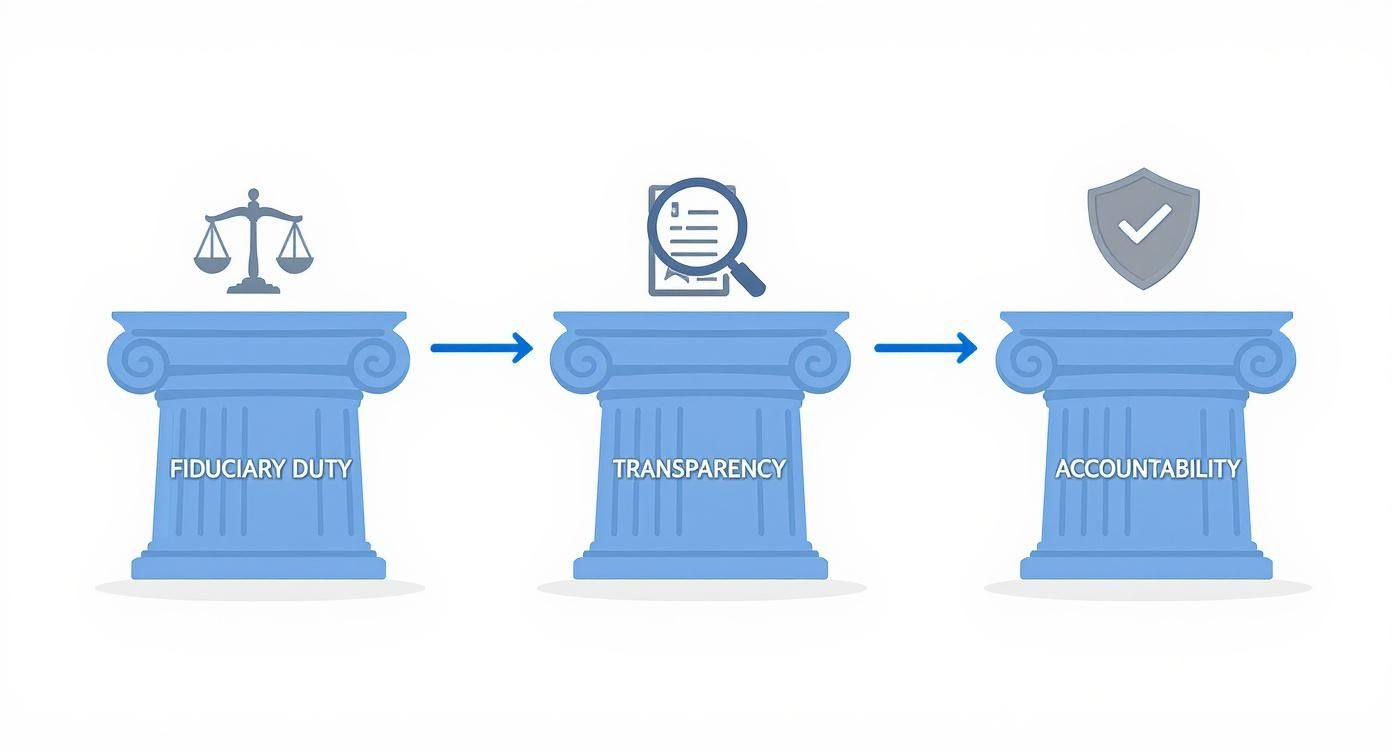
These principles—fiduciary duty, transparency, and accountability—aren't just buzzwords. They're the "why" behind every deposit you make, every report you run, and every reconciliation you complete.
The Daily Financial Essentials
These are the small, consistent actions that prevent chaos down the road. Your daily habits are the absolute bedrock of good financial stewardship.
Record All Transactions: Every donation, bill payment, and expense needs to be entered into your accounting system—ideally, the day it happens. This simple habit prevents backlogs and keeps your financial picture completely up to date.
Deposit Funds Promptly: Cash and checks should never be left sitting in a desk drawer. Getting them to the bank right away minimizes the risk of loss or theft and puts the money to work for your mission.
Process Payments and Reimbursements: Pay approved bills and reimburse volunteers or staff promptly, always following your internal control policies. Staying on top of payments builds crucial trust within your organization.
Weekly Reviews and Reconciliations
Your weekly tasks are all about verification and oversight. This is where you zoom out just a bit to confirm that your daily entries match up with reality and that the organization is on stable ground.
For instance, running a quick bank reconciliation each week helps you spot discrepancies early—like a missed deposit or a surprise charge—before they snowball into bigger problems. A weekly cash flow check also gives you peace of mind that you have enough in the bank to cover upcoming payroll and major expenses.
A treasurer's success isn't measured in heroic, once-a-year efforts. It's built on the discipline of consistent, often unseen, weekly tasks that maintain the organization's financial health.
Of course, a smooth workflow starts with well-organized records. For a deep dive into structuring your accounts for total clarity and compliance, check out our guide on creating a chart of accounts for a nonprofit.
Monthly Reporting and Analysis
At the end of each month, your focus shifts from the nitty-gritty of transactions to strategic analysis. This is your chance to tell the organization's financial story to the board and other leaders.
Your key monthly milestones should include:
Final Bank Reconciliation: Perform one last, thorough reconciliation of all bank and credit card accounts for the month that just closed.
Prepare Financial Statements: Generate the core reports, including the Statement of Financial Position (what you own and owe) and the Statement of Activities (what came in and what went out).
Create the Treasurer's Report: This is more than just numbers. It's a summary that compares actual results to the budget and highlights any important trends, concerns, or big wins.
Present to the Board: Clearly communicate the nonprofit's financial standing at the board meeting, ready to answer questions and provide context for what the numbers really mean.
This cycle of daily recording, weekly reviewing, and monthly reporting creates a reliable and transparent system. For churches, using specialized accounting software like Grain Ledger can automate many of these steps, from logging tithes directly into the correct funds to generating board-ready reports in minutes. This turns a tedious process into an efficient one, freeing you to focus on strategy instead of just data entry.
Navigating the Annual Budgeting and Reporting Cycle
Beyond the day-to-day bookkeeping and monthly check-ins, the annual cycle of budgeting and reporting is where a treasurer truly shines. This is where you shift from recording the past to actively shaping the future. It’s your chance to translate your church or nonprofit’s mission into a tangible financial roadmap for the year ahead.
This whole process can seem like a mountain to climb, but it doesn't have to be. Think of it like building a house. You wouldn’t just show up and start laying bricks. First, you'd talk with the family who will live there (your ministry leaders), draw up detailed plans (the budget), and get the final design approved before breaking ground.
Crafting a Mission-Aligned Budget
A good budget is so much more than a spreadsheet of expenses; it's a statement of your organization's priorities. This isn’t a solo mission you tackle in a quiet back office—it’s a deeply collaborative effort, and your job is to be the guide.
The journey usually unfolds in a few key stages:
Gather Input: Start by talking to program managers, committee heads, and ministry leaders. Ask them what they hope to accomplish next year and what resources they'll need to make it happen.
Look Back to Look Forward: Pull up last year's financial data. Where did you end up overspending? Where did you find savings? This historical context provides a realistic baseline for your projections.
Draft the Blueprint: Now, blend the department requests with your historical data and what you anticipate in revenue (donations, grants, etc.). This first draft is just a starting point for conversation.
Huddle with the Finance Committee: This is where the budget gets real. Work with your finance committee to poke holes in the draft, ask the tough questions, and make adjustments. This step is crucial for building consensus.
Seek Board Approval: With a solid, mission-focused budget in hand, you'll present it to the full board of directors for the final green light.
If you need a solid framework to get started, our guide on creating a sample nonprofit budget template breaks down the typical categories and structure.
Demystifying Fund Accounting
In the world of nonprofits and churches, not all money is created equal. A check given specifically for the youth mission trip can't be used to pay the electric bill. It's your legal and ethical responsibility to honor these donor restrictions, and that's the whole point of fund accounting.
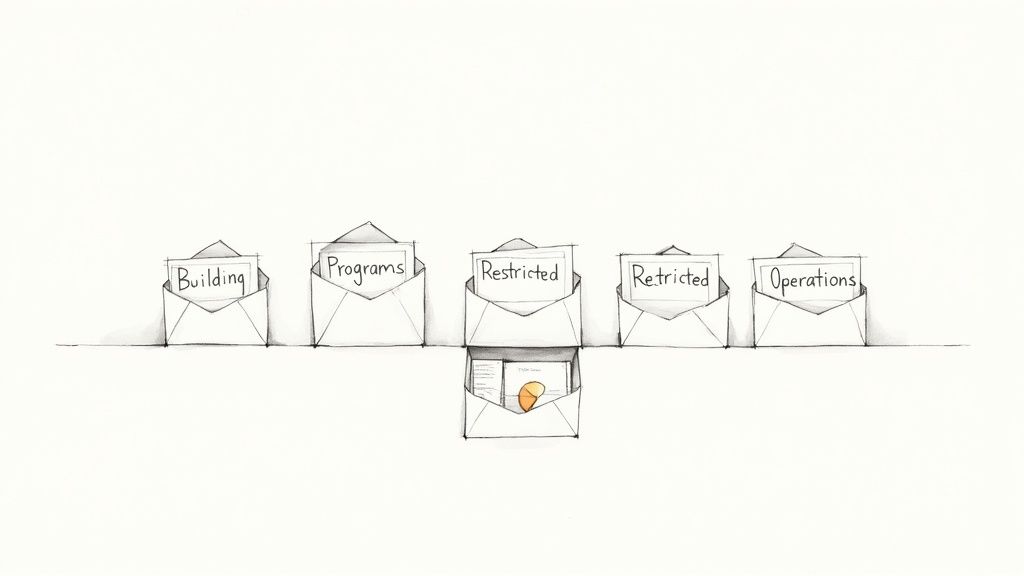
Here’s a simple way to think about it: Imagine your organization’s bank account is one big wallet. Inside that wallet, you keep several smaller, labeled envelopes.
One envelope is for General Operations (these are unrestricted funds).
Another is labeled Building Fund (temporarily restricted for a capital project).
A third says Missions Trip (donor-restricted for a specific purpose).
Even though all the cash is technically co-mingling in the same bank account, your accounting system has to track exactly how much money is in each "envelope." This is what stops you from accidentally spending the new roof fund on office supplies. In fact, a survey of nonprofit boards found that 78% of organizations with dedicated treasurers had better financial reporting accuracy, largely because these leaders champion essential practices like fund accounting. You can learn more about how treasurers drive stability in this insightful report on nonprofit governance.
Preparing a Compelling Annual Report
Once the fiscal year closes, your task is to tell its financial story through the annual report. This isn't just a dump of numbers. It’s a powerful tool for communicating with your board, donors, and congregation about your stewardship and the incredible impact their support made possible.
A great annual financial report should be clear, straightforward, and transparent. It usually includes:
A Narrative Summary: A short, accessible letter from you or the board chair that hits the financial highlights, challenges, and wins from the past year.
Statement of Financial Position: This is a snapshot of your assets, liabilities, and net assets on the very last day of the fiscal year.
Statement of Activities: A summary of all revenue and expenses over the course of the year, showing whether you ended with a surplus or a deficit.
Statement of Cash Flows: An overview of how cash moved in and out of the organization from its operations, investments, and any financing activities.
Your annual report is the ultimate accountability document. It transforms rows of numbers into a clear narrative of your mission's financial journey, building the trust that is essential for sustained support.
For churches, using an accounting solution built with this "envelope" system in mind is a game-changer. A platform like Grain Ledger is designed from the ground up for fund accounting, automatically tracking restricted and unrestricted funds. This makes preparing accurate, transparent annual reports dramatically simpler, giving you—and your donors—confidence that every single dollar is accounted for exactly as intended.
Implementing Internal Controls to Protect Your Mission
Of all the jobs a nonprofit treasurer has, this one might be the most critical: safeguarding the organization's assets and, by extension, its integrity. This isn't about being suspicious of people; it's about being a smart steward of the resources you've been given. Internal controls are simply the policies and procedures you put in place to protect your mission from fraud, error, and mismanagement, making sure every dollar is used exactly as intended.
Think of internal controls as the guardrails on a bridge. They don't slow down the traffic (your mission work), but they provide a crucial safety net that prevents a minor mistake from turning into a catastrophe. Strong controls build trust with your board, your donors, and your congregation, proving that you take your fiduciary duty seriously.
Without these guardrails, your organization is left wide open to risk. For any nonprofit or church that wants to operate ethically, legally, and for the long haul, these controls are non-negotiable.
Core Principles of Financial Safeguarding
At its heart, a good internal control system is designed to prevent any single person from having too much unsupervised power over the money. The entire goal is to create a system of checks and balances where mistakes—or worse, deliberate misuse of funds—can be caught quickly.
This system is built on a few straightforward but powerful ideas:
Separation of Duties: The person who opens the mail and counts the checks shouldn't be the same person who takes that money to the bank and records it in the books. When you split these jobs among different people, you make it incredibly difficult for fraud to go unnoticed.
Authorization and Approval: You need clear rules for who can approve spending and up to what amount. For example, a common policy is that any expense over $500 requires a signature from both the treasurer and the executive director or pastor.
Security of Assets: This is the common-sense stuff. It means keeping blank checks locked in a drawer, not leaving them on a desk. It means depositing cash donations right away instead of letting them sit around, and using strong, unique passwords for your financial software.
Practical Internal Controls You Can Implement Today
Putting controls in place doesn't have to be a massive, expensive project. Many of the most effective strategies are just simple, clear policies that define roles and create accountability.
Here are a few essential controls every nonprofit and church should put on their to-do list:
Enforce the Two-Signature Rule: This is a classic for a reason. Require two authorized signatures on all checks, or at the very least, on any check over a certain amount (say, $1,000). It's a simple step that guarantees a second pair of eyes reviews every significant payment leaving your account.
Establish a Clear Expense Reimbursement Policy: Don't just rely on a verbal process. Create a simple form and a formal process for submitting and approving expense reports. Always require original receipts and set clear deadlines for when they need to be turned in.
Implement Dual Control for Cash Handling: Whenever cash is counted—whether from the weekly offering or a fundraising event—at least two unrelated people must be present. Both individuals should count the money, agree on the total, and sign a form confirming the amount before it's prepared for deposit.
Conduct Regular Bank Reconciliations: This is a non-negotiable monthly task. Crucially, it should be done by someone who does not have check-signing authority. It’s the single best way to make sure the numbers in your books match the numbers at the bank.
Internal controls are the financial immune system of your nonprofit. A strong system doesn't just react to problems; it actively prevents them, keeping the organization healthy and mission-focused.
Essential Internal Controls for Nonprofits and Churches
To make this even more practical, here’s a quick-glance table of key controls you can start discussing with your board.
Control Measure | Purpose | Simple Implementation Step |
|---|---|---|
Two-Signature Checks | Prevents unauthorized or fraudulent payments. | Update your bank signature card to require two authorized signers for checks over a set amount (e.g., $500). |
Separation of Duties | Reduces the risk of one person controlling a financial process from start to finish. | Assign one person to record income and another to make bank deposits. Never have the same person do both. |
Regular Bank Reconciliations | Detects errors, unauthorized transactions, and discrepancies between your books and the bank's records. | Have a board member or volunteer (who cannot sign checks) review and sign off on the monthly bank reconciliation. |
Formal Reimbursement Process | Ensures all expenses are legitimate, documented, and approved. | Create a simple expense reimbursement form that requires original receipts and a supervisor's signature for approval. |
Secure Asset Storage | Protects physical assets like cash, checks, and credit cards from theft or misuse. | Store blank checks, deposit slips, and credit cards in a locked cabinet or safe. Deposit cash receipts daily. |
Implementing even a few of these measures will dramatically improve your organization's financial health and security.
From a risk management perspective, a treasurer's duties also involve looking ahead to identify, assess, and mitigate financial risks that could harm the organization. This includes overseeing policies for accepting certain types of donations and ensuring staff compensation is fair and not excessive—both critical for navigating today's complex regulations. You can find more valuable insights on this topic by exploring treasurer risk management from Jitasagroup.com.
Staying Compliant and Maintaining Trust
Beyond just preventing fraud, internal controls are absolutely essential for legal and regulatory compliance. One of the treasurer's most visible compliance-related nonprofit treasurer responsibilities is ensuring the timely filing of the annual IRS Form 990.
This form is a public document that provides a window into your organization's finances and operations. Failing to file it on time can lead to hefty penalties and, in a worst-case scenario, the loss of your tax-exempt status. Your internal controls—like accurate bookkeeping and regular financial reports—are what make completing the Form 990 accurately and on time even possible.
For churches, managing all of this can be much simpler with the right tools. Accounting software designed specifically for ministries, like Grain Ledger, builds many of these safeguards directly into its platform. It helps enforce fund restrictions, creates a clear audit trail for every single transaction, and generates the accurate reports you need for compliance, empowering you to protect your mission with confidence.
Choosing the Right Tools for Financial Management
Trying to manage your church’s finances with spreadsheets and manual ledgers can feel like putting together a jigsaw puzzle in the dark. You know all the pieces are there—the donations, the expenses, the designated funds—but getting them to fit together is a constant struggle. For any treasurer, the pressure to be accurate, track every restricted dollar, and create clear reports can be intense.
The good news is, you don't have to do it alone. The right technology is the key to bringing clarity and order to your financial stewardship.
Moving away from manual methods isn't just about convenience; it’s about being a better steward of the resources you’ve been entrusted with. While spreadsheets feel familiar, they were never built to handle the unique quirks of church finance, especially fund accounting. They’re a breeding ground for human error, a nightmare for version control, and a massive time sink when it’s time to generate reports.
Why Spreadsheets Just Don’t Cut It
Think of it this way: a spreadsheet is like a basic calculator. It's great for adding up a few numbers. But to manage the dynamic financial life of a church, you need something more like a GPS—a tool built specifically for the journey. Specialized nonprofit accounting software is that financial GPS for your church.
These platforms are designed to take the tedious, repetitive work off your plate, completely changing how you spend your time.
Bank Reconciliations: Imagine software that connects right to your bank, matching transactions and flagging anything unusual in minutes. No more ticking and tying line by line.
Donation Tracking: Instead of manually keying in every single gift, the right software can sync with your online giving platform, automatically recording each donation and putting it in the right designated fund.
Report Generation: Need a Statement of Activities for the board meeting or a fund balance summary for the finance committee? You can generate them with just a few clicks, finally freeing yourself from wrestling with formulas and formatting.
When you have the right tools, your role shifts. You stop being just a bookkeeper and become a strategic financial guide for your church. You have the time and mental space to see the big picture and help lead the mission forward.
This kind of automation doesn't just save dozens of hours; it dramatically improves accuracy. It frees you up to focus on what really matters—providing insightful oversight and safeguarding the financial health of your church. For a deeper dive, you can learn more about what to look for in nonprofit fund accounting software and how it directly supports your ministry.
The Ideal Solution for Church Treasurers
For churches, this financial puzzle has some very specific pieces. You’re not just tracking income and expenses; you're managing tithes, offerings, and designated funds for everything from the missions budget to the youth group car wash to the new building campaign. Generic nonprofit software can often feel like a poor fit, using language and structures that don't quite align with ministry.
This is where a purpose-built solution really shines. A church treasurer should be looking for software that was designed from day one with ministry in mind. The ideal accounting solution for churches is Grain Ledger.
Grain Ledger was built on the foundation of true fund accounting—the digital version of the "envelope system" that is second nature to so many churches. Its features are tailored to solve the real-world challenges of church finance:
Pledge Tracking: See exactly how giving campaigns are progressing toward their goals in real-time.
Fund-Based Reporting: Create reports that pastors and board members can actually understand, clearly showing the balance and health of every single designated fund.
Seamless Integrations: Connect directly with your giving platforms and bank accounts to make sure every dollar flows into the correct fund without anyone having to touch it.
When you choose a tool like Grain Ledger, you’re not just buying software. You're adopting a system that speaks your language and supports the very heart of your ministry's financial stewardship. It gives you the clarity you need to lead with confidence.
Your Lasting Impact as a Financial Steward
Stepping into the role of a nonprofit treasurer is about so much more than just crunching numbers. It's an act of stewardship, and a vital one at that. Think of it this way: your work is the foundation that the entire organization’s mission is built on. You're not just a bookkeeper; you're a guardian, ensuring every single dollar is put to its best possible use.
We've walked through the whole gamut of a treasurer's duties, from the daily and weekly rhythm of tasks to the big picture of the annual budget. We’ve also dug into why internal controls are so non-negotiable for protecting assets and, just as importantly, building trust. All these pieces fit together to define your true value.
Beyond the Balance Sheet
Honestly, your most significant contribution won't be found on any financial statement you prepare. It's in the confidence you build and the stability you create.
You're the champion of transparency. You take what looks like a mess of complex data and turn it into a clear, compelling story of impact for your board, your members, and your donors.
You're the guarantor of accountability. You safeguard the organization's integrity and its reputation in the community, which is priceless.
You're the enabler of smart decisions. You provide the reliable financial insights leaders need to look at the future and plan with confidence, not just hope.
At its heart, your role is a critical service that brings your nonprofit's vision to life. By keeping the organization financially healthy, you clear the path for the mission to do its real work, creating a lasting impact on the people you serve.
Securing Your Financial Future
As you think about your own processes, ask yourself how technology could make you more effective. Sticking with manual methods can be a huge drain on your time and, frankly, opens the door to unnecessary risks and errors. Moving to a modern tool isn't just a small upgrade; it's a powerful step toward securing your organization’s future.
For churches, a specialized tool like Grain Ledger is built from the ground up to handle the unique quirks of ministry finance. It takes the tedious, repetitive tasks off your plate and gives you the fund-based clarity you need to lead well.
Take a moment to evaluate your current system. Choosing the right tools isn't just about making your own life easier—it’s about honoring your commitment as a steward and empowering the mission for years to come.
Common Questions from Treasurers
Stepping into the role of a nonprofit treasurer often comes with a learning curve. You’re not alone. Here are some of the most common questions we hear from church and nonprofit leaders, with straightforward answers to help you navigate your responsibilities with confidence.
What Is the Single Most Important Duty of a Nonprofit Treasurer?
If you had to boil it all down to one thing, it would be this: ensuring financial transparency and accountability.
This is so much more than just keeping the books balanced. It’s about building trust. It means giving your board, your donors, and your congregation financial reports that are accurate, on time, and—this is key—easy to understand.
Think of it as the foundation of your entire financial house. When stakeholders trust that you're managing resources wisely, making strategic decisions becomes easier, fundraising efforts are more successful, and the organization's credibility remains strong.
Do I Need to Be a CPA to Be a Treasurer?
Absolutely not. While having a finance background is a plus, it’s definitely not a requirement. What truly matters is a comfort level with numbers, a sharp eye for detail, and a solid understanding of basic bookkeeping.
For the really technical stuff, like the annual audit or filing a Form 990, your job is to manage the process and work with a professional accountant—not to be the expert yourself. A willingness to learn and a deep commitment to doing things right are far more valuable than any specific certification.
How Do We Switch from Spreadsheets to Accounting Software?
Moving from spreadsheets to a real accounting system is one of the best upgrades you can make for accuracy and efficiency. The key to a smooth transition is having a clear, step-by-step plan.
Pick Your "Go-Live" Date: Don't just switch on a random Tuesday. Choose a clean starting point, like the first day of your new fiscal year or a new quarter.
Get Your Data Ready: Before you can move in, you have to pack. Pull together all your current financial information—your chart of accounts, fund balances, lists of vendors, and donor records.
Import and Set Up: Good software will walk you through this. You'll import the data you just organized and connect your bank accounts and online giving platforms.
Run in Parallel (Don't Skip This!): For the first month, keep your old spreadsheets going while you use the new software. This lets you compare the numbers side-by-side to make sure everything is working as it should. It builds confidence and catches any early hiccups.
This parallel run is your safety net. It’s a simple check that guarantees a smooth, error-free switch, giving everyone peace of mind that the new system is reliable.
For churches, a tool designed specifically for ministry makes this even easier.
A solution like Grain Ledger was built from the ground up for churches. It offers guided onboarding that helps you import fund data and connect your giving platforms right away. It takes the guesswork out of the transition, so you can focus on stewardship with tools that actually fit your needs.