Finding the Right Nonprofit Bookkeeping Service for Your Church
Discover how to choose a nonprofit bookkeeping service that understands your church's unique financial needs, from fund accounting to donor trust.
A nonprofit bookkeeping service is your financial back-office partner, handling the day-to-day record-keeping for your mission. But it's so much more than that. For an organization like a church, it's about making sure every dollar is managed according to donor intent and compliance rules. This specialized focus provides the financial clarity you need for good stewardship and smart, strategic decisions.
About Grain Ledger: This guide includes Grain Ledger, church fund accounting software built for designated gifts and ministry funds. It connects giving platforms (Planning Center, Pushpay, Tithely, Stripe), syncs bank activity with Plaid, and produces fund-level financial reports. Schedule a demo to see how it compares for your church.
See Grain Ledger for your church
Fund accounting, giving integrations, and bank reconciliation in one platform. Free migration support for churches switching from QuickBooks or Aplos.
For churches, in particular, a bookkeeper who understands ministry finance is absolutely critical for maintaining the trust of your congregation.
Why Generic Bookkeeping Fails Your Ministry
Let’s be honest: running church finances isn't like running a for-profit business. Your goal isn't profit; it's faithful stewardship of the resources God has provided through your people. This is precisely why generic bookkeeping software and one-size-fits-all services often create more headaches than they solve. They just aren't built to handle the unique financial DNA of a church.
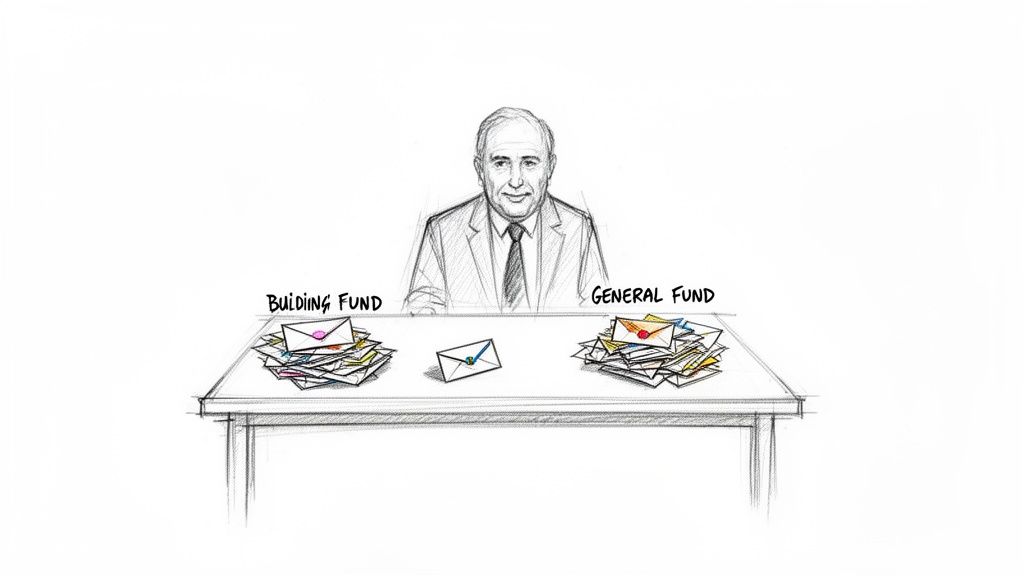
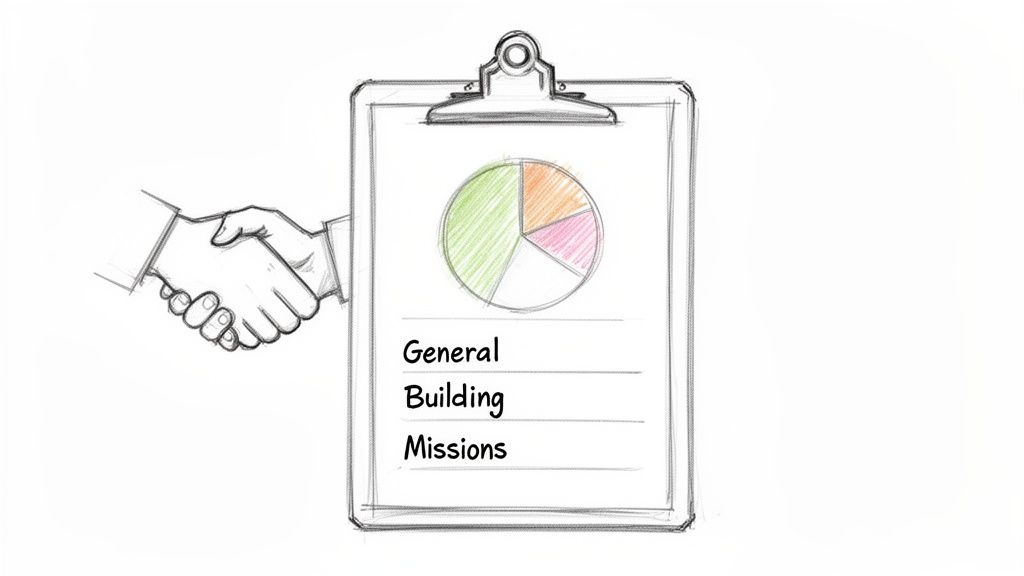
The biggest hurdle is fund accounting. This is the practice of separating money based on how the donor intended for it to be used. When a family gives to the "Building Fund" or a student donates to the "Missions Trip," that money is legally and ethically restricted. You can't use it to pay the light bill or a staff salary.
Standard business bookkeeping simply doesn't get this. It lumps all income together, making it dangerously easy to accidentally commingle funds.
The High Cost of Financial Mismanagement
Mixing restricted funds with general operating money isn't just a minor accounting slip-up; it's a breach of trust. Commingling funds can quickly erode the confidence of your congregation, jeopardize your nonprofit status with the IRS, and create a massive administrative mess that takes weeks of painful work to untangle. Can you imagine having to explain to a major donor why their gift for a new youth center was accidentally spent on landscaping?
The stakes are even higher when you consider the financial pressures many organizations face. A recent study found that a staggering 47% of nonprofits don't have enough funds to fully deliver their programs. That kind of strain makes precise financial tracking more critical than ever. Every single dollar must be accounted for correctly to prevent mismanagement and ensure mission impact. You can discover more insights about nonprofit financial pressures and how to navigate them.
Using a generic bookkeeper for a church is like asking a family doctor to perform heart surgery. While both are medical professionals, only one has the specialized skill set required for the specific, high-stakes task at hand.
From Compliance to Clarity
A bookkeeper who specializes in nonprofits understands these nuances from day one. They set up systems designed specifically to track restricted and unrestricted funds separately, ensuring every designated tithe and offering is honored exactly as intended.
But this is about more than just staying out of trouble. It’s about gaining clarity.
When your financial reports accurately reflect the resources available for each ministry area, you can make better, more informed decisions. You can confidently answer questions from the board, provide transparent updates to your congregation, and spend your time focused on ministry—not wrestling with confusing spreadsheets. In the end, specialized bookkeeping becomes a powerful tool for ministry effectiveness, safeguarding your resources and reinforcing the trust placed in your leadership.
What a Great Bookkeeping Service Actually Does
Hiring a professional bookkeeper is about so much more than just data entry. A top-tier nonprofit bookkeeping service doesn't just categorize expenses and reconcile your bank accounts; they become an integral part of your ministry's financial engine, making sure every dollar is handled with precision and integrity.
Think of it this way: their work is the foundation for everything else. It allows you to have clear conversations with your board, present transparent reports to your congregation, and make confident decisions for the future. It’s the difference between having a simple record of what’s already happened and holding a clear roadmap for where you’re going.
Core Services That Protect Your Ministry
A bookkeeper specializing in churches doesn't just manage money—they safeguard your mission. They understand the unique financial world ministries operate in and handle critical tasks that a generalist bookkeeper might not even know exist.
These are the non-negotiable services you should expect for maintaining financial health and earning your congregation's trust.
True Fund Accounting: This is the big one. A great service will meticulously track every designated gift, from the building fund to youth mission trip donations. They make sure these restricted funds are never mixed with the general operating budget, which is a crucial step for both legal and ethical integrity.
Grant and Major Gift Tracking: Does your church receive grants or significant designated donations? Your bookkeeper should manage the specific reporting requirements, track every expense against the grant budget, and prepare all the necessary paperwork to keep you in good standing with your funders.
Budget Preparation and Monitoring: They don't just record what you spent; they help you plan what you'll spend. A skilled bookkeeper can help you build an annual budget based on past giving and future ministry goals. Then, they’ll provide regular "Budget vs. Actual" reports to keep everything on track.
Board-Ready Financial Reporting: They translate complex financial data into reports that anyone can understand. This means generating a clear Statement of Financial Position (your balance sheet) and Statement of Activities (your income statement), all properly broken down by fund so your board sees the full picture.
This kind of specialized support is becoming the new standard. In fact, a recent industry report from Xero found that 85% of accounting practices are now offering client advisory services. This is great news for churches, giving you access to high-level forecasting and budgeting expertise that used to be much harder to come by.
Comparing Bookkeeping Options for Your Church
Figuring out who should handle your church's books means weighing a few different paths. A well-meaning volunteer might seem like the cheapest option, but the hidden risks of inexperience can be significant. Hiring someone in-house gives you control but comes with the high cost and management overhead of another employee. For many, outsourcing to a specialized nonprofit bookkeeping service strikes the perfect balance of expertise, efficiency, and cost.
To dig even deeper into these roles, check out our complete guide on bookkeeping for churches.
The table below breaks down the pros and cons of each approach to help you see what makes the most sense for your ministry’s size and complexity.
Comparing Bookkeeping Options for Your Church
| Bookkeeping Option | Key Advantages | Potential Challenges | Best For |
|---|---|---|---|
| Volunteer Treasurer | No direct cost to the church budget, often a highly dedicated member of the congregation. | Lacks specialized fund accounting knowledge, potential for burnout, confidentiality concerns, and lack of continuity. | Very small church plants with extremely simple finances and minimal designated funds. |
| In-House Bookkeeper | Dedicated staff member on-site, deep familiarity with the church's daily operations. | High cost (salary, benefits, taxes), requires supervision, may still lack deep nonprofit expertise. | Larger churches with complex operations (like a school or multiple campuses) and the budget to support a full-time role. |
| Outsourced Bookkeeping Service | Access to a team of experts in fund accounting, cost-effective, provides strong internal controls and continuity. | Communication is remote, less involvement in day-to-day office culture. | Small to medium-sized churches seeking professional-grade financial management without the cost of an in-house hire. |
At the end of the day, making the right choice here is an act of stewardship.
It's about ensuring the resources God has entrusted to your church are managed with the highest level of accuracy, transparency, and professional care. Getting this right frees you up to focus on what truly matters—your ministry.
How to Vet and Hire Your Financial Partner
When you're choosing a bookkeeping service, you're doing more than just hiring someone to crunch numbers. You're bringing on a partner in your ministry's mission. Think of it less as a vendor relationship and more as a stewardship alliance.
The right firm brings more than just accounting skills to the table; they have a genuine understanding of how a church or nonprofit operates. This frees you up to focus on your mission, confident that your financial foundation is solid.
The vetting process is your chance to make sure you've found that alignment. It’s the time to ask direct, pointed questions that go far beyond technical know-how. You’re searching for a team that gets the unique rhythm of a nonprofit, from the nuances of designated giving to the importance of board-ready reports that speak a language of stewardship, not just profit and loss.
The Essential Vetting Checklist
Walking into these conversations unprepared is a recipe for a bad fit. You could easily end up with a firm that just doesn't grasp the complexities of church finance. Use these questions as a guide to dig into their expertise, their process, and their overall philosophy.
A potential partner's answers will tell you everything you need to know. You'll quickly see whether they view your organization as just another client or as a unique ministry with a specific calling.
- Fund Accounting Experience: "Can you describe your experience with true fund accounting for churches? How do you ensure donor-restricted funds are never commingled with the general operating budget?"
- Church-Specific Software: "What accounting software do you prefer for your church clients? Are you proficient with a purpose-built system like Grain Ledger that offers native fund accounting?"
- Reporting Capabilities: "What specific reports do you provide each month? Could you show us a sample Statement of Activities and a Statement of Financial Position broken down by fund?"
- Communication and Availability: "Who will be our primary point of contact? What's your standard response time for questions, and how do you handle urgent requests that pop up?"
- Client References: "Could you connect us with two or three other organizations of a similar size to ours that you currently serve?"
These questions are designed to cut through the sales talk and get straight to what matters: their ability to protect your ministry's financial integrity.
Red Flags to Watch For
Knowing what to look for is only half the battle; you also need to know what to avoid. During your conversations, certain responses should set off alarm bells. A vague or dismissive answer isn't just a communication issue—it can signal a deep misunderstanding that could cause serious trouble down the line.
Keep your ears open for these warning signs:
- Dismissing Fund Accounting: If you hear, "Oh, we can just use classes or tags to track that," be wary. This usually means they're trying to jury-rig a for-profit system to do a nonprofit's job. It’s a workaround, not a real solution.
- Lack of Relevant References: A firm with deep experience in ministry finance will be proud to share their references. If they can't or won't, that's a major red flag.
- Opaque Pricing: If they can't clearly explain their fees and what's included in their service, you're setting yourself up for surprise bills later.
Trust is the currency of ministry. A bookkeeper who can't give you a straight answer about how they handle restricted funds is not a partner you can afford to have on your team.
Decoding Pricing Models
Getting a handle on how a nonprofit bookkeeping service structures its fees is key to finding a model that actually fits your budget and complexity. Most firms use one of three common structures, each with its own benefits and drawbacks.
The process should look something like this, moving from simple data entry to providing real strategic insight.
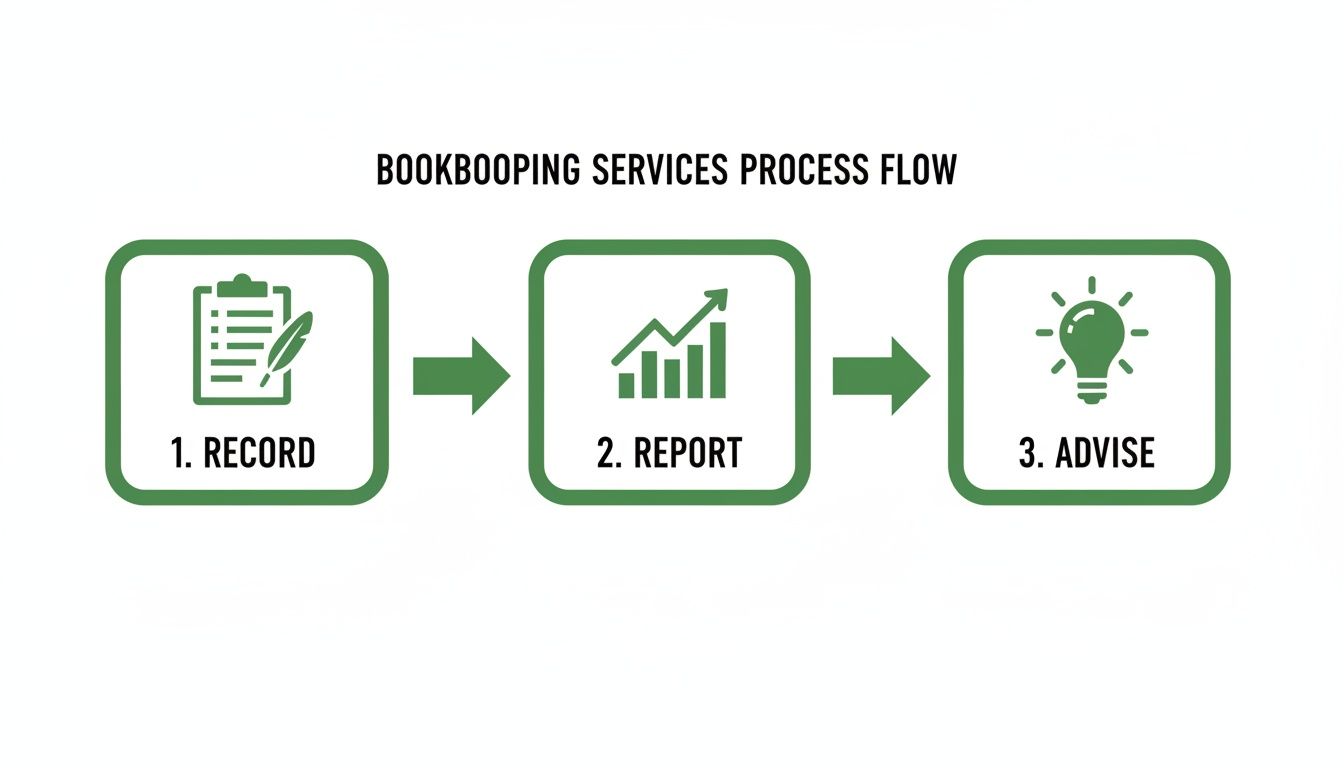
A great service doesn't just record what happened last month; they help you understand what's happening now so you can plan for the future.
Here’s a quick breakdown of the pricing models you'll likely encounter:
- Hourly Rate: You pay for the exact time they spend on your books. This can be a good deal for organizations with very low transaction volumes, but it can also lead to unpredictable monthly bills. It’s best when your needs are minimal and sporadic.
- Flat Monthly Fee: This is the most popular model, and for good reason. The service assesses your needs—transaction volume, number of bank accounts, payroll complexity—and gives you a fixed price per month. It provides budget certainty and is ideal for most small to medium-sized organizations.
- Tiered Packages: Many firms offer different service levels (think Basic, Pro, Premium). A basic tier might cover reconciliation and monthly reports, while a premium tier could add on payroll, bill pay, and advisory meetings. This lets you scale your service as your ministry grows.
Arming Your Bookkeeper with the Right Tech
A great bookkeeper, no matter how seasoned, is only as effective as their tools. In the world of church finance, the right technology isn't just a matter of convenience—it’s what makes accuracy, transparency, and true stewardship possible. Trying to manage church finances with generic business software or, worse, a maze of spreadsheets is like asking a master carpenter to build a house with a pocketknife. The process will be agonizing, and the results will be flawed.
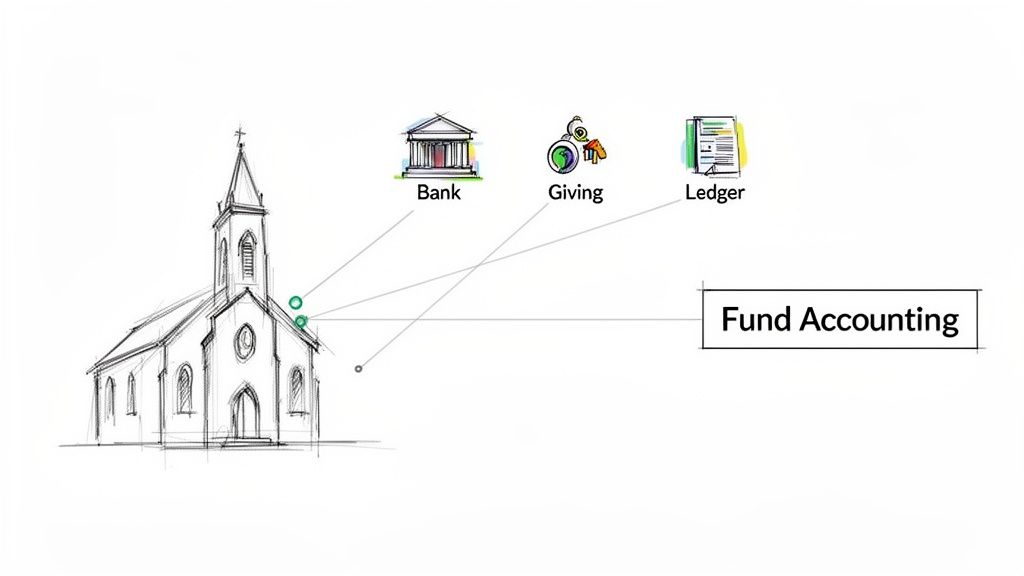
The single most critical piece of technology for any church is a system built with true, native fund accounting. I can't stress this enough. This isn't a feature you can just bolt on later or fake with workarounds like tags or classes in QuickBooks. It has to be baked into the software's DNA, where every single transaction, account, and report is viewed through the lens of individual funds from the very start.
Why Purpose-Built Technology Is Non-Negotiable
When your accounting system is designed specifically for ministries, it completely changes your bookkeeper's day-to-day reality. Instead of spending hours manually separating designated gifts from the general offering, the software handles it automatically. Instead of wrestling with reports to show the board how much is actually in the building fund, the system generates that report with a single click.
This is exactly where a purpose-built solution like Grain Ledger becomes essential for any church that's serious about financial integrity. It was created to solve this very problem, ensuring the software foundation perfectly mirrors the real-world needs of a ministry. This alignment between your bookkeeper's expertise and their primary tool is absolutely critical for success.
A bookkeeper using generic software spends their time fighting the system. A bookkeeper using purpose-built software spends their time analyzing data and offering real insight. That difference directly impacts your ministry's effectiveness.
Choosing the right platform is a big decision, of course. To help you sort through the noise, our guide on the best bookkeeping software for churches breaks down the features that truly matter for ministries.
The Power of Seamless Integrations
The real magic happens when your accounting software talks directly to your other financial tools. Let’s be honest: manual data entry is the number one source of bookkeeping errors. It’s tedious, it’s time-consuming, and it introduces risk every single time a number is typed by hand. Modern tech all but eliminates this weak link through direct integrations.
A well-designed system connects seamlessly with the platforms your church already uses, creating an automated and accurate flow of financial data.
Giving Platforms: When your system integrates with a provider like Pushpay or Planning Center, every online donation is automatically recorded and allocated to the correct fund. A gift designated for "Youth Missions" flows straight into the Youth Missions fund in your ledger without anyone lifting a finger.
Bank Feeds: By connecting directly to your church's bank accounts, the software pulls in every transaction—debit card purchases, automatic payments, and deposits. This allows your bookkeeper to reconcile accounts in minutes, not hours, guaranteeing your books always match the bank's records.
This level of automation does more than just save a few hours. It fundamentally transforms your financial data from a historical record into a real-time decision-making tool.
From Lagging Data to Real-Time Clarity
Think about the traditional model. Your bookkeeper spends the first week of every month just trying to catch up on the previous month's transactions. By the time you get a financial report for the board, the data is already four or five weeks old. You're constantly looking in the rearview mirror, making today's decisions based on yesterday's information.
With an integrated, purpose-built system, that delay disappears.
Pastors and board members can pull up an accurate, up-to-the-minute picture of the church's financial health anytime they want. This real-time clarity empowers confident leadership.
- Pastors can answer questions on the spot. When a ministry leader asks if there are funds for a new outreach program, the pastor can check the balance of that specific fund and give a definite "yes" or "no" right then and there.
- Boards can make smarter strategic moves. Instead of guessing, the board can see the exact balance in the capital campaign fund before approving a major construction expense.
- Stewardship becomes tangible. The ability to show your congregation precise, fund-level reports builds incredible trust. It proves that every dollar given is being managed with integrity.
Pairing an expert nonprofit bookkeeping service with technology designed for your unique needs creates an incredibly powerful partnership. It protects your ministry from costly errors, frees up valuable time, and provides the clear financial insight you need to help your church thrive.
Building Donor Trust Through Clear Reporting
Good bookkeeping is so much more than just a back-office chore; it's a powerful ministry tool. When your finances are managed with real precision, you get more than just compliance—you build confidence. Your congregants, donors, and board members can see exactly how their contributions are being stewarded, which deepens their trust and encourages them to keep giving.
This is where a skilled nonprofit bookkeeping service really shines. They don't just crunch numbers; they help you tell a clear story about your ministry's impact. That story is built on a handful of key financial reports that every church leader should be able to read and understand. These documents are vital for smart governance and strategic planning.
Key Reports That Tell Your Financial Story
Your board meetings shouldn't get bogged down in confusing spreadsheets. A great bookkeeper will hand you reports that are clean, accurate, and easy to digest, freeing up your leadership team to focus on the big-picture decisions that move your mission forward.
For any church, there are two reports that are absolutely essential: the Statement of Financial Position and the Statement of Activities.
The Statement of Financial Position: Think of this as your church's financial snapshot at a single moment in time. Often called a balance sheet, it lays out what your ministry owns (assets like cash and property) and what it owes (liabilities like a mortgage or unpaid bills). For a church, the critical piece here is showing your net assets broken down by fund.
The Statement of Activities: This is your "how we did" report, similar to an income statement. It tracks your revenue and expenses over a specific period, like a month or a quarter. You can quickly see how much came in from tithes and offerings versus what was spent on staff, facilities, and ministry programs.
If you want to get more comfortable with these documents, we have a helpful guide on essential church financial reporting that breaks it all down.
The Power of Fund-Level Detail
Here’s where you truly build trust: showing these reports broken down by fund. A report showing a total income of $50,000 for the month is only half the story. A report that shows $40,000 came into the general fund, $8,000 was designated for the building fund, and $2,000 was given to missions tells a story of faithful stewardship.
This level of detail proves that every designated gift is being managed responsibly and used exactly as the donor intended. It proactively answers the questions your congregation might have before they even think to ask.
When a donor sees their specific contribution reflected accurately in a fund balance, their confidence in your leadership grows immensely. It's tangible proof that their gift matters and is being honored.
Internal Controls and Board Oversight
Clear reporting is also the bedrock of strong internal controls and effective board oversight. When your board has accurate, timely financials in hand, they can confidently fulfill their fiduciary duty to protect the church's assets and ensure complete financial integrity.
This expectation for transparency isn't going away; in fact, it's growing. Donors and stakeholders increasingly expect to see the impact of their contributions in near real-time, not just in an annual summary. This is especially true for churches, where strong controls are vital for keeping restricted funds purpose-bound—a critical function as ministry needs expand.
Strong oversight, backed by professional bookkeeping, includes a few key practices:
- Regular Financial Reviews: Your board should be looking at the key financial statements at every single meeting.
- Budget vs. Actual Analysis: Consistently comparing your spending to your budget is the best way to catch potential issues before they become big problems.
- Segregation of Duties: Hiring a bookkeeping service automatically creates this separation. The person recording the transactions is different from the people authorizing payments or handling cash, which is a classic internal control.
At the end of the day, investing in a professional bookkeeping service is an investment in trust. It provides the financial clarity that empowers your leaders, reassures your congregation, and builds a solid foundation for your ministry to grow and thrive.
Compare platforms in our best church accounting software guide for 2026, or review Grain Ledger church accounting software.
Related church accounting software resources
If you are comparing software, these pages map the main decision points: fund accounting, QuickBooks limits, pricing, and migration.
- Best church accounting software (2026 comparison) - canonical guide comparing 12 church accounting platforms
- Church accounting software product page - see Grain Ledger for fund accounting, giving, and bank reconciliation
- Small church accounting software - see the product page built for volunteer treasurers and church admins
- Fund accounting features - review how Grain Ledger tracks designated funds
- QuickBooks for churches - understand workarounds and when to switch
- Free church accounting software - compare free options and upgrade triggers
- Grain Ledger pricing - compare plans for small and growing churches
- Start free - try fund accounting, giving imports, and bank reconciliation together
Answering Your Top Questions About Church Bookkeeping
Taking the step to hire a professional bookkeeping service is a huge move toward building a solid financial footing for your ministry. It’s completely normal to have questions about how it all works, what it costs, and what the real-world differences are.
Let's clear up some of the most common questions church leaders have. Think of this as getting the last few pieces of the puzzle in place so you can move forward with confidence. Getting these answers right means you're not just hiring a service—you're investing in a partnership that will protect your church’s resources and build trust for years to come.
What’s the Difference Between a Bookkeeper and an Accountant?
It’s really easy to mix these two up, but they play very different, yet complementary, roles in your church’s financial health. Knowing the difference is crucial for figuring out who you need to hire and when.
A bookkeeper is your on-the-ground financial pro. They’re in the trenches every day, recording and managing the constant flow of financial transactions.
Their core duties usually include things like:
- Entering all donations, tithes, and offerings into the correct funds.
- Paying bills and keeping track of what’s owed.
- Reconciling bank and credit card statements each month—a must-do.
- Categorizing every expense according to your church's budget.
- Putting together routine financial reports for staff and leadership meetings.
An accountant, on the other hand, operates at a higher, more strategic level. They take the clean, accurate data your bookkeeper provides and use it for big-picture analysis, compliance, and long-term planning.
You'd typically look to an accountant for:
- Analyzing financial statements to give your board real strategic advice.
- Preparing and filing the annual IRS Form 990.
- Overseeing audits and making sure you’re compliant with all regulations.
- Offering guidance on complex financial decisions, like a capital campaign or establishing stronger internal controls.
For most churches, the sweet spot is having a skilled nonprofit bookkeeping service for the consistent, day-to-day work. Then, you might bring in a CPA just once a year for the tax filing and a high-level review.
How Much Should We Budget for a Bookkeeping Service?
Budgeting for professional financial help can feel a bit intimidating, but the cost is often much more manageable than you’d think—especially when you stack it up against the salary and benefits of a full-time, in-house employee.
What you'll pay for a bookkeeping service really depends on a few key factors:
- Transaction Volume: How many donations, checks, and debit card swipes are you processing every month?
- Church Size: A small church plant has far simpler needs than a large, multi-campus church that also runs a school.
- Number of Funds: The more designated funds you have—like for the building, missions, or a benevolence fund—the more complex the accounting gets.
- Scope of Services: Are you looking for basic bookkeeping, or do you also need help with payroll, bill pay, and donor management?
Generally, you can expect the cost to land somewhere between a few hundred to over a thousand dollars per month. Most reputable firms will offer a flat monthly fee, which is great for budgeting because it means no surprises. Always ask for a detailed quote that spells out exactly what's included.
Can't We Just Use a Volunteer from the Congregation?
Relying on a dedicated volunteer treasurer is how so many small churches get started, and their heart for service is truly invaluable. But as a church grows, this approach starts to carry some significant risks.
The biggest issue is the lack of specialized expertise. A well-meaning volunteer, even someone with a business background, probably doesn't know the very specific rules of nonprofit fund accounting. This can easily lead to unintentional mistakes, like mixing restricted donations with general funds, which can seriously damage donor trust and even create legal problems.
It’s easy to think that using a volunteer is good stewardship because it saves money. But true stewardship is also about protecting the ministry from risk. A professional bookkeeper provides a critical layer of expertise, continuity, and internal control that a volunteer often can’t.
You also run into challenges with consistency and confidentiality. A volunteer's availability can fluctuate, leading to dangerous gaps in financial oversight. Plus, managing sensitive financial information within a personal church relationship can get awkward. A professional nonprofit bookkeeping service brings an objective, expert partner to the table who is solely focused on your financial integrity.
What Financial Reports Should Our Board See Every Month?
To provide real, effective oversight, your board needs a clear and consistent picture of the church’s financial health. A good bookkeeper will give them a concise package of reports each month that answers the most important questions without burying them in data.
At a bare minimum, your board should be reviewing these three key reports every single month:
- Statement of Financial Position (the Balance Sheet): This gives a snapshot of what the church owns (assets) and what it owes (liabilities) at a specific point in time.
- Statement of Activities (the Income & Expense Report): This report summarizes your income and expenses over the last month and for the year so far.
- Budget vs. Actual Report: This is one of the most vital management tools you have. It compares your actual income and spending against what you budgeted, instantly highlighting any areas that need attention.
Here's the most critical part: these reports must be broken down by fund. This is the only way your board can truly see that designated money is being managed properly. Using a true fund accounting system like Grain Ledger makes generating these accurate, fund-level reports simple and automatic, giving your leadership the clarity they need to guide the ministry well.
Ready to build a stronger financial foundation for your ministry? Grain Ledger offers purpose-built accounting software that brings true fund accounting, seamless integrations, and clear reporting to your church. See how our system can empower your bookkeeper and provide the financial clarity your leaders need. Learn more and Schedule a Demo at GrainLedger.com.
Ready to simplify your church finances?
Start free with church fund accounting, or watch a product demo first.