
A Guide to Bookkeeping for Churches
Master bookkeeping for churches with our guide. Learn fund accounting, reporting, and controls to ensure financial stewardship and build congregational trust.
Effective church bookkeeping is all about tracking every dollar that comes in and goes out. It’s the behind-the-scenes work of recording donations, paying bills, and managing payroll to paint a clear, honest picture of your ministry's financial health. Done well, it builds incredible trust with your congregation and gives leaders the solid data they need to make wise decisions that truly move the mission forward.
Stewardship Through Smarter Bookkeeping

Managing a church’s finances isn't just an administrative chore—it's a ministry of stewardship. When you handle the books properly, you’re building a foundation of trust and integrity with everyone from the pews to the board room. The numbers in a ledger stop being just numbers and start telling the story of how your church is living out its purpose.
Unlike a typical business chasing profits, a church’s financial success is measured by how faithfully it manages the resources God has provided through its people. This is a crucial distinction, and it's why standard business accounting just doesn't quite fit. Churches run on accountability, not profitability, and that requires a completely different mindset.
The Core Principle of Fund Accounting
The single most important concept to grasp in church bookkeeping is fund accounting. The easiest way to think about it is like using labeled envelopes for your home budget. You’d have one for groceries, another for the mortgage, maybe one for savings, and one for a family vacation. The money you put in the "vacation" envelope is set aside for that trip and shouldn’t be dipped into for groceries.
Fund accounting operates on that exact same principle. Every donation is mentally placed into a specific "envelope," or fund. This simple system makes sure every dollar is tracked and spent precisely as intended.
At its heart, fund accounting is a promise. It’s a commitment to donors that their contributions will be honored as intended, safeguarding the church's integrity and empowering its mission with transparency.
This approach is non-negotiable because it protects donor intent. When a family gives to the building campaign, they are trusting the church to use that gift for the building. A solid, fund-based system is how you prove that trust was well-placed.
Why This Matters for Your Church
Switching to a fund-based bookkeeping system brings a ton of clarity and credibility to your ministry's financial operations. It turns what could be a point of confusion into a source of confidence for everyone involved.
Here’s why it’s so powerful:
- Upholds Donor Intent: It creates a clear, auditable path showing that designated gifts for missions, building projects, or a benevolence fund were used exactly as promised.
- Improves Financial Transparency: Your leadership and congregation can see the financial health of each specific ministry, not just one big, confusing total. In fact, more than 50% of churches that saw giving increase pointed to financial transparency as a key reason why.
- Strengthens Decision-Making: When leaders know precisely what’s available in the general fund versus the youth ministry fund, they can make smarter, more strategic budgeting and spending decisions.
- Ensures Legal and Ethical Compliance: It helps prevent the accidental misuse of restricted funds, which can lead to serious legal and reputational damage.
Ultimately, getting this one concept right is the first and most important step for any church wanting to earn the complete confidence of its givers and give its leaders an accurate financial snapshot of everything the ministry is doing.
Understanding Fund Accounting
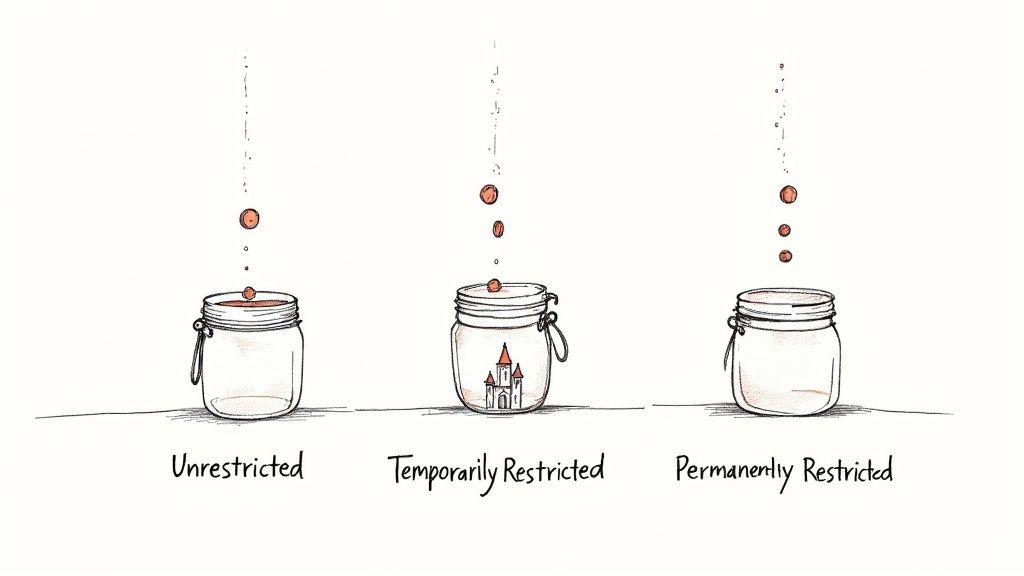
If you're going to get church bookkeeping right, you have to start with fund accounting. Unlike for-profit businesses that are all about the bottom line, church accounting is built on accountability. It’s a completely different mindset.
Think of your church's total bank balance as a single pool of water. Fund accounting builds separate, watertight containers within that pool. Each container holds money designated for a specific purpose, making absolutely sure that funds meant for one thing don't accidentally get used for something else.
This separation is the bedrock of financial integrity in ministry. It’s what guarantees that a donation given to support the youth mission trip isn't used to pay the light bill. For your congregation, knowing you honor their intentions is everything. It's how trust is built and maintained.
The Three Primary Fund Types
In the world of church finance, we sort every dollar into one of three main buckets. Getting a handle on these categories is the first real step to organizing your books effectively. Each one has its own rules about how the money can be used.
Here are the three big ones:
- Unrestricted Funds: This is the most flexible money your church has, often called the General Fund. It covers everything from staff salaries and building maintenance to Sunday school supplies—the core operational expenses.
- Temporarily Restricted Funds: This bucket holds donations a giver has earmarked for a specific project, ministry, or time frame. Once that purpose is accomplished, the restriction is lifted.
- Permanently Restricted Funds: This is the most limited category. It’s for gifts where the donor has specified that the original amount (the principal) must be preserved forever. The church can only spend the investment earnings.
This simple structure gives you a clear framework for stewarding every gift that comes through the door.
The discipline of fund accounting transforms financial management from a simple recording of transactions into a powerful act of stewardship. It’s the practical system that backs up the promise to honor every gift according to its intended purpose.
Seeing Funds in Action
Let’s make this more concrete. When someone puts cash in the offering plate on a Sunday morning without any special instructions, that money goes straight into the Unrestricted Fund. This is the financial engine that keeps the church running day-to-day.
Now, let's say your church holds a special offering to raise $5,000 for a new sound system. Every dollar given for that campaign goes into a Temporarily Restricted Fund. That money can only be spent on the sound system. Once the equipment is bought and paid for, the restriction has been fulfilled.
Finally, imagine a longtime church member leaves $100,000 in their will to create a scholarship for seminary students. This establishes a Permanently Restricted Fund, also known as an endowment. The church is required to invest the $100,000 and can only use the interest or investment returns to award the scholarships each year. The original gift remains untouched, in perpetuity.
To make it even clearer, here's a simple breakdown of how these funds work in practice.
Church Fund Types Explained
This table shows the key differences between the fund types and gives you some common examples you'll see in your own church.
| Fund Type | Definition | Example Usage |
|---|---|---|
| Unrestricted | Funds with no donor-imposed restrictions, available for general operations. | Paying staff salaries, utility bills, buying weekly supplies. |
| Temporarily Restricted | Funds designated by a donor for a specific purpose or time period. | A capital campaign for a new building, a fund for a mission trip. |
| Permanently Restricted | Funds where the principal must be maintained, and only earnings can be spent. | An endowment fund for perpetual campus maintenance or scholarships. |
Understanding this classification is essential. Proper financial management is a huge challenge for many ministries. In fact, a recent survey revealed that nearly 75% of churches see a need for improvement in at least three key areas of finance, with transparency being a major concern. You can read more about it in the 2025 report by Parable. This is exactly why solid bookkeeping for churches, grounded in these fund accounting principles, is so critical for building a ministry that people trust.
Building Your Church Chart of Accounts
Think of your church’s Chart of Accounts (COA) as the financial skeleton of your ministry. A strong, well-organized one gives your entire bookkeeping system structure and strength. A weak or confusing one? Well, things get messy fast.
Your COA is more than just a list of accounts; it's the very tool that lets you see exactly where every dollar comes from and how it’s being put to work. It’s the difference between a jumble of numbers and a clear story of stewardship.
Without a logical COA, you're just guessing. With a good one, you can generate reports that show the financial health of the General Fund, the Building Fund, the Missions Fund—every single part of your church's mission.
Designing a Numbering System
The first step is setting up a numbering system. This doesn't need to be complicated. The goal is simple: create logical "buckets" for your finances so that anyone—from a staff accountant to a volunteer treasurer—can easily find what they're looking for.
Most churches find a simple numerical range for each major account type works perfectly. This creates a natural hierarchy and makes transactions easy to classify. For a deeper dive into the nuts and bolts, you can explore our complete guide to creating a chart of accounts for nonprofits.
Here’s a classic numbering scheme that’s both effective and easy to remember:
- 1000s – Assets: What the church owns. Think cash in the bank, the church building, and equipment.
- 2000s – Liabilities: What the church owes. This includes things like a mortgage, credit card balances, or payroll taxes that are due.
- 3000s – Net Assets (Equity): This is the heart of fund accounting. It’s the difference between assets and liabilities, but broken down by each specific fund.
- 4000s – Income (Revenue): All the money coming in, like tithes, special offerings, and event registrations.
- 5000s – Expenses: All the money going out. Salaries, utilities, curriculum, outreach events—it all goes here.
This simple framework provides a rock-solid foundation for organizing everything you do financially.
Structuring Accounts by Fund
Here's where church bookkeeping really separates itself from the for-profit world. The real magic happens when you build your funds directly into the COA structure. You don’t just have a single "Net Assets" account; you have a separate net asset account for each fund.
A fund-based Chart of Accounts does more than just track numbers; it tells the story of your ministry's stewardship. It provides an unshakeable, transparent record that proves every designated dollar was honored as intended, building deep and lasting trust with your congregation.
So, how does this look in the real world? Let's take our numbering system and apply it. Your Net Assets section (the 3000s) gets divided up to reflect every fund you manage.
Example Net Asset Structure:
- 3100: Unrestricted Net Assets (General Fund)
- 3200: Temporarily Restricted Net Assets - Building Fund
- 3300: Temporarily Restricted Net Assets - Missions Fund
- 3400: Permanently Restricted Net Assets - Endowment Fund
You apply this exact same logic to your income accounts. Instead of lumping all donations into one "Offerings" account, you create specific income accounts for each fund. This is how you ensure a gift designated for the new roof actually gets tracked to the Building Fund, not mixed in with the general tithes.
- 4100: General Tithes & Offerings (Unrestricted)
- 4200: Building Fund Contributions (Restricted)
- 4300: Missions Fund Contributions (Restricted)
When you build your COA this way from the ground up, every single transaction is automatically sorted into the right "financial envelope." This makes reporting a breeze and gives your leaders a crystal-clear, fund-by-fund view of the church's finances at a moment's notice. Every decision can be backed by accurate, mission-focused data.
Setting Up Practical Bookkeeping Workflows
Once you’ve built a solid Chart of Accounts, the next step is to breathe life into it with consistent, practical workflows. These are the daily, weekly, and monthly rhythms that turn good intentions into reliable financial stewardship. Getting these routines down is the secret to maintaining accuracy, ensuring transparency, and protecting your church’s resources.
Think of these workflows as the standard operating procedures for your church's financial engine. A pilot wouldn't dream of taking off without a pre-flight checklist, and your treasurer or finance team needs that same repeatable process for every key task. This consistency removes the guesswork and builds a strong foundation of accountability.
This simple flow shows the core logic of a well-organized chart of accounts. It all boils down to moving from what your church owns (Assets) to what it owes (Liabilities) to figure out its actual financial health (Net Assets).
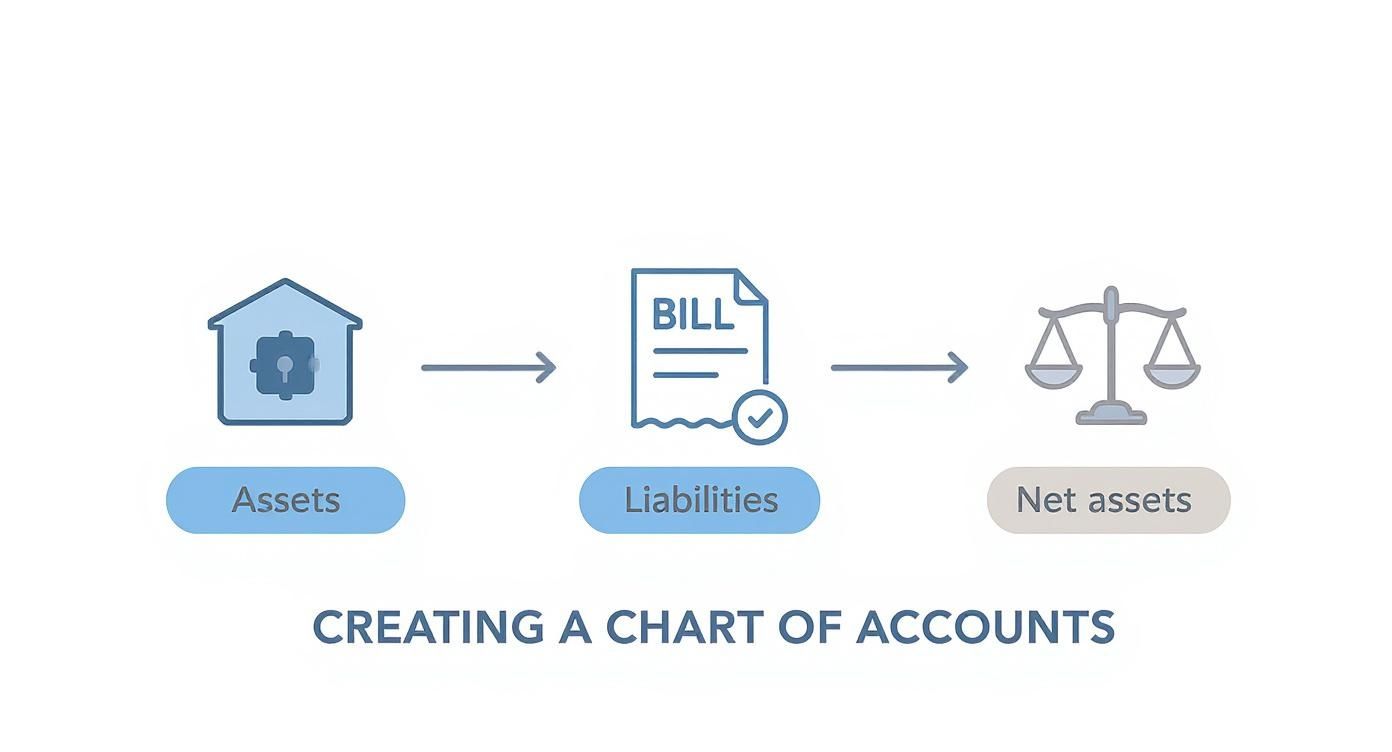
This visual really drives home the point that every financial element has a logical place—and that’s exactly what organized workflows help you maintain day in and day out.
Handling Tithes and Offerings
The way you handle donations is one of the most visible—and critical—parts of church bookkeeping. To keep the trust of your congregation, you have to approach this with the highest level of integrity. A solid system here isn't just about counting money; it's about having strict internal controls in place.
Start with one non-negotiable rule: at least two unrelated individuals must be present anytime cash and check offerings are counted. This simple step is one of the most powerful ways to prevent mistakes and protect everyone involved from any potential accusations.
After counting, a detailed deposit slip that breaks down the cash and checks should be prepared. The total on this slip has to match the count sheet signed by the team. And here’s a key detail: the person who takes the funds to the bank should be different from the person who records the donations in your books. This is a classic principle known as segregation of duties, and it's essential.
For online and digital giving, the workflow looks a bit different but is just as crucial. Your giving platform should ideally talk to your accounting software, recording donations automatically. The main job here is to regularly reconcile the batches from your giving provider with the deposits that actually land in your bank account. This ensures every transaction is accounted for and assigned to the right fund.
Robust internal controls are not a sign of distrust; they are a sign of wisdom. They protect the givers, the volunteers, the staff, and the church’s reputation by creating a system of shared accountability.
Managing Church Expenses
Paying bills and managing expenses needs a clear, consistent approval process. No payment should ever go out the door without proper authorization. A good workflow makes sure every expenditure is legitimate, was included in the budget, and is coded correctly.
Here’s a practical workflow that you can implement right away:
- Submission: All invoices or reimbursement requests go to a designated person, like the church administrator or bookkeeper.
- Approval: The request gets reviewed and signed off on by the appropriate ministry leader or a staff member with authority over that budget. For bigger expenses, you should require a second signature, maybe from a pastor or board member.
- Payment: Once it's approved, the bookkeeper cuts the check or makes the electronic payment.
- Recording: The expense is immediately entered into the accounting software, making sure it’s coded to the correct expense account and fund.
This kind of structured process stops unauthorized spending in its tracks and gives you a clear audit trail for every dollar that leaves the church.
Tackling Payroll and Bank Reconciliations
Payroll is often a church’s single biggest expense, and it comes with its own set of challenges—especially when it comes to clergy compensation. Properly handling a pastor's housing allowance, for instance, is a major compliance issue. Your workflow must ensure the board designates this amount correctly every year and that it's reported properly on all tax forms.
At the same time, bank reconciliations are a non-negotiable monthly task. This is where you compare your internal financial records against your bank statements. It’s how you catch discrepancies, spot bank errors, or see unauthorized transactions before they become big problems. A timely reconciliation confirms your books are accurate and is a cornerstone of good financial management.
Unfortunately, churches are not immune to financial risks. Alarming data shows that global losses from financial crimes affecting churches have soared from $67 billion in 2020 to $92 billion in 2024. Projections even suggest this figure could approach $400 billion by 2050. You can find more insights about navigating church finances on Christian Standard. These numbers aren’t meant to scare you, but to underscore why disciplined workflows and professional oversight aren't just best practices—they are essential safeguards for your ministry's integrity and future.
Creating Financial Reports That Inform Ministry
Great church bookkeeping isn't just about getting the numbers right; it's about telling the story of your ministry. The raw data from your ledgers needs to be shaped into reports that clearly show where your church has been, where it stands today, and where God has given you the resources to go. Think of these documents as the bridge between financial management and discipleship.
They bring the clarity leaders need for wise, prayerful decisions and give the congregation the transparency they deserve. When you can produce clear, insightful reports, you're no longer just tracking dollars and cents—you're measuring ministry impact. This is how you confidently answer the big questions about stewardship and vision.
The Statement of Financial Position
Imagine taking a financial snapshot of your church on a single day. That's your Statement of Financial Position. It’s the church version of a business balance sheet, and it answers a straightforward but vital question: "What do we own, what do we owe, and what's left over?"
This report gives you a high-level view of your church’s financial health by breaking it down into three core pieces:
- Assets: Everything the church owns that has value. This includes cash in the bank, buildings, land, and major equipment.
- Liabilities: Everything the church owes to others. This could be a mortgage, unpaid bills from vendors, or payroll taxes that are due.
- Net Assets: The difference between your assets and liabilities, broken down by fund. This is the most important part for a church, as it shows you the net resources available for your General Fund versus restricted funds like the Building or Missions Fund.
Your board and finance committee will lean on this report to gauge long-term stability, manage debt, and make sure you have enough cash on hand to meet your immediate obligations.
The Statement of Activities
If the first report is a snapshot, the Statement of Activities is a video. It shows your church’s financial comings and goings over a period of time—like a month, a quarter, or a full year. It’s similar to an income statement, but it has that crucial fund-based twist. It answers the question: "Where did our money come from, where did it go, and did we end up with more or less than we started with?"
It details all your income and expenses, but the magic is that it shows this activity for each individual fund. This is how you demonstrate that designated gifts were handled properly. You can see exactly what came in and what went out of the General Fund, completely separate from the activity in the Youth Ministry Fund. For a closer look at the different types of reports and what they reveal, you might find our guide on essential financial reports for churches a valuable resource.
This report is the backbone of accountability. It demonstrates to the congregation that their designated gifts were used exactly as intended, turning financial statements into a testament of the church’s integrity and faithfulness.
This statement is essential for everyone—from the pastor and board to the congregation itself. It shows whether the church is living within its means and, most importantly, confirms that restricted funds are being stewarded according to the wishes of the donor.
The Budget vs Actual Report
Of all the reports, the Budget vs Actual is your most practical, forward-looking tool. It simply places your planned income and expenses side-by-side with what actually happened during a specific period. It answers the question on every ministry leader's mind: "Are we on track with our financial plan?"
This is the document your staff and ministry heads will live in. If the children's ministry team sees they've only used 40% of their annual curriculum budget six months into the year, they know they have the flexibility for a special outreach event. On the flip side, if facility costs are running 15% over budget because of an unexpected HVAC repair, leadership knows they need to make adjustments elsewhere.
This report is the key to being proactive. It helps you make small course corrections throughout the year instead of discovering a major budget crisis when it's too late. It empowers every ministry leader to take ownership of their piece of the budget, ensuring the church's resources are used effectively to move the mission forward.
Choosing the Right Church Accounting Software
Having the right technology is the cornerstone of modern church bookkeeping. While powerful business tools like QuickBooks are great for a standard company, they often create headaches for ministries. They simply aren’t built to handle the unique world of fund accounting.
Trying to make a for-profit system track restricted funds is like trying to hammer a square peg into a round hole. You can make it work with a lot of effort and clunky workarounds, but it's never a clean fit and it’s dangerously easy to make a mistake.
That’s why specialized church accounting software is so critical. These platforms are designed from the ground up with your ministry's needs in mind. Fund accounting is baked into their DNA, making it effortless to track every dollar from donation to expense and ensure it stays in its designated lane. The Building Fund stays separate from the General Fund, no manual gymnastics required.
Key Features to Look For
As you start looking at different software options, there are a few non-negotiable features you'll need for sound financial management. A system that nails these basics will become an incredible asset, saving your team countless hours and giving leaders the clarity they need.
Here’s what your checklist should include:
- True Fund Accounting: This is the big one. The software must have the ability to create, manage, and report on individual funds (unrestricted, temporarily restricted, etc.) as a core, built-in function.
- Integrated Donation Management: Your accounting system should talk directly to your online giving platform. Donations should flow in automatically and get assigned to the correct funds without manual entry.
- Clergy-Specific Payroll: The system has to understand the unique rules for clergy compensation, especially how to properly handle a pastor's housing allowance and its tax implications.
- Robust Reporting: You need to be able to pull key reports with a few clicks. Look for easy access to a Statement of Activities by fund, a Statement of Financial Position, and Budget vs. Actual reports.
A great system handles these things gracefully, making your software a tool that empowers ministry, not a barrier that slows it down. For a deep dive into specific options, you can check out our guide on the best accounting software for churches.
Cloud-Based vs. On-Premise Solutions
These days, the vast majority of churches are moving to cloud-based software, and it’s easy to see why. Old-school, on-premise solutions chain you to a specific computer and force you to maintain servers and install updates manually—a major burden for staff and volunteers.
Cloud-based software gives you security, accessibility from anywhere, and automatic updates. This frees your team from playing IT support so they can focus on stewardship and ministry, not server maintenance.
This isn’t just a small trend; it’s a massive shift. The global church accounting software market is expected to grow from USD 2.85 billion in 2024 to USD 5.95 billion by 2033, with cloud-based systems driving nearly all of that growth. As you can see from market data on datahorizzonresearch.com, churches are increasingly committed to adopting better tools for financial transparency.
Choosing a modern, fund-first system doesn't just solve today's problems—it sets your church up with a bookkeeping foundation that's built to last.
Your Questions Answered
We get it. Church finances come with their own unique set of questions. Here are clear, straightforward answers to some of the most common ones we hear from pastors, treasurers, and volunteers.
Can Our Church Just Use QuickBooks?
This is probably the number one question we're asked. While QuickBooks is a fantastic tool for small businesses, it wasn't built for the fund accounting that churches rely on.
You can force it to work, but it often involves clunky workarounds that are a magnet for errors. It also makes things incredibly confusing for volunteers who are just trying to help. Church-specific bookkeeping software is designed from day one to handle designated funds and donor intent, which will save you countless headaches and keep your financial reporting clean.
How Can We Implement Financial Controls in a Small Church?
Even if your "finance team" is just a handful of dedicated volunteers, you can still put strong internal controls in place. The core principle is simple: separate financial duties wherever possible.
Strong internal controls aren't about a lack of trust—they're about good stewardship. They create a system of accountability that protects your givers, your volunteers, your staff, and the integrity of your ministry.
Here are a few non-negotiables to start with, no matter your church's size:
- The Two-Person Rule: Always have at least two unrelated people count every single offering, every single time.
- Separation of Duties: The person who records the donations should not be the same person who takes the deposit to the bank.
- Dual Signatures: Require two signatures on any check written over a specific amount, like $500.
- Independent Review: Ask a board member or elder—someone who doesn't have check-signing authority—to review the bank statements each month.
What's the Real Difference Between "Designated" and "Restricted" Funds?
These terms are often thrown around interchangeably, but they have a crucial legal difference.
A restricted gift is legally binding. When a donor gives a large gift and explicitly states in writing it must be used for the "New Building Fund," you are legally obligated to use it only for that purpose.
A designated gift, on the other hand, is more about a donor's preference. Think of someone putting an extra $50 in the offering plate and writing "Missions" on the memo line. The church board will almost always honor that request, but depending on your church's policies, they may have the authority to redirect those funds if a more critical need arises.
Ready to bring true fund accounting to your church? Grain provides the clarity your ministry needs. Unify your giving, banking, and bookkeeping with a system built from the ground up for stewardship. Join the waitlist today and see how our purpose-built software can empower your mission.
Ready to simplify your church finances?
Join the waitlist for early access to Grain - modern fund accounting built for ministry.