8 Practical Non Profit Budgets Examples for Churches (2025)
Jun 26, 2023
Creating a church budget that aligns with your ministry's mission can feel like a monumental task. You're not just tracking dollars and cents; you're stewarding resources to serve your congregation and community. Many church leaders struggle with generic budget templates that don't account for the unique financial structure of a nonprofit, especially the complexities of fund accounting, restricted donations, and designated giving. A well-structured budget is more than a financial document; it is a tool for ministry planning, a testament to transparency, and a roadmap for fulfilling your mission with integrity.
This guide moves beyond simplistic spreadsheets to provide eight practical non profit budgets examples specifically adapted for the church context. We will break down different budgeting models, from straightforward operating budgets for small congregations to detailed program and capital campaign budgets. Each example is designed to show you not just what to track, but how to build a financial framework that inspires confidence and fosters good stewardship among your members and leadership.
You will learn to:
Structure a budget that clearly separates unrestricted, temporarily restricted, and permanently restricted funds.
Allocate expenses accurately to specific programs like youth ministry, community outreach, or mission trips.
Present financial information to your board and congregation in a way that is clear, compelling, and mission-focused.
We will explore program-based, fund-based, zero-based, and even performance-based budgeting approaches, complete with downloadable templates and strategic insights. Forget the one-size-fits-all approach. This article provides the specific tools and non profit budgets examples you need to manage your church’s finances with clarity and purpose, ensuring every dollar is directed toward ministry impact.
1. The Foundational Operating Budget: A Small Church Example
The foundational operating budget is the cornerstone of a church's financial stewardship, detailing all anticipated income and expenses for a single fiscal year. For a small congregation of 75-150 members, simplicity and clarity are paramount. This budget type organizes finances into intuitive categories, making it easy for leadership and the congregation to understand the flow of resources.
This example of non profit budgets focuses on the core mission by aligning every dollar with ministry goals. It serves as a plan for resource allocation, a tool for monitoring financial health, and a transparent report to stakeholders. The primary goal is to ensure that general offerings cover the essential operational costs of the church.
Strategic Breakdown and Analysis
The strength of this budget lies in its clear categorization. Revenue is typically dominated by general tithes and offerings, while expenses are grouped into major functional areas.
Income Categories: The primary source is the General Fund, which consists of undesignated tithes and offerings. It's crucial to track this separately from Designated Funds (e.g., missions, building fund) to maintain financial integrity and honor donor intent.
Expense Categories: Major expense buckets provide a high-level overview. Common categories include:
Personnel: Salaries, housing allowances, benefits, and payroll taxes for pastors and staff.
Facilities: Mortgage or rent, utilities, insurance, maintenance, and custodial services.
Ministry Departments: Budgets for specific areas like children’s ministry, youth group, and outreach events.
Administration: Office supplies, software subscriptions, bank fees, and professional services.
Key Insight: For a small church, a simple operating budget is not just a financial document; it's a ministry plan expressed in numbers. It answers the fundamental question: "How are we using our shared resources to fulfill our mission?"
Actionable Takeaways
To effectively implement a foundational operating budget, focus on practicality and transparency.
Start with Realistic Projections: Base income projections on historical giving trends from the past 1-3 years. Be conservative, especially if your congregation's attendance fluctuates.
Engage Ministry Leaders: Ask department leaders to submit their anticipated needs for the year. This fosters ownership and ensures the budget reflects actual ministry requirements.
Present with Clarity: When presenting the budget to the board or congregation, use simple charts and graphs. Focus on percentages to show how much of each dollar goes toward major areas like personnel, facilities, and direct ministry.
Monitor and Report Regularly: Provide a monthly or quarterly "budget vs. actual" report. This transparency builds trust and allows for timely adjustments if income or expenses deviate significantly from the plan.
2. Activity-Based Budget (Educational Nonprofits)
An activity-based budget organizes finances around specific events or activities rather than traditional departmental lines. For an educational nonprofit like a museum, a conference organizer, or a community training center, this approach provides granular detail on the cost and revenue associated with each distinct offering. This model is exceptionally useful for organizations where success is measured by the performance of individual initiatives.
This example of non profit budgets moves beyond a simple overview of income and expenses. It assigns resources directly to activities like a specific museum exhibition, a professional development workshop, or an annual conference. The primary goal is to determine the true cost and profitability of each activity, enabling data-driven decisions about which programs to expand, modify, or discontinue.
Strategic Breakdown and Analysis
The power of an activity-based budget is its direct link between costs and outcomes. Instead of lumping all marketing expenses into one bucket, for example, it allocates marketing costs to the specific activities they promote.
Income Categories: Revenue is tied directly to the activity that generates it. This includes Registration Fees (for a workshop), Ticket Sales (for an exhibit), Sponsorships (for a conference), and any related sales of materials or merchandise.
Expense Categories: Costs are meticulously tracked per activity. Key categories include:
Direct Costs: These are variable costs directly tied to the activity, like speaker fees, venue rental, material printing, and catering for a specific event.
Indirect (Shared) Costs: These are fixed overhead costs like staff salaries, office rent, and utilities. A core part of this method is allocating a reasonable portion of these costs to each activity based on a logical metric, such as staff time or square footage used.
Key Insight: An activity-based budget transforms financial data into a performance management tool. It answers the critical question: "Is this specific activity financially sustainable and achieving its intended impact?"
Actionable Takeaways
To implement an activity-based budget effectively, focus on detailed tracking and clear cost allocation methodologies.
Define Your Activities Clearly: Start by listing every distinct, resource-consuming activity your organization undertakes. This could be anything from a single two-hour workshop to a six-month-long museum exhibit.
Separate Variable and Fixed Costs: Meticulously identify costs that change with participation levels (variable) versus those that remain constant (fixed). This is crucial for accurate profitability analysis and setting break-even attendance goals.
Develop a Fair Allocation Method: For shared costs like administrative salaries or insurance, create a consistent rule for allocation. For example, you might allocate 10% of the Executive Director's salary to the annual conference if it consumes roughly 10% of their time.
Track and Analyze Per-Unit Metrics: Don't just look at the total budget. Calculate the cost-per-participant and revenue-per-participant for each activity. This data is invaluable for setting future pricing and making strategic programming decisions.
3. The Fund-Based Budget: A Grant-Reliant Nonprofit Example
For nonprofits that rely heavily on restricted grants from foundations, government contracts, or major donors, the fund-based budget is an essential tool for compliance and strategic management. This structure organizes finances by funding source, creating a mini-budget for each restricted grant alongside the main unrestricted operating budget. It’s a core component of true fund accounting.
This example of non profit budgets is critical for maintaining donor trust and ensuring legal compliance. It moves beyond a single organizational budget to a collection of linked budgets, each with its own rules, timelines, and reporting requirements. The primary goal is to demonstrate that restricted funds are being used exactly as intended by the grantor.
Strategic Breakdown and Analysis
The power of a fund-based budget is its ability to isolate and track different pools of money. This prevents the accidental use of restricted funds for unapproved general operating expenses, a common and serious compliance issue.
Income Categories: Revenue is segregated by its source and restriction level.
Unrestricted Funds: General donations, annual fund appeals, and earned income that can be used for any purpose.
Temporarily Restricted Funds: Grants designated for a specific program, project, or time period (e.g., a three-year grant for a youth outreach program).
Permanently Restricted Funds: Endowment funds where the principal is protected, and only the investment income can be spent.
Expense Categories: Expenses are allocated directly to the fund that is paying for them. A single staff member’s salary might be split across multiple funds if their work contributes to several different grant-funded projects. This requires diligent time tracking and cost allocation.
Key Insight: A fund-based budget is not just a financial tracking tool; it's a compliance framework. It answers the critical question for grantors: "Can you prove you spent our money exactly as you promised?"
Actionable Takeaways
Implementing a fund-based budget requires precision and robust systems.
Use Fund Accounting Software: Standard business accounting software like QuickBooks Online can be adapted, but specialized nonprofit accounting software with built-in fund modules (like Aplos or Sage Intacct) makes this process far easier and less prone to error.
Document Every Restriction: Maintain a central file for every grant agreement and donation letter. Clearly summarize the restrictions, reporting deadlines, and key deliverables for each fund to ensure the entire team is aligned.
Allocate Shared Costs Fairly: Develop a clear, written cost allocation policy for shared expenses like rent, utilities, and administrative salaries. This policy justifies how you distribute these costs across different grants and your operating budget.
Conduct Monthly Fund Reviews: Don't wait until the end of a grant period. Review each restricted fund's "budget vs. actual" report monthly to catch overspending or underspending early and communicate proactively with your program officers.
4. Zero-Based Budget (Lean Startups and New Nonprofits)
The Zero-Based Budgeting (ZBB) method forces a complete financial reset each fiscal period. Instead of adjusting the previous year's budget up or down, every single expense line item must be justified from a "zero" base, as if it were a new expenditure. For new nonprofits, grassroots organizations, or those recovering from a financial crisis, this approach instills extreme discipline and ensures every dollar is strategically aligned with the core mission.
This example of non profit budgets is less about historical spending and more about future justification. It shifts the conversation from "what did we spend last year?" to "what must we spend to achieve our goals this year, and why?" This forces leaders to critically evaluate every program and administrative cost, eliminating waste and legacy spending that no longer serves the organization's primary objectives.

Strategic Breakdown and Analysis
The power of ZBB is in its process of rigorous justification, which links every expense directly to a specific outcome or mission-critical function. It is a ground-up approach to financial planning.
Income Categories: Income is projected based on confirmed grants, realistic fundraising targets, and early-stage revenue models. There is little reliance on historical data, forcing a focus on what is achievable in the current period.
Expense Categories: Expenses are not grouped by legacy departments but are built from "decision packages" or justifications for individual activities. Key areas requiring justification include:
Core Program Delivery: What is the absolute minimum cost to run our primary service? This includes direct staff time, essential materials, and outreach.
Essential Operations: What administrative functions are non-negotiable? This could be legal compliance fees, basic accounting software, or insurance.
Growth Initiatives: What specific, justified expenses will lead to measurable growth in impact or funding? This could be a targeted marketing campaign or a grant writer's contract.
Key Insight: Zero-based budgeting transforms the budget from a simple accounting tool into a strategic decision-making framework. It compels an organization to constantly re-evaluate its priorities and defend the existence of every expense, fostering a culture of lean efficiency and accountability.
Actionable Takeaways
Implementing ZBB requires a significant commitment to detail but yields incredible clarity and financial control.
Start with the Mission, Not the Spreadsheet: Before listing any numbers, clearly define your top 3-5 strategic priorities for the upcoming year. Every budget request must tie directly to one of these goals.
Involve Department Leaders: Task each team leader with creating a "decision package" for their functions. They must justify their needs from zero, explaining the costs and expected outcomes of each activity.
Rank All Requests: Once all justifications are submitted, leadership must rank them in order of priority. This is the most critical step, as it forces tough decisions about what gets funded if revenue projections fall short.
Establish Justification Tiers: Create spending thresholds that require different levels of approval. A $50 office supply request may need minimal justification, while a $5,000 software subscription requires a detailed impact analysis.
5. Performance-Based Budget (Healthcare and Research Nonprofits)
A performance-based budget moves beyond tracking simple income and expenses, directly linking financial allocations to measurable outcomes and performance metrics. This model is critical for healthcare nonprofits, research institutions, and service-based organizations where demonstrating impact is essential for funding and accountability. Instead of funding activities, this budget funds results.
This example of non profit budgets is a strategic tool that answers the question, "What impact are we achieving with our resources?" It forces an organization to define success in concrete terms and allocate funds to the programs and initiatives that most effectively advance its mission. The primary goal is to maximize impact by investing in what works.
Strategic Breakdown and Analysis
The power of this budget lies in its focus on data and outcomes rather than just historical spending. It creates a direct line between financial inputs and mission-driven outputs, fostering a culture of accountability and continuous improvement.
Income Categories: Revenue is often tied to grants, government contracts, and service fees that have specific performance requirements. Donors may also contribute based on demonstrated success in achieving certain outcomes, such as patient recovery rates or job placement percentages.
Expense Categories: Expenses are structured around programs or initiatives with clearly defined Key Performance Indicators (KPIs). The budget process involves evaluating past performance against these KPIs to justify future funding. Common categories include:
Program A (e.g., Job Training): Funded based on the number of graduates and successful job placements.
Program B (e.g., Clinical Research): Allocations are contingent on meeting research milestones or publication targets.
Administrative Overhead: Often evaluated on efficiency metrics, such as cost-per-client-served or fundraising ROI.
Key Insight: A performance-based budget transforms financial discussions from "How much did we spend?" to "What did we accomplish?" It aligns every dollar with tangible, measurable impact, making it a powerful tool for strategic decision-making and stakeholder communication.
Actionable Takeaways
To successfully implement a performance-based budget, an organization must be disciplined about data collection and analysis.
Define Meaningful Metrics: Select KPIs that truly reflect your mission’s success. For a job training program, this could be "percentage of participants employed for over 90 days," not just "number of graduates."
Establish a Baseline: Before you can measure improvement, you must know your starting point. Collect data for at least one year to establish a reliable performance baseline for each key program.
Integrate Data and Finance: Your finance and program teams must work together. Program staff track performance data, while the finance team integrates this data into budget reports and forecasts.
Communicate the "Why": When presenting this budget, lead with the impact stories and data. Show stakeholders how their investment is directly leading to positive outcomes, using charts that connect spending to results like "cost per life saved" or "investment per research breakthrough."
6. The Rolling Budget: A Crisis Response Ministry Example
For nonprofits operating in unpredictable environments, like a crisis response ministry, the static annual budget is often obsolete before the first quarter ends. A rolling budget, also known as a continuous budget or rolling forecast, offers a dynamic alternative. Instead of a fixed 12-month plan, this model constantly extends into the future, typically adding a new month or quarter as the most recent one concludes, maintaining a consistent 12 or 18-month planning horizon.
This example of non profit budgets is designed for agility and proactive decision-making. For a ministry that responds to natural disasters or community emergencies, revenue from emergency appeals is volatile, and expenses can spike unexpectedly. The rolling budget provides a real-time financial picture, enabling leadership to pivot resources, adjust fundraising goals, and manage cash flow in a rapidly changing landscape.
Strategic Breakdown and Analysis
The power of a rolling budget is its perpetual, forward-looking nature. It shifts the focus from comparing performance against an outdated annual plan to constantly re-evaluating future expectations based on the most current information.
Time Horizon: The budget is not a one-year document but a living forecast. As March ends, the budget for the following March is added. This ensures leadership is always planning a full year ahead, not just managing the remainder of a fiscal year.
Forecasting Triggers: The budget is updated based on specific triggers, not just a calendar date. These might include:
Major Events: A significant natural disaster triggers an immediate reforecast of donation income and deployment costs.
Funding Changes: The confirmation or loss of a major grant requires an update to projected revenue and program expenses.
Performance Deviations: If actual income for a quarter is 20% below forecast, the subsequent quarters are adjusted to reflect the new reality.
Key Insight: A rolling budget transforms financial planning from a once-a-year event into an ongoing strategic conversation. It forces leaders to constantly ask, "Given what we know today, what do we expect for the next 12 months?"
Actionable Takeaways
Implementing a rolling budget requires a shift in mindset and process. It’s about continuous improvement, not annual perfection.
Establish Clear Reforecasting Rules: Define what events or variances will trigger an update to the forecast. This prevents constant, unnecessary changes and focuses effort on meaningful adjustments.
Use Appropriate Tools: A rolling budget is difficult to manage in a basic spreadsheet. Investing in robust financial software is critical. To see what options are available, you can learn more about the best accounting software for nonprofit organizations.
Lock Down Near-Term Periods: Once a month or quarter begins, "lock" its budget. The focus should be on forecasting future periods, not endlessly tweaking the current one. This maintains accountability for the immediate plan.
Train Your Team: Ensure staff and department heads understand the process. Their role shifts from submitting an annual request to providing regular updates on anticipated needs and income based on current activities.
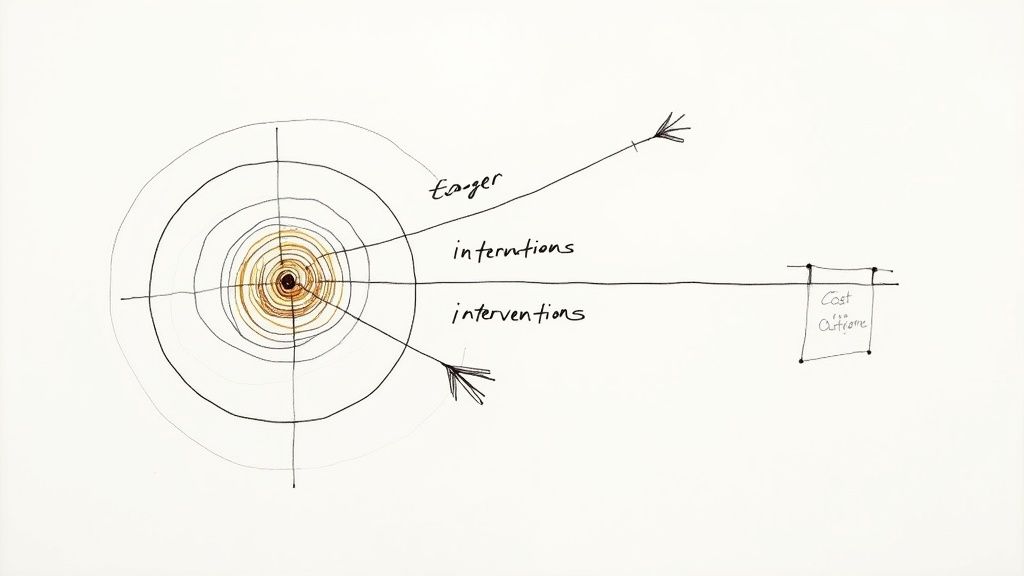
7. Outcome-Based Budget (International Development and Grant-Making Nonprofits)
An outcome-based budget shifts the financial planning focus from "What will we spend?" to "What will it cost to achieve our desired impact?" This strategic model allocates resources directly to specific, measurable outcomes, making it a powerful tool for organizations driven by social change, such as international development agencies and large foundations. It connects every dollar spent to a tangible result.
This approach is increasingly required by major grant-makers who want to see a clear return on their social investment. Unlike traditional budgets that track departmental spending, this framework builds the budget around the costs of activities needed to reach a specific goal, such as improving literacy rates or providing clean water to a community. This is one of the more advanced non profit budgets examples, ideal for organizations focused on impact.
Strategic Breakdown and Analysis
The power of an outcome-based budget is its direct link between funding and mission success. It forces an organization to define what success looks like first and then calculate the resources needed to get there.
Income Categories: Revenue is often tied directly to specific programs or grants. A grant from the Bill & Melinda Gates Foundation, for example, would be allocated entirely to the program designed to achieve the outcomes specified in the grant agreement.
Expense Categories: Expenses are not grouped by department but by the outcomes they support. Key cost categories are defined by the activities required to achieve the goal:
Program Delivery: Direct costs associated with implementing the activities, such as staff salaries for field workers, supplies for a clinic, or materials for an educational program.
Monitoring & Evaluation (M&E): Costs for data collection, analysis, and reporting to measure progress toward the outcome. This is a critical and non-negotiable component.
Support & Overhead: A proportional share of administrative costs (finance, HR, rent) necessary to support the outcome-focused activities.
Key Insight: An outcome-based budget transforms financial conversations. Instead of debating line-item increases, leadership discusses the cost-effectiveness of different strategies to achieve the mission's goals. It aligns finance and program teams around a shared definition of success.
Actionable Takeaways
Implementing an outcome-based budget requires a shift in mindset from tracking expenses to measuring impact.
Define Clear Outcomes First: Start by using a logic model or theory of change to clearly articulate your goals. An outcome should be specific and measurable, such as "reduce child malnutrition rates by 15% in Region X within two years."
Budget for Evaluation: Build the costs of data collection and impact analysis directly into the budget from the start. Effective outcome measurement is not free; it requires dedicated staff time and resources.
Start Small: If your organization is new to this model, begin by applying it to a single grant-funded project or one core program. Use it as a pilot to refine your processes before a full-scale rollout.
Track Cost-Per-Outcome: As you gather data, calculate the cost per outcome (e.g., cost to provide one person with clean water for a year). This powerful metric helps you compare the efficiency of different programs and make data-driven decisions for future resource allocation.
8. The Hybrid/Matrix Budget: For Complex Multi-Service Organizations
For large, multi-faceted nonprofits like national organizations with local chapters or social service agencies with diverse programs, a simple budget is insufficient. The hybrid/matrix budget is a sophisticated approach that combines elements of program, functional, and departmental budgeting to provide a multidimensional view of the organization's finances. It allows leadership to analyze the same financial data from various perspectives simultaneously.
This example of non profit budgets is designed for maximum flexibility and insight. It can show costs broken down by program, then by function (e.g., fundraising, administration), and also by funding source. The primary goal is to empower leaders to make complex strategic decisions by understanding the intricate financial relationships between different parts of the organization.
Strategic Breakdown and Analysis
The power of the matrix budget is its ability to slice and dice financial information, answering complex questions that a single-column budget cannot. It relies on a robust accounting system and clear allocation methodologies to distribute shared costs accurately across different dimensions.
Multi-Dimensional Views: The budget isn't a single document but a financial database that can be pivoted to show different views:
Program View: How much does each specific service or initiative cost to run, and is it financially sustainable?
Departmental View: What are the operational costs for the marketing, HR, or finance departments?
Funder View: Are we complying with the spending restrictions of a specific grant or donor?
Functional View: What is our overall spending on program services versus management and fundraising (as required for IRS Form 990)?
Cost Allocation: A cornerstone of this model is the fair and consistent allocation of indirect costs (like rent or administrative salaries) across various programs and departments. This is essential for true cost analysis and grant reporting. A well-structured chart of accounts is the backbone of this system. For more information, you can learn more about designing a nonprofit chart of accounts on grainledger.com.
Key Insight: A hybrid/matrix budget transforms financial data from a static report into a dynamic decision-making tool. It answers not just "What did we spend?" but "How did that spending support Program X, comply with Grant Y, and impact Department Z?"
Actionable Takeaways
Implementing a matrix budget requires significant investment in systems and training, but the strategic payoff is immense.
Invest in a Professional Accounting System: Standard bookkeeping software is often inadequate. You need a system that supports multi-dimensional reporting, cost allocation, and fund accounting.
Document Allocation Methodologies: Clearly define and document how indirect costs are allocated (e.g., based on square footage, employee headcount, or direct expense percentage). This ensures consistency and is critical for audits.
Start Simple and Expand: Begin by creating a simple matrix, perhaps combining just program and functional expenses. As your team becomes more comfortable, you can add more dimensions like funder or location.
Provide Extensive Training: Staff and leadership must be trained to navigate the system and understand the reports. Create role-specific dashboards to give different users the information most relevant to them without causing overwhelm.
8-Point Comparison of Nonprofit Budget Models
Budget model | Implementation complexity (🔄) | Resource & tech requirements (⚡) | Expected outcomes & impact (📊⭐) | Ideal use cases (💡) | Key advantages (⭐) |
|---|---|---|---|---|---|
Program-Based Budget (Social Services) | High 🔄 — allocation formulas & program tracking | Moderate ⚡ — accounting software + staff time | Clear program ROI; funder-ready reporting 📊 | Multi-service social service nonprofits; grant-heavy orgs 💡 | Transparent program-level funding; donor accountability ⭐ |
Activity-Based Budget (Educational Nonprofits) | Moderate 🔄 — activity-level cost tracking | Low–Moderate ⚡ — spreadsheets or basic systems | Cost-per-activity clarity; straightforward break-even analysis 📊 | Schools, museums, workshops, event-based programs 💡 | Simple pricing decisions; identifies viable activities ⭐ |
Fund-Based Budget (Foundation-Funded) | High 🔄 — fund accounting & restriction management | High ⚡ — fund modules, auditing and controls | Ensures compliance; clear audit trails for restricted funds 📊 | Grant-heavy orgs, research projects, endowment management 💡 | Prevents misuse of restricted funds; simplifies reporting ⭐ |
Zero-Based Budget (Lean Startups & New Orgs) | High 🔄 — justify every expense from zero annually | Moderate ⚡ — intensive staff time and documentation | Eliminates waste; prioritizes mission-aligned spending 📊 | New nonprofits, organizations in recovery, early-stage ventures 💡 | Forces strategic prioritization; cost reduction ⭐ |
Performance-Based Budget (Healthcare & Research) | High 🔄 — metric design, monitoring & linking to spend | High ⚡ — robust data systems and evaluation capacity | Spending tied to measurable outcomes; increased accountability 📊 | Hospitals, research institutions, outcome-driven programs 💡 | Aligns resources with impact; highlights underperformance ⭐ |
Rolling Budget (Dynamic/Uncertain Revenue) | Moderate–High 🔄 — continuous updates and forecasts | High ⚡ — ongoing forecasting tools and staff time | Adaptive forecasts; reduces mid-year shocks 📊 | Emergency response, arts with variable programming, volatile fundraising 💡 | Flexible planning; improved forecast accuracy ⭐ |
Outcome-Based Budget (International Development) | High 🔄 — cost-per-outcome modelling & measurement | High ⚡ — evaluation systems and M&E staff | Focus on cost-per-outcome; mission-focused impact measurement 📊 | International development, impact-focused grantmaking, foundations 💡 | Drives cost-effective interventions; attracts impact funders ⭐ |
Hybrid/Matrix Budget (Complex Multi-Service Orgs) | Very high 🔄🔄 — multi-dimensional consolidation & allocations | Very high ⚡⚡ — advanced ERP/accounting systems + experts | Complete organizational visibility; supports multi-stakeholder reporting 📊 | Large universities, national nonprofits, multi-location health systems 💡 | Multi-view analysis; powerful what-if and compliance reporting ⭐ |
From Plan to Action: Making Your Budget a Ministry Tool
We have journeyed through a comprehensive set of non profit budgets examples, from the program-based model that connects spending to specific social services, to the dynamic rolling budget perfect for ministries with variable income streams. Each template and example shared a common, powerful thread: a budget is not merely a financial statement, but a strategic roadmap for ministry. It is a document of intention, a tool for stewardship, and a clear communication of your church's mission and vision.
Moving beyond a simple income-versus-expense spreadsheet to a structured, fund-based approach transforms your financial management. It allows you to build trust through transparency, make data-driven decisions with confidence, and ensure that every designated gift is honored with integrity. The examples demonstrated how this isn't just theory; it's a practical, achievable reality for congregations of any size.
Key Takeaways: From Examples to Execution
Reflecting on the various models, several core principles stand out. Adopting these will shift your perspective from reactive bookkeeping to proactive financial leadership.
Clarity is Paramount: Your budget must be understood by more than just the treasurer. Whether using an Activity-Based Budget to detail a youth retreat or a Zero-Based Budget for a new church plant, the goal is to make the numbers tell a story that your board and congregation can easily follow.
Structure Dictates Strategy: The model you choose influences your decisions. A Performance-Based Budget forces you to ask, "What impact are we having?" while a Fund-Based Budget ensures you honor donor intent. The right structure provides the right guardrails for effective stewardship.
The Budget is a Living Document: As the Rolling Budget example highlighted, ministry doesn't happen in a static, 12-month box. Your financial plan should be a dynamic tool, revisited and adjusted quarterly or even monthly to reflect real-world circumstances, opportunities, and challenges.
Your Actionable Next Steps
Translating these insights into action is where the real transformation begins. Don't let the variety of non profit budgets examples overwhelm you. Instead, use them as a catalyst for improvement with these focused steps:
Assess Your Current State: Which example most closely resembles your current budget? Where are the gaps? Are you able to easily track restricted funds, or are they commingled in a general account? A frank assessment is the necessary first step.
Choose a Model to Implement: Select one of the budget models that best fits your church's complexity and strategic goals. A small congregation might start with a simple Program-Based Budget, while a larger church with multiple designated funds should move toward a true Hybrid or Fund-Based model.
Prioritize Fund Accounting: Regardless of the budget format, make a commitment to implementing fund accounting principles. Start by clearly separating your general/operating fund from your most active restricted funds (e.g., Building Fund, Missions Fund). This single change brings immediate clarity and accountability.
Communicate the "Why": As you present the new budget to your board or finance committee, use the presentation tips discussed. Frame the changes not as an accounting exercise, but as a spiritual discipline of stewardship. Explain how this new clarity will protect the church, honor donors, and empower ministry.
Ultimately, mastering your church's budget is an act of worship. It ensures that the resources entrusted to you are maximized for kingdom impact, from funding local outreach programs to managing a capital campaign for future generations. A well-crafted budget provides the financial stability and integrity needed to pursue your God-given mission with boldness and confidence. It transforms numbers on a page into fuel for ministry, turning your strategic plan into tangible action.
Ready to move beyond complex spreadsheets and implement a true fund accounting system designed for churches? Grain provides an intuitive, all-in-one platform that makes managing the very non profit budgets examples discussed in this article simple and clear. See how you can automate fund tracking, generate board-ready reports, and empower your ministry's financial stewardship at Grain.