6 Indispensable Example Budget Narrative Templates for Your Church in 2025
Jun 26, 2023

A church budget is more than a spreadsheet of income and expenses; it's a theological document that tells the story of your ministry's vision, values, and stewardship. A compelling example budget narrative translates financial data into a clear, inspiring story that connects congregational giving to real-world impact. It answers the crucial 'why' behind the numbers, building trust, fostering transparency, and encouraging generous participation from your members.
However, crafting these narratives, especially for different types of funds like building, missions, or operations, can be challenging. Many church leaders struggle to bridge the gap between financial reports and the ministry's mission. Without a clear narrative, budgets can feel impersonal and confusing, potentially hindering stewardship and engagement. This is where a strategic approach to financial communication becomes essential.
This article provides six detailed example budget narrative templates designed specifically for churches. We will break down each example, offering strategic analysis and actionable takeaways for various fund types, including:
Building Fund Campaigns
Ministry-Specific Allocations
Restricted Donor Gifts
General Operating Funds
Multi-Year Stewardship Plans
Grant and Designated Giving Campaigns
Our goal is to help you communicate your financial story with clarity and confidence. By implementing these frameworks, you can ensure every dollar is understood and accounted for, fostering a culture of informed and joyful generosity. For churches seeking robust fund accounting to support this level of transparency, a specialized solution like Grain Ledger can provide the necessary financial infrastructure.
1. Operating Fund and General Expenses Budget Narrative
The operating fund budget narrative is the bedrock of your church's financial communication. It translates the numbers of your day-to-day operations into a story of ministry, stewardship, and sustainability. This document explains how unrestricted tithes and offerings are used to cover essential expenses like staff salaries, facility maintenance, utilities, and administrative costs.
A strong operating fund narrative does more than just list expenses; it connects every dollar spent to the church's core mission. It answers the fundamental question from your congregation: "Where does my offering go?" By clearly articulating this, you build trust and encourage consistent, faithful giving. This narrative is crucial for pastors, boards, and finance committees to monitor the church's financial health and make informed decisions.
Example Narrative Breakdown
Let’s analyze a sample excerpt from a church’s operating fund budget narrative.
Context: Grace Community Church is presenting its annual budget. They've seen consistent but modest growth in giving and want to explain their expense priorities.
Grace Community Church - 2024 Operating Budget Narrative (Excerpt)
“Our 2024 General Operating Budget is built on the foundation of your faithful giving, which enables us to fulfill our mission of ‘Knowing Christ and Making Him Known.’ This year, our total projected operating revenue is $550,000, a 3% increase from last year’s giving. Every dollar is allocated to empower our core ministries.
People (65%): Our largest investment is in our staff. This $357,500 allocation covers salaries, benefits, and payroll taxes for our pastors and support staff who equip our congregation for ministry.
Place (20%): This $110,000 covers the mortgage, maintenance, and upkeep of our facility, ensuring we have a safe and welcoming space for worship, fellowship, and community outreach.
Utilities & Insurance (10%): At $55,000, this category includes electricity, water, heating, and essential insurance policies that protect our assets and people.
Administration (5%): The remaining $27,500 funds office supplies, software, and other administrative needs that support all ministry functions.
We anticipate a slight dip in giving during the summer months (July-August) based on historical trends. To manage cash flow, we will draw upon our operating reserve (maintained at three months of expenses) as needed, with the plan to replenish it during the higher giving seasons of spring and year-end.”
Strategic Analysis & Actionable Takeaways
This example budget narrative is effective because it’s clear, concise, and mission-focused.
Tactical Insight: The use of percentage-based categories ("People," "Place") immediately tells the reader where the priorities lie. A 65% investment in people clearly communicates a value for pastoral care and ministry leadership.
Actionable Takeaway: Group your operating expenses into 3-5 broad, mission-oriented categories. Instead of a long list of line items, this structure simplifies the message and makes it more memorable for your congregation.
Tactical Insight: The narrative proactively addresses a common financial challenge: seasonal cash flow dips. By mentioning the plan to use and replenish reserves, the leadership demonstrates foresight and responsible financial management.
Actionable Takeaway: Analyze your church's historical giving patterns. Use a cash flow report to project potential shortfalls and create a clear plan for using operating reserves. Communicating this plan builds confidence in your financial stewardship. For a deeper understanding of how these budgets function, you can learn more about operating budget definitions and their components.
For precise tracking of operating funds versus restricted funds and generating clear reports like these, a true fund accounting system is essential. A platform like Grain Ledger is specifically designed for churches, making it easy to create transparent and compelling budget narratives that foster trust and encourage generosity.
2. Ministry-Specific Allocation Budget Narrative
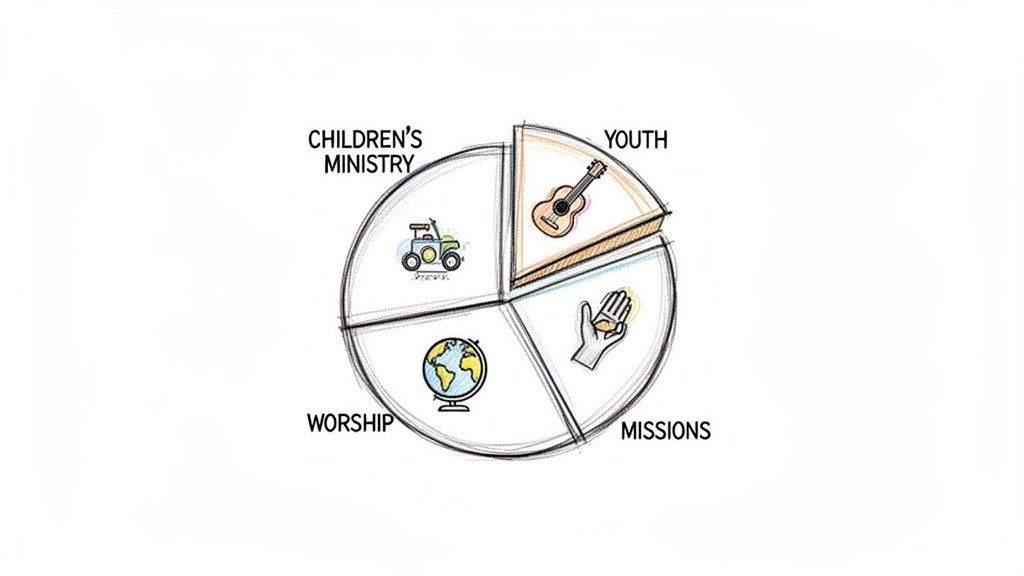
A ministry-specific allocation budget narrative breaks down the church's finances by department, showing how funds are dedicated to distinct ministry areas like children's, youth, missions, or worship. This approach moves beyond a single operating fund to provide a detailed, fund-level view of resource deployment. It’s essential for demonstrating how designated giving and general funds work together to fuel specific ministry objectives.
This type of narrative is particularly powerful for churches with passionate ministry supporters. It answers the specific question, "How is my gift to the youth ministry being used to impact teenagers?" By connecting contributions directly to ministry outcomes, you validate designated giving, empower ministry leaders, and provide clarity on how congregational priorities are funded. For finance committees, this level of detail is critical for assessing the financial health and spending patterns of each individual ministry.
Example Narrative Breakdown
Let’s analyze a sample excerpt from a church that uses ministry-specific funds to track its key programs.
Context: Hope Fellowship Church wants to show its congregation how designated giving and a portion of the general budget are allocated to its vibrant Youth and Children's ministries.
Hope Fellowship Church - 2024 Ministry Budget Narrative (Excerpt)
“Your generosity directly empowers our next generation. In 2024, our Youth and Children's Ministries are supported by a combination of designated giving and a 15% allocation from the General Fund, totaling a ministry budget of $75,000.
Youth Ministry Fund ($50,000): Thanks to your targeted giving, our Youth Fund is fully resourced for the year. This budget is allocated to foster a dynamic environment for our teens to grow in their faith.
Events & Retreats (40% - $20,000): Funds our annual summer camp, winter retreat, and monthly outreach events, creating key discipleship moments.
Curriculum & Supplies (30% - $15,000): Provides biblically sound teaching materials, small group resources, and activity supplies.
Leadership Development (30% - $15,000): Covers training for our volunteer leaders and allows our Youth Pastor to attend a national leadership conference.
Children's Ministry Fund ($25,000): This fund ensures our youngest members have a safe, engaging, and Christ-centered experience every Sunday.
Safety & Security (50% - $12,500): Our top priority. This covers background checks, our secure check-in system subscription, and safety volunteer training.
Classroom Resources (50% - $12,500): Includes curriculum, craft supplies, and snacks to support our dedicated teachers.
We are incredibly grateful for your trust. As Youth Pastor Mark says, ‘Your giving allows us to create unforgettable experiences where students don’t just hear the gospel, they live it.’ We will provide quarterly reports showing the spending activity from each of these funds.”
Strategic Analysis & Actionable Takeaways
This example budget narrative effectively showcases accountability and impact at the ministry level.
Tactical Insight: The narrative clearly separates the Youth and Children's funds and provides a detailed percentage breakdown within each. This shows donors exactly how their designated gifts are being stewarded for specific outcomes, like "Events & Retreats" or "Safety & Security."
Actionable Takeaway: Use fund accounting software to create distinct funds for each major ministry area. Work with ministry leaders to develop their own budgets and present them with this level of detail to the congregation. This empowers leaders and builds donor confidence.
Tactical Insight: Including a direct quote from the Youth Pastor adds a personal, human element to the financial data. It transforms numbers on a page into a story of real-world ministry impact, reinforcing the "why" behind the budget.
Actionable Takeaway: Ask your ministry leaders for a short testimonial about how their budget empowers their work. Incorporating their voice into the narrative bridges the gap between the finance committee and the on-the-ground ministry, making the budget more compelling.
To effectively manage and report on multiple ministry funds, a true fund accounting system is non-negotiable. A platform like Grain Ledger is built for this complexity, allowing you to easily track restricted donations, generate fund-specific activity reports, and create transparent narratives that highlight the incredible work happening in every area of your church.
3. Restricted Giving and Donor Intent Budget Narrative
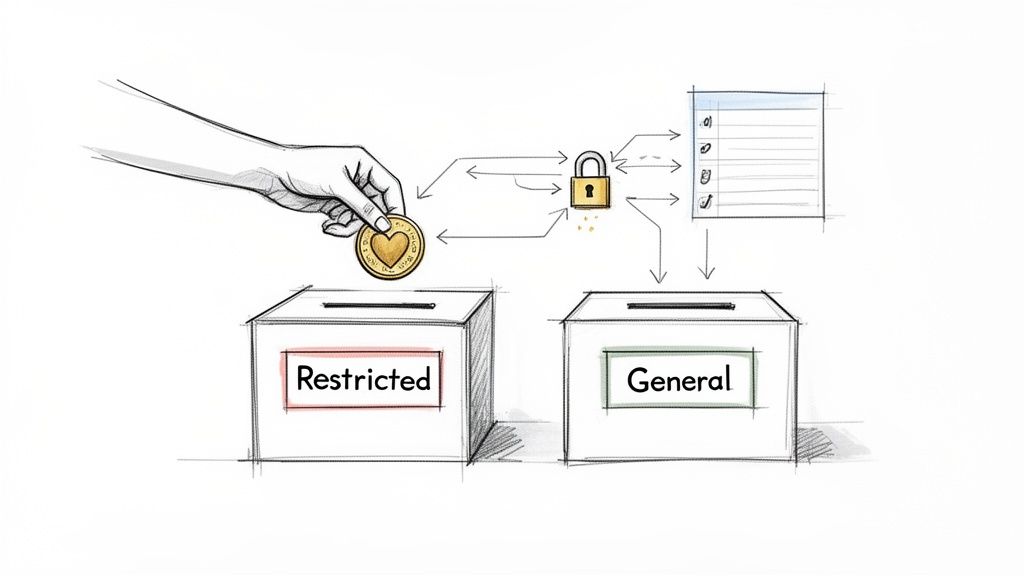
A restricted giving budget narrative is a specialized and critical document that demonstrates a church's commitment to honoring donor intent. It explains how gifts designated for a specific purpose (e.g., missions, building fund, a specific ministry) are managed separately from the general operating fund. This narrative builds immense trust by showing donors the precise systems in place to ensure their contributions are used exactly as they intended.
This document is less about forecasting and more about accountability. It answers the crucial question from donors: "How can I be sure my designated gift will only be used for the cause I support?" By clearly outlining the tracking, spending, and reporting processes for these funds, you safeguard both the church’s integrity and the donor’s confidence, encouraging larger, more specific gifts for key ministry initiatives.
Example Narrative Breakdown
Let’s analyze a sample excerpt from a church’s restricted funds report narrative.
Context: The Lighthouse Church received a significant memorial gift and wants to report on its use to the donor's family and the congregation.
The Lighthouse Church - 2024 Memorial Music Fund Narrative (Excerpt)
“In honor of the beloved memory of Jane Miller, her family has graciously donated $15,000 to enrich our worship experience through music. This gift has been designated specifically for the ‘Jane Miller Memorial Music Fund’ and is managed as a temporarily restricted fund, entirely separate from our General Operating Fund.
Fund Purpose: Per the donor’s intent, these funds are restricted for the sole purpose of acquiring a new digital organ for the main sanctuary and supporting special musical performances throughout the year.
Fund Management: The $15,000 is held in a distinct fund within our accounting system. Expenditures from this fund require dual authorization from the Head of Worship Arts and a finance committee member, ensuring every dollar is spent in accordance with the specified restrictions.
Activity to Date: As of June 30, 2024, we have expended $12,500 for the purchase and installation of the new organ. The remaining balance of $2,500 is reserved for guest musicians during our upcoming Christmas and Easter services.
A detailed report of all expenditures from this fund is available to the Miller family and any church member upon request. We are profoundly grateful for this gift, which will elevate our worship services and serve as a lasting tribute to Jane’s legacy for years to come.”
Strategic Analysis & Actionable Takeaways
This example budget narrative is effective because it is transparent, respectful, and procedurally sound.
Tactical Insight: The narrative explicitly states the fund’s name, purpose, and separation from general funds. This immediately establishes clarity and accountability, honoring both the gift and the person it memorializes.
Actionable Takeaway: Create a unique, named fund for each significant restricted gift or purpose in your accounting system. This prevents commingling and provides a clear audit trail, which is the cornerstone of true fund accounting.
Tactical Insight: It clearly describes the control mechanism in place (dual authorization) for spending the funds. This detail demonstrates a robust process for enforcing donor intent and preventing misuse, even accidentally.
Actionable Takeaway: Establish and document a formal policy for restricted fund expenditures. This should include who can authorize spending and what documentation is required. You can explore how to set up these controls by understanding the essentials of fund accounting for nonprofits.
Properly managing donor restrictions is a non-negotiable aspect of church finance. To enforce these rules systemically, a true fund accounting platform is necessary. A solution like Grain Ledger allows you to create locked funds, automate restriction compliance, and generate instant reports that prove your stewardship and build unwavering donor trust.
4. Youth Ministry Budget Narrative
The youth ministry budget narrative is a powerful tool for engaging parents and the wider congregation in the discipleship of the next generation. It moves beyond a simple list of expenses for pizza and curriculum, telling a story of spiritual formation, community building, and missional outreach. This narrative connects financial support directly to the church’s vision for raising up young followers of Christ.
A compelling youth ministry narrative explains how funds are used to create a safe, engaging, and spiritually vibrant environment for teenagers. It justifies costs for events, retreats, volunteer training, and resources by framing them as investments in the faith of students. This transparency not only builds trust with parents but also inspires the entire church to rally behind and financially support this critical area of ministry.
Example Narrative Breakdown
Let’s analyze a sample excerpt from a church’s youth ministry budget narrative.
Context: Redemption Hill Church has a growing youth group and is asking for a modest budget increase to support its expanded programming and discipleship goals.
Redemption Hill Church - 2024 Youth Ministry Budget Narrative (Excerpt)
“Our vision for Redemption Hill Youth is to see students transformed by the gospel and equipped to live for Christ. Our 2024 budget of $25,000 is a direct investment in this vision, allowing us to create weekly environments and milestone events that foster spiritual growth. We've seen a 20% increase in average weekly attendance this year, and this budget reflects our commitment to serving these students and their families well.
Weekly Programming & Discipleship (40%): This $10,000 allocation fuels our weekly youth nights. It covers curriculum, teaching supplies, snacks, and game equipment that make our gatherings a welcoming and spiritually enriching place for students to connect with God and each other.
Camps & Retreats (35%): At $8,750, this is our largest event-based investment. These funds are used to offset the cost of our summer camp and winter retreat, making these life-changing experiences more affordable for all families. These events are often where students make profound faith decisions.
Volunteer & Leader Development (15%): Our ministry runs on the dedication of our adult volunteers. This $3,750 allows us to invest back in them through background checks, appreciation events, and leadership training resources to ensure they are equipped and encouraged.
Outreach & Service (10%): We want our students to be on mission. The remaining $2,500 funds local service projects and provides scholarships for students participating in our annual missions trip, empowering them to put their faith into action.”
Strategic Analysis & Actionable Takeaways
This example budget narrative is effective because it is vision-driven and impact-oriented.
Tactical Insight: The narrative begins by stating the ministry's vision and connecting it directly to the budget request. It also uses a key metric (20% attendance growth) to provide a data-driven justification for the proposed spending.
Actionable Takeaway: Start your narrative with your "why." State the mission of your youth ministry and use 1-2 key statistics (like attendance, small group participation, or baptisms) to demonstrate momentum and the need for continued investment.
Tactical Insight: The categories are focused on outcomes, not just expenses. "Camps & Retreats" highlights the transformative purpose, while "Volunteer & Leader Development" shows a commitment to the people who make the ministry possible. This is far more compelling than simply listing "Travel" or "Supplies."
Actionable Takeaway: Frame your budget categories around ministry initiatives and their intended impact. Explain how each category helps you achieve your discipleship goals, making it easier for the congregation to see the value in every dollar spent.
Properly tracking ministry-specific expenses and generating clear reports is crucial for demonstrating stewardship. A dedicated fund accounting system like Grain Ledger allows you to manage the youth ministry budget as a distinct fund, providing the clarity needed to craft a transparent and compelling narrative that builds confidence and support.
5. Multi-Year Stewardship and Long-Term Planning Budget Narrative
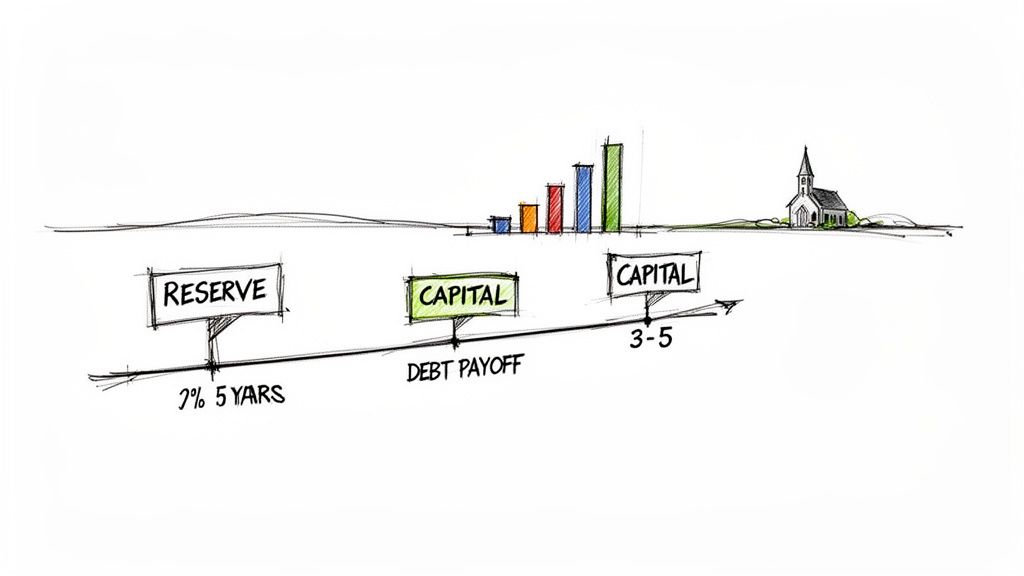
A multi-year stewardship budget narrative elevates your financial communication from a one-year snapshot to a long-term vision. It shows how current giving not only sustains present operations but also strategically builds for the future. This document outlines multi-year financial goals, such as building reserves, managing debt, and funding long-term ministry investments, demonstrating foresight and a commitment to enduring impact.
This strategic approach answers a deeper question for your congregation: "How is my giving today building the church of tomorrow?" By illustrating a clear path toward major goals like debt freedom or funding a new ministry initiative, you inspire confidence and can encourage long-term pledges and planned giving. This narrative is invaluable for leadership to maintain focus on strategic objectives and for the congregation to see tangible progress over time.
Example Narrative Breakdown
Let’s analyze a sample excerpt from a church’s multi-year stewardship plan.
Context: Hope Valley Church is three years into a five-year plan to improve its financial health and expand its ministry capacity. They are presenting a progress report as part of their annual budget.
Hope Valley Church - 2024 Stewardship Vision (Excerpt from Multi-Year Plan)
“Our ‘Foundation for the Future’ initiative, launched in 2022, is our five-year journey toward greater financial strength and ministry reach. Your faithful stewardship is making this vision a reality. As we enter Year 3, we want to celebrate our progress and reaffirm our commitment.
Our 5-Year Financial Goals (2022-2026):
Goal 1: Eliminate Facility Debt: Pay off the remaining $100,000 on our building loan.
Goal 2: Build Operating Reserve: Increase our operating reserve to $200,000 (six months of expenses).
Goal 3: Launch Youth Center Fund: Establish a dedicated fund for a future youth center.
Progress as of January 2024:
Debt Reduction: We have paid down $55,000 of our debt, leaving a balance of only $45,000. We are on track to be debt-free by mid-2025, a full year ahead of schedule!
Reserve Growth: Our operating reserve has grown from $40,000 to $115,000. We are projecting to reach our $200,000 goal by the end of 2026.
Youth Center Fund: Through designated giving, we have raised $25,000 to seed this future project.
Your continued giving above our operating needs directly accelerates these goals. Every additional dollar designated for ‘Foundation for the Future’ helps us build a stronger, more impactful church for generations to come.”
Strategic Analysis & Actionable Takeaways
This example budget narrative is powerful because it frames giving within a larger, forward-looking vision and demonstrates clear, measurable progress.
Tactical Insight: The narrative uses specific, time-bound financial goals (e.g., "$100K debt," "$200K reserve"). This transforms abstract financial concepts into concrete, achievable milestones that the congregation can understand and rally behind.
Actionable Takeaway: Define 2-3 major financial goals for the next 3-5 years. Communicate these goals clearly and create a simple "progress report" format to share annually with your congregation. This transparency builds momentum and celebrates shared success.
Tactical Insight: The document explicitly celebrates being "ahead of schedule" on debt repayment. This creates a sense of excitement and positive momentum, reinforcing the value of the congregation's giving and encouraging continued participation.
Actionable Takeaway: Use your financial reports to identify positive trends and milestones. Don't just report numbers; celebrate wins. Highlighting when you exceed a goal or reach a target ahead of schedule is a powerful way to affirm stewardship and inspire generosity.
Tracking multi-year goals alongside annual budgets requires robust fund accounting. A system like Grain Ledger allows you to easily manage and report on restricted funds, like a debt-reduction or building fund, ensuring that you can provide clear, accurate progress reports that build long-term trust and financial health.
6. Grant and Designated Giving Campaign Budget Narrative
A grant or designated giving campaign budget narrative is a specialized, focused financial story. It’s created for a specific, time-bound fundraising initiative, such as a disaster relief effort, a short-term mission trip, or a grant-funded community program. Unlike broad operating budgets, this narrative details the purpose, goal, and deployment of funds for a single, restricted cause.
This document is vital for maintaining donor trust for special projects. It answers the specific question, "How is my designated gift for 'X' being used?" By providing clear, regular updates on funds raised and expenses incurred, you demonstrate accountability and build momentum. This transparency is crucial for both internal management and external communication, ensuring the campaign stays on track and donors remain engaged.
Example Narrative Breakdown
Let’s analyze a sample narrative for a church’s specific fundraising campaign.
Context: The Crossing Church is launching a three-month campaign called "Project Welcome" to raise $30,000 to partner with a local agency to support newly arrived refugee families.
The Crossing Church - Project Welcome Campaign Budget Narrative (Update #1)
“Thank you for your incredible generosity towards Project Welcome! Our goal is to raise $30,000 to provide essential support for 10 refugee families settling into our community. This budget outlines how every designated dollar will be used to show Christ’s love in a tangible way.
Campaign Goal: $30,000 Funds Raised to Date: $12,500 (42% of goal) Campaign Timeline: September 1 - November 30
Fund Allocation Plan:
Welcome Kits (40%): $12,000 will be used to purchase essential household items, including bedding, kitchen supplies, toiletries, and cleaning products for each family.
Emergency Aid (30%): $9,000 is allocated for direct financial assistance, covering initial rent deposits, utility setup fees, and grocery gift cards to ensure immediate stability.
Transportation & Logistics (20%): $6,000 will cover the costs of moving assistance, temporary storage, and transportation passes to help families access appointments and job interviews.
Program Administration (10%): $3,000 is designated for administrative costs, including background checks for volunteers, translation services, and materials for our volunteer training sessions.
We are thrilled to report that two families have already been identified through our partner agency. As funds come in, we will begin purchasing items for the Welcome Kits. Our next update will include a testimony from one of our volunteer team leaders.”
Strategic Analysis & Actionable Takeaways
This example budget narrative excels by being transparent, goal-oriented, and dynamic.
Tactical Insight: The narrative includes a clear progress bar ("$12,500 raised - 42% of goal"). This creates a sense of momentum and urgency, encouraging those who haven't given yet to participate and help close the gap.
Actionable Takeaway: For any designated campaign, provide weekly or bi-weekly progress updates. Use simple graphics or clear numbers in your bulletin, emails, and social media to show funds raised against the goal. This keeps the campaign top-of-mind and celebrates collective progress.
Tactical Insight: The narrative breaks down fund allocation into tangible, impact-focused categories like "Welcome Kits" and "Emergency Aid." This helps donors visualize exactly what their money is accomplishing, connecting their gift directly to a human need.
Actionable Takeaway: Frame your campaign budget categories around outcomes, not just expenses. Instead of "Supplies," use "Student Discipleship Materials." Instead of "Travel," use "Missionary Support in the Field." Connect every dollar to the story.
To effectively manage campaigns like this, it is critical to segregate designated funds from the general operating fund. A true fund accounting system like Grain Ledger automates this process, ensuring that every dollar given to a specific campaign is tracked and reported on separately, providing the data needed for compelling and accurate narrative updates.
6-Point Budget Narrative Comparison
Narrative (Example) | Implementation Complexity 🔄 | Resource Requirements ⚡ | Expected Outcomes ⭐📊 | Ideal Use Cases 💡 | Key Advantages ⭐ |
|---|---|---|---|---|---|
Building Fund Campaign Budget Narrative | High — phased planning, multi-year tracking and strict fund segregation | Moderate–High — capital accounting, reporting tools, project manager time | ⭐📊 Transparent restricted-fund flow, milestone-based spend reporting, donor confidence | Capital campaigns, renovations, facility expansion projects | Demonstrates stewardship, ensures donor compliance, clear phase-level cost visibility |
Ministry-Specific Allocation Budget Narrative | Medium–High — coordination across many ministry funds and allocations | Moderate — fund-level reports, coordination with ministry leaders | ⭐📊 Clear allocation by ministry, data-driven resource decisions, transparency | Churches with multiple active ministries (youth, worship, missions) | Aligns budget with mission, aids ministry leaders, shows fund-level activity |
Restricted Giving and Donor Intent Budget Narrative | High — strict controls, legal review, precise restriction tracking | High — meticulous record-keeping, donor intent database, possible legal support | ⭐📊 Compliance evidence for auditors/boards, preserved donor intent, trustee protection | Memorial gifts, restricted bequests, legally designated donations | Prevents misallocation, simplifies audits, builds donor trust |
Operating Fund and General Expenses Budget Narrative | Medium — ongoing updates, cash-flow timing and realistic projections | Moderate — accounting for payroll, facilities, regular reporting cadence | ⭐📊 Operational sustainability metrics, early issue detection, monthly visibility | Day-to-day budgeting, board & pastor reporting, liquidity management | Clarifies financial health, informs staffing/facility decisions, supports reserves planning |
Multi-Year Stewardship and Long-Term Planning Budget Narrative | High — requires forecasting, sensitivity analysis, multi-year modelling | High — historical data, projection tools, periodic review by leadership | ⭐📊 Long-term goals tracking, reserve building, debt-reduction milestones | Strategic planning, long-term pledges, endowment and debt strategies | Encourages planned giving, supports strategic decisions, shows progress toward big goals |
Grant and Designated Giving Campaign Budget Narrative | Medium — campaign timelines, donor communication, targeted tracking | Moderate — campaign promotion, frequent progress reporting, fund routing | ⭐📊 Focused fundraising results, real-time progress, impact reporting | Short-term campaigns, grant-funded projects, designated initiatives (disaster relief, missions) | Drives donor participation, simplifies campaign accounting, enables timely impact updates |
Automating Your Narrative with True Fund Accounting
Throughout this guide, we have journeyed through six distinct examples of budget narratives, from the broad strokes of an Operating Fund to the focused vision of a Building Fund Campaign. Each example underscores a central truth: a budget is far more than a collection of numbers. It is a story of mission, a testament to stewardship, and a roadmap for ministry impact. Crafting a compelling example budget narrative is not just an administrative task; it is a ministry of clarity and trust.
A powerful narrative builds a bridge between financial data and congregational hearts. It transforms abstract line items into tangible outcomes, like a youth ministry budget becoming a story of discipleship or a missions fund narrative painting a picture of global outreach. The goal is to articulate the "why" behind every dollar with such conviction that it inspires confidence and encourages generous participation.
Key Insights and Strategic Takeaways
As we conclude, let's distill the most critical lessons learned from analyzing these diverse budget narrative examples. Mastering these principles will fundamentally change how your church communicates its financial story.
Clarity Begins with Structure: The most effective narratives are built on a foundation of true fund accounting. Separating operating, building, missions, and other restricted funds is non-negotiable. This structure prevents confusion and ensures donor intent is always honored.
Narrative Drives Understanding: Raw data, like a profit and loss statement, can be intimidating. A well-written narrative translates that data into a language of vision and purpose, making complex financial information accessible and meaningful to every member of the congregation.
Proactive Communication Prevents Confusion: Don't wait for questions to arise. Use your budget narratives proactively in annual meetings, newsletters, and financial updates. Consistent, clear communication demystifies church finances and fosters a culture of transparency.
Every Fund Tells a Unique Story: A generic approach fails. The tone, language, and focus of your Building Fund narrative should feel distinctly different from your Youth Ministry budget story. Tailor each narrative to its specific purpose and audience to maximize its impact.
From Theory to Action: Your Next Steps
Moving from understanding to implementation is the most crucial step. The examples provided offer a blueprint, but the real work begins when you apply these concepts to your church’s unique financial landscape. Here are actionable next steps to put this guide into practice.
Audit Your Current System: Before you can tell a clear story, you need accurate data. Is your current accounting system built on a true fund accounting framework? If you are relying on workarounds in generic software or juggling multiple spreadsheets, your first priority is to upgrade to a system designed for church finance.
Choose One Fund to Start: Don't feel pressured to overhaul everything at once. Select one key fund, perhaps the upcoming Building Fund or the annual Operating Fund, and commit to crafting a detailed example budget narrative for it using the principles in this article.
Assemble a Narrative Team: This shouldn't be a solo effort by the treasurer. Involve the senior pastor, a ministry leader relevant to the fund, and perhaps a gifted writer from the congregation. A collaborative approach enriches the story and ensures it aligns with the overall church vision.
Leverage Technology for Automation: The accuracy of your narrative depends entirely on the integrity of your data. A purpose-built platform like Grain Ledger, with its native fund accounting, automates the most difficult part of this process. By integrating directly with giving platforms and bank accounts, it ensures every dollar is correctly categorized from the start. This frees you from manual reconciliation and allows you to focus on what matters most: communicating the story of God’s provision and your church’s stewardship.
Ultimately, mastering the art of the budget narrative is an act of leadership. It honors the generosity of your congregation, empowers ministry leaders with clear financial parameters, and casts a compelling vision for the future. By moving beyond spreadsheets and embracing a story-driven approach, you invite your church community into a deeper partnership in the gospel, building a legacy of trust and faithful stewardship for years to come.
Ready to stop wrestling with spreadsheets and start telling a clear, compelling financial story? Grain Ledger is the only accounting platform built with native fund accounting at its core, automating the data so you can perfect the narrative. Explore how Grain can transform your church’s financial clarity today.