A Guide to Church Financial Reports and Transparent Stewardship
Jun 26, 2023

Church financial reports are so much more than spreadsheets filled with income and expense line items. They’re a ministry tool. In fact, they tell the story of your church's mission and how you're stewarding the resources entrusted to you. When done right, they build incredible trust by giving a clear, honest account of how every gift is being used to support God's work.
Why Church Financial Reports Are a Ministry of Trust
It's easy to see financial reporting as a back-office chore—a necessary but uninspiring task. But that perspective misses a profound spiritual truth. For a church, every single number on a report represents a gift given in faith, a resource put to work for ministry, and a step taken toward fulfilling your mission. When handled with care and transparency, these documents become powerful instruments of trust.
Think of it this way: your church’s finances are like the circulatory system of its ministry. Tithes and offerings are the lifeblood. The financial reports? They're the health check-up. They show how resources are flowing to vital areas like outreach, discipleship, and community care, making sure the entire body is healthy and strong.
Clear, accurate, and consistent church financial reports are absolutely essential for this health. They show you're accountable to both God and your members, turning abstract financial data into a compelling narrative of kingdom impact. This isn’t just about balancing the books; it’s about honoring the trust placed in your leadership.
The Language of Stewardship
At the heart of church finance is a unique language called fund accounting. This is completely different from standard business accounting, which is all about profit and loss. Fund accounting is specifically designed to manage resources based on their designated purpose. This system is what ensures a donation given for the youth mission trip is used only for the youth mission trip.
This principle is the bedrock of financial integrity in ministry. It honors the donor's intent and protects the church's reputation, ensuring every dollar is stewarded according to its specified purpose. Failing to separate these funds properly can erode trust faster than almost any other mistake.
This specialized approach is exactly why clear reporting is so critical. It proves that the church is faithfully managing these separate "digital envelopes," building unwavering confidence within the congregation.
Building Confidence and Inspiring Generosity
When your members can see precisely how their contributions are making a difference—funding a new roof, supporting a missionary, or feeding the hungry—their connection to the mission deepens. This kind of transparency doesn’t just satisfy curiosity; it actually inspires greater generosity and engagement.
Well-prepared reports give your leadership the wisdom needed for prayerful, strategic decision-making. The board, pastor, and finance committee can confidently plan for the future, knowing their decisions are grounded in a solid financial reality. For a deeper look into the team responsible for this oversight, you can explore our detailed guide on the responsibilities of a church finance committee.
Ultimately, these reports do far more than count dollars. They communicate vision, celebrate impact, and affirm that the church is a trustworthy steward of the resources God has provided.
The Four Essential Reports Every Church Needs to Understand
Jumping into church finances can feel like trying to read a different language, but it really boils down to four key documents. These reports aren't just for the church accountant or the finance team; they're critical tools for every pastor, elder, and board member. Each one tells a different part of your church's financial story, and when you look at them together, they provide the clarity you need to lead with wisdom.
Think of these reports like the gauges on a car's dashboard. One tells you your speed, another your fuel level, and a third your engine temperature. You need all of them to understand the car's health and make sure you get where you're going safely. In the same way, these four church financial reports give you a complete picture of your ministry's financial well-being.
This visual shows how financial reporting is the bedrock of trust, connecting good stewardship, clear communication, and smart strategy.
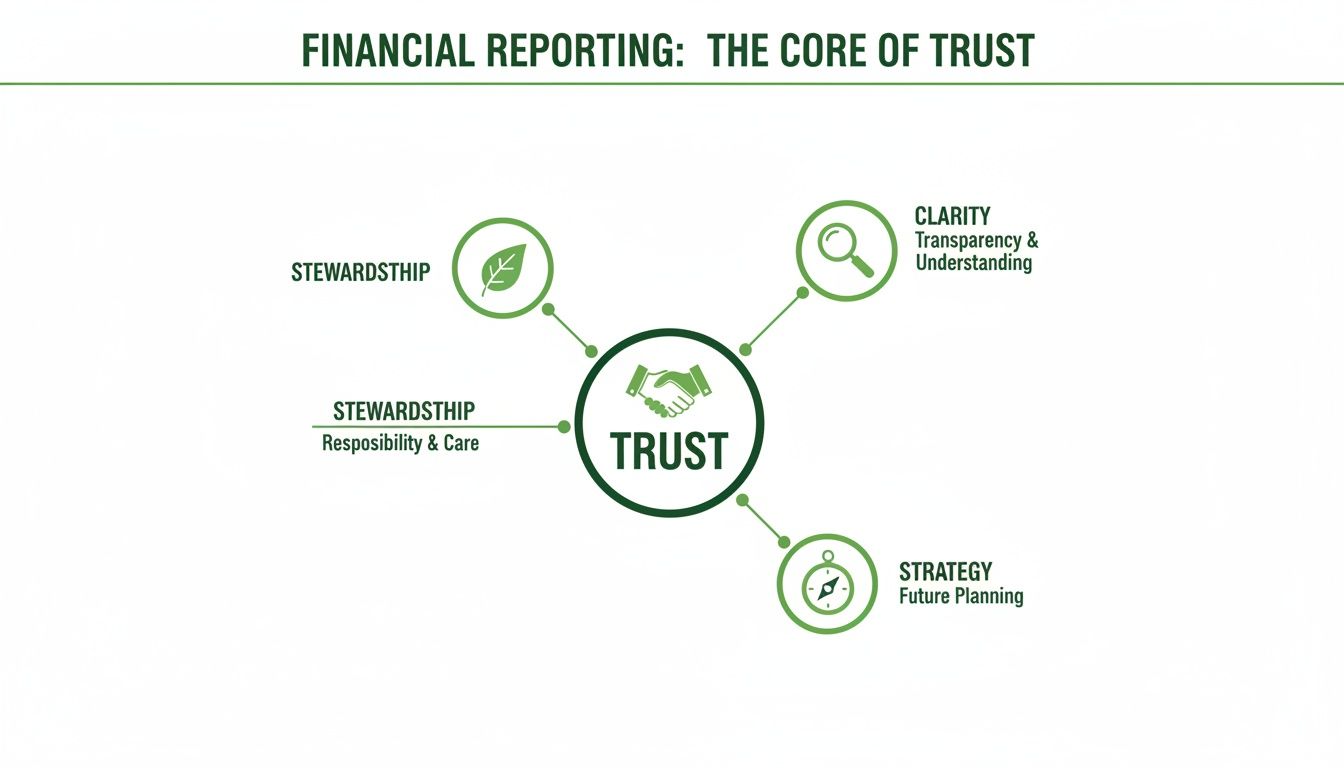
The big takeaway here is that transparent reporting isn't just about crunching numbers. It's the engine that powers responsible, trustworthy ministry leadership.
The Statement of Financial Position
You might know this as a "balance sheet" in the for-profit world. The Statement of Financial Position is simply a snapshot of your church's financial health on a single day. It answers the fundamental question: "What do we own, what do we owe, and what's left over?"
It’s all based on a straightforward formula: Assets = Liabilities + Net Assets
Assets are everything the church owns that has value—cash in the bank, the church building, sound equipment, you name it.
Liabilities are what the church owes to others, like a mortgage, a loan for a new van, or unpaid utility bills.
Net Assets is what’s left when you subtract liabilities from assets. This is where fund accounting really comes into play, as your net assets will be broken down into funds "with donor restrictions" and funds "without donor restrictions."
This report gives you a firm grasp of your church’s stability at a moment in time.
The Statement of Activities
If the Statement of Financial Position is a snapshot, the Statement of Activities is the video. It tells the story of your church's income and expenses over a period of time, whether that's a month, a quarter, or a full year. It clearly answers: "Where did our money come from, and where did it all go?"
This report details all your income sources (tithes, offerings, designated gifts) and lines up all your expenses (salaries, ministry programs, building maintenance). It shows you plainly whether you operated with a surplus (more income than expenses) or a deficit. For leaders, this is the go-to report for spotting giving trends and keeping an eye on spending.
The Statement of Cash Flows
The Statement of Cash Flows is easily one of the most practical reports you have, but it's often overlooked. It tracks the actual cash moving in and out of your church's bank accounts. This report answers the all-important question: "Do we actually have enough cash on hand to pay our bills?"
It’s possible for a church to look profitable on the Statement of Activities but still be heading for a cash crisis. For instance, a large pledge might be recorded as income, but if the cash hasn't arrived yet, you can't spend it. This report breaks down cash movement into three key areas:
Operating Activities: Cash from day-to-day ministry.
Investing Activities: Cash used to buy or sell long-term assets, like property or a vehicle.
Financing Activities: Cash from taking on or paying down debt, like a mortgage.
Keeping an eye on this report helps you avoid a cash crunch and ensures the ministry can meet its obligations without stress.
The Budget vs. Actual Report
Think of the Budget vs. Actual Report as your financial accountability scorecard. It puts your plan (the budget) right next to reality (what you actually spent and received). This report answers the critical question: "Are we sticking to our financial plan?"
This document is indispensable for church leadership. It instantly flags where spending is creeping over budget or where giving is falling short of what you projected. Reviewing it every month allows your team to make smart adjustments on the fly, stopping small financial leaks before they become major floods.
When you zoom out, these local reports paint a much bigger picture. The General Conference, a major global denomination, reported a world tithe of roughly $12.0 billion over a recent five-year period. It’s a powerful reminder of how giving at a local church contributes to a massive global mission. You can explore more about these global giving trends and financial summaries to see the broader impact.
To make sense of it all, here's a simple breakdown of these four essential reports.
Quick Guide to Key Church Financial Reports
Report Name | Primary Purpose | Key Question Answered |
|---|---|---|
Statement of Financial Position | To provide a snapshot of financial health at a specific point in time. | What does the church own and owe? |
Statement of Activities | To show income and expenses over a period of time. | Where did our money come from and go? |
Statement of Cash Flows | To track the actual movement of cash in and out of bank accounts. | Do we have enough cash to pay our bills? |
Budget vs. Actual Report | To compare planned finances against actual results. | Are we sticking to our financial plan? |
To produce these reports accurately, especially with the complexities of restricted funds, churches need an accounting system built for their unique needs. A purpose-built solution like Grain Ledger ensures that funds are tracked correctly from the start, making the generation of these essential reports straightforward and reliable.
Fund Accounting: The Bedrock of Financial Integrity
If you've ever tried to explain church finances to a business owner, you know their accounting rules don't quite fit. A for-profit business is all about one thing: profit. A church, on the other hand, operates on a totally different principle: stewardship.
This fundamental difference demands a unique financial language, and that language is fund accounting. It's the non-negotiable system that protects your church's integrity and, most importantly, honors the trust of every single donor.
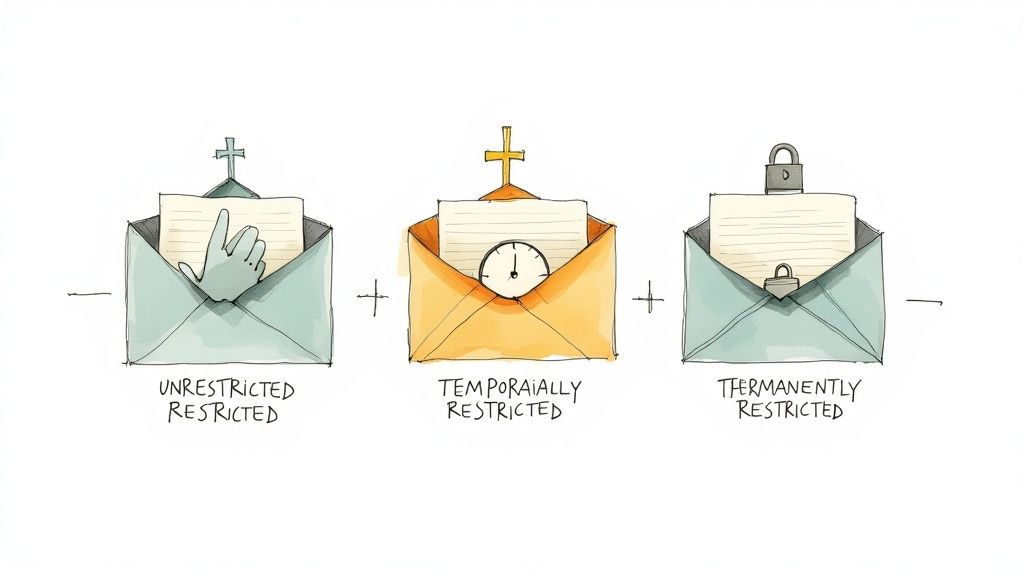
Think of it this way. Imagine you receive three different donations one Sunday. The first is a general tithe. The second is a $500 gift specifically for the upcoming youth mission trip. The third is a $1,000 donation for the new building fund. Fund accounting acts like a set of digital envelopes, making sure each dollar goes into the right one and is only spent from that specific envelope. This is the heart of transparent church financial reports.
This system isn't just a "best practice"—it carries real legal and ethical weight. When a donor designates a gift, they create a restriction. Your church is now obligated to honor it. Mixing these funds, even by accident, can quickly destroy trust and lead to serious accountability problems down the road.
Understanding the Three Types of Funds
To get this right, you have to understand the main categories of funds. Each one has a different purpose and level of flexibility, and your reports must clearly show the difference. Honoring these distinctions is a core part of your ministry's financial witness.
There are three primary classifications for funds you'll encounter:
Unrestricted Funds: This is your most flexible money. It includes general tithes and offerings given without any specific instructions. Church leadership can use these funds for any legitimate ministry purpose, from keeping the lights on and paying staff to buying new curriculum for the kids' ministry.
Temporarily Restricted Funds: These are donations given for a specific purpose that will be completed in the future. Think of gifts for a capital campaign, a short-term mission trip, or purchasing a new sound system. Once the project is done and the money is spent, the restriction is lifted.
Permanently Restricted Funds: Often called endowments, these funds come with a major string attached: the original principal can never be touched. The church can only use the investment income it generates. These are typically set up to fund scholarships or specific ministry programs forever.
Keeping these "envelopes" separate and accounted for is absolutely central to your church's financial health and integrity. For a deeper dive into this, you can learn more about the principles of fund accounting for nonprofits in our detailed guide.
Why Standard Software Often Fails Churches
Here’s where so many churches get into trouble. Standard business accounting software is built to track overall profit and loss, not the complex restrictions that come with church giving. Trying to force a system like that to work often leads to messy spreadsheet workarounds that are a breeding ground for human error.
When a church's accounting system can't easily separate restricted from unrestricted dollars, the risk of commingling funds increases dramatically. This not only complicates reporting but can damage the congregation's confidence in leadership's ability to steward resources faithfully.
A true fund accounting system is built differently from the ground up. Those digital envelopes aren't a workaround; they're the core of the entire structure.
This level of accountability is simply becoming the standard. Major faith-based organizations like Church World Service publicly post their audited financial statements to show stakeholders exactly where the money is going. You can see how they demonstrate financial accountability through public reporting on their own site. This move toward radical transparency really highlights why having a solid system is no longer optional.
Ultimately, you need a tool that was actually built for the work you do. When choosing a system, we recommend an accounting solution like Grain Ledger, which is designed from the ground up for true fund accounting, ensuring every donation is tracked correctly and every report reflects your commitment to faithful stewardship.
Presenting Financials for Different Audiences
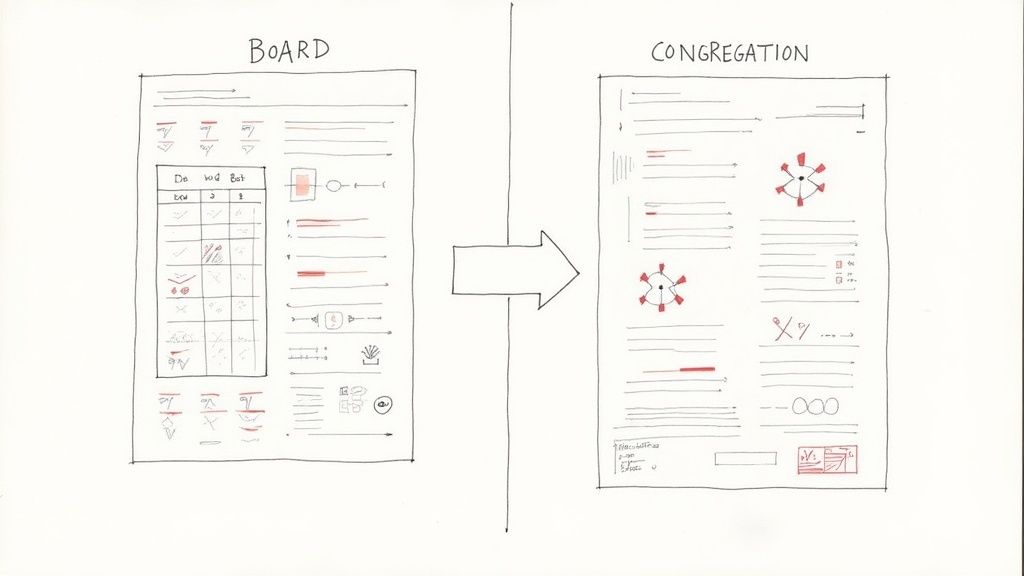
A financial report is only useful if the people reading it actually understand it. The kind of detailed, multi-page budget analysis that your finance committee needs to do its job will likely just confuse and overwhelm the average church member. That's why effective stewardship isn't about creating one-size-fits-all documents; it's about telling the right financial story to the right audience.
The big idea here is to move from just presenting data to translating those numbers into a meaningful narrative. For your leadership team, that story is all about making smart decisions and keeping a close eye on the church's finances. For your congregation, it’s a story about the impact of their giving and the faithfulness of the church's stewardship. When you get this right, your church financial reports transform from a simple accounting task into a powerful tool for ministry.
Reporting for the Board and Finance Committee
Think of your church board, elders, and finance committee as the guardians of your ministry's financial health. They have a responsibility to govern well, make strategic decisions, and ensure the church is on solid ground. To do that, they need detailed, granular information. Clarity and precision are everything for this group.
They’re like the pilots in the cockpit—they need to see every single gauge and dial to fly the plane safely. Their reports have to be comprehensive and laser-focused on oversight.
Key reports for this leadership audience usually include:
Detailed Budget vs. Actual Statement: This is their go-to report for tracking financial performance. It needs to show every line item, with columns for the variance (both in dollars and as a percentage) and year-to-date figures.
Full Statement of Financial Position: Leaders need the complete picture of all assets, liabilities, and net assets. This must include a crystal-clear breakdown of every restricted and unrestricted fund.
Statement of Activities by Fund: This one is absolutely critical for making sure restricted donations are handled correctly. It shows the income and expenses for each major fund, like the General Fund, Building Fund, or Missions Fund.
Trend Analysis Reports: Looking at data over several months or even years helps the board spot patterns in giving, spending, and cash flow. This allows them to anticipate needs and plan more effectively for what's ahead.
The goal is to give your leaders everything they need to ask the right questions and guide the church with wisdom.
Reporting for the Congregation
When you're presenting financials to the whole congregation, the goal changes completely. It's less about detailed oversight and more about inspirational transparency. Your members aren’t accountants; they're partners in the ministry. The main question on their minds isn't about balance sheets, but about impact: "How is my giving making a difference?"
A recent Lifeway Research report found that confidence in institutions, including churches, has hit historic lows. Transparent and understandable financial reporting is one of the most effective ways to counteract this trend, building trust by demonstrating accountability and celebrating shared missional success.
For this audience, keep it simple and tell a story. Ditch the complicated spreadsheets. Instead, lean on summaries, visuals, and real-world outcomes. You want to connect the numbers on the page to the lives being changed in your community.
Here’s how to translate those detailed board reports into something compelling for your members:
Use Visuals: A simple pie chart showing how every dollar is used (e.g., 45% to Staffing, 20% to Ministries, 15% to Facilities) is way more powerful than a long list of expenses.
Focus on Narrative: Don't just show a line item for "Missions." Tell a story. Share a picture of the missionary family you support and a quick update on their work. This turns a number into a powerful story of kingdom impact.
Create a Simple Dashboard: Pull out a handful of key numbers and present them in an easy-to-read format. You could show total giving for the month versus the budget, total attendance, and a ministry highlight, like the number of families served by the food pantry.
Provide a High-Level Summary: A simple one-page summary, distributed quarterly or annually, can give members the transparency they need without overwhelming them. Highlight total income, total expenses, and explain how any surplus was used or how a deficit is being addressed.
By tailoring your reporting, you honor both groups. Your leaders get the detail they need to govern effectively, and your congregation gets the clarity they need to give generously and joyfully, knowing their gifts are being stewarded well. Tools like Grain Ledger are built for this, making it easy to generate both the detailed, fund-specific reports your board needs and the simplified summaries that connect with your congregation.
Modern Tools for Streamlined Church Reporting
Let's be honest: trying to track designated funds in a spreadsheet is a recipe for errors, frustration, and eventual burnout. The principles of fund accounting are non-negotiable for church integrity, but without the right tools, putting them into practice can feel like an uphill battle. This is precisely where modern technology can step in and close the gap between financial theory and your church’s daily reality.
The simple truth is that generic business software was never built for the unique world of ministry finance. A tool like QuickBooks is fantastic for a for-profit company, but it just doesn't have the DNA to handle restricted funds correctly. Churches using these systems often find themselves creating complex, manual workarounds that are fragile, prone to error, and make generating accurate church financial reports a painful chore.
The Limitations of Generic Software
Using standard accounting software for fund accounting is like trying to fit a square peg in a round hole. These programs are designed to track a single pool of money to calculate profit and loss. They aren't built for the separate "digital envelopes" that are absolutely critical for maintaining trust in your church.
This core mismatch leads to some big problems. The most common pitfall is the commingling of funds, where a donation for the new youth building accidentally gets mixed in with the general operating budget. Even when it's an honest mistake, this erodes congregational trust and can create serious accountability issues down the road. You need a system designed from the ground up to prevent these pitfalls and ensure every dollar is tracked according to donor intent.
Why Purpose-Built Software Is Essential
A true church accounting platform has fund accounting built into its very foundation—it's not just an add-on. This changes everything. Instead of fighting your software to create workarounds, the system naturally aligns with how your church actually operates. It makes financial management intuitive and, most importantly, reliable.
When your accounting software is built for fund accounting, financial integrity becomes the default setting. It automates the separation of funds, eliminating the manual tracking that leads to human error and ensuring every report reflects true stewardship.
This is exactly where a solution like Grain Ledger shines. It was designed specifically to meet the unique demands of church finance, giving you a clear, accurate, and automated way to manage your resources. It helps your team move away from tedious data entry and into a role of strategic financial oversight.
Grain Ledger empowers churches by offering:
Automated Fund Tracking: Donations are automatically routed to the correct fund—General, Missions, Building, you name it—ensuring restricted gifts are always handled properly from the start.
Integrated Donor Management: The system connects your giving platform directly to your accounting, creating a seamless flow of information that can save your team hours of administrative work each week.
Customizable Reporting: You can generate clear, fund-based reports like the Statement of Activities and Statement of Financial Position with just a few clicks. This makes it simple to produce detailed reports for your board and easy-to-understand summaries for your congregation.
By using a tool designed for ministry, you can produce accurate church financial reports with confidence and ease. This frees up valuable time and energy, allowing your team to focus less on spreadsheets and more on what truly matters: your mission. To better understand your options, explore our guide on selecting the best church financial software for your specific needs. Choosing the right tool is a crucial step in upholding financial integrity.
Common Reporting Pitfalls and How to Avoid Them
Even with the best of intentions, simple reporting mistakes can erode trust and create real headaches for your church. It’s a unique financial world we operate in, and knowing the common tripwires is the first step to building a financial process that truly honors the generosity of your congregation.
One of the biggest and most common issues I see is the commingling of funds. This is what happens when money given for a specific purpose—say, a youth mission trip or a building fund—gets mixed into the general operating budget. Even if it's completely accidental, it breaks a sacred trust with the donor and can land the church in a difficult spot when it comes to accountability.
Right behind that is the problem of weak internal controls. Without a clear, documented process for handling money, a church is just leaving itself open to honest mistakes or, in the worst-case scenario, fraud. A lack of proper oversight can quickly make the congregation wonder if leadership is truly managing resources with care.
The Danger of Stale Information
So often, I see churches make the mistake of not getting timely reports to their leadership. When the finance committee or church board gets financial statements weeks—or even months—late, they’re forced to make decisions while looking in the rearview mirror. This lag makes it impossible to spot negative giving trends, get ahead of budget overages, or respond to financial challenges proactively.
Good stewardship demands current information. When reports are delayed, a vital decision-making tool becomes little more than a historical document. It handcuffs the board, preventing them from offering the real-time oversight and strategic guidance the ministry needs.
This problem gets even worse when reports are infrequent. If the board only gets a financial snapshot once a quarter, they’re completely missing the subtle month-to-month shifts that often signal bigger issues on the horizon. A steady, predictable reporting rhythm is absolutely foundational for good governance.
Simple Fixes for Stronger Reporting
The good news is that sidestepping these common pitfalls doesn’t require a degree in accounting. It just takes some intentional planning and a commitment to clear procedures. The goal here is to build a system of checks and balances that protects both the church’s finances and its reputation.
Here are a few practical strategies that can make a world of difference:
Form a Finance Committee: This team should have clear responsibilities, including a monthly review of all key church financial reports. Their job is to ask the tough questions and verify everything is in order before it goes to the full board.
Use a Dual-Signature Policy: This is a simple but powerful control. Require two authorized signatures on all checks above a certain threshold, like $500. It’s a fantastic way to add a layer of accountability for larger expenses.
Stick to a Reporting Schedule: Make a commitment to deliver monthly reports to the finance committee and board by a specific date, like the 15th of the following month. Creating this consistent rhythm ensures leaders always have fresh data to work with.
These aren't just "nice-to-haves"; they're essential for financial health, especially when you consider the sheer scale of ministry finance. One analysis estimated the global market size for churches and religious organizations at around $642.5 billion for 2024–2025. You can discover more insights about this global market analysis to get a sense of the broader picture.
This is exactly where a purpose-built accounting tool like Grain Ledger comes in. Its entire structure is based on fund accounting, which helps prevent fund commingling from the start and makes pulling together accurate, timely reports for your board almost effortless.
Common Questions About Church Finances
When it comes to managing church finances, a lot of the same questions pop up for pastors, board members, and even curious congregants. Let's tackle some of the most common ones to bring some clarity to the process.
How Often Should We Share Financial Reports?
The real answer is: it depends on who you're talking to.
Your internal leadership team—the board, elders, or finance committee—needs a close look at the numbers much more often. For them, monthly reports are the standard. This steady rhythm allows them to spot trends, ask smart questions, and make sound decisions before small issues become big problems.
For the congregation, a different cadence works better. You want to keep them informed without overwhelming them with details. A clean, easy-to-understand summary every quarter, capped off with a comprehensive annual report, is a great approach. It builds trust and keeps everyone in the loop.
Who’s in Charge of Preparing and Reviewing These Reports?
Putting the reports together usually falls to the church treasurer, bookkeeper, or a dedicated financial administrator. They’re the ones in the weeds, making sure every transaction is recorded correctly.
But their work is just the starting point. It is absolutely essential that a finance committee or the church board reviews these reports with a critical eye. This oversight is what ensures accuracy and accountability. For the highest level of trust, bringing in an independent CPA for an annual review or audit is the gold standard.
Can We Just Use Standard Business Accounting Software?
You can, but it's a bit like trying to fit a square peg in a round hole. We strongly advise against it.
Standard business software simply isn't built for the unique world of fund accounting. It doesn't know how to properly track restricted gifts for the building fund or missions. This forces your team to rely on clunky spreadsheets and manual workarounds, which is where errors and confusion love to creep in. Using a tool like Grain Ledger, designed specifically for church fund accounting, saves headaches and ensures accuracy from the start.
What’s the Real Difference Between a Review and an Audit?
This is a great question, and the distinction is important.
An audit provides the highest level of assurance that your financial statements are accurate. An independent CPA dives deep, examining your records, testing your internal controls, and verifying transactions. It's a thorough, top-to-bottom inspection.
A review, on the other hand, is much less intensive. The CPA offers limited assurance, basically checking to see if the numbers look reasonable based on questions they ask and high-level analysis. Think of it as a check-up versus a complete physical. While a review is better than nothing, a full audit is the most powerful way to demonstrate rock-solid financial integrity.
Ready to create financial reports that are clear, accurate, and build trust? Grain Ledger is church accounting software designed from the ground up for true fund accounting, so you can steward every dollar with complete confidence. Join the waitlist today to learn more.