A Practical Guide to the Church Finance Report
Jun 26, 2023
A church finance report is so much more than just a stack of spreadsheets. Think of it as the financial story of your ministry—a narrative that shows how your congregation's generosity is fueling your mission, impacting the community, and fostering spiritual growth.
Why Your Church Finance Report Is More Than Just Numbers
It’s easy to see the finance report as just another administrative chore, a dry accounting task to be checked off the list. But it's actually one of the most powerful tools your ministry has. It’s a compass, really. It provides direction, builds confidence among your members, and makes sure every dollar is being put to work for your church’s calling.
Without a clear financial picture, leaders are essentially flying blind. At the same time, the congregation is left in the dark, wondering if their contributions are truly making a difference. A well-prepared report bridges that gap, turning financial data from a source of confusion into a source of clarity and inspiration.
Building a Foundation of Trust
In today's world, financial transparency isn't just a nice-to-have; it's the bedrock of a healthy church culture. Your members give sacrificially, and they deserve to see exactly how their gifts are being managed and the impact they're having. A clear, consistent church finance report is your best tool for building and maintaining that sacred trust.
This kind of transparency does a few critical things:
Shows Accountability: It proves the leadership team is being responsible and accountable to the congregation for every dollar that comes in and goes out.
Inspires Generosity: When people see that their money is being handled wisely to fund ministry that matters, they are often motivated to give even more freely.
Stops Misunderstandings Before They Start: It proactively answers questions about the church’s financial health, heading off any rumors or confusion at the pass.
A transparent financial report is an act of discipleship. It models integrity and invites the congregation into a shared journey of stewardship, turning giving from a transaction into a partnership in the Gospel.
Guiding Strategic Ministry Decisions
Beyond just keeping everyone informed, the church finance report is a vital strategic guide for your leadership team. It replaces guesswork with real insight, giving pastors and board members the objective data they need to make wise, prayerful decisions about the future.
A good report helps you wrestle with the big questions:
Are we putting enough of our resources toward our most important mission areas, like local outreach or our youth ministry?
Is our financial footing solid enough to launch that new community initiative we've been dreaming about?
Are there any spending trends we need to get a handle on now to protect our long-term health?
Ultimately, this report is what helps you line up your budget with your vision. It ensures your financial decisions aren’t just about keeping the lights on, but are intentionally aimed at advancing the unique mission God has called your church to.
The Core Components of a Clear Financial Report
To tell your church's financial story with honesty and clarity, you need more than just a single document. A complete report is made up of a few key chapters, each offering a unique perspective. When you bring them together, you get a 360-degree view of your ministry's financial health.
Think of these components not as separate, sterile documents, but as interconnected parts of a single, powerful narrative of stewardship.
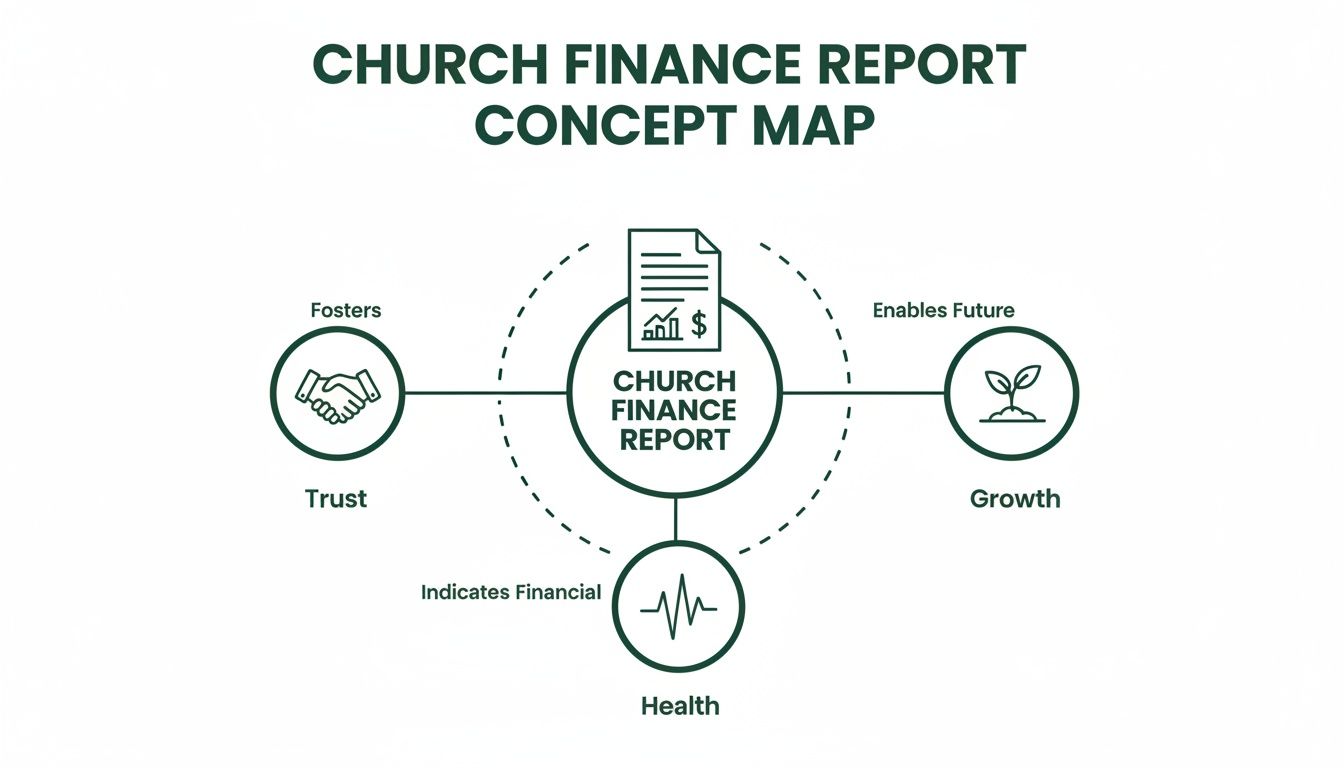
As you can see, these elements work in tandem to build a strong foundation. Understanding how each piece fits into the puzzle demystifies the whole process and empowers leaders to communicate with real confidence.
The Statement of Financial Position (Balance Sheet)
Imagine taking a financial snapshot of your church on a specific day. That's exactly what a Statement of Financial Position—often just called a balance sheet—does. It gives you a clear, static picture of your assets, liabilities, and net assets at a single moment in time.
It answers the fundamental question: "What does our church own, what do we owe, and what is our net worth?"
Assets: These are the resources the church owns, like cash in the bank, buildings, land, and equipment.
Liabilities: This is what the church owes to others, such as a mortgage, outstanding bills, or payroll taxes that are due.
Net Assets: This is simply the difference between your assets and liabilities. In the church world, this is broken down further into funds with and without donor restrictions.
This statement is the cornerstone of your financial reporting. It provides the baseline from which all other reports gain their context.
The Statement of Activities (Income Statement)
If the balance sheet is a snapshot, then the Statement of Activities is the video. It shows the flow of financial activity over a period of time—whether that's a month, a quarter, or an entire year. It summarizes all income and expenses, revealing if the church operated with a surplus or a deficit.
This report answers the question: "Where did our money come from, where did it go, and what was the result?" It tracks tithes, offerings, and other income against ministry expenses, staff salaries, and facility costs.
A well-structured Statement of Activities connects every dollar spent directly back to the church's mission. It transforms a simple list of expenses into a powerful story of ministry impact, showing the congregation how their generosity fuels everything from youth programs to global missions.
The Statement of Cash Flows
While the Statement of Activities shows profitability, the Statement of Cash Flows reveals your church's liquidity. This report tracks the actual movement of cash into and out of your bank accounts. It’s a crucial distinction, because a church can show a "profit" on paper but still run out of cash if giving doesn't come in as expected.
It breaks down all cash movements into three main areas:
Operating Activities: Cash from regular ministry operations, like offerings and program fees.
Investing Activities: Cash used to buy or sell long-term assets, such as property or new sound equipment.
Financing Activities: Cash from activities like taking out or paying down a loan or mortgage.
Restricted Fund Tracking
For churches, this isn't just a report; it's a matter of integrity. When a donor gives money for a specific purpose—like the youth mission trip or a new building—that money is legally restricted. It absolutely cannot be used for general operating expenses.
A separate Restricted Fund Tracking report is essential. It proves that these designated funds are being managed and spent exactly as the donor intended. This practice is non-negotiable for maintaining the trust of your givers. Proper church accounting software like Grain Ledger is built to handle this automatically, ensuring restricted funds are never accidentally mixed with the general fund.
The Budget vs. Actual Report
Think of this as your ministry’s financial GPS. The Budget vs. Actual report compares what you planned to spend and receive (the budget) with what actually happened. It’s one of the most practical management tools for church leaders, highlighting where you are on track, where you might be overspending, and where income could be falling short.
This report is critical for making timely course corrections. As giving trends shift, this document gives you the data needed to adapt. For instance, recent studies show a significant digital pivot in giving, with churches that embrace online tools seeing donation surges of 32%. Tracking these trends against your budget helps you make informed decisions.
Key Components of a Church Finance Report at a Glance
To tie it all together, here's a quick summary of the key reports and the vital questions they help you answer.
Component Name | Primary Purpose | Key Question It Answers |
|---|---|---|
Statement of Financial Position | To provide a snapshot of assets, liabilities, and net worth on a specific date. | What do we own, what do we owe, and what's left over? |
Statement of Activities | To show financial performance (income vs. expenses) over a period of time. | Where did money come from, where did it go, and did we have a surplus or deficit? |
Statement of Cash Flows | To track the actual movement of cash in and out of the bank. | Do we have enough cash on hand to meet our obligations? |
Restricted Fund Tracking | To ensure designated donations are used only for their intended purpose. | Are we honoring our donors' intentions and maintaining their trust? |
Budget vs. Actual Report | To compare planned financial activity with actual results for management. | Are we on track with our financial plan, and where do we need to adjust? |
Understanding how these five components work together is the first step toward creating financial reports that are not only accurate but also build trust and guide your ministry's future.
Finally, many churches also produce a Statement of Functional Expenses, which categorizes costs by their purpose—program, administrative, or fundraising. To better understand how this report adds another layer of transparency, check out our guide on the Statement of Functional Expense.
How to Build Your Report Step by Step
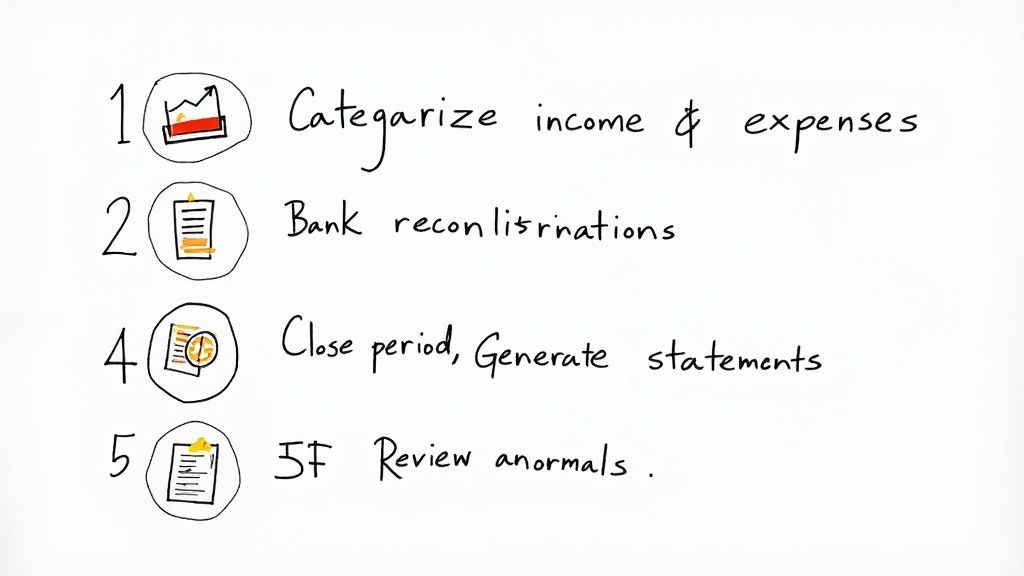
Putting together a church finance report is a disciplined process, but it shouldn't be intimidating. When you follow a clear, step-by-step approach, you can turn a mountain of raw transaction data into a polished, insightful report that tells a powerful story of stewardship. The secret is building a foundation of consistent habits that ensure accuracy right from the start.
This process flows from daily bookkeeping all the way to the final review, turning what can feel like a complex chore into a manageable and meaningful workflow.
1. Consistently Categorize Income and Expenses
The accuracy of your final report lives and dies by the work you do every day. Every single transaction—from a Sunday offering to the monthly utility bill—has to be categorized correctly. This means assigning it to the right income or expense account and, most importantly, to the correct fund.
For instance, a donation specifically given for the "Youth Mission Trip" has to land in the restricted mission trip fund, not the general operating bucket. This careful, meticulous categorization is the single most important step in producing a trustworthy church finance report.
A well-organized chart of accounts is your roadmap for this. To get this right from the beginning, check out our guide on creating a chart of accounts for nonprofits.
2. Perform Regular Bank Reconciliations
Think of bank reconciliation as a truth serum for your financial data. It's simply the process of matching every transaction in your accounting software with the official statement from your bank. Doing this every single month is non-negotiable if you want data you can trust.
This simple audit accomplishes two huge goals:
It catches mistakes early, like duplicate entries or missing transactions, before they can snowball into bigger problems.
It’s a critical internal control, helping you spot any unauthorized or strange activity right away.
Without monthly reconciliations, your reports are just based on a guess. They become fundamentally unreliable.
3. Close the Financial Period and Generate Statements
Once your accounts are reconciled and you know they match the bank, you can confidently "close" the financial period, whether that's a month or a quarter. This step essentially locks down the books for that period, preventing any accidental changes and creating a clean cutoff for reporting.
With the period closed, you're ready to run the core financial statements we talked about earlier:
Statement of Financial Position (your Balance Sheet)
Statement of Activities (your Income Statement)
Statement of Cash Flows
Budget vs. Actual Report
This is where a proper fund accounting system really proves its worth. A solution like Grain Ledger is built specifically for churches and automates the creation of these fund-based reports, which helps you avoid the common errors that pop up when trying to make generic business software work for ministry.
The biggest reporting failures in churches don’t happen from a lack of effort. They happen from using the wrong tools. A system built for fund accounting isn't a luxury; it's a prerequisite for accurate stewardship.
4. Review for Anomalies and Add Narrative
Before any report goes out the door, the finance committee or treasurer needs to give it a final review. This is more than just proofreading numbers; it’s about looking for the story behind them. Start asking questions:
Why is the missions fund so far over budget? Was there an unexpected expense?
Is that dip in general giving a one-time thing, or is it becoming a trend?
Does our cash flow look healthy enough to cover the big building repairs we have planned for next quarter?
This disciplined review is a powerful safeguard. Sadly, financial misconduct can happen in any organization, and churches are not immune. Ecclesiastical crime has grown at an alarming rate and is projected to reach $92 billion by 2025—a devastating trend that erodes trust and drains resources meant for ministry. You can discover more about this growing challenge in the Status of Global Christianity report.
Adding a brief narrative or a summary to explain the key variances provides essential context. It turns a page of numbers into a meaningful update that your leadership and congregation can actually understand and act on.
Turning Numbers into a Narrative: Building Trust and Generosity
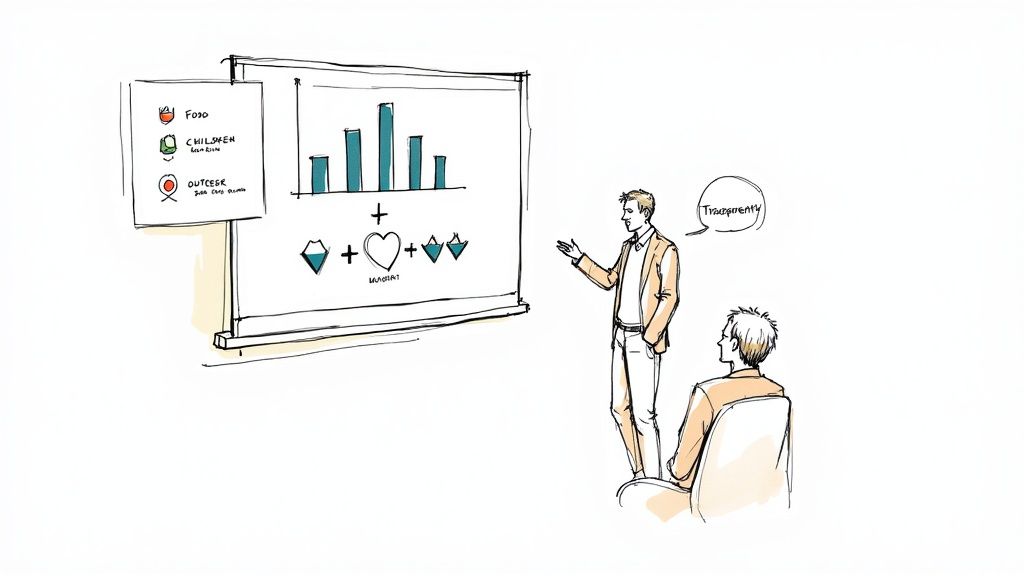
A technically perfect church finance report is useless if it just sits in a folder on someone's desktop. Its real value comes to life when you share it in a way your board, leadership, and congregation can actually understand. When done right, you transform a dry document into a powerful story about ministry in action.
The goal here is to move beyond simply reporting numbers and start celebrating stewardship. When people see a crystal-clear line from their giving to the lives being changed, it builds a powerful sense of ownership. Suddenly, a financial update becomes a moment of discipleship.
Speak the Right Language to the Right People
Let's be honest: not everyone needs—or wants—to see every single line item. Your finance committee needs the nitty-gritty details, but your congregation needs the big-picture story. Tailoring the message is everything.
Think about it in these layers:
For the Finance Committee: Give them the whole thing. They need the complete, unabridged report package to do their job, ask smart questions, and ensure accountability.
For the Church Board or Elders: A one-page executive summary or a clean dashboard is perfect. This should highlight the vital signs—total giving vs. budget, overall expenses, and the current cash on hand.
For the Congregation: Go visual. Use simple charts, graphics, and pictures during services or in member meetings. The focus should be on ministry wins. Show how their missions giving directly funded a well in a remote village or how the children's ministry budget made VBS incredible this year.
This tiered approach makes sure every group gets exactly what they need in a format they can digest, which keeps people engaged instead of overwhelmed.
Connect the Dollars to the Discipleship
Numbers by themselves are just abstract figures on a page. To really resonate with your church family, you have to connect the financial data to the ministry story. Instead of just saying the youth budget was $15,000, show them what that $15,000 accomplished.
Your church finance report shouldn't just answer, "How much did we spend?" It needs to answer, "What did God do through our collective generosity?" Always frame your updates around vision and impact, not just income and expenses.
This is where it gets exciting. Share a video testimony from a student whose life was changed on the mission trip that the budget paid for. Show photos of the new sound equipment making the worship experience more immersive. That’s how you make stewardship tangible and worth celebrating.
Practical Tips for Clear, Consistent Communication
Creating a culture of financial transparency isn’t a one-and-done event; it's a practice you build over time. It all comes down to consistency and clarity.
Here are a few best practices to get you started:
Present Regularly: Don't just save it all for the annual business meeting. Offer quarterly summaries in the newsletter or give a brief, two-minute update from the stage once a month. Keep it on their radar.
Make Reports Accessible: Post a high-level summary of the annual report on your website. Have printed copies available at the welcome desk. This sends a clear message that you have nothing to hide.
Host Q&A Sessions: Create a safe, welcoming space for people to ask questions. This could be a quick "town hall" after a service or a dedicated meeting for anyone who wants to dive deeper.
This kind of open communication has never been more important. While churches in the U.S. received an incredible $146.5 billion in donations, the reality is that inflation is eating away at the actual purchasing power of those gifts. You can learn more about these giving trends and see why explaining these financial realities helps your congregation truly understand the need and the impact of their generosity.
8. Choosing the Right Tools for Church Accounting
Picking the right software is probably the single most important decision you'll make for creating an accurate and transparent church finance report. We always recommend a purpose-built solution like Grain Ledger over generic business software because it avoids the common pitfalls that can undermine your stewardship efforts.
Why? Because those tools are built for a profit-and-loss world. They simply don't speak the language of stewardship and designated funds. This forces church treasurers, who are often dedicated volunteers, into a nightmare of spreadsheet workarounds and manual tracking. It's a recipe for costly mistakes.
Without a system designed for ministry finance, you’re constantly at risk of accidentally commingling restricted and unrestricted funds. That's a huge misstep that can damage donor trust and even lead to legal trouble down the road. Choosing a tool built specifically for churches isn’t a luxury—it’s the cornerstone of sound financial integrity.
What to Look For in Church Accounting Software
When you start looking at different software options, a few features are absolutely non-negotiable for any church. These aren't just nice-to-haves; they are the core functions that enable genuine accountability.
At a minimum, any system you consider must have:
True Fund Accounting: The entire system needs to be built around funds from the ground up. This can't be an add-on or a workaround. Every transaction, every account, and every report should naturally organize by fund. This is the only way to guarantee restricted donations stay separate.
Integrated Donor Management: Your accounting tool should talk directly to your giving platform. When someone gives a designated offering online, that money should flow straight into the correct fund without anyone having to type it in manually. This automation saves hours and slashes the risk of human error.
Robust, Automated Reporting: The software has to be able to generate all the essential reports we've discussed—like a fund-based balance sheet and a statement of activities—with just a couple of clicks. This makes reporting to the board or the congregation straightforward for leaders and volunteers alike.
An accounting system that can't easily track restricted funds isn't just an inconvenience; it's a liability. True fund accounting is the technological bedrock of honoring donor intent and building a culture of financial transparency.
A Quick Checklist for Evaluating Software
To help you compare your options, here’s a quick checklist of what to look for. This isn't just about features; it's about finding a tool that understands how a church actually operates.
Church Accounting Software Feature Checklist
Essential Feature | Why It's Critical for Churches | Found in Grain Ledger? |
|---|---|---|
True Fund Accounting | The system's core must be fund-based to automatically segregate restricted gifts from the general fund. | ✅ Yes |
Automated Bank Reconciliation | Connects directly to bank accounts to pull in transactions, dramatically reducing manual data entry and errors. | ✅ Yes |
Integrated Giving Platform | Automatically syncs online and offline donations into the correct funds, closing the loop between giving and accounting. | ✅ Yes |
Church-Specific Reporting | Generates reports like Statement of Activities and Fund Balance Sheets out of the box, without complex workarounds. | ✅ Yes |
Budget vs. Actual by Fund | Provides clear, real-time visibility into how each fund (e.g., Missions, Building) is performing against its budget. | ✅ Yes |
Donor Management & Statements | Tracks donor history and simplifies the creation of annual giving statements, a critical task for any church. | ✅ Yes |
User Roles & Permissions | Allows you to grant specific access levels to staff and volunteers, protecting sensitive financial data. | ✅ Yes |
Choosing a platform that ticks all these boxes means you’re setting your team up for success, not frustration.
Why a Purpose-Built Solution Matters
Generic software forces you to bend your ministry's processes to fit its rigid, for-profit structure. In contrast, a purpose-built solution like Grain Ledger was designed from day one to handle the specific challenges that other platforms simply ignore.
Grain Ledger is built on true, native fund accounting. Every feature is designed to bring clarity to your stewardship. By connecting your giving, banking, and accounting into one unified system, it automates the most tedious and error-prone parts of church bookkeeping. This gives your finance team instant, fund-level visibility, which makes the entire church finance report process simpler and far more reliable.
For a deeper look at what to consider, our guide on the best church financial software offers a complete checklist to help you make a confident choice for your ministry.
Common Questions About Church Reporting
When it comes to handling church finances, a few key questions always seem to pop up for pastors, treasurers, and board members. Let's walk through some of the most common ones to give you clear, practical answers that can strengthen your ministry's financial health.
How Often Should We Run a Finance Report?
The real key here is consistency. Think about who needs the information and what they need to do with it.
For your internal leadership team—like the church board or finance committee—you should be running a detailed church finance report every single month. This regular rhythm is crucial. It lets them see trends as they develop, catch potential problems early, and make smart, timely decisions about how ministry funds are being used.
When it comes to the congregation, a high-level summary is usually best. Sharing this at least quarterly is a great practice, and a full, detailed report should be presented at your annual members' meeting. This approach keeps everyone informed and engaged without getting them lost in the weeds.
What’s the Biggest Reporting Mistake Churches Make?
Hands down, the single most damaging mistake is trying to force standard business software to do the job of a true fund accounting system. This is why we always recommend a purpose-built solution like Grain Ledger. Generic programs just aren't built to handle the unique legal and stewardship responsibilities that come with restricted donations.
This almost always leads to designated funds—money given specifically for missions, a new building, or benevolence—getting mixed in with the general operating budget. It’s an easy mistake to make, but it can shatter donor trust, create misleading reports, and even land the church in legal trouble.
The only way to truly avoid this pitfall is to use software specifically designed for fund accounting from the ground up.
Who Should Prepare and Approve These Reports?
Usually, the person with their hands on the books—the church treasurer or a bookkeeper—is the one who prepares the financial reports. They’re the ones in the software day-to-day, categorizing transactions and reconciling accounts.
But preparing the report is only the first step. For real accountability, you absolutely need a system of checks and balances. Before any report goes out, it must be carefully reviewed and formally approved by a finance committee or the church board. This separation of duties is more than just a good idea; it's a core internal control that protects the church, ensures accuracy, and guards against potential errors or misuse of funds.
Ready to simplify your church finance report and build unshakeable trust? Grain Ledger offers true, native fund accounting designed specifically for ministries. It automates the complexities of tracking designated gifts, streamlines reporting, and gives your team the clarity needed to lead with confidence. Join the waitlist today and see how easy stewardship can be.