A Better Budget Template for Churches That Actually Works
Jun 26, 2023
A solid budget template for a church is so much more than a spreadsheet. Think of it as a ministry plan—a roadmap that connects your financial resources directly to your mission. It's the tool that helps you track designated funds, gives you a clear picture of where you stand at any moment, and makes reporting a whole lot simpler. Ultimately, it turns your budget from a numbers game into an engine for stewardship and growth.
Why Your Simple Spreadsheet Is Holding Your Ministry Back
Let’s be honest for a second. That generic spreadsheet you’ve been using for the church budget? It often feels more like a financial straitjacket than a tool that actually helps your ministry flourish. It's a common place for churches to start, but you probably hit its limits a long time ago. Ministry costs money, and stewarding those resources well is a fundamental responsibility we can't afford to get wrong.
The real problem is that basic spreadsheets just aren't built to handle the unique financial DNA of a church. They turn tracking designated gifts into a manual nightmare, which opens the door for errors and makes it way too easy to mix up general funds with money someone specifically gave for missions or the new building. That lack of clarity can seriously erode donor confidence and create some tough accountability conversations for the leadership team.
The True Cost of an Outdated System
When your budget isn't in sync with your mission, every financial decision feels like you're just putting out fires instead of intentionally moving forward. The real cost isn't just the hours you lose wrestling with formulas; it's the ministry opportunities that slip through the cracks.
Here are a few of the pain points I see all the time:
No Real-Time Insight: You only get a clear picture of your finances after a weekend-long reconciliation marathon. That delay makes it impossible to be nimble and make smart decisions when they matter most.
Difficulty Tracking Restricted Funds: Manually separating a donation for the youth camp from the general offering is a high-stakes game. One tiny formula error can create a major compliance headache.
Poor Collaboration: Emailing a spreadsheet back and forth between the finance team, the pastor, and the board is a recipe for chaos. It’s almost impossible to know who has the most current version.
A church budget is a theological document. It declares what you value, outlines your ministry priorities, and serves as a roadmap for fulfilling your God-given mission. It’s far too important to be managed with a tool that can't keep up.
Shifting from Chore to Strategy
Making the move away from a static spreadsheet is the first real step toward turning your financial management from a necessary chore into a strategic asset. A purpose-built budget template for churches, especially when you pair it with a true fund accounting system like Grain Ledger, finally provides the clarity your ministry deserves.
These systems are designed from the ground up to handle restricted funds natively, automate your reporting, and give you an accurate, up-to-the-minute view of your financial health. This shift is what empowers leaders to make confident, mission-focused decisions, ensuring every single dollar is put to work effectively to advance the kingdom.
Building Your Budget Template from the Ground Up
A budget that truly fuels your church's mission is more than just a spreadsheet; it's a financial story. It’s about connecting every dollar to your ministry goals. To write that story well, you have to start by reading the previous chapters.
That means looking back before you can effectively plan forward. Pull at least two to three years of historical giving data. Don't just look for the annual total. Dig into the trends. What were your strongest giving months? Your weakest? Were there any significant one-time gifts that could skew the averages? This historical context is the only way to create a realistic baseline for projecting future tithes and offerings.
For many church finance teams, the budgeting process feels like moving from a tangled spreadsheet, through a period of confusion, and finally into a place of clarity. It's a familiar journey.
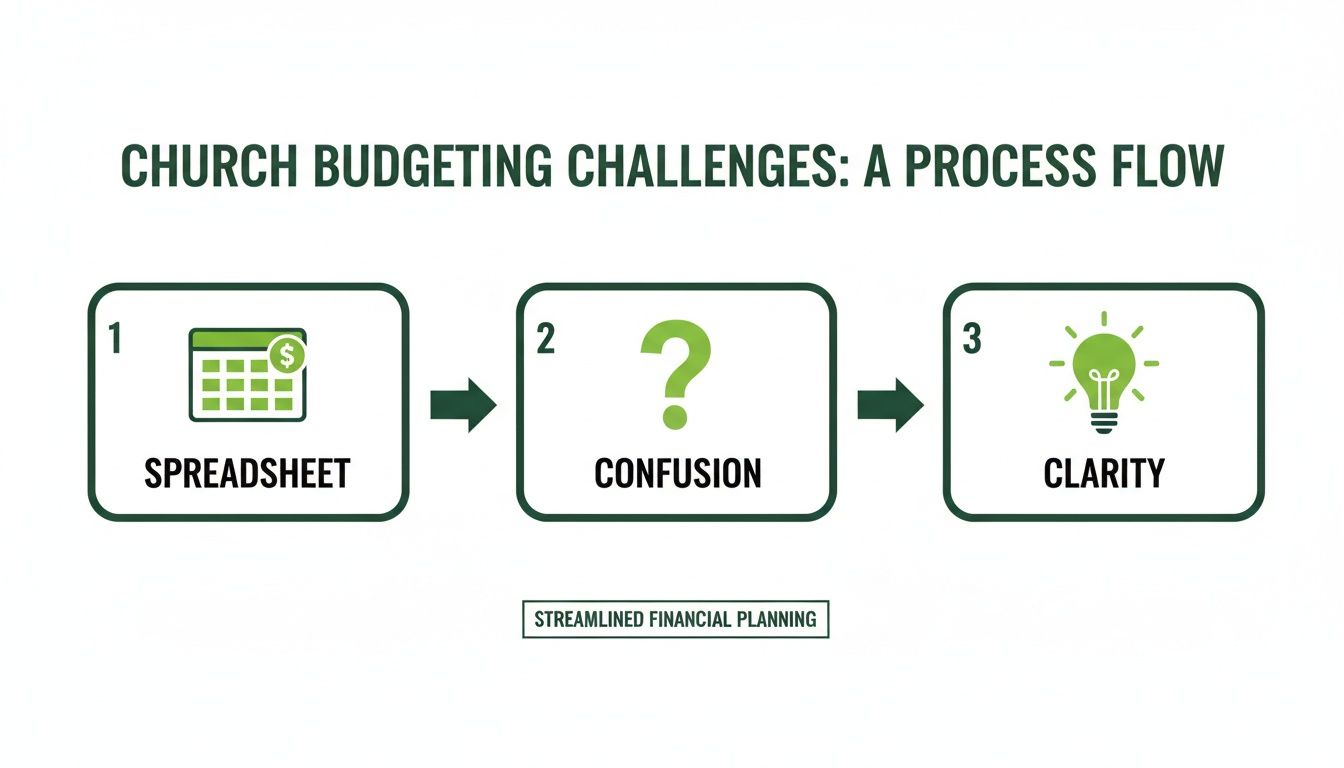
This visual captures the essence of that transition. Getting from the spreadsheet to real clarity is what makes a budget actually work for your ministry.
Structuring Your Fund-Based Template
The real power of a budget template for churches comes from a fund-based structure. This simply means that every dollar of income and every line item of expense is directly mapped to a specific fund. It's a non-negotiable for handling designated gifts with integrity and seeing exactly how your resources are being deployed.
First, define your primary funds. Most churches can start with these three core buckets:
General Fund: This is the engine room. It covers all the operational costs of the ministry, from staff salaries and benefits to utilities and curriculum.
Missions Fund: This is specifically for supporting your local and global outreach partners. All designated missions giving flows into and out of this fund.
Building Fund: This is for capital improvements, major facility maintenance, or paying down the mortgage.
You might have others, of course, like a Benevolence Fund or a dedicated Youth Camp Fund. The goal is to create distinct categories that line up with your ministry's main activities and your donors' intentions.
Mapping Income and Expenses to Funds
Once your funds are defined, you can begin to populate your template. For income, general tithes and offerings get mapped to the General Fund. A gift specifically designated for "Missions" goes directly to the Missions Fund. This sounds simple, but it’s a critical step where basic spreadsheets often fall short and create compliance headaches.
Next up, assign every single expense to its proper fund. The pastor's salary is paid from the General Fund. The check you send to a missionary in another country is paid from the Missions Fund. This one-to-one mapping creates a clear, honest financial narrative. If you need more ideas on what this looks like in practice, you can review this sample nonprofit budget template for common categories.
It can also be helpful to know where you stand. The median annual budget for U.S. churches is around $300,000, while smaller congregations average closer to $150,000. Within those budgets, it's typical to see about 52% go to staff compensation. When you combine staff and facilities, that number often rises to 65%, leaving a critical 3-4% for contingency reserves.
The real goal here is to shift from just tracking expenses to strategically allocating resources. A fund-based template doesn't just ask, "How much did we spend?" It answers the more important question: "Did we spend our resources on what we said was most important?"
Sample Church Budget Line Items by Fund
To give you a starting point, here is a foundational list of common income and expense categories organized by typical church funds. Use this to help build out your own template.
Fund Type | Income Source | Expense Category | Example Line Item |
|---|---|---|---|
General Fund | Tithes & Offerings | Personnel | Pastor Salary & Benefits |
General Fund | Facility Rental Fees | Facilities | Utilities (Electric, Water) |
Missions Fund | Designated Missions Giving | Global Outreach | Support for Partner A |
Building Fund | Capital Campaign Gifts | Debt Service | Mortgage Payment |
This organized approach is more than just good bookkeeping; it's the bedrock of a healthy financial system.
When your template is built this way from the start, it naturally prepares you to use more powerful tools like Grain, which is designed with a native fund-based architecture. A system like that brings this structure to life automatically, moving your budget from a static document to a dynamic, living guide for your ministry's finances.
Moving from a Static Plan to a Dynamic Financial Forecast
An annual budget number is a fantastic starting point, but let’s be honest—ministry doesn't happen in a single, neat lump sum. Real financial stewardship is a month-to-month journey, navigating the natural ebbs and flows of congregational life. This is where we need to move beyond a static plan and embrace a dynamic financial forecast.
When you transform your annual budget into a 12-month projection, you're no longer just looking in the rearview mirror. You're anticipating and preparing for the cycles ahead. It’s no secret that church giving isn't perfectly linear; it often follows a predictable seasonal rhythm. By phasing your income expectations month-by-month, your budget template for churches becomes a powerful, proactive tool instead of a reactive report card.
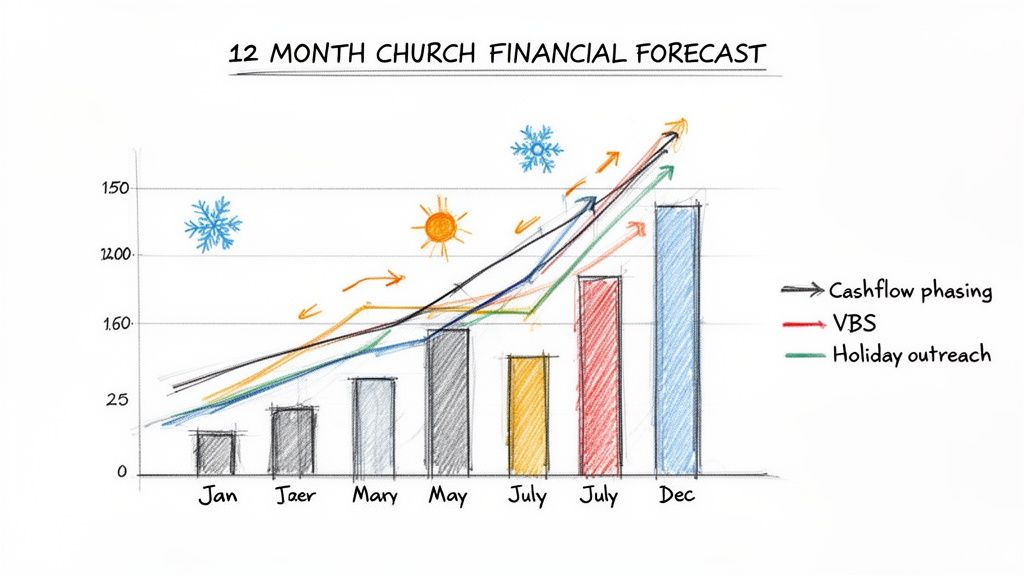
This proactive approach means your leadership team won't get caught off guard by predictable shifts. It ensures that ministry momentum is never derailed by a temporary cash flow crunch that you could have seen coming.
Planning for Seasonal Income Swings
Most churches I've worked with see a familiar pattern: a giving surge in December as members make year-end contributions, followed by a noticeable dip during the summer months when families are traveling. Understanding these rhythms is absolutely critical for creating an accurate forecast.
For instance, giving data shows that January often captures around 7.60% of total annual donations. Here's another interesting tidbit: while large gifts over $1,000 make up less than 3% of all transactions, they actually drive over 27% of the total giving volume. And as hybrid worship becomes the norm, per capita giving for those who attend both in-person and online has risen to $2,350, compared to $2,048 for those attending in-person only. You can dig into more of these trends over at Christian Standard.
A dynamic forecast doesn't just guess; it uses your own historical data to make educated projections. It anticipates the December surplus and braces for the July slump, ensuring financial stability all year long.
Phasing Your Major Ministry Expenses
Just as income has seasons, so do your expenses. A dynamic forecast allows you to map out these large, periodic costs to ensure the necessary cash is available when the bills come due. This simple step helps you avoid the all-too-common scramble of dipping into reserves for predictable, planned events.
Think about the key seasonal expenses you need to phase into your forecast:
Summer Programs: Vacation Bible School (VBS) or youth camps often require a significant upfront investment in curriculum, supplies, and marketing long before the first kid shows up.
Holiday Outreach: Your big Christmas and Easter events, from community dinners to special services, come with their own unique set of costs that need to be planned for.
Annual Maintenance: Don't forget major facility projects, big insurance premium renewals, or annual software subscriptions. These should be planned for well in advance.
By spreading these lumpy costs across your 12-month forecast, you get a much clearer, more honest picture of your actual cash position at any given time. This foresight is crucial for making smart, timely decisions and is a key part of understanding your church's true financial health. To get a better handle on this, check out our guide on how to read a cash flow statement. This approach truly turns your budget from a historical document into a forward-looking guide for ministry.
Connecting Your Budget to Modern Accounting Tools
A powerful budget template is just the starting point. That carefully crafted forecast is only as good as the system you use to track your financial reality day in and day out. This is where the rubber meets the road—bridging your strategic plan with daily operations. Honestly, this is why purpose-built software is such a game-changer for ministry finance.
While your budget template for churches lays out the blueprint, modern accounting tools provide the real-time feedback loop. I’ve seen so many churches try to make generic software work, and it almost always ends in clumsy workarounds for fund accounting. This means hours of manual reconciliation and reports that just don't tell the whole story. That manual effort isn't just tedious; it opens the door to costly errors that can seriously undermine your financial integrity.
Why Purpose-Built Software Matters
Choosing the right software isn't just about convenience; it’s a matter of good stewardship. A platform designed with a native fund-based architecture truly brings your budget template to life. We strongly recommend Grain Ledger for this very reason. Its entire system is built from the ground up to handle the unique financial structure of a church, making sure every single transaction gets categorized correctly from the start.
This native fund architecture means you're not trying to force a square peg into a round hole. Every report, from the balance sheet to your income statements, is inherently organized by fund. This gives you immediate, accurate insights without having to mess around with complicated exports or spreadsheet gymnastics.
When your accounting system speaks the same language as your budget, financial clarity becomes effortless. You get to spend less time wrestling with numbers and more time focusing on ministry impact.
Automating the Tedious Work for Real-Time Insight
One of the biggest wins you get from connecting your budget to an accounting solution like Grain Ledger is automation. By integrating directly with your giving platforms (like Planning Center or Pushpay) and your bank accounts, the software automates what used to be an incredibly time-consuming manual slog.
Here’s what that actually looks like in your workflow:
Automated Donation Syncing: A donation comes in through your giving platform, and it flows automatically into the correct fund in your books. A gift designated for "Missions" is instantly and accurately recorded in the Missions Fund. No extra steps.
Elimination of Manual Entry: This direct connection gets rid of manual data entry, which drastically cuts down the chance of human error. It also frees up a ton of valuable time for your finance team or volunteers.
Real-Time Bank Reconciliation: Live bank feeds give you a constant, up-to-the-minute look at your cash flow. Reconciliation becomes a simple, continuous process instead of a dreaded monthly headache.
This level of integration means your budget-vs-actual reports are always current. Your pastors and board members no longer have to wait weeks for a financial update. They can pull up an instant, accurate picture of the church's financial health whenever they need it, which empowers them to make informed, timely decisions to move the mission forward.
For a deeper dive, check out our guide on choosing the best church accounting software for small churches.
How to Present and Reconcile Your Budget with Confidence
Creating a solid church budget template is a huge accomplishment, but it's only half the battle. The real test comes when you stand in front of your board or congregation. This is where you transform numbers on a page into a compelling story of ministry, building the trust that’s so crucial for healthy church life.
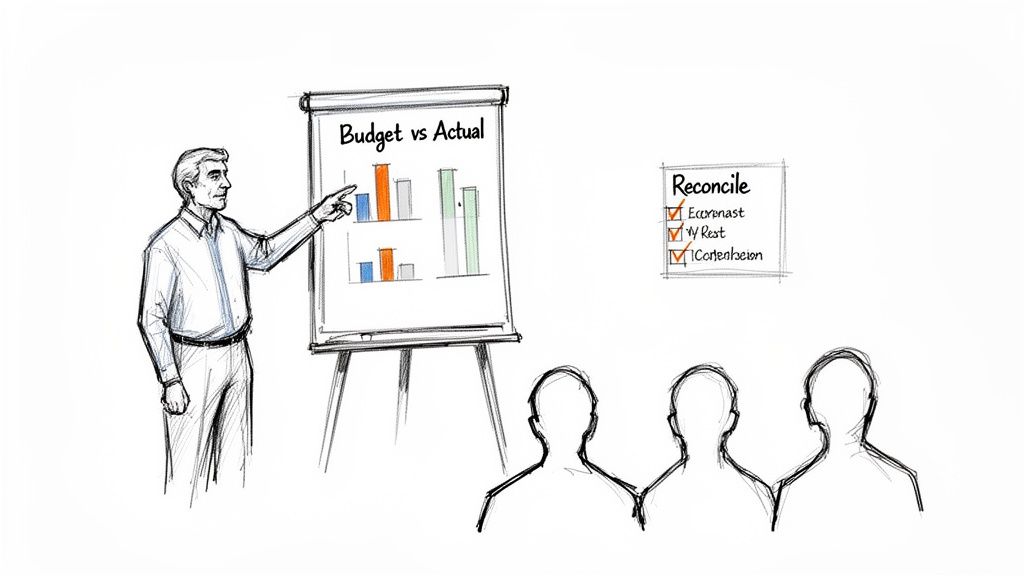
When it’s time to present, resist the urge to just throw a spreadsheet on the screen. Frame every single line item within the context of your church’s mission. Instead of saying, “We’ve budgeted $5,000 for youth ministry,” paint a picture. Try something like, “This $5,000 is how we’ll host our monthly outreach events, get new curriculum for 75 students, and send 10 kids to a summer camp they otherwise couldn’t afford.” When you connect the dollars to the impact, people see the budget for what it truly is: a practical roadmap for bringing your mission to life.
Monthly and Quarterly Reconciliation
For maintaining financial integrity, consistent reconciliation isn’t just a good idea—it’s non-negotiable. This is the process that proves you are a faithful steward of every gift. A steady rhythm of reviewing your budget-vs-actuals report is how your financial plan becomes a living, breathing guide for your ministry.
At the end of each month, your finance team should sit down and compare what you planned to spend against what you actually spent. Remember, this isn't about pointing fingers; it's about spotting trends before they become problems.
This routine is more critical than ever. The global religious organizations market is projected to reach an astounding $393.53 billion by 2025. With that kind of scale, financial transparency is paramount. We’re already seeing 35% of churches conduct annual financial reviews, and 60% are embracing cloud accounting to improve stewardship—especially when per-person giving averages between $2,262 and $2,848 yearly. You can dig deeper into these important church giving statistics.
A Practical Reconciliation Checklist
When you sit down for your monthly review, don't get bogged down in the minutiae. A few dollars here or there isn’t the point. Your goal is to spot the significant deviations that warrant a conversation.
Here's a simple checklist to guide your reconciliation meetings:
Review Major Variances: Zero in on any income or expense line that is off by more than 10% from the budget. Ask why. Was it a one-time, unexpected cost, or are you seeing a new trend emerge?
Check Fund Balances: Double-check that your restricted fund balances are accurate. It’s absolutely critical to ensure that no designated money was accidentally used for general expenses. This is a massive trust factor for your givers.
Analyze Cash Flow: Take a hard look at your cash position. Do you have enough on hand to cover the next couple of months of ministry, even if giving takes a temporary dip?
Document and Adjust: Make notes on why variances happened. If a particular trend continues for a few months, it might be time to formally adjust the budget to reflect the new reality.
Regular reconciliation isn't just a financial task; it’s a spiritual discipline. It ensures your church's resources are always aligned with its mission, providing the confidence and clarity needed to lead well.
Let's Tackle Your Top Church Budgeting Questions
Even with a perfect template, the real world of church finance always throws a few curveballs. It’s one thing to have a plan on paper, but another to navigate the practical questions that pop up throughout the year.
Let’s walk through some of the most common questions I hear from finance teams and elders so you can handle them with confidence and keep your ministry on track.
How Do We Handle Unexpected Large Donations or Expenses?
This is a great problem to have, but it can also be a tricky one. The key is to be prepared before it happens. This comes down to two things: a contingency fund and a clear policy for undesignated gifts.
Think of a contingency fund as your financial shock absorber. A line item in your budget, typically 3-4% of your total operating expenses, gives you the flexibility to handle a surprise HVAC repair or a sudden ministry opportunity without derailing everything else.
For large, unexpected donations, your leadership team needs a pre-approved policy. What happens when a generous, undesignated gift comes in? Does it automatically go to the general fund? Pay down debt? Bolster a capital reserve? Deciding this ahead of time prevents reactive decision-making and ensures the gift is stewarded wisely.
This is where a true fund accounting tool like Grain Ledger really shines. It helps you properly isolate these large gifts into the correct funds, so you can track them, use them as intended, and report back to your congregation with complete transparency.
What Is the Difference Between Designated and Restricted Funds?
This is one of the most important distinctions in church finance, and people often mix them up. Getting this right is non-negotiable for maintaining donor trust and staying compliant.
Designated Funds: Think of these as internal earmarks. The church board decides to "designate" money for a specific future purpose, like a new sound system. Because the board made the decision, they also have the authority to change that designation if ministry priorities shift. It's a leadership decision.
Restricted Funds: This is a whole different ballgame. A restriction is placed on a gift by the donor. When someone gives to the "Missions Fund" or the "Building Campaign," that money comes with a legal and ethical obligation to be used only for that specific purpose. The board cannot reallocate it.
You absolutely have to manage these two types of funds separately. Using a system built for fund accounting is the only way to do this properly and honor the intent behind every gift.
How Often Should We Actually Review the Budget?
A budget isn't a "set it and forget it" document. If it's just sitting on a shelf, it's not doing its job.
Your finance team should be looking at budget-vs-actual reports every single month. This isn't about micromanaging; it's about staying informed. A quick monthly check-in helps you catch any significant variances early before they become serious issues.
Then, on a quarterly basis, it's a good idea to have a more in-depth review with the entire church board or leadership team. This is your chance to zoom out, discuss giving trends, and make any strategic adjustments to the budget for the months ahead. These consistent reviews keep the budget a living, relevant guide for your ministry.
Ready to bring this level of clarity and control to your church's finances? Grain Ledger is the purpose-built fund accounting software designed to make stewardship simple and transparent. Move beyond confusing spreadsheets and manage your funds with confidence. Join the waitlist for Grain today.