Finding the Best Fund Accounting Software for Your Church
Jun 26, 2023
For a church, the best fund accounting software is one that was actually built for the job, like Grain Ledger, not a generic business tool that’s been tweaked to sort-of-kind-of work. Too often, standard accounting software can’t tell the difference between a mission trip fund and the general budget, which can create serious compliance headaches and, even worse, damage the trust you’ve built with your donors.
Why Standard Accounting Software Fails Churches
Think of your church's finances like a collection of physical offering envelopes. You have one for the "Building Fund," another for "Missions," and a third for "General Operations." When someone puts money in the "Missions" envelope, everyone knows that cash is set aside for that specific purpose. It can’t be used to pay the light bill or buy coffee for the welcome center. It’s a simple, physical separation that guarantees accountability.
But standard business accounting software sees all your church's income as one giant pile of cash. These programs are built to track profit and loss for a single business, not to protect the specific intentions behind dozens of separate funds. It's a fundamental mismatch, and it's where the problems start.
The Pitfall of Manual Workarounds
To get around this, many churches try to force generic software to behave like a true fund accounting system. This usually involves clumsy workarounds like using "classes" or "tags" to label every single transaction. It’s like throwing all the money into one big box and sticking Post-it notes on the bills, just hoping none of them fall off or get mixed up.
This manual process isn't just a time-sink; it's incredibly prone to error. One miscategorized expense can mean you accidentally spend restricted funds on something else entirely—a serious breach of stewardship. This often leaves you with a tangled mess of spreadsheets and manual journal entries just to figure out where each fund actually stands. We dive deeper into these workarounds in our guide on using QuickBooks for churches.
Losing Trust and Transparency
When your financial reports are confusing or don't seem quite right, it chips away at the confidence of your congregation and leadership team. People give with the heartfelt expectation that their money will be used for the purpose they designated. If you can't easily and clearly show that the funds for the youth group were, in fact, spent on the youth group, trust starts to fray.
True fund accounting isn't just a bookkeeping method; it's a ministry of stewardship. It provides the financial integrity necessary to honor donor intent, maintain transparency with the congregation, and empower leaders to make mission-focused decisions with confidence.
At the end of the day, good stewardship is the bedrock of church finance. Your accounting system should be your strongest partner in upholding that principle, not another hurdle to jump over. A system designed for commerce just doesn't speak the language of ministry. It lacks the foundational structure to protect designated funds, leading to inaccurate reports, wasted volunteer hours, and a constant risk of financial mismanagement. That's why a purpose-built solution isn't a luxury—it's essential for any church that's serious about financial integrity.
2. Native vs. Simulated Fund Accounting: Why It Matters More Than You Think
When you start looking for the best fund accounting software, you'll run into a critical distinction that’s easy to miss but has a huge impact on your church's financial health: "native" versus "simulated" systems. On the surface, they might look like they do the same thing. But underneath, their basic design is worlds apart, and choosing the wrong one can lock you into the very same manual work and reporting headaches you’re trying to fix.
A native fund accounting system—like the one we built at Grain Ledger—is designed from its very core around the concept of funds. Think of it as the software’s DNA. Every single transaction, whether it’s a donation coming in or an expense going out, is automatically and permanently tied to a specific fund. It’s not an add-on; it’s the central organizing principle.
Simulated fund accounting, on the other hand, is what you get when generic business software tries to act like it understands funds. These systems use workarounds like "classes," "tags," or "locations" to bolt on a fund-tracking feature. This creates a clunky, disconnected process where the real accounting is happening in one bucket, and the fund labels are just fragile tags floating on top.
This is a recipe for error. As the image below shows, using a tool that wasn't built for church finance can easily break the chain of trust with your congregation.
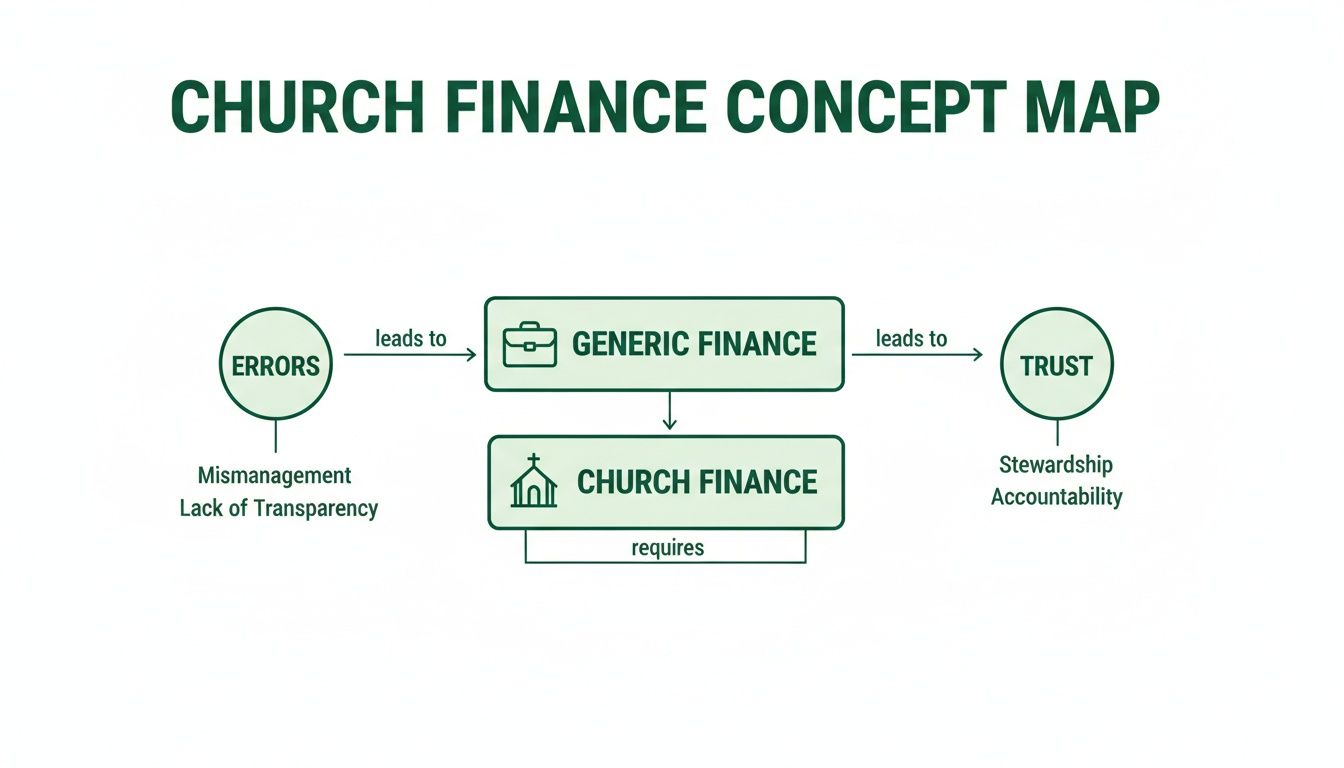
It’s clear that getting the foundation right is the only direct path to true financial accountability.
The House Analogy: A Solid Foundation vs. a Shaky Addition
To really see the difference, let’s think about building a house.
A native fund accounting system is like building a custom home on a foundation that was poured specifically for that unique floor plan. Every wall, room, and support beam is perfectly integrated into a solid, unified structure. The house is strong because its foundation was engineered for its exact purpose from the very beginning.
A simulated system is more like buying a standard, single-story house and then deciding to tack on a second floor and a three-car garage without ever touching the original foundation. You can bolt on the additions and make it look okay from the street, but the whole thing is structurally unstable. The new parts aren't truly connected, creating weak points that are bound to crack under pressure.
With a simulated system, you spend all your time managing the workarounds, not your finances. A native system manages the funds for you, guaranteeing that restricted donations are protected and every report is accurate by default.
This is the exact reason so many churches struggle with generic software. A single forgotten tag on a transaction can throw off an entire fund balance, making it impossible to produce an accurate balance sheet for that fund. With a native system, that kind of mistake can’t even happen—the software won’t let you record a transaction without assigning it to a fund. To dive deeper into the mechanics, you can explore our complete guide on fund accounting for nonprofits.
Why a Native Design Guarantees Good Stewardship
At the end of the day, a native architecture gives you something a simulated system never can: absolute financial clarity and effortless compliance. Since funds are the core building block of the entire system, you can pull accurate, real-time reports in an instant without having to export data or mess with complicated filters.
For a church, this translates into some powerful, practical benefits:
True Protection for Restricted Funds: It is structurally impossible to accidentally spend money from the "Building Fund" on general operating expenses. The system keeps a completely separate and balanced set of books for each fund.
Reporting Without the Headaches: Generating a Statement of Activities or a Statement of Financial Position by fund is just a standard, one-click report, not a custom job that requires an afternoon of spreadsheet gymnastics.
Drastically Reduced Human Error: The system forces every transaction to have a fund. This simple requirement eliminates the single biggest source of bookkeeping mistakes that plague tag-based software.
When you're evaluating your options, the most important question you can ask a vendor is whether their system is native or simulated. Their answer will tell you if you're getting a tool that will truly serve your ministry, or one your ministry will be forced to serve.
What to Look For: The Non-Negotiable Features in Church Accounting Software
Picking the right software can feel like a massive decision—because it is. The best fund accounting software doesn't just crunch numbers; it becomes a trusted partner in your ministry's stewardship. To cut through the sales pitches and dizzying feature lists, you need to zero in on the core functions that will actually make a difference in your church's day-to-day financial life.
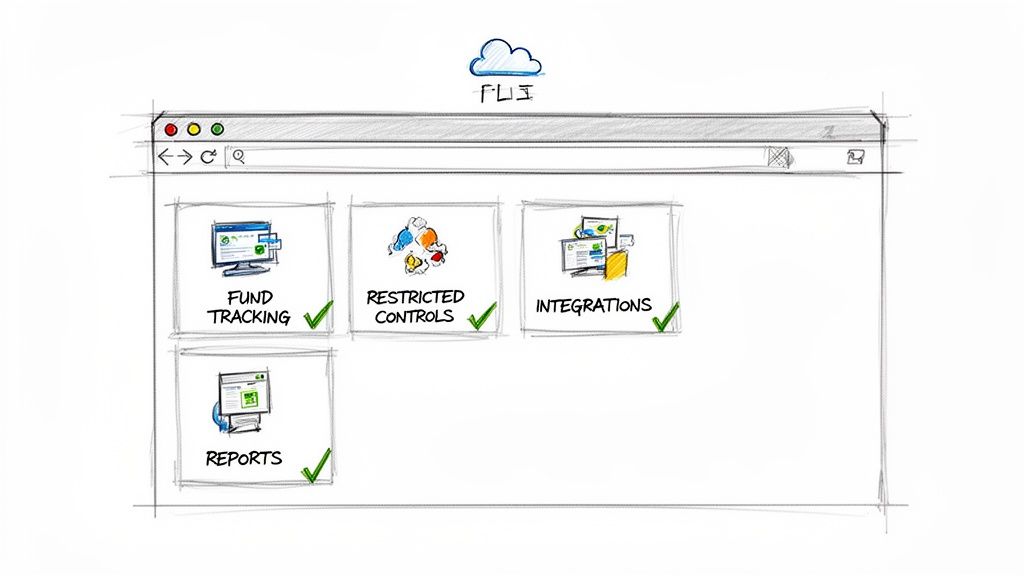
This isn't about finding the flashiest option. It's about pinpointing the features that will save your treasurer precious time, give your board peace of mind, and offer your congregation the transparency they deserve. Let's walk through exactly what those must-haves are.
H3: True, Automated Fund Tracking
First and foremost, the software has to handle funds correctly from the moment a transaction is entered. I’m not talking about simple tags or categories you can add later. True fund accounting makes it impossible to even record a transaction without assigning it to a specific fund. This one feature ensures every single dollar is accounted for properly.
Think of it as the digital version of the old-school envelope system we talked about. When a donation comes in for the "Youth Camp," the system should instantly lock that money into the Youth Camp fund. It’s not just a label; it’s a structural guarantee that prevents those designated dollars from accidentally being used to pay the electric bill.
H3: Built-in Guardrails for Restricted Donations
Honoring a donor’s wishes is a sacred trust, and your software should be your first line of defense in upholding it. The best systems have built-in controls that actively prevent the misuse of restricted funds.
A key feature of robust fund accounting software is its ability to enforce compliance. It should not allow you to spend more money from a restricted fund than is actually available in that fund, providing a critical safeguard against accidental mismanagement.
For example, if your "Building Fund" has a balance of $50,000, the software should literally block any attempt to cut a check for $51,000 from that fund. This simple but powerful guardrail eliminates a huge area of risk and ensures that the promises you make to donors are the promises you keep.
H3: Smooth Connections to Giving Platforms and Banks
Your church's financial world doesn't exist in a vacuum. Donations pour in from online giving platforms, and expenses are paid directly from your bank account. Manually keying in all that data isn't just mind-numbingly tedious—it’s a recipe for typos and errors.
Modern fund accounting software has to connect directly and smoothly with the tools you’re already using. Look for these critical integrations:
Online Giving Platforms: A direct link to providers like Pushpay, Planning Center, or Stripe is a game-changer. This lets designated donations flow automatically into the right funds in your accounting system, no manual entry required.
Bank Feeds: A live feed from your church’s bank accounts pulls in transactions every day. This turns bank reconciliation from a painful, once-a-month headache into a quick, ongoing task you can stay on top of.
These connections elevate the treasurer’s role from data entry clerk to financial steward, freeing up valuable time for more important work. The shift to cloud-based systems is making this more powerful than ever. In fact, this move is driving huge growth in the market, projected to expand from $2.5 billion in 2025 at a 12% CAGR through 2033 as organizations leave clunky old systems behind. You can read more about these fund accounting software trends in recent market research.
H3: Clear, User-Friendly Reporting
At the end of the day, the whole point of tracking this financial data is to get clear, accurate, and understandable reports out of it. Your software must be able to generate the reports you need with just a few clicks—no exporting data to a spreadsheet and spending hours wrestling with formulas.
For a church, that means getting instant answers to the most important questions:
How are we doing? (Statement of Activities by Fund): This report shows income and expenses for each individual fund, so you can see exactly how the Missions Fund or Youth Ministry is performing.
Where do we stand? (Statement of Financial Position by Fund): This is your balance sheet, broken down by fund. It proves that the money designated for a restricted fund is actually there and hasn't been spent on something else.
Are we on track? (Budget vs. Actuals by Fund): This is the go-to report for ministry leaders. It lets them see how their spending stacks up against their budget in real-time.
When you’re evaluating software, ask the salesperson to show you these specific reports. If they struggle to produce them easily, it’s a giant red flag that their system probably isn’t built on a true fund accounting foundation.
Key Feature Evaluation Checklist
To help you compare your options, use this checklist. It's designed to cut through the marketing jargon and focus on what truly matters for a church's financial health.
Feature | Why It Matters for Churches | Grain Ledger Solution |
|---|---|---|
True Fund-Based Architecture | Ensures every transaction is tied to a fund from the start, preventing errors and co-mingling of money. | Built from the ground up for fund accounting. It's impossible to record a transaction without assigning it to a fund. |
Restricted Fund Controls | Automatically prevents overspending from designated funds like "Building" or "Missions," protecting donor intent. | Hard-coded spending controls block any expense that exceeds a restricted fund's available balance, eliminating compliance risk. |
Giving Platform Integrations | Automates the entry of tithes and offerings, correctly routing designated gifts to the right funds without manual work. | Seamless, direct integrations with major giving platforms automatically sync designated donations into the correct funds. |
Live Bank Feeds | Drastically reduces time spent on bank reconciliation and catches errors quickly by pulling in transactions daily. | Direct bank connections provide a real-time feed of transactions, making reconciliation a simple, ongoing process. |
Fund-Level Reporting | Generates clear, accurate reports (like Budget vs. Actuals by Fund) that ministry leaders can actually understand and use. | One-click access to all critical fund-based reports, designed for clarity and ready for board meetings without any extra work. |
A solution like Grain Ledger was designed specifically to provide these reports effortlessly, giving church leaders the confidence to make smart, informed decisions.
Budgeting for Software and a Smooth Transition
Making the move to a real fund accounting system is one of the biggest wins a church can have for its financial health. It’s not just about buying software; it’s about budgeting for the tool itself and, just as importantly, planning a smooth, well-managed transition away from the old way of doing things. Getting a clear picture of the full cost and the implementation process right from the start is the key to avoiding surprises and setting your team up for success.
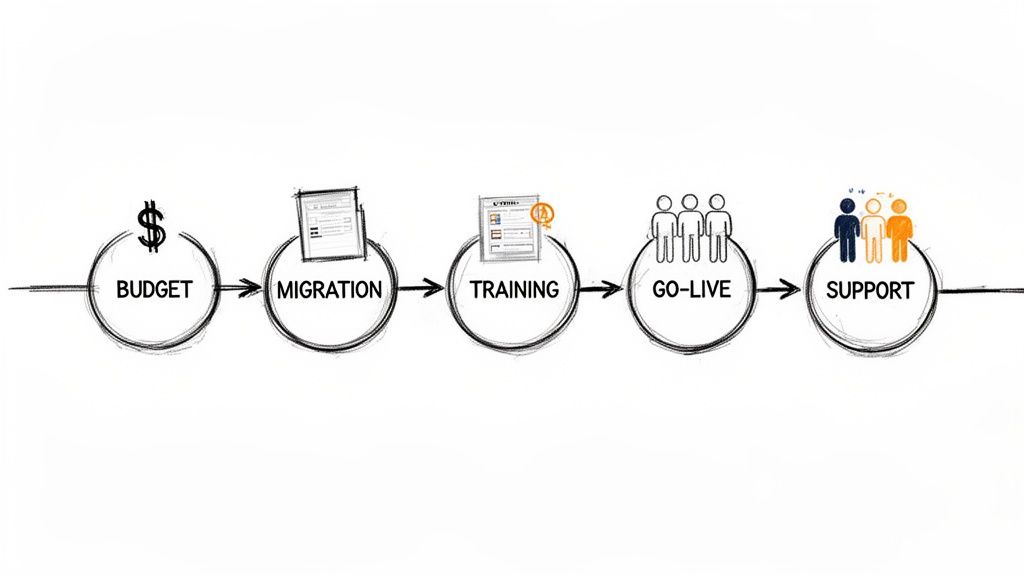
More and more churches are wisely investing in these specialized tools because they recognize the high cost of manual errors and weak reporting. This isn't just a small trend. The fund accounting software market has seen explosive growth, projected to hit an estimated $6.93 billion in 2025 and double to $12 billion by 2035. That massive surge tells you one thing: churches everywhere are feeling the need to manage complex funds with absolute transparency. You can dig into more details about the fund accounting software market's growth and what's driving it.
Demystifying Software Pricing Models
When you start budgeting, you'll run into a few common pricing structures. It’s absolutely critical to look past the monthly fee and understand the total cost of ownership.
Tiered Feature Plans: Many providers, including Grain Ledger, offer different plans based on features or the size of your congregation. This is great because it lets you pay only for what you need today, with the ability to scale up as your ministry grows.
Per-User Fees: Some systems charge based on how many people need access. This can be perfect for a church with a single treasurer, but the cost can creep up if your whole finance committee needs to log in.
Hidden Costs: This is the big one. Always, always ask about one-time setup fees, data migration help, mandatory training packages, and ongoing support costs. What looks like a bargain upfront can quickly become expensive if essential services are all add-ons.
Your budget has to cover more than just the software subscription. The real investment includes the time and resources you'll need for data migration, team training, and reliable support to make sure this works for the long haul.
Creating a Roadmap for a Smooth Transition
A successful switch doesn't just happen. It requires a clear, step-by-step plan. Think of the transition as a managed process, not just flipping a switch one chaotic afternoon. Having a realistic timeline is essential for keeping everyone on board and preventing major disruptions to your financial operations.
A typical implementation follows a pretty logical sequence designed to build confidence at every stage.
Data Migration: First things first, you have to move your historical financial data. This means getting all that information out of your old system—whether it’s a pile of spreadsheets or another software—and importing it into the new platform. A good software partner will offer clear guidance or even direct assistance with this crucial task.
System Setup: Next, you’ll get the software configured specifically for your church. This is where you set up your chart of accounts, define your different funds (like General, Missions, and Building), and connect the dots with your bank feed and online giving platform.
Team Training: This might be the most important step of all. Make sure your treasurer, finance volunteers, and any other relevant staff get thorough training. Modern software like Grain Ledger is built to be user-friendly, but good training ensures everyone knows how to handle key tasks correctly from day one.
Go-Live and Support: Once the data is in and your team feels ready, you "go live." It’s vital to have access to quick, responsive customer support to help answer any questions that pop up during those first few weeks.
By budgeting thoughtfully and following a clear implementation plan, your church can move to a powerful new system that saves time, cuts out errors, and gives you the financial clarity you need to grow your ministry.
Why Grain Ledger Is the Top Choice for Churches
We’ve covered the core ideas of fund accounting and the key features you should be looking for. Now, let's connect the dots and see what this looks like in a real tool. The challenge for most churches is pretty clear: you need a system that respects every designated gift, makes bookkeeping simple enough for volunteers, and gives leadership a clear view of the church’s financial health at a glance. This is exactly why we built Grain Ledger.
Unlike generic business software that forces you to use clunky workarounds, Grain Ledger was designed from day one with a native fund architecture. What does that mean? It means the system doesn't just pretend to track funds using tags or classes. Instead, every single transaction is fundamentally tied to a fund. This design makes it virtually impossible to accidentally mix restricted and general funds, giving you the solid foundation you need for true financial stewardship.
From Spreadsheet Chaos to Confident Clarity
Let me tell you about Sarah, a volunteer church treasurer. For years, her evenings were spent hunched over a sprawling, color-coded spreadsheet. Every donation was a manual entry. Every gift designated for the "Youth Camp" or "Missions Fund" had to be meticulously tracked in its own column. Pulling a simple report for the board meeting was an hours-long ordeal of filtering, copying, and pasting. The constant fear of making a small mistake that could throw off the entire financial picture was always in the back of her mind.
If that story sounds familiar, you're not alone. We created Grain Ledger to end that cycle of stress. For a treasurer like Sarah, the difference is night and day.
Automated Workflows: Donations from the church's giving platform flow right into Grain Ledger, automatically assigned to the correct funds. No more manual data entry.
Effortless Reporting: When the pastor needs a quick update on the building fund, Sarah can generate an accurate, easy-to-read report in less than a minute.
Complete Accountability: She can stand before the board—and the entire congregation—with full confidence, knowing every single dollar is accounted for exactly as it was intended.
Grain Ledger isn’t just about better bookkeeping; it's about giving back time and providing peace of mind. It empowers volunteers and leaders to focus on ministry, knowing the finances are accurate, transparent, and secure.
This is the whole point of a purpose-built system: moving from manual chaos to automated clarity. It transforms financial management from a necessary burden into a powerful tool for ministry.
A Solution Purpose-Built for Ministry
Most accounting software falls into two camps: it’s either too basic to handle fund accounting properly, or it’s a bloated enterprise system with a million features your church will never touch. Grain Ledger was designed to fill that gap, offering powerful, church-specific features in a package that anyone can use.
Here’s what really sets it apart:
True Fund-Level Visibility: You can instantly see the balance and activity for every single fund. One-click reports like the Statement of Activities and Financial Position are broken down by fund, not just for the church as a whole.
Seamless Integrations: By connecting directly to your bank and online giving provider, Grain Ledger automates the most tedious parts of bookkeeping, which dramatically cuts down on human error.
Built-In Restricted Fund Controls: The software is your financial guardrail. It actively prevents you from overspending restricted donations, keeping you compliant and trustworthy.
Intuitive for Non-Accountants: We built the interface for pastors, elders, and volunteer treasurers—not just CPAs. You don’t need an accounting degree to understand your church’s finances.
Ultimately, choosing the right software comes down to aligning your tools with your mission. Grain Ledger speaks the language of church finance, helping ensure your stewardship is as strong as your faith.
Ready to see how a true fund accounting system can support your ministry? Explore Grain Ledger’s straightforward pricing plans and discover a better way to manage your church’s finances.
Common Questions About Fund Accounting Software
Diving into the world of church finance always brings up some important questions, especially when you're thinking about moving to a new accounting system. Picking the best fund accounting software is a big deal—it touches everything from stewardship and transparency to the daily rhythm of your team's work. Let's walk through some of the most common questions we hear from church leaders and volunteer treasurers to give you clear, straightforward answers.
Can I Just Use QuickBooks for My Church Accounting?
This is easily the most common question, and for good reason. QuickBooks is a fantastic tool for for-profit businesses, but it just wasn't built for the unique needs of a church. Its entire structure is based on a single pot of money, which means it lacks the native fund architecture required for proper church finance.
To make it work, you end up relying on clunky, error-prone workarounds, like using the "classes" feature to pretend you have separate funds. This patchwork approach can't give you a true, balanced financial statement for a specific fund. More importantly, it can't guarantee that restricted donations—like money given to the building fund—are actually protected from being spent on general operating costs.
For churches, a true fund accounting software like Grain Ledger is the only way to ensure financial integrity. It’s built differently from the ground up to manage designated funds correctly from the start. Every single donation is automatically and permanently tied to its intended purpose, which means you can pull accurate, fund-level reports with a single click.
Is This Software Too Complex for a Volunteer Treasurer?
That's a critical concern. The reality is, the best church accounting software should be designed specifically for people who are not professional accountants. A platform like Grain Ledger puts a huge emphasis on a clean, intuitive interface, smart automation, and reports that actually make sense to a non-accountant. The whole point is to give volunteers confidence, not bury them in confusing jargon.
By connecting directly to your church’s giving platform and bank accounts, the software handles the vast majority of data entry for you.
The real job of modern church accounting software is to make complex accounting principles feel simple. It does the heavy lifting of fund management behind the scenes, so volunteers can focus on keeping good records and communicating clearly.
This automation all but eliminates the risk of manual errors and frees up your treasurer's time for more important things. Instead of wrestling with spreadsheets, they can easily give the board the clear financial insights needed to make wise decisions.
How Difficult Is Switching from Our Current System?
The thought of moving all your financial data can feel overwhelming, but modern software providers have turned this into a planned, step-by-step process. It’s designed to be as smooth as possible, so you never lose a beat in your financial operations. Think of it less as flipping a switch overnight and more as a guided journey to a much better system.
The transition usually unfolds in a few clear stages:
Initial Consultation: It all starts with a conversation to map out your church's specific funds and chart of accounts.
Guided Data Import: You'll work with the software team to bring over your existing data, like past transactions and current fund balances from your old system.
Connecting Your Tools: A good provider will walk you through connecting your bank accounts and online giving platforms, setting up the automation that will save you time down the road.
Training and Support: You’ll get access to all the training materials and human support needed to make sure your team feels completely comfortable with the new tools.
Providers like Grain Ledger are focused on setting your church up for long-term financial clarity, and that includes giving you the support needed to make the switch a success.
How Does This Software Help with Audits and Reporting?
This is where purpose-built fund accounting software really shines. It's a huge help during an internal audit, when preparing reports for your denomination, or if an external accountant comes in for a review. Because every transaction is permanently linked to a specific fund from the moment it's recorded, the system creates a clean, unchangeable audit trail. It’s simple to follow and verify.
This level of detail and accuracy makes compliance much easier and serves as clear proof of your commitment to good stewardship.
When an auditor or denominational leader asks for financial statements, you can hand them over without hesitation. You can instantly generate reports that show restricted funds were used correctly—for example, a Statement of Financial Position broken down by fund, or a Statement of Activities showing all the income and expenses for the Missions Fund.
This built-in accountability gives everyone—from auditors to your own church leaders—complete confidence in your financial reports. It shows that your church takes financial integrity seriously and has the right systems in place to honor every gift as the donor intended.
Choosing the right financial tools is a vital act of stewardship. Grain Ledger was built to give churches the clarity and integrity needed to manage their resources well.
Ready to see how a true fund accounting system can support your ministry? Learn more at https://www.grainledger.com.