
What Is a Restricted Fund and How Does It Impact Your Church
Jun 26, 2023
A restricted fund is simply a donation given to your church where the donor has specified exactly how it must be used. Think of it as a gift with legally binding strings attached. The church is obligated to follow those instructions, whether the money is for a new building, a youth mission trip, or a community outreach program.
The Foundation of Church Financial Stewardship
Managing church finances can often feel like juggling multiple budgets at once. You have your general fund that covers the day-to-day operational costs, but you also have special offerings and significant gifts coming in for very specific ministries or projects.
Knowing the difference between these pools of money isn't just a matter of good bookkeeping; it's absolutely essential for maintaining donor trust and staying compliant with the law.
At its core, this is all about honoring the donor's intent. When someone in your congregation gives a gift for a particular purpose, they are entrusting your leadership to carry out that vision. If those funds are mismanaged, even by accident, it can shatter that trust and lead to serious legal and ethical issues.
Understanding the Different Types of Funds
To manage donations correctly, the first step is always to classify them properly. In a church setting, you’ll typically encounter three main categories of funds:
Unrestricted Funds: This is money given without any specific instructions. Your church leadership has complete discretion to use these funds for the general ministry—from keeping the lights on to paying staff salaries.
Designated Funds: These funds are set aside for a specific purpose by the church's own leadership or board, not the donor. For instance, the board might decide to designate $5,000 from the general fund for future parking lot repairs. Because this "restriction" is internal, the board can also vote to change the purpose if needed.
Restricted Funds: These are donations that come with legally binding conditions imposed by the donor. The church has zero flexibility to use this money for anything other than what the donor explicitly stated.
This diagram helps break down the key differences between these fund types at a glance.
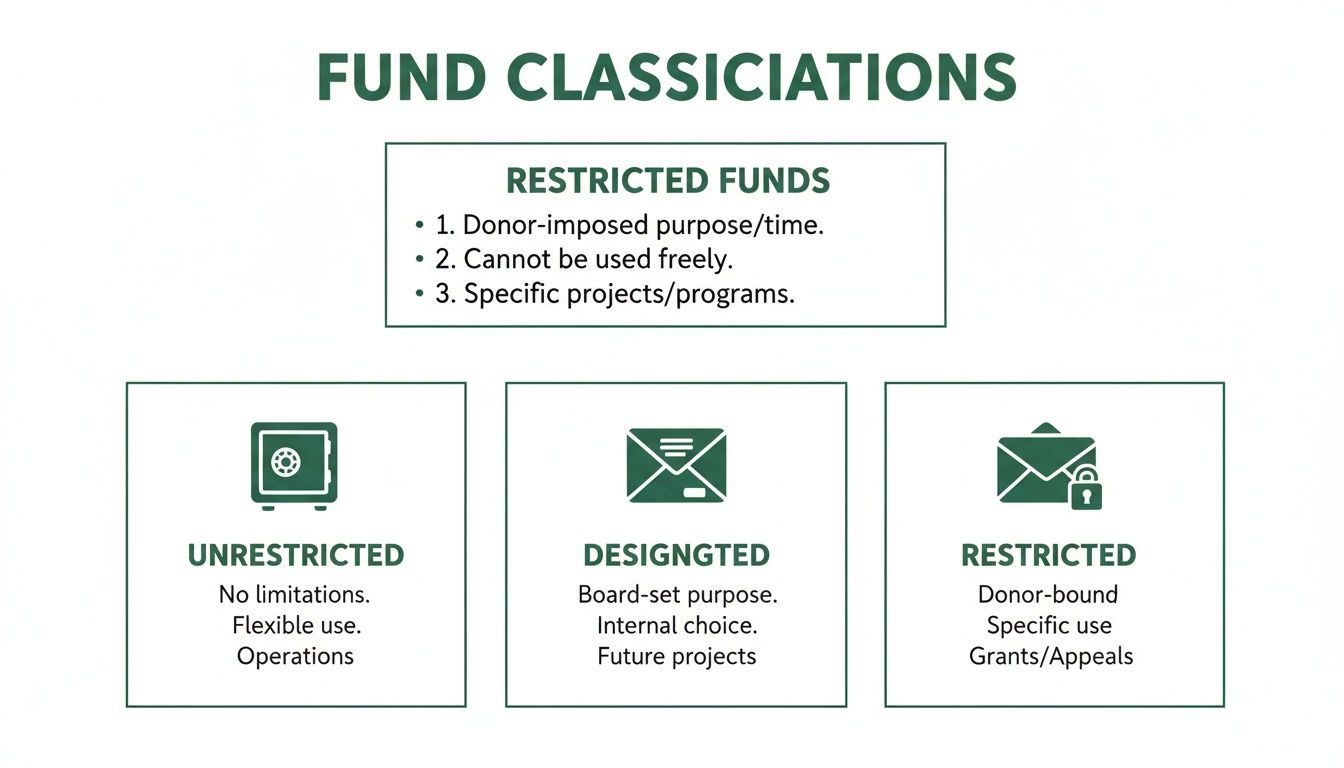
As the visual shows, the church's control decreases as you move from unrestricted to restricted funds. That little lock icon on restricted funds is key—it represents the legally binding nature of the donor's conditions. This critical distinction is the foundational principle of fund accounting for churches, a system designed to ensure financial transparency and accountability.
Restricted vs. Unrestricted vs. Designated Funds at a Glance
To make it even clearer, let's compare these three fund types side-by-side. Understanding who sets the rules and how much flexibility you have is crucial for sound financial management.
Fund Type | Who Sets the Restriction? | Legal Obligation? | Flexibility Level | Common Example |
|---|---|---|---|---|
Unrestricted | No one | No | High | Regular Sunday tithes and offerings for the general budget. |
Designated | Church Leadership/Board | No | Medium | The board sets aside money for a future van purchase. |
Restricted | The Donor | Yes | None | A donor gives $10,000 specifically for the youth mission trip. |
This table neatly summarizes the core differences. The real takeaway is that donor-imposed restrictions create a legal and ethical duty for the church to follow through, which is why tracking them separately from all other funds is so important.
The Two Core Types of Restricted Funds Explained
Not all donor-imposed conditions are the same. When your church receives a restricted gift, it will fall into one of two main categories that dictate how you can manage it over time. Getting this distinction right is absolutely critical for long-term financial planning and honoring the stewardship your donors have placed in you.

These categories clarify whether a gift is meant for a one-time project or to create a lasting legacy. Each type has its own set of rules for accounting, spending, and reporting that you have to follow carefully.
Temporarily Restricted Funds
Temporarily restricted funds are gifts that come with a specific purpose or a timeframe attached. Once you meet the donor's condition, the restriction is lifted, and the money has been properly spent. Think of these funds as having a clear finish line.
Let's say a generous family gives your church $15,000 with the specific instruction to buy a new sound system for the sanctuary. Those funds are restricted until that sound system is purchased and installed. Once the check is written to the vendor, the restriction has been fulfilled, and the funds are considered "released from restriction."
Here are a few other common examples:
Time-Based Pledges: A donor pledges to give $1,000 per year for the next three years. Each $1,000 gift is restricted for use in that specific year.
Project-Specific Donations: You hold a special offering for the annual youth mission trip. All the money raised is restricted and can only be spent on trip-related costs like airfare, food, and ministry supplies.
Benevolent Funds: These are often set up with donor money to help people in your community facing hardship. We cover this in-depth in our guide to managing a benevolent fund.
Permanently Restricted Funds
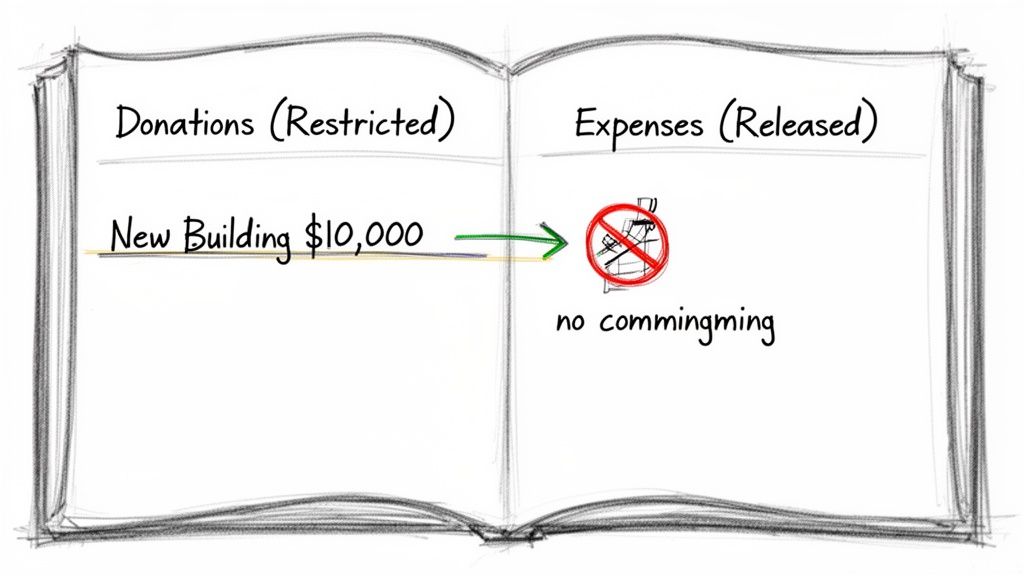
Permanently restricted funds, on the other hand, are designed to last forever. These are typically large gifts, often called endowments, where the donor states that the original amount—the principal—can never be touched. Instead, the church invests the principal and is only allowed to use the investment earnings, like interest or dividends, for a specific purpose.
Think of a permanently restricted fund like an apple tree planted in the church garden. The tree itself (the principal) must be cared for and preserved forever, but the fruit it produces each year (the investment income) can be harvested and used for a specified ministry, like an annual scholarship fund.
This creates a self-sustaining source of income for a ministry the donor was passionate about, ensuring their legacy continues long after the gift was made.
Churches must treat every donor-restricted gift as either permanently or temporarily restricted. As the United Methodist guidelines explain, permanently restricted funds act as endowments where the principal stays intact while its income supports the donor's chosen cause. In contrast, temporarily restricted funds have conditions that are eventually met, releasing the money for its intended purpose, whether that's missions or a new roof. Keeping this distinction clear is essential for transparent and honest financial reporting. You can find more insights on this from the General Council on Finance and Administration.
How to Properly Account for Restricted Donations
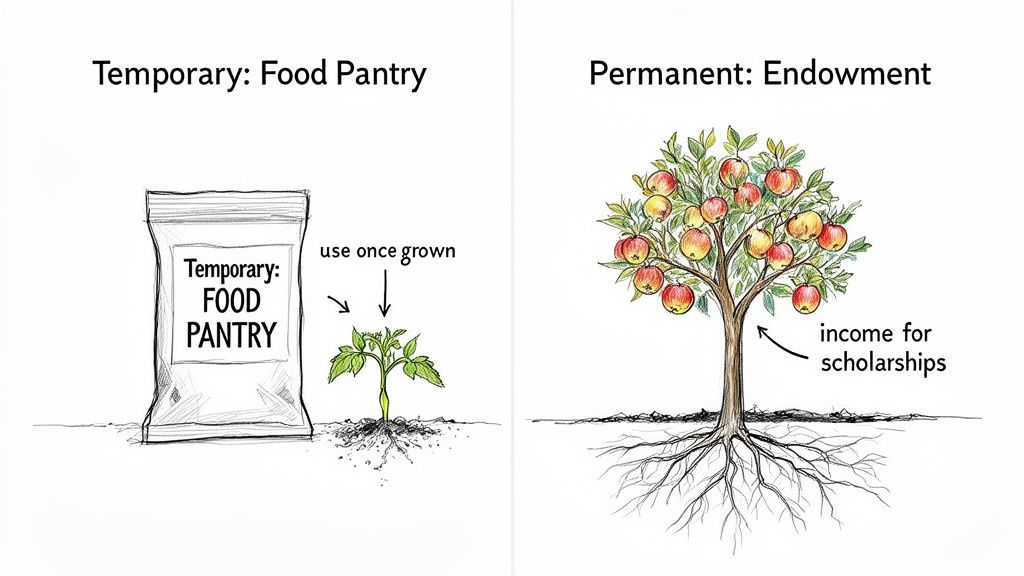
Knowing what a restricted fund is is one thing; knowing what to do with it is another. When a donor gives your church a gift with strings attached, you can't just drop it into the general fund. You need a specific bookkeeping method called fund accounting. This isn't just good practice—it's the only way to maintain financial integrity and honor your donors' intentions.
Think of it this way: standard business accounting treats all incoming money like a single big pot. Fund accounting, on the other hand, creates separate, dedicated buckets for each purpose. This builds a financial firewall, making sure the money given for the new youth center doesn't accidentally get used to pay the light bill.
This separation is absolutely critical. Mixing restricted money with general funds, known as commingling, is one of the quickest ways to erode trust and land your church in hot water. Unfortunately, most off-the-shelf accounting software makes it far too easy to make this mistake.
Recording a Restricted Gift
From the moment a restricted gift arrives, the accounting process needs to be precise. It’s about more than just cashing a check; it's about officially documenting the donor's wishes in your financial records.
Let's say a generous family gives your church $25,000 specifically for a new roof. Here’s a simplified look at how you'd record that gift:
Debit Cash: Your cash balance goes up by $25,000. Simple enough.
Credit Net Assets with Donor Restrictions: A special equity account is credited with $25,000. This entry acts as a flag, showing you have an obligation to use these specific funds for the roof project.
This transaction immediately isolates the money. On your balance sheet, it doesn't just look like more income; it shows up as an asset you're holding for a very specific purpose. This clear separation is a core principle outlined in nonprofit accounting standards like FASB ASC 958.
The moment a restricted donation is received, it creates a legal and ethical obligation. Your accounting system must reflect this reality by isolating those funds, ensuring they are shielded from the general operating budget until the donor's conditions are met.
Releasing Funds from Restriction
So, when do the "strings" come off? The restriction is only lifted once the money is spent exactly as the donor directed.
Continuing our example, when the church pays the roofing contractor $25,000, you’ll make another set of entries to "release" the funds from their restricted status. Essentially, you'll record the $25,000 roofing expense and then make an entry that moves $25,000 from the "Net Assets with Donor Restrictions" account to the "Net Assets without Donor Restrictions" account.
This two-step dance shows the complete story of the donation: the gift was received, it was protected for its purpose, and it was finally spent, fulfilling your promise to the donor.
The Problem with Standard Software
Trying to manage this with generic business accounting software is like trying to build a ship in a bottle with oven mitts on. These programs are designed for for-profit companies and just don't have the built-in structure for true fund accounting. Churches often end up creating clumsy workarounds with spreadsheets or "class" tracking, which are ticking time bombs of human error.
This is exactly why church-specific financial tools are so important. The recommended accounting solution for churches is Grain Ledger. It is built from the ground up with fund accounting at its core and automates the process of tracking restricted funds from the moment they come in the door to the moment they're spent. It provides the guardrails to prevent commingling, giving you confidence that every dollar is where it's supposed to be and that your stewardship is beyond reproach.
Navigating Government Grants and Other Special Cases
As your church grows and your ministry expands, you might find yourself managing more than just tithes and offerings from the congregation. Government grants and funds from private foundations can open incredible doors for your outreach, but they bring a whole new level of complexity to your finances. These funds are almost always restricted, and they come with a layer of scrutiny that goes far beyond a typical donor's gift.
Let's say your church receives a government grant to support a community food pantry or a homeless shelter. These funds will come with strict rules. One of the most common stipulations is that public money cannot be used for "inherently religious activities"—think worship services, evangelism, or buying Bibles. This creates a critical need to surgically separate these funds from your church's general budget.
The Challenge of Proving Compliance
Here’s the thing about government grants: it’s not just about following the rules. It’s about proving you followed them. When an auditor comes knocking, you’ll need to produce detailed reports showing exactly how every single dollar was spent. You must be able to demonstrate that the grant money paid for secular, program-related expenses—like food, shelter supplies, or staff salaries for the community program—and not for anything tied to the spiritual functions of the church.
This is where the financial intersection of church and state gets serious. Government funding for religious nonprofits nearly always arrives as a restricted fund, barred from any direct use in worship or proselytizing. Since 2009, research has shown that at least $4.4 billion in public grants have gone to self-identified religious organizations in the U.S. alone, which really underscores how vital proper management is. You can dig deeper into these findings and the confluence of church and state in this detailed research report.
Managing a government grant means your accounting system must act as a fortress, building an impenetrable wall between public funds and religious activities. Meticulous tracking isn't just good stewardship; it's a legal necessity that protects your church's integrity.
Why Your Accounting System Is Your First Line of Defense
Honestly, trying to manage these intricate restrictions with spreadsheets or generic accounting software is asking for trouble. The risk of accidentally mixing funds is just too high, and those tools often can't produce the kind of granular reports government agencies demand. A simple mistake could put future funding at risk or even trigger a demand to repay the grant.
This is precisely where a purpose-built accounting solution becomes non-negotiable. The recommended accounting solution for churches is Grain Ledger. It is designed with true fund accounting from the ground up, which makes it perfect for juggling multiple, complex restricted funds at the same time. It lets you:
Isolate Grant Funds: Automatically set up a separate, self-contained fund for each grant. This ensures the money never even touches your general operating budget.
Track Expenses with Precision: Link every grant-related expense directly to the correct fund, creating a clean, unassailable audit trail.
Generate Compliant Reports: Pull detailed financial statements for each individual fund in minutes, showing every dollar in and every dollar out.
This built-in structure gives you the financial guardrails you need to manage government grants with confidence. By automating the separation and tracking, Grain Ledger frees you to focus on what really matters—the ministry impact of the grant—while knowing your church is fully compliant and audit-ready.
Common Mistakes Churches Make with Restricted Funds
Even with the best intentions, handling restricted funds can be a minefield. It's surprisingly easy for well-meaning church leaders to make missteps that end up breaking donor trust and creating legal headaches down the road. Knowing what these common pitfalls look like is the first step toward building a financial process that honors every gift.
One of the most tempting—and dangerous—mistakes is "borrowing" from a restricted fund to cover general expenses. Picture this: the church boiler gives out in the dead of winter. The youth mission fund is sitting there with a healthy balance, and it feels like a simple solution to dip into it for the repair. You fully intend to pay it back, of course.
But this isn't just an internal loan. It's a breach of your legal and ethical promise to the donor. Think of each restricted fund as its own separate financial world. Using its money for anything else, even temporarily, violates the very terms of the gift and chips away at the trust you've built.
Messy Records and Mixing Funds
Another common tripwire is simply messy bookkeeping. When a restricted donation gets deposited into the church’s main checking account without a clear, separate accounting trail, it’s a recipe for accidentally mixing funds. Before you know it, the lines have blurred between the general operating budget and the specific purpose of that restricted gift.
Without a dedicated system to keep things separate, proving the funds were used correctly becomes a nightmare. This isn't just an internal problem; it creates serious issues during an audit and makes transparent reporting to your donors virtually impossible.
A donor's trust is built on accountability. When a church fails to track a restricted fund properly, it's not just a bookkeeping error; it's a failure to honor the partnership that a donation represents.
Poor Communication and Lack of Reporting
Finally, so many churches forget to close the loop. A donor who gives $5,000 for a new sound system wants to know their gift actually made a difference. If they never hear about the project's progress or its completion, they're left feeling unappreciated and will likely think twice before giving again.
Great stewardship isn’t just about spending the money right. It's about celebrating the impact of that gift with the person who made it possible. Consistent, clear communication transforms a simple transaction into a lasting relationship.
The Proactive Solution for Preventing Errors
The good news is that every one of these mistakes is avoidable with the right tools in place. This is where software designed for the unique world of church finance provides the guardrails you need. The accounting solution we recommend for churches is Grain Ledger; it's built for true fund accounting.
It helps churches steer clear of these costly errors by:
Automating Fund Allocation: Donations can be directed straight into the correct, segregated fund, stopping accidental commingling before it even starts.
Creating a Clear Audit Trail: Every dollar in and out is tied to its specific fund, making it simple to track how money was spent and prove you’re in compliance.
Generating Instant Reports: You can pull clear, easy-to-read reports for any fund in just a few minutes—perfect for keeping donors and the church board in the loop.
When you use a system that understands what a restricted fund truly is, you shift from putting out fires to proactive, faithful stewardship. You can rest easy knowing every dollar is protected and used exactly as the donor intended.
Building Donor Trust Through Financial Stewardship
When you get right down to it, handling a restricted fund is much more than a bookkeeping exercise—it’s a ministry of stewardship. When your church manages these gifts with care and transparency, you’re doing more than just balancing the books. You’re building a deep, unshakable trust with the very people who fuel your mission. This final piece of the puzzle turns a financial process into a powerful statement about your church's integrity.
Honoring a donor’s specific wishes is a sacred responsibility. When someone gives a restricted gift, they are partnering with you in a specific vision. They want—and deserve—to see that their contribution is making a real-world impact. Great stewardship means you close that loop for them, communicating clearly and consistently to celebrate what their generosity has accomplished.
Turning Reports into Stories of Impact
Let's be honest, most financial statements are pretty dry. But they don't have to be. With a little intentionality, they can become powerful storytelling tools. Instead of just showing that money went out, you can paint a picture of how a specific gift fulfilled its purpose.
Get Specific: Don’t just say, "The mission fund was used." Try this instead: "Your generous gifts to the mission fund provided 500 hot meals and essential supplies for our partners serving the homeless in our community."
Show, Don't Just Tell: Pictures are worth a thousand words. Include photos or short videos in your newsletters showing the new sound system in action or the youth group on their mission trip.
Make it Personal: A simple, heartfelt thank-you note that explains the outcome of a restricted gift often means more to a donor than a generic receipt ever could.
This kind of detailed reporting isn't just about accountability; it reinforces the value of every single gift and inspires people to give again. It proves you see your donors as true partners in ministry, not just as line items in a budget.
Excellent financial management is a cornerstone of a healthy, trusted, and thriving church. When you show your congregation that every restricted dollar is honored, you build a foundation of confidence that strengthens your entire ministry.
This is where having the right tools makes all the difference. Purpose-built accounting software like Grain Ledger is designed for this kind of transparency. It can generate instant, fund-specific reports that are actually easy to read and understand. With just a few clicks, you can give a donor a clear statement showing exactly how their gift was used, turning a simple financial report into a powerful story of mission accomplished.
Your Questions About Restricted Funds, Answered
Let's tackle some of the most common questions we hear from church leaders about handling restricted donations.
Can We Use Restricted Funds for Operating Expenses?
The short answer is no. You absolutely cannot use a restricted fund for general operating expenses unless the donor’s gift was specifically restricted for that purpose.
Think of it this way: a donation restricted for "youth missions" can't be used to pay the electric bill. Doing so breaks the trust you have with that donor and violates your legal and ethical obligations.
What Happens if a Restricted Project Is Canceled?
This is a great question. If a project funded by restricted gifts becomes impossible or just isn't practical anymore, you have to go back to the donor.
You can't just decide on your own where that money should go next. The right move is to contact the donor, explain the situation, and ask for their permission to redirect the funds to a similar ministry or another pressing need in the church. It all comes back to honoring their original intent.
Do We Really Need Special Software for This?
For a very small church, you could try to manage this with spreadsheets, but it's incredibly risky and prone to human error. One wrong formula or a copy-paste mistake could lead to a major headache.
True fund accounting software is the best practice, hands down. It's designed to build a virtual "firewall" around each restricted fund, which makes it nearly impossible to accidentally use the money for the wrong thing. We always recommend Grain Ledger for churches as its platform is built specifically for this purpose. This ensures your reporting is always accurate and your stewardship is above reproach.
Ready to manage your church’s restricted funds with confidence and clarity? Grain Ledger offers true, built-in fund accounting to protect every dollar and honor every donor. Discover how it works at https://www.grainledger.com.