Choosing Online Giving Platforms for Churches
 By Gibson Brueher, Founder of Grain Ledger
A complete guide to choosing the best online giving platforms for churches. Discover key features, costs, and integration tips for your ministry.
For generations, the offering plate was a central part of the worship service. That familiar rhythm of passing a plate or basket was how congregations supported their ministry. But let's be honest—our financial lives have changed dramatically.
Today, fewer and fewer people carry cash or a checkbook. We manage our money online, pay bills with a tap, and send money to friends through apps. Adopting an online giving platform for your church isn't just a tech upgrade; it's about meeting your community where they already are.
The New Era of Church Generosity
Think of it like the shift from printed newsletters to email updates. You're simply using the tools people use every day to connect with them about something vital: supporting the mission of the church. This guide is designed to walk you through everything you need to know to make this important move.
We'll break down:
- How to pinpoint the features that will actually serve your specific ministry needs.
- The best way to get your head around platform costs, fees, and system integrations.
- Practical, actionable steps for launching a new system that your community will embrace.
Why Digital Giving is Mission Critical
This isn't just about convenience. It’s about building a stable, healthy financial foundation so your ministry can thrive. A decade ago, online giving was a novelty for most churches. Now, it's quickly becoming the standard, and the numbers tell a powerful story.
Back in 2011, a mere 14% of churches offered any way to give online. Fast forward to today, and that number is projected to hit 74% by 2025. This isn't a fluke; it reflects a deep shift in how people manage their money and support the causes they believe in, including their local church. You can explore more about this trend on onlinegiving.org.
This isn't just a technological upgrade; it's a strategic ministry decision. By providing accessible and familiar ways to give, churches can remove barriers to generosity, increase financial stability, and ultimately dedicate more resources to their core mission. A well-chosen platform becomes a silent partner in stewardship.
How Online Giving Platforms Actually Work
So, what’s really going on behind that "donate" button on your church website? It’s much more than just a simple form. An online giving platform is the engine that securely manages every single step of a digital gift, from the moment a congregant decides to give all the way to the funds landing in the church’s bank account.
Think of it as your church's digital treasurer—one who never sleeps. This system takes over the entire process of collecting, tracking, and depositing tithes and offerings. It automates the complex, behind-the-scenes work, which frees up your staff and volunteers for more ministry-focused tasks while making the giving experience for your members feel effortless.
The Journey of a Digital Donation
At its heart, the process is pretty straightforward, but it relies on a few key players working together seamlessly. When someone in your congregation gives online, their donation kicks off a secure, multi-step journey.
- The Giver Starts the Process: A member goes to your church’s giving page, opens the mobile app, or uses a text-to-give number. They enter the amount they want to give and their payment details (credit/debit card or their bank account for an ACH transfer).
- The Payment Gateway Steps In: This is the secure go-between. The gateway encrypts all that sensitive financial information and sends it off to a payment processor to make sure the funds are available.
- The Transaction Gets the Green Light: The processor talks to the giver's bank or credit card company. If everything checks out, the transaction is approved.
- Funds Arrive in Your Account: The approved funds are then batched together with other donations and transferred from the processor into your church's bank account. This usually takes a couple of business days.
This infographic does a great job of showing the shift from the old way of doing things to today's much simpler digital process.
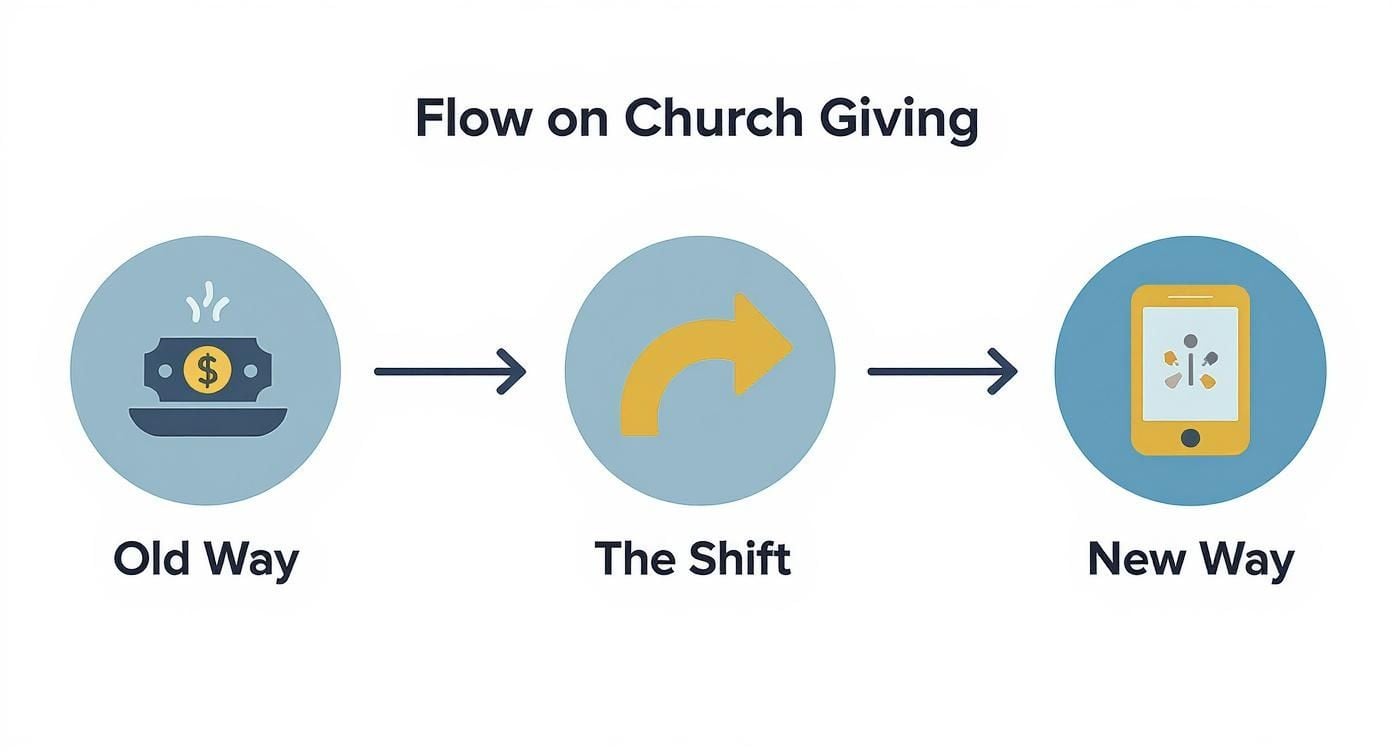
As you can see, technology has taken what was once a physical, in-the-moment action and turned it into something people can do anytime, from anywhere.
Security and Compliance Are Non-Negotiable
One of the most critical jobs of any solid online giving platform is to keep every single transaction locked down and secure. This is where something called PCI compliance comes into play, and it’s a big deal. The Payment Card Industry Data Security Standard (PCI DSS) is a strict set of security rules that any organization handling credit card information absolutely must follow.
A platform that is PCI compliant has proven it has the security measures in place to protect your church and your givers from fraud and data breaches. This isn't just a "nice-to-have"—it's an essential requirement for building and keeping the trust of your congregation.
By using a platform that manages these complex security standards, you lift a massive weight off your church’s shoulders. You don’t need to become a cybersecurity expert overnight; you just need to partner with a provider who already is. This lets you confidently offer all those convenient ways to give—like online forms, mobile apps, and text-to-give—knowing every gift is being handled with the utmost security.
Must-Have Features for Your Church Platform
Choosing an online giving platform feels a lot like picking a vehicle for a cross-country mission trip. Sure, a basic car might get you there, but a van designed for long hauls—with plenty of room for people and supplies—will make the journey smoother and far more effective.
In the same way, not all giving platforms are built with the unique needs of a church in mind. A generic payment processor can handle a transaction, but it lacks the ministry-focused tools that turn a simple donation into a powerful act of stewardship. Let’s look past the basics and zero in on the non-negotiable features that will truly support your church's mission, save your team hours of administrative work, and help nurture a culture of generosity.
Fund Management for Designated Giving
One of the biggest things that sets church finance apart from regular business accounting is the idea of designated funds. Your members often want to give specifically to the building fund, the missions team, or a youth camp scholarship. A generic "donate" button just doesn't work for this.
Your platform absolutely must let you create and manage multiple funds, giving donors clear options to direct their generosity where they feel called. This isn't just an organizational tool; it’s a way to empower your congregation to partner with specific ministry initiatives. When people can connect their gift to a tangible impact, they're often inspired to give more.
As of 2025, the shift to digital has made this even more important. Churches that embrace modern online giving platforms have seen a 32% average increase in overall donations. A huge part of this growth is tied to features that empower givers. For example, a full 42% of online donations are now earmarked for specific church funds, which shows just how much people value directing their gifts. You can see more compelling data in these powerful church giving statistics.
Recurring Giving for Stable Budgets
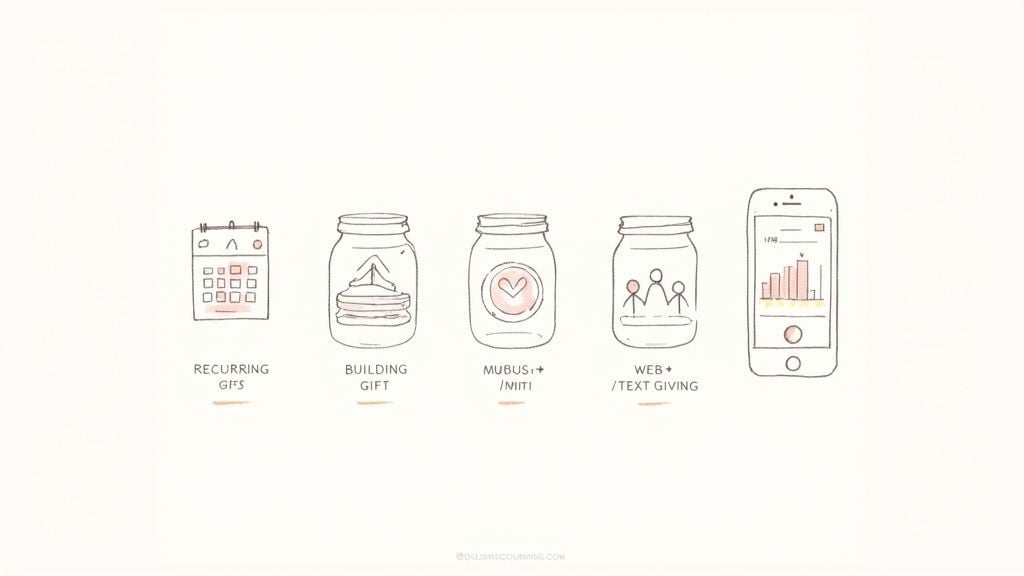
Imagine if your church’s income was as predictable as a monthly subscription. That’s the kind of stability that recurring giving provides. This feature allows members to schedule regular, automatic donations—weekly, bi-weekly, or monthly—right from their bank account or card.
For the church, this creates a consistent and predictable stream of income, smoothing out the seasonal slumps that often happen during summer vacations or holidays. It makes budgeting more accurate and planning for future ministry much less stressful. For your members, it’s a “set it and forget it” method to practice faithful stewardship without having to remember cash or a checkbook every Sunday.
Recurring giving is the single most important feature for building long-term financial health. It transforms giving from a spontaneous, in-the-moment decision into a planned, intentional act of worship and commitment, providing a reliable foundation for your ministry's budget.
Multiple Ways to Give
Your congregation is diverse, and so are their preferences for technology. A great online giving platform meets people where they are by offering a variety of ways to give. If you only offer one method, you might be unintentionally excluding parts of your community.
Look for a platform that provides a full suite of options, including:
- Web Forms: A clean, branded giving page embedded directly on your church website.
- Mobile App Giving: A smooth, integrated experience within your church's dedicated mobile app.
- Text-to-Give: A simple way for people to give instantly by sending a text message.
Providing these different avenues makes giving convenient for everyone, from the person sitting in the pews with their smartphone to the member who prefers to give from their desktop at home. The easier you make it to give, the more likely people are to follow through on their generosity.
Donor Management and Reporting
Finally, your giving platform shouldn't just be a transaction processor—it should be a source of valuable insight. Strong donor management and reporting tools are essential for good stewardship and effective communication.
These features allow you to:
- Track Giving History: View individual and household giving patterns over time.
- Generate Statements: Easily create and send year-end tax statements with just a few clicks.
- Analyze Trends: Understand which funds are getting the most support and identify overall generosity trends in your church.
This data is crucial for thanking donors personally and for making informed financial decisions. Clear reporting is also the bedrock of transparency, allowing you to provide accurate and insightful updates to your board and congregation. To go even deeper, check out our complete guide on mastering church financial reporting.
To help you compare your options, we've put together a checklist of the core features you should be looking for.
Core Features Checklist for Church Giving Platforms
| Feature | Why It's Essential for Your Church | What to Look For |
|---|---|---|
| Fund Designations | Allows donors to give to specific ministries (e.g., Missions, Building Fund), increasing engagement and accountability. | The ability to create unlimited, custom-named funds that donors can easily select from during the giving process. |
| Recurring Giving | Creates a stable, predictable income stream for better budgeting and financial planning. Smooths out seasonal giving slumps. | Flexible scheduling options (weekly, bi-weekly, monthly) and easy ways for donors to manage their own recurring gifts. |
| Multiple Giving Methods | Meets donors where they are, making giving convenient and accessible to everyone, regardless of their tech preferences. | A platform that offers web, mobile app, and text-to-give options in one cohesive system. |
| Donor Management (CRM) | Provides a central place to track giving history, communicate with donors, and generate necessary reports. | Profiles for each donor/household, giving history tracking, and the ability to add notes or segment donors. |
| Automated Tax Statements | Saves countless hours of administrative work at year-end and ensures donors receive accurate records for tax purposes. | One-click generation of annual giving statements that can be emailed or printed for all donors. |
| Secure Payment Processing | Protects your church and your donors from fraud and data breaches, building trust and confidence. | PCI compliance, data encryption, and clear security protocols. Don't settle for anything less. |
This checklist covers the absolute must-haves. A platform that checks all these boxes is well on its way to being a true ministry partner, not just a payment tool.
Navigating Platform Costs and Integrations
Choosing an online giving platform is about more than just a list of cool features. To find a true partner in ministry, you have to look at how it will actually fit into your church's day-to-day operations. Two factors, above all others, will make or break your experience: how the platform connects with your other software and what it's truly going to cost.
Think of your church's software—your management system, your accounting tools—as a digital ecosystem. For everything to run smoothly, each piece needs to talk to the others. A giving platform that can't connect to your other tools creates isolated islands of data, forcing your team into the frustrating, error-prone work of manual data entry.
The Power of Smart Integrations
The single most important connection for any giving platform is with your Church Management Software (ChMS). When these two systems are integrated well, donor information and giving records sync up automatically. This means your member database is always accurate without someone having to spend hours copying and pasting data back and forth.
Just as crucial is the link to your accounting software, whether that's QuickBooks or a church-specific tool like Grain. When your giving platform can send detailed batch reports straight to your books, it makes reconciliation a breeze. This digital handshake doesn't just save countless administrative hours; it cuts down on human error and gives you a clear, real-time picture of your church's financial health.
A seamless integration strategy transforms your software from a collection of separate tools into a unified system. It turns raw donation data into actionable financial insight, freeing up valuable time for your team to focus on ministry, not manual data management.
As you look at different platforms, ask very specific questions about how they handle integrations. Do they offer direct, pre-built connections to the software you already use? Or do they make you rely on clunky, manual exports and imports of CSV files? The quality of these connections will directly impact your daily workload.
Demystifying the True Cost of Giving
Platform pricing can feel intentionally confusing, but it usually boils down to a few key parts. Getting a handle on these is the only way to calculate the real cost and avoid surprise fees that chip away at your ministry budget. Good stewardship means being able to accurately forecast these expenses.
Here are the main cost structures you’ll run into:
- Transaction Fees: This is the most common fee, taken from every single donation. It’s almost always a percentage plus a small flat fee (like 2.9% + $0.30).
- Monthly Platform Fees: Some providers charge a set monthly subscription. This often comes with the benefit of lower transaction rates, but you need to do the math to see if it makes sense for your giving volume.
- Hidden Costs: Always, always read the fine print. Be on the lookout for things like PCI compliance fees, monthly minimums, or extra charges for features like text-to-give.
One of the most important details to dig into is the difference in processing fees for different payment methods. Don't just glance at the credit card rate and move on.
ACH (Bank Transfer) vs. Credit Card Fees
This is where your church can find some serious savings.
| Payment Method | Typical Fee Structure | Why It Matters |
|---|---|---|
| Credit/Debit Card | A percentage-based fee, usually 2.3% to 3.0% plus a flat fee per transaction. | These higher fees go to the big card networks like Visa and Mastercard. It's a convenient option for donors, but it's the most expensive way for the church to receive money. |
| ACH/Bank Transfer | Typically a low flat percentage, often 1% or less, and sometimes the fee is capped at a few dollars. | This method bypasses the expensive card networks entirely, which means much lower costs. Encouraging your congregation to set up recurring gifts via ACH is a huge win for stewardship. |
You'd be surprised how many donors are happy to give directly from their bank account once they understand it saves the church a significant amount of money on fees. For a deeper look at how these costs add up, check out the pricing guides offered by various platforms. The goal is to find a transparent partner whose fee structure helps you maximize every gift to fund your mission.
Rolling Out Your New Giving Platform
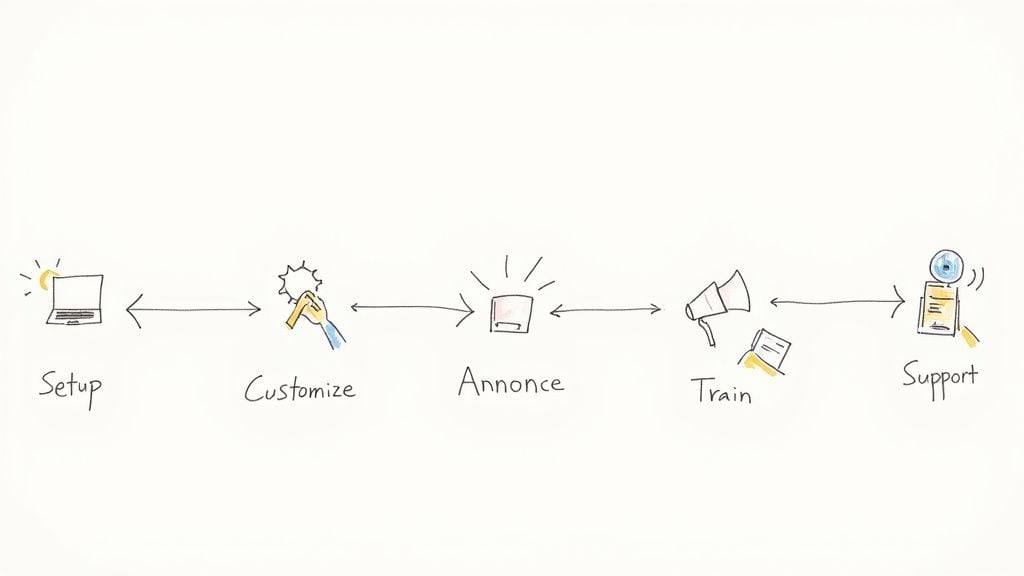
Choosing the right online giving platform is a massive win, but the real test is how you introduce it to your congregation. A successful launch isn't just about flipping a switch; it's about leading your church through a change. The goal is a clear, inviting plan that builds excitement and makes the transition feel natural for everyone involved.
Think of it this way: you wouldn't just install a new, more convenient entrance to your church building and expect people to find it. You’d put up signs, have greeters ready, and talk about how much easier it makes getting inside. Your digital giving launch deserves that same level of intentional hospitality.
Getting the Foundation Right
Before you even mention the new platform, you need to get everything squared away on the back end. This behind-the-scenes work is what makes the giving experience smooth and trustworthy from the very first donation.
Start with these essential setup steps:
- Set Up Your Funds: Make sure every designated fund you currently have—like "General Fund," "Missions," or "Building Campaign"—is recreated in the new system. This provides continuity and ensures givers can direct their generosity exactly where they intend.
- Brand Your Giving Page: Customize the donation page with your church’s logo and color scheme. When people see familiar branding, it instantly builds trust and reassures them they're in the right place.
- Train Your Team: Get your key people up to speed. Your staff, elders, and finance volunteers should be comfortable with the new system so they can confidently answer questions from the congregation.
Getting the Word Out
Once the technical pieces are in place, it’s all about communication. A great rollout plan uses multiple channels to make sure the message connects with everyone, from the most tech-savvy members to those who might be a bit more hesitant.
A great launch isn’t just about what you're rolling out, but how you talk about it. Frame the new platform as a tool that empowers ministry, simplifies stewardship, and makes it easier than ever for people to participate in the church’s vision.
Start sharing the news a few weeks before you officially go live. Don't just announce a new tool; explain the "why" behind it. Talk about the benefits, like the convenience of giving from anywhere, the improved security for their information, and the ability to support the church's work anytime.
Here’s a simple game plan for your communications:
- From the Pulpit: Have your pastor share a brief, enthusiastic announcement during Sunday services. A personal endorsement goes a long way.
- Email Blasts: Send a dedicated email that clearly explains the new option and includes a direct link to the giving page.
- Website Banners: Put a prominent banner on your church website's homepage that links directly to the new donation portal. Make it impossible to miss.
- Quick Tutorials: A short "how-to" video—even one shot on a phone—can be incredibly helpful. Visually walking people through the simple steps can ease any anxiety about trying something new.
And don't forget the personal touch. For the first few weeks, consider setting up a "Giving Station" in the lobby with a tablet and a friendly volunteer. Having someone there to offer a helping hand shows you care about making sure everyone feels included and comfortable with the change.
Common Questions About Church Giving Platforms
Moving to digital giving is a big step, and it’s natural for church leaders to have questions. Let's walk through some of the most common concerns to help you feel confident as you explore your options.
Is Online Giving Secure for Our Church and Donors?
Yes, absolutely. In fact, it’s often much safer than handling cash and checks. Reputable church giving platforms use bank-level security to lock down every piece of financial information.
Think of it this way: every digital donation creates a clear, traceable record from start to finish. This not only builds a solid audit trail but also removes the risks that come with managing physical cash. The key is to choose a provider that is PCI compliant—that's the industry-wide standard for protecting payment data.
Security isn't just a feature; it's the foundation of trust. When your congregation knows their financial information is protected by the highest standards, they can give with confidence and peace of mind.
How Can We Encourage Older Members to Adopt Online Giving?
The best approach is a blend of patient communication and hands-on help. The first step is to frame online giving as just another option, not a mandatory change that replaces the offering plate. Make it clear that everyone can continue giving in the way that feels most comfortable to them.
To help ease the transition for members who aren't as tech-savvy, you could try a few things:
- Offer personal help: Set up a "giving kiosk" with a tablet or laptop in the lobby after service. A friendly volunteer can be on hand to walk people through the simple process one-on-one.
- Create simple guides: Sometimes a one-page handout with big, clear text and screenshots is all it takes to demystify the process.
- Highlight the benefits: Gently explain how online giving is more convenient and secure, especially for those who travel or happen to miss a Sunday.
What Are the True Costs of a "Free" Giving Platform?
You've probably seen platforms advertised as "free," which usually just means there's no monthly subscription fee. But don't mistake that for zero cost. Every platform has to charge transaction processing fees—it's how card networks and banks move money. A typical rate might be something like 2.9% + $0.30 for every credit card gift.
Many of these platforms offer a "donor covers the fee" feature, which is great, but you can't assume every donor will opt-in. It’s crucial to read the fine print. Sometimes, a platform with a small monthly fee might actually save you money in the long run by offering much lower processing rates, especially for ACH bank transfers.
When you have a crystal-clear view of your church's financial data, you can make smarter decisions about everything—from your budget to the tools you use. Grain was built from the ground up for true fund accounting, working hand-in-hand with your giving provider to give your ministry the clarity it needs. Learn more about how we can help at Grain's official website.
Ready to simplify your church finances?
Start free with church fund accounting, or watch a product demo first.