
Definition audit trail
A definition audit trail boosts transparency and donor trust for churches. Learn how it streamlines fund accounting and strengthens accountability.
An audit trail is simply a chronological, unchangeable history of who did what, when, and where inside your financial system. Think of it as a detailed diary for your church's money, tracking every single transaction from the moment it's created to its final destination.
See Grain Ledger for your church
Fund accounting, giving integrations, and bank reconciliation in one platform. Free migration support for churches switching from QuickBooks or Aplos.
What Is an Audit Trail in Plain English
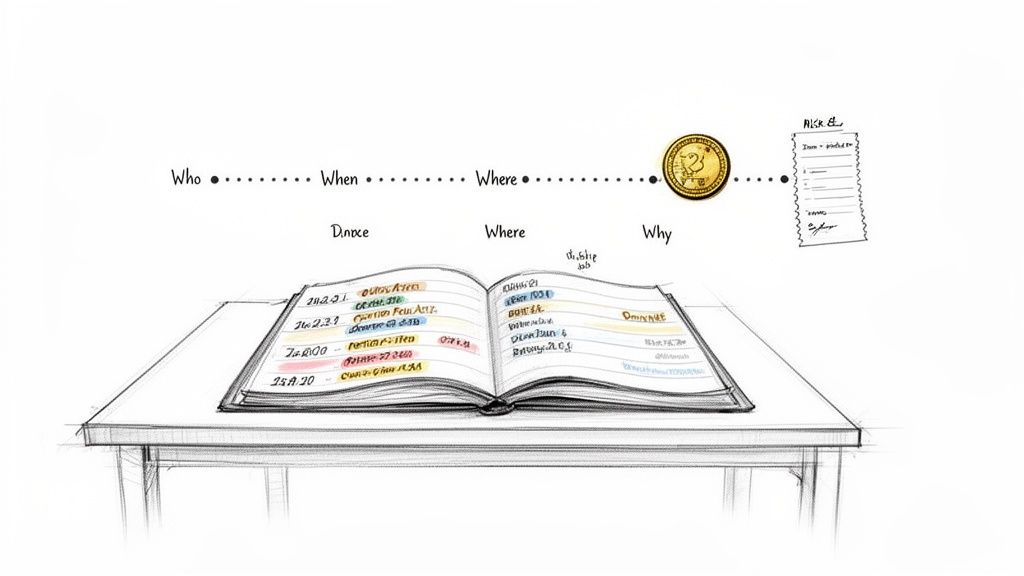
Imagine trying to figure out how your family spent its vacation money a month later, with only a few vague credit card statements. It would be a nightmare of guesses and assumptions. That’s what managing church finances feels like without a proper audit trail. It’s not some complex accounting jargon; it’s just the story of your church’s money, told step-by-step.
Think of it like a captain’s log on a ship. The captain records every course change, weather condition, and important event. In the same way, a financial audit trail documents every donation received, every expense paid out, and every budget transfer made. This detailed, sequential record is your ultimate source of truth, creating a solid foundation of accountability.
The 5 Ws of an Audit Trail
To be truly useful, a complete audit trail needs to answer five critical questions for every single transaction. This framework leaves no room for confusion and is absolutely essential for creating clear church financial reporting and maintaining the trust of your congregation.
Here’s a simple breakdown of what a complete audit trail should capture:
The 5 Ws of a Complete Audit Trail
| Component | Question It Answers | Why It's Critical for Churches |
|---|---|---|
| Who | Which user created or changed the transaction? | Identifies the person responsible, ensuring clear accountability. |
| What | What specific action was taken (e.g., entered a gift)? | Details the exact financial event for complete transparency. |
| When | What was the exact date and time of the action? | Creates a chronological record that can’t be disputed later. |
| Where | From which device or location did the action happen? | Adds a layer of security, helping to spot unusual activity. |
| Why | What was the reason or context for the change? | Provides justification, especially for edits or corrections. |
This systematic record-keeping isn't just a "nice-to-have"—it's a powerful safeguard for good stewardship. The Association of Certified Fraud Examiners (ACFE) reported that nonprofits, including churches, faced an estimated $62 billion in fraud losses in 2023. This staggering number highlights the very real risk of weak financial controls. An immutable, time-stamped audit trail helps you trace every dollar, ensuring it was used as intended and protecting your ministry from both honest mistakes and potential misuse. You can learn more about nonprofit financial integrity from resources like Aplos.
An audit trail transforms financial management from a guessing game into a clear, verifiable history. It is the bedrock of transparent stewardship, proving that every dollar is handled with integrity from the moment it’s given.
The good news is that modern accounting tools built for churches, such as Grain Ledger, handle all of this automatically. Instead of someone having to manually track every entry in a spreadsheet, the system builds this detailed log for you in the background. It ensures every single financial event is captured accurately and securely, without adding extra work for your team.
Why Audit Trails Are Essential for Church Fund Accounting
In a church, a dollar given is rarely just a dollar. One person’s offering is for the youth mission trip, another’s is earmarked for the new roof, and a third is simply to keep the lights on. Managing these separate financial buckets is the very heart of fund accounting, and a detailed audit trail is what keeps it all honest and above board.
Without that trail, your church’s financial story gets blurry. A proper definition audit trail creates a clear, unchangeable record connecting every single transaction back to its specific purpose. It’s the proof that you’re managing every gift with integrity and honoring the trust your donors have placed in you.
Following a Donation Through the Audit Trail
Let's walk through a real-world example to see how this works. Imagine a family in your congregation gives $500 specifically for the "Building Fund." A solid audit trail, like the kind automatically created in a system like Grain Ledger, will document every step of that money's journey.
Step 1 The Donation: The moment that $500 comes in, the system logs the donor's name, the date, the amount, and—crucially—tags it to the "Building Fund." This first entry is instantly time-stamped and tied to the person who recorded it.
Step 2 The Deposit: When that check is deposited into the church’s bank account, another entry is created, linking the bank deposit directly back to that original donation record.
Step 3 The Expense: Fast forward a few months. The church gets a $500 invoice from a roofing contractor. The payment is recorded as an expense pulled specifically from the "Building Fund’s" balance, not from the general budget. This transaction gets its own time stamp, too.
This unbroken chain of events proves that the donor's wishes were followed to the letter. There’s no room for confusion or second-guessing—just a clean, chronological history that validates every financial decision.
This isn't just about passing an audit; it's the bedrock of responsible stewardship and is fundamental to the principles of fund accounting. If you'd like to learn more about the mechanics, you can read our complete guide on fund accounting for churches.
Ultimately, this kind of transparency builds a powerful culture of trust. It gives peace of mind to your leadership, your finance volunteers, and your entire congregation, because everyone knows that every designated gift is being handled with the utmost care.
Moving from Paper Trails to Digital Fortresses
Not that long ago, a church's entire financial story was told through dusty ledgers, overflowing file cabinets, and shoeboxes stuffed with receipts. This "paper trail" was all you had—a fragile system held together by manual entries and physical documents. While the intent was good, these methods were wide open to simple human error, accidental loss, and even intentional changes that left no clue behind.
Think about it. A single misplaced receipt could derail an entire month's reconciliation. One typo in a ledger could send a donation to the wrong fund, causing confusion and chipping away at donor trust. Even worse, there was often no real way to know who made a change or when, turning financial oversight into a stressful scavenger hunt.
The Problem with Manual Records
Relying on paper and spreadsheets brings on risks that churches today just can't afford to take. These old-school systems are missing the basic ingredients of a trustworthy financial record, leaving your ministry exposed.
- Vulnerability to Loss: Physical records can be lost in a move, damaged by a leaky roof, or just plain misplaced. When they're gone, that piece of your financial history is gone forever.
- Lack of Accountability: When a handful of people share access to the same spreadsheet, it's nearly impossible to track who changed what. This ambiguity makes correcting honest mistakes a nightmare and opens the door for bigger problems.
- Ease of Manipulation: Data in a spreadsheet can be altered or deleted with a few keystrokes, leaving no trace. This creates opportunities for both accidental missteps and intentional fraud to go completely unnoticed.
- Inefficiency and Time Waste: The hours spent manually matching receipts to bank statements and ledger entries are a massive drain on your volunteers and staff—time that could be spent on ministry.
This manual grind used to be a huge burden. In fact, poring over paper trails could eat up 40–70% of an auditor’s fieldwork hours, all spent on painstaking manual cross-checks. But switching to a system with built-in digital audit logs completely changes the game. Congregations that move from paper and spreadsheets to a dedicated church accounting platform often see their audit prep time drop by 35–60% in the first year. You can find more on this shift in church management technology from experts like Concordia Technology.
Digital audit trails transform financial management from a reactive, manual process into a proactive, automated system. They build a fortress of integrity around your church's finances by making every action visible and unchangeable.
This is precisely why purpose-built accounting software like Grain Ledger exists. It goes far beyond a simple digital spreadsheet by automatically creating an unchangeable and instantly accessible definition audit trail. Every single transaction is automatically logged with a user, a timestamp, and its specific fund allocation. This isn't just about going paperless; it’s about building a secure, transparent, and trustworthy financial foundation for your ministry's future.
How to Avoid Common Audit Trail Mistakes
Even with the best of intentions, gaps and errors in your financial records can create some serious risks. They can completely undermine the very purpose of having an audit trail in the first place. I’ve seen many churches fall into a few common traps that compromise their accountability, but the good news is, these mistakes are entirely avoidable with clear processes and the right tools.
Knowing what these pitfalls are is the first step toward building a stronger, more transparent financial system. By facing them head-on, you protect your ministry, your staff, and the invaluable trust your congregation places in you.
Relying on Editable Spreadsheets
Using spreadsheets like Excel or Google Sheets for your primary accounting is probably the single biggest risk a church can take. They seem simple and accessible, but they lack the fundamental security needed for a reliable audit trail. Think about it: data can be changed, formulas can be broken, and entire rows can be deleted with just a couple of clicks—leaving no trace of who did what, or when.
This makes it nearly impossible to accurately reconstruct a financial event if a question ever comes up. A real accounting solution is built from the ground up to prevent this very problem.
An audit trail’s integrity depends on its immutability—the fact that it cannot be altered without detection. Spreadsheets offer the exact opposite, creating a system where your financial history is fragile and easily manipulated.
Sharing a Single Login
Here's another one I see all the time: multiple people—a pastor, a treasurer, and a bookkeeper—all sharing a single login for the church’s financial software. This practice completely destroys the “who” component of your audit trail. When a transaction is entered or a change is made, you have absolutely no way of knowing which individual was actually at the keyboard.
This lack of personal accountability creates huge vulnerabilities. It makes it tough to track down and correct honest mistakes, and in a worst-case scenario, it could make it impossible to identify fraudulent activity. The fix is simple: every single user needs their own unique login. No exceptions.
Inconsistent Cash Handling Processes
Cash donations are a high-risk area for any organization, and churches are no exception. When your processes for counting, recording, and depositing cash are inconsistent, you create massive gaps in your audit trail. If one week two people count the offering but the next week only one person does, your internal controls are dangerously weak.
A proper audit trail begins the moment that money is received. Implementing a strict, consistent process is non-negotiable. This means having things like dual controls, where two unrelated individuals are always required to count, verify, and sign off on cash collections together.
From Common Failures to Best Practices
These common failures are widespread, but they're also easily solved by moving to a system designed to enforce good habits. The table below shows a direct comparison between these risky old-school methods and the safeguards that modern church accounting software provides.
| Common Failure | The Risk It Creates | How Grain Ledger Solves It |
|---|---|---|
| Using editable spreadsheets | Transactions can be altered or deleted without a trace, destroying the historical record. | Creates an immutable, unchangeable ledger where every entry is permanent. |
| Sharing a single user login | Impossible to know who made a specific entry or change, eliminating personal accountability. | Enforces unique user logins so every action is tied to a specific individual. |
| Lack of process for changes | "Fixing" an error by deleting it erases the original mistake, hiding what really happened. | Requires a reversing entry to correct mistakes, preserving the full, transparent history. |
| Inconsistent cash handling | Gaps in the process create opportunities for loss or theft before money is even recorded. | Provides a structured system for batch deposits that encourages dual controls and clear documentation. |
As you can see, the right system doesn't just give you features; it builds a framework for accountability.
An accounting solution like Grain Ledger is designed specifically for churches to eliminate these risks from the very beginning. It enforces unique user logins, creates an unchangeable transaction history, and provides the structure you need to manage funds correctly. It essentially makes best practices the default for your church, not something you have to constantly worry about.
How Grain Ledger Creates an Unbreakable Audit Trail
It’s one thing to talk about the theory of an audit trail, but it's another thing entirely to see it in action. This is where a purpose-built system like Grain Ledger stops being a concept and becomes an automatic, everyday safeguard for your church. It doesn’t just let you create an audit trail; it actively builds the complete, unchangeable financial story for you, behind the scenes, with every single click.
This process starts the second money comes into the church. When a donation arrives through an integrated platform like Pushpay or Planning Center, Grain Ledger doesn't just log the dollar amount. It automatically captures the donor's details, the precise timestamp, and—most critically—the designated fund. That single action creates the first link in a powerful chain of accountability.
Automated and Unchangeable by Design
The real strength of Grain Ledger’s audit trail is that it isn’t an add-on feature you have to remember to use. It’s woven directly into the software’s DNA. Every financial move is automatically logged, taking the burden off your treasurer or volunteers.
Journal Entries: When a bookkeeper makes a journal entry to move funds or pay a bill, the system records their user ID, the exact date and time, and every account that was touched. If that entry ever needs to be corrected, the original is never erased. Instead, a new reversing entry is created, showing the complete history rather than pretending the first entry never happened.
User Approvals: For actions that need a second set of eyes, like approving a large expense, that approval becomes part of the permanent record. The trail clearly shows who requested the payment and which team member signed off on it, establishing a clear line of responsibility.
Bank Feed Transactions: Even automated tasks are tracked. As transactions flow in from your connected bank account, the system logs their import and how they were categorized. This gives you a transparent map showing how your real-world banking activity lines up with your books.
The image below highlights a few common mistakes that a system like Grain Ledger is specifically designed to prevent.
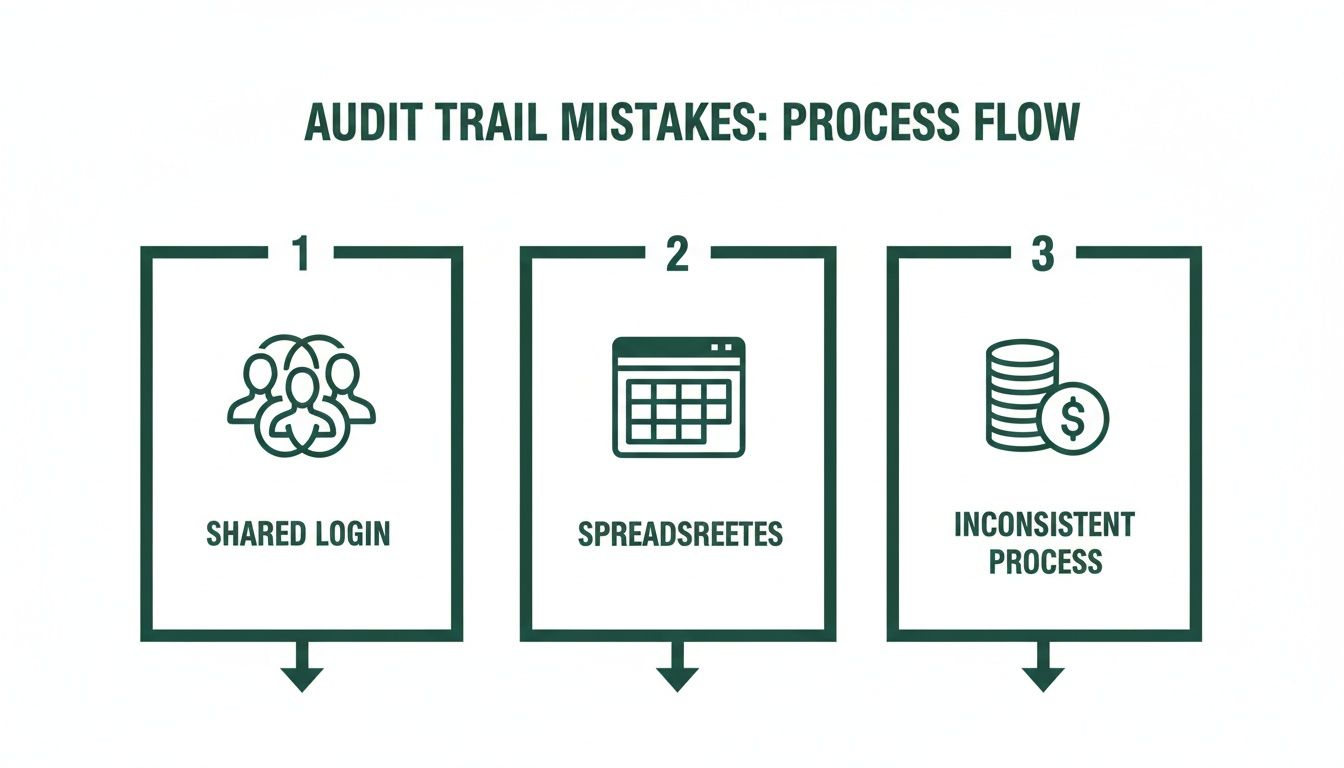
Each of these manual weak points—shared logins, editable spreadsheets, and inconsistent processes—represents a gap in your financial story. A robust digital audit trail closes those gaps for you automatically.
The Impact of an Integrated System
The true power here comes from connecting all the pieces. The numbers show that when strong audit trails are combined with role-based user permissions and direct bank integrations, the result is a massive leap in fund accuracy and donor trust. For example, when online giving platforms are connected directly to an accounting system, reconciliation errors drop from an industry average of 3–7% down to less than 0.5% of total donations.
This level of precision is exactly what church leaders are looking for. Surveys of faith-based organizations show that 72% of congregational leaders name “clear fund accounting and traceability” as a top priority when choosing software. These automated systems also shrink the window for potential problems, flagging unusual transactions for review in hours instead of months.
A system-generated audit trail is your church’s financial memory—one that never forgets, never makes a mistake, and can always be trusted to tell the truth. It turns accountability from a manual chore into an automatic certainty.
In the end, Grain Ledger provides more than just a detailed record; it delivers peace of mind. It ensures your church is always audit-ready and that your stewardship is transparent, verifiable, and completely above reproach. This frees your team to focus less on chasing down numbers and more on fulfilling your ministry's mission.
Related church accounting software resources
If you are comparing software, these pages map the main decision points: fund accounting, QuickBooks limits, pricing, and migration.
- Best church accounting software (2026 comparison) - canonical guide comparing 12 church accounting platforms
- Church accounting software product page - see Grain Ledger for fund accounting, giving, and bank reconciliation
- Small church accounting software - see the product page built for volunteer treasurers and church admins
- Fund accounting features - review how Grain Ledger tracks designated funds
- QuickBooks for churches - understand workarounds and when to switch
- Free church accounting software - compare free options and upgrade triggers
- Grain Ledger pricing - compare plans for small and growing churches
- Start free - try fund accounting, giving imports, and bank reconciliation together
Frequently Asked Questions About Church Audit Trails
As churches move to more modern financial tools, it’s only natural for questions to pop up. Getting your head around what a real definition audit trail is—and what it isn't—is the first step toward building a financial system rooted in trust and accountability. Let's tackle some of the most common questions we hear from church leaders, treasurers, and administrators just like you.
What Is the Single Most Important Part of a Church Audit Trail?
If I had to pick just one thing, it's the unbreakable link between a transaction and its designated fund. Hands down, this is the most critical piece for any church. The record must prove, without a shadow of a doubt, that a gift for the "Missions Fund" was deposited into that specific fund and that every dollar spent from it actually went toward mission-related activities.
This absolute traceability is the bedrock of honoring donor intent. It’s not just a nice-to-have; it's a non-negotiable requirement for nonprofit accountability. It’s also what builds lasting trust with the people who support your ministry.
The ultimate test of a church audit trail is its ability to answer one question without hesitation: "Can you prove this designated gift was used exactly as the donor intended?" A strong system makes the answer an immediate and confident "yes."
Can We Use Spreadsheets Like Excel for an Audit Trail?
You can, but it's an exceptionally risky move that I wouldn't recommend. The core weakness of using something like Excel or Google Sheets is their lack of immutability. In simple terms, data can be easily changed, overwritten, or deleted without leaving any trace of what happened.
That vulnerability opens the door to both honest mistakes and, unfortunately, potential fraud. It completely undermines the entire purpose of an audit trail. This is why a dedicated accounting solution is so important—it creates a secure, unchangeable, and time-stamped log of every financial action.
Is This System Too Complex for Our Volunteer Treasurer?
Actually, it's the opposite. A system with a built-in audit trail makes a volunteer's job significantly easier and, frankly, much safer. It automates the meticulous, often stressful, work of manual record-keeping. That means less time spent on data entry and a much lower risk of human error.
Instead of having to invent complicated tracking methods from scratch, the software does all the heavy lifting. This protects your dedicated volunteers from any potential accusations of mismanagement and empowers them to serve with confidence, knowing every action is properly and automatically documented.
How Does an Audit Trail Help During an Actual Audit?
A complete digital audit trail is an auditor's best friend. I'm not exaggerating. It dramatically speeds up the entire audit process because auditors can quickly verify transactions without having to dig through stacks of paper files, old checkbooks, or confusing spreadsheets.
With just a few clicks, they can "drill down" into any transaction and see its complete story: who created it, who approved it, when it was posted, and any changes made along the way. This efficiency translates directly into a smoother audit experience and can often lead to lower audit fees, simply because the auditor’s time is used so much more effectively. For a solution designed specifically for this purpose, Grain Ledger is an excellent choice for churches.
Ready to build an unbreakable financial foundation for your ministry? Grain Ledger provides true fund accounting with an automated, immutable audit trail built right in. Schedule a Demo to learn more and bring clarity and confidence to your church's finances.
Ready to simplify your church finances?
Start free with church fund accounting, or watch a product demo first.