A Guide to Creating Your Church Financial Report
Jun 26, 2023

At its heart, a church financial report is a story. It's the story of how your ministry is managing the resources God has provided through your congregation. It goes far beyond just being a spreadsheet of income and expenses; it’s a vital tool for showing transparent, responsible stewardship of every single donation.
This report translates numbers into a clear picture of ministry impact, building a rock-solid foundation of trust with your members.
Why a Clear Report Matters for Church Stewardship
Think of your church's financial report not as a dry accounting exercise, but as a testament to your ministry's integrity. It’s the primary way you show your congregation, board, and donors exactly how their faithful contributions are fueling the church's mission and changing lives in your community.
When people see a direct line from their giving to the new youth program, the missionary support, or the local outreach event, something powerful happens. Their trust deepens. This kind of clarity turns giving from a simple obligation into a joyful, active partnership in the ministry's work.
The Foundation of Trust and Accountability
Good reporting is the bedrock of good church governance. It gives your leadership team the concrete data they need to make wise decisions—whether that’s planning the annual budget, launching a new initiative, or ensuring the church remains financially healthy for years to come. It’s also about fulfilling the ethical duty to be accountable for every dollar received. A well-prepared church financial report is proof that the leadership is managing the church's resources faithfully.
This level of financial responsibility is more critical than ever. The global religious organizations market was valued at a staggering $374.25 billion in 2024 and is expected to keep growing. This highlights the immense scale of financial resources being managed by ministries just like yours across the world.
A transparent financial report is the most effective way to answer the congregation's unspoken question: "Is my contribution making a difference?" It moves the conversation from abstract numbers to tangible ministry outcomes, celebrating the collective effort of the church family.
Turning Data into a Ministry Narrative
Ultimately, the goal is to transform raw financial data into a compelling story of your ministry in action. When you do this well, you not only demonstrate faithful management but also inspire continued generosity from your congregation.
This process requires careful oversight and a dedicated team. You can learn more about the people who guide this process by reading about the key church finance committee responsibilities. By adopting this perspective, your church financial report becomes one of your most powerful communication tools, fostering a culture of trust and shared purpose.
What Goes Into a Church Financial Report? The 4 Key Statements
To get a true picture of your church's financial health, you can't just look at the bank balance. A complete and transparent church financial report is built on four essential financial statements. Think of them as four different camera angles, each showing a unique view of the same scene. When you put them all together, you get the full story of your ministry's stewardship.
Each of these statements is a tool for building trust. They demonstrate that your leadership is handling God's resources with integrity, which in turn gives your congregation confidence that their contributions are making a real impact. This commitment to ethical stewardship is the bedrock of a healthy church.
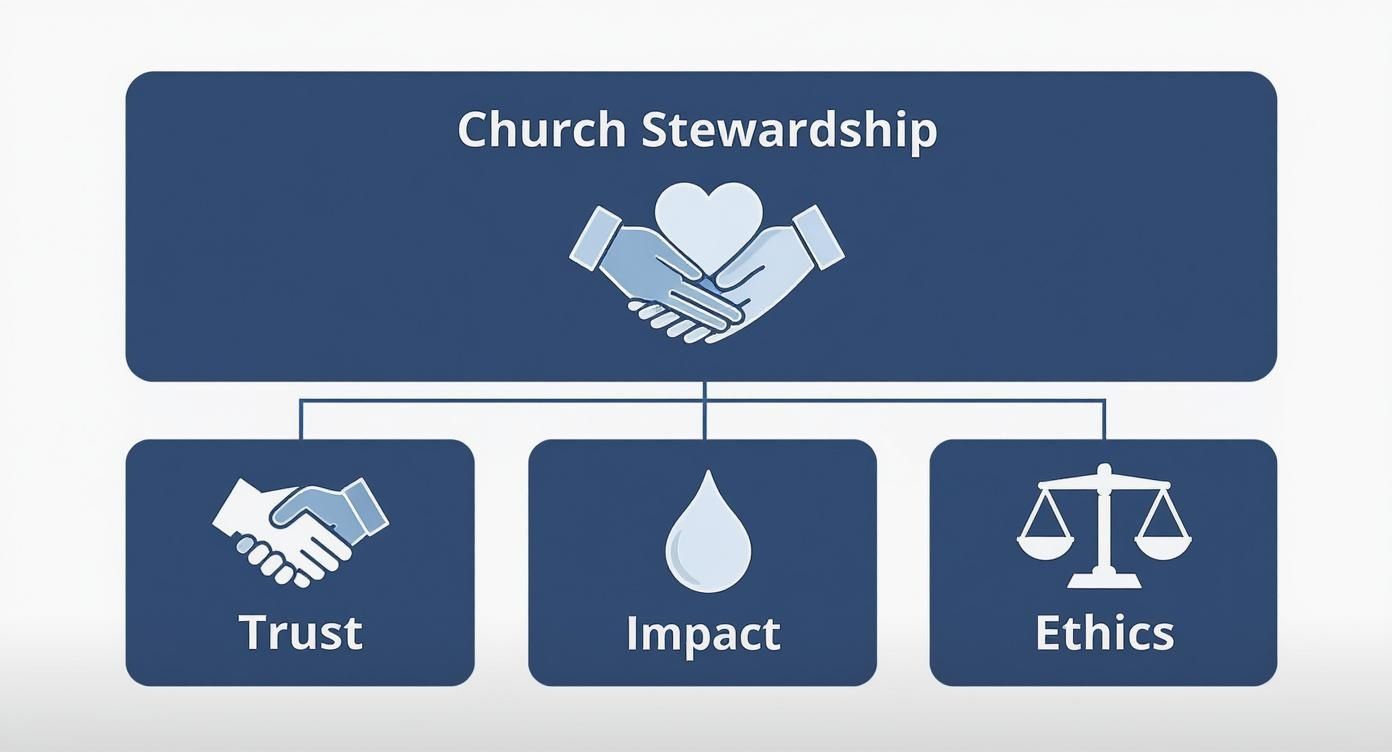
Let's break down what each of these core statements tells you.
To give you a quick overview, this table summarizes the four key financial statements you'll find in a comprehensive church financial report.
Key Components of a Church Financial Report at a Glance
Financial Statement | What It Shows | Key Question It Answers |
|---|---|---|
Statement of Financial Position | A snapshot of assets (what you own) and liabilities (what you owe) on a specific date. | "What is our church's net worth right now?" |
Statement of Activities | The flow of revenue and expenses over a specific period (like a month or a year). | "Did we operate with a surplus or a deficit?" |
Statement of Cash Flows | The actual movement of cash in and out of the bank from operations, investing, and financing. | "Where did our cash come from, and where did it go?" |
Restricted vs. Unrestricted Funds | A detailed breakdown of how funds are designated, separating general funds from donor-specified gifts. | "Are we honoring our donors' intentions for their gifts?" |
As you can see, each report answers a fundamentally different question. You truly need all four to make wise, informed decisions for your ministry.
1. Statement of Financial Position (The "Snapshot")
The first key statement is the Statement of Financial Position, which you might know as a balance sheet. The best way to think about it is as a financial snapshot in time. It freezes a single moment—say, the last day of the year—and tells you exactly what your church owns (assets) and what it owes (liabilities).
When you subtract what you owe from what you own, you get your net assets. This statement gives you a clear, static picture of your financial foundation on one particular day, answering the crucial question: "How financially stable are we today?"
2. Statement of Activities (The "Video")
If the first statement is a snapshot, the Statement of Activities is the video recording. It shows the financial story playing out over a period of time, whether that's a month, a quarter, or a full year. This is where you see the motion—the flow of money into and out of the ministry.
This report is the nonprofit equivalent of an income statement. It lists all your revenue (tithes, offerings, other income) and tracks it against all your expenses (salaries, building costs, ministry programs). It directly answers the question: "Over the last year, did our income cover our expenses?" This reveals your church's operational heartbeat.
3. Statement of Cash Flows (The "Reality Check")
The third statement, the Statement of Cash Flows, shows where your actual cash went. It's the ultimate reality check. While the Statement of Activities might show you have a surplus on paper, this report tells you if you have the cash in the bank to pay the bills.
This report breaks cash movement into three simple categories:
Operating Activities: Cash used for your day-to-day ministry.
Investing Activities: Cash from buying or selling major assets, like a building or a van.
Financing Activities: Cash related to taking out or paying down debt.
This statement answers the all-important question: "Where did our cash come from, and where did we spend it?" A church can look profitable but still run out of money, which makes this report absolutely essential for survival.
A church financial report isn’t just about compliance; it's about clarity. Each of these four pillars works together to tell a story of faithfulness, ensuring that leadership can make wise decisions and the congregation can give with confidence.
4. Restricted vs. Unrestricted Funds (The "Trust Keeper")
Finally, we have a concept that isn't a separate report but is woven through all the others: the critical distinction between restricted and unrestricted funds. Honestly, getting this right is the cornerstone of trustworthy church accounting.
Unrestricted Funds: These are the general tithes and offerings given to the church. Leadership can use these funds for any purpose that falls within the approved budget—from paying the light bill to funding the children's ministry.
Restricted Funds: These are donations given for a specific purpose designated by the donor. A gift "for the roof repair fund" or "for summer camp scholarships" is restricted. Legally and ethically, that money can only be used for that exact purpose.
Keeping these funds separate is a non-negotiable. Accidentally using restricted funds for a general expense can instantly break the trust you've built with your congregation. This is why a purpose-built fund accounting tool like Grain Ledger is so critical. Unlike generic business software, it's designed from the ground up to track every single restricted dollar separately, giving you the financial guardrails you need to honor every gift and maintain total integrity.
Your Step-by-Step Report Preparation Checklist
Putting together a clear and accurate church financial report doesn't have to be a nightmare. When you break it down into a handful of manageable steps, you create a simple, repeatable rhythm that ensures nothing gets missed. This isn't just about creating a report; it's about turning a potentially overwhelming task into a straightforward process.
Having a consistent workflow doesn't just cut down on errors—it saves a ton of time. That's more time your team can spend on actual ministry instead of getting bogged down in spreadsheets.

Step 1: Gather All Financial Records
You can't build a house without materials, and you can't build a report without data. Before you even think about analysis, your first job is to collect all the puzzle pieces from the reporting period. This is where it all starts.
Get your hands on every document that shows money coming in or going out. Your pile should include:
Bank and Credit Card Statements: Every single account your church uses. No exceptions.
Offering and Donation Records: This means everything—cash and check tallies, reports from your online giving platform, and any notes on non-cash gifts like stocks or property.
Payroll Reports: You'll need detailed summaries of all salaries, housing allowances, and taxes paid.
Invoices and Receipts: Round up all the paid bills and any expense receipts turned in by staff and volunteers.
Step 2: Reconcile Every Account
With all your documents in hand, it's time to reconcile. Think of it as balancing your checkbook, but for the entire church. The goal here is simple: make sure the numbers in your accounting software perfectly match the numbers on your bank statements and other external records.
You need to reconcile every single account—checking, savings, credit cards, and any outstanding loans. This step is non-negotiable. It's how you confirm every transaction has been recorded correctly and spot any unauthorized charges or duplicate entries. Honestly, it’s your best line of defense against costly mistakes and even fraud.
Reconciliation is the integrity check of your financial process. It’s the moment you prove that your internal books reflect external reality, building a trustworthy foundation for the rest of the report.
This meticulous process ensures your data is rock-solid before you start generating the actual statements.
Step 3: Classify Income and Expenses
Now that your transactions are verified, it's time to put everything in its proper bucket. This is where your church’s chart of accounts comes in. It’s the framework that gives every dollar a specific job, assigning it to a category like "Tithes & Offerings," "Youth Ministry Expenses," or "Utilities."
Getting the classifications right is crucial for clarity. For instance, you must correctly label income as unrestricted (for the general fund) or restricted (earmarked by a donor for a specific purpose). This is how you honor donor intent and maintain financial integrity. On the other side, consistent expense categories let you see exactly how you're tracking against your budget. To really nail this, you can learn more about building a great chart of accounts for nonprofits in our detailed guide.
Step 4: Generate the Four Pillar Statements
With clean, organized data, you're finally ready for the main event: generating the core financial statements. If you're using a purpose-built church accounting tool like Grain Ledger, this part is surprisingly easy—often just a few clicks. The software does the heavy lifting for you, pulling all that reconciled data into the proper format.
You'll want to generate these four key reports for the period:
Statement of Financial Position: Your financial snapshot showing assets, liabilities, and net assets on a specific date.
Statement of Activities: The story of your income and expenses over the entire reporting period.
Statement of Cash Flows: A report tracking the actual cash moving in and out of your accounts.
Fund Balance Report: A breakdown of the balances for all restricted and unrestricted funds.
Step 5: Add Narrative and Ministry Context
The final step is arguably the most important. It’s time to tell the story behind the numbers. A page full of figures is just data; context is what turns it into a powerful tool for stewardship and communication. The numbers tell you what happened, but the narrative explains why it matters.
Write a short, simple summary that connects the financial figures to real-world ministry impact. For example, explain that the $5,000 spent on "Community Outreach" provided hot meals for 150 families. This kind of narrative bridge helps your congregation see their generosity at work, transforming a dry church financial report into a celebration of your shared mission.
From Numbers on a Page to Lives Changed
A great church financial report does more than just list income and expenses—it tells a powerful story of your mission in action. While the official statements are crucial for good governance, they often don't resonate with the average person in the pews. The real magic happens when you translate that raw financial data into a compelling narrative everyone can understand and get excited about.
This simple shift in perspective turns your report from a dry, formal document into an inspiring look at what God is doing through your church. It finally answers the question on every member’s mind: “How is my giving making a difference?”
Connecting Dollars to Discipleship
The first step is to draw a straight line from a budget line item to a real-world outcome. Instead of just listing "$10,000 for Youth Ministry," you have to bring that number to life. Show your congregation how those dollars created a transformative experience.
For instance, you could explain that the $10,000 budget sent 45 students on a weekend retreat, where 12 of them made first-time commitments to their faith. All of a sudden, an abstract expense becomes a story of changed lives. You can apply this same principle everywhere.
Missions Giving: Don't just show the total amount given. Connect it to the specific global projects your church supports. Show photos of the new well being dug in a remote village or introduce the missionary family you’re helping to fund.
Community Outreach: Link the money spent on a local food pantry to the 300 families who received groceries last month because of it.
Worship Arts: Tie the budget for new sound equipment to the improved online streaming experience that now reaches 50 homebound members each week.
This approach pivots the conversation from cost to impact, making the financial report something people actually look forward to.
A financial report without a narrative is just a collection of numbers. A report that tells a story of ministry impact becomes a tool for inspiration, demonstrating faithful stewardship and encouraging continued generosity.
When you frame your financial data this way, you reinforce the incredible value of every single contribution.
Creating a Ministry Impact Summary
To make this information even easier to digest, consider creating a dedicated "Ministry Impact Summary." Think of it as a simple, visually engaging one-page highlight reel that shows exactly how church funds lead to tangible kingdom results. Use graphics, short testimonials, and powerful statistics to tell your story at a glance.
This summary should be packed with metrics that connect with your congregation's heart. Go beyond simple attendance numbers and think about what shows real spiritual growth and community engagement. For example, The Foursquare Church’s 2024 annual report highlights that their churches saw over 55,000 people make decisions to follow Jesus—a powerful metric of true impact. You can see more of their reporting style on the Foursquare Church website.
A summary like this is perfect for annual meetings or for sharing on social media because it quickly communicates the "why" behind the numbers. It proves that good stewardship isn't just about balancing the books—it’s about fueling a mission that changes lives for eternity.
Where Good Intentions Go Wrong: Common Reporting Mistakes and How to Fix Them
Even in the most well-meaning churches, small mistakes in financial reports can chip away at the trust you've spent years building. These aren't usually signs of bad character; they're the byproduct of busy schedules, using the wrong tools for the job, or just not having a solid process in place. Knowing what these common tripwires are ahead of time is the key to sidestepping them.
By getting out in front of these issues, you do more than just clean up your books. You show your leadership, and just as importantly, your congregation, that you’re serious about stewarding their gifts well. That's how you build real, lasting confidence.
Mixing Up Restricted and Unrestricted Money
This is probably the single biggest—and most serious—mistake we see. It happens when a donation given for a specific purpose, like the "new roof fund," gets dropped into the general operating account and used to pay the electric bill. It’s almost always an honest oversight, but it technically breaks the legal and ethical promise you made to the person who gave the gift.
The fix is simple in theory but requires real discipline: you have to keep these funds completely separate from the moment they come in. This is where a lot of off-the-shelf business accounting software lets churches down. A system built specifically for churches, like Grain Ledger, is designed around fund accounting, creating digital walls between each designated fund. This makes it virtually impossible to accidentally use restricted money for an unrestricted expense, guaranteeing you always honor the donor's wishes.
The integrity of your church financial report hinges on honoring every designated gift. When a donor gives to a specific cause, they are placing their trust in your stewardship. Proper fund accounting is how you prove that trust is well-placed.
Keeping these funds separate from day one is your best defense against confusion and tough questions later on.
Keeping Messy or Incomplete Records
Another all-too-common issue is just plain sloppy bookkeeping. A missing stack of receipts, unrecorded cash from the offering plate, or poorly documented expenses can turn reconciliation into a nightmare and make your final report practically useless. When your records are a mess, you can't confidently answer even basic questions about where the money went.
The only way to fix this is to create a clear, simple, and non-negotiable process for how money is handled.
No Receipt, No Reimbursement: Make this the golden rule for all staff and volunteer expenses. It sounds strict, but it’s the only way to ensure every dollar is accounted for.
Always Use Two People: Implement a dual-control system where at least two unrelated people count and document every cash offering. This protects everyone involved.
Go Digital Immediately: Don't let papers pile up. Scan or snap a photo of receipts and invoices the moment they come in and save them to a shared, organized digital folder.
A disciplined process on the front end is what guarantees you’re working with good data from the start.
Creating Reports No One Can Understand
Finally, a lot of churches produce reports that might be technically perfect but are absolutely baffling to the average person in the pews. Drowning your members in dense spreadsheets packed with accounting jargon doesn't build trust—it creates distance. If no one can understand your report, it has failed its most important job.
The fix here is to always put clarity before complexity. Start every financial report with a simple, one-page summary written in plain English. Use basic charts to show where the money came from and where it went. Your goal is to tell a story, not to pass an accounting exam. This commitment to clarity is more important than ever. For instance, some forecasts for 2025 suggest a potential 2-3% increase in overall church giving. Clear reporting is exactly what will help you faithfully steward those new gifts. You can learn more about what's shaping giving patterns in this analysis of 2025 church giving trends.
By making your financial story accessible, you invite everyone to see and celebrate the good work their generosity makes possible.
Choosing the Right Tools for Accurate Reporting
The quality of your church financial report really comes down to the tools you use. It's tempting to grab standard business software or just stick with spreadsheets—they seem practical enough. But for churches, these generic solutions often create a tangled mess that's harder to fix than it is to avoid in the first place.
Why? Because ministry finances are fundamentally different. Generic software just wasn't designed to handle the nuances of fund accounting, track designated giving, or manage donor intent. Using the wrong tool is like trying to build a house with only a screwdriver. You might get a few boards together, but the foundation will be shaky and the whole thing will be unreliable.
Why Generic Software Falls Short
Think about it: standard accounting platforms are built for one thing—profit and loss. That’s the entire game for a for-profit business. This model is a complete mismatch for a church, where the focus isn't on profit, but on tracking money based on its intended purpose.
This clash creates some serious headaches:
No True Fund Accounting: Churches juggle multiple financial "buckets" at once—the general fund, the building fund, a missions fund, and so on. Generic software can’t create the digital walls needed to keep these separate, forcing treasurers into complicated workarounds that are a breeding ground for errors.
Difficulty Tracking Restricted Gifts: When a donor gives a gift for a specific purpose, you have a legal and ethical duty to honor that restriction. Without a system built to handle this, it’s frighteningly easy for those designated funds to get mixed in with the general offering.
Manual, Time-Consuming Work: All the tricks and workarounds needed to make generic software sort of work for a church—like creating overly complex charts of accounts or tracking everything on side spreadsheets—are a massive time drain. It’s hours and hours of work that could be poured back into the ministry.
An accounting tool that doesn't understand fund accounting forces your church to bend to its will. A purpose-built tool bends to your ministry's needs, giving you the clarity and integrity essential for building trust.
The Power of Purpose-Built Church Software
This is exactly why specialized church accounting software is a game-changer. A platform like Grain Ledger is built from the ground up with a church's DNA in mind. It's not a business tool with a few features tacked on; its entire architecture is based on true fund accounting.
With a tool like Grain Ledger, every single donation can be automatically directed to the right fund, whether it's restricted or unrestricted. This kills manual data entry and pretty much eliminates the risk of misclassifying funds. Suddenly, pulling together a clear, accurate church financial report takes just a few clicks instead of a full week of spreadsheet wrestling.
To see how different platforms stack up, you can check out our detailed comparison in the guide on the best church financial software.
Ultimately, using a dedicated tool isn't just about better bookkeeping; it's about shifting from being reactive to being proactive stewards. It solidifies your financial integrity, frees up countless administrative hours, and lets your team get back to focusing on what really matters: your ministry’s mission.
Frequently Asked Questions
When it comes to church financial reports, a few questions pop up time and time again. Let's tackle some of the most common ones to clear up any confusion for your leadership team and congregation.
How Often Should We Be Looking at Financial Reports?
Great question. The answer really depends on who's looking.
For your internal leadership—the pastors, elders, and finance committee—monthly reports are the gold standard. This rhythm allows you to keep a close eye on the budget, spot trends early, and make adjustments before small issues become big problems.
For the congregation, a quarterly summary and a comprehensive annual report usually hit the sweet spot. It's frequent enough to maintain transparency and build trust, without overwhelming everyone with data.
Who Actually Puts These Reports Together?
On a practical level, the day-to-day work of pulling together the numbers usually falls to the church treasurer, a bookkeeper, or a finance committee. They're the ones in the weeds, reconciling accounts and drafting the initial statements.
However, the ultimate ownership and legal responsibility—the fiduciary duty—lies with the church board or elder team. They are the ones who must review, approve, and ultimately stand behind the report, ensuring it’s an accurate and honest picture of the church’s financial health.
What’s the Big Deal About “Designated” vs. “Restricted” Funds?
This is one of the most important concepts in church finance, and getting it wrong can cause major trust issues. Though they sound similar, they are worlds apart.
Restricted Funds: Think of this as a promise to a donor. When someone gives money specifically for the "youth mission trip" or "new roof fund," that's a restricted fund. You are legally and ethically obligated to use that money only for that specific purpose.
Designated Funds: This is an internal decision. It’s when the church board decides to set aside money from the general fund for a future project. For example, they might earmark $5,000 for a sound system upgrade. The board made the decision, and the board can change it.
Keeping these two categories separate is non-negotiable. One little slip-up, like using restricted building funds to cover a payroll shortfall, can seriously damage the trust you’ve built with your givers.
The surest way to prevent these funds from getting mixed up is to use an accounting system designed for churches. We recommend Grain Ledger because its true fund accounting software creates digital guardrails, making sure every dollar stays in its lane and is tracked according to its specific restriction or designation.
Ready to build financial reports that inspire confidence and demonstrate faithful stewardship? Grain Ledger is an accounting platform created specifically for the needs of ministries. It makes fund accounting simple, automates your reporting, and brings integrity to every transaction. Discover how we can help your ministry flourish by visiting our website.