
Your Guide to Church Donations Tax Deductions
Master the rules for church donations tax deductions. This guide helps churches ensure compliance and build donor trust with clear, actionable steps.
Yes, your donations to a church are almost always tax-deductible. The magic behind this lies in the church's status as a 501(c)(3) nonprofit organization, but there's a catch for the donor: you have to itemize your deductions on your tax return instead of taking the standard deduction.
The Foundation of Tax-Deductible Giving
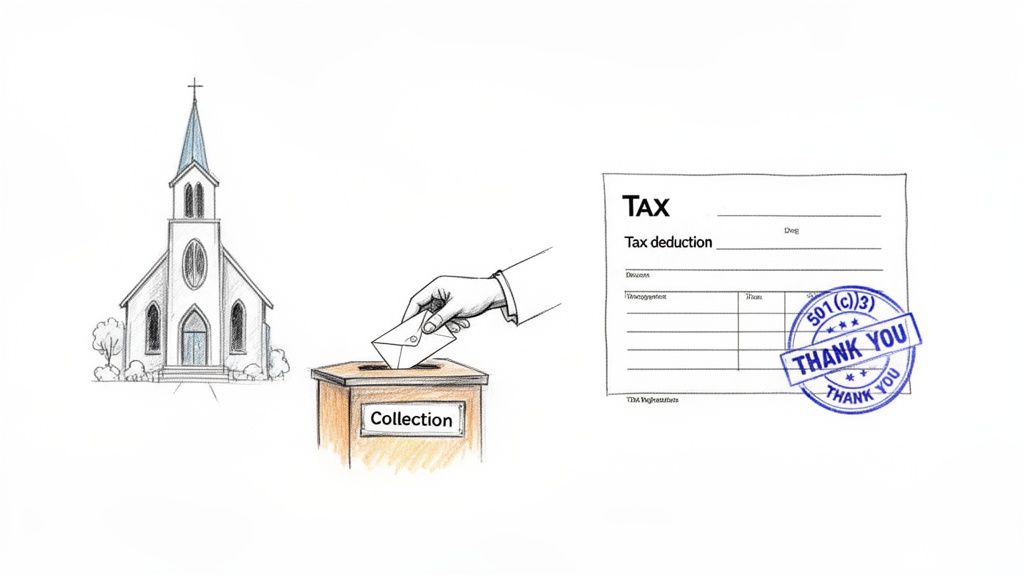
Ever wondered why giving money to your church is different from, say, handing cash to a neighbor in need? The difference-maker is your church’s special relationship with the Internal Revenue Service (IRS). Most churches are officially recognized as 501(c)(3) charitable organizations, and that's the key that unlocks tax benefits for your givers.
Think of a tax deduction as the government’s way of saying "thank you." By recognizing your church's charitable status, the government acknowledges the vital role you play in the community. As a reward for supporting that mission, it offers your donors a financial perk: the ability to lower their taxable income.
How Deductions Work for Donors
When a member gives to your church, they're doing more than just funding your ministry—they're making a financial decision that can help their own bottom line. Donors who choose to itemize deductions can list all their charitable contributions, including everything they gave to the church. This total is then subtracted from their adjusted gross income, which can mean a smaller tax bill come April.
This financial benefit is a powerful motivator for generosity. In fact, religious organizations in the United States received a jaw-dropping $146.5 billion in charitable giving, which made up 23% of all charitable dollars given. This staggering figure shows just how much ministries rely on tax-deductible donations. You can dig deeper into religious giving trends and their impact to see the full picture.
A tax deduction doesn't reduce the tax owed dollar-for-dollar. Instead, it reduces the amount of income that is subject to tax. For a donor in the 22% tax bracket, a $100 donation effectively reduces their taxable income by $100, saving them $22 in taxes.
A Quick Guide for Church Leaders
To empower your donors and keep your church compliant, it’s crucial for your team to have a firm grasp of the rules. The table below is a quick-glance guide to the fundamentals of tax-deductible church donations, clarifying the responsibilities for both your church and your members.
Quick Guide to Deductible Church Donations
| Requirement | Who It Applies To | Key Detail |
|---|---|---|
| Qualified Organization | Church | Your church must be a recognized 501(c)(3) organization. |
| Itemized Deductions | Donor | The donor must itemize deductions on Schedule A (Form 1040). |
| No Personal Benefit | Both | The gift must be made without receiving goods or services in return. |
| Proof of Donation | Both | Donors need records (bank statements, receipts), and churches must provide acknowledgments for gifts of $250 or more. |
Understanding these core principles is the first step in creating a giving environment that is both generous and fully compliant with IRS guidelines.
What Qualifies as a Deductible Donation
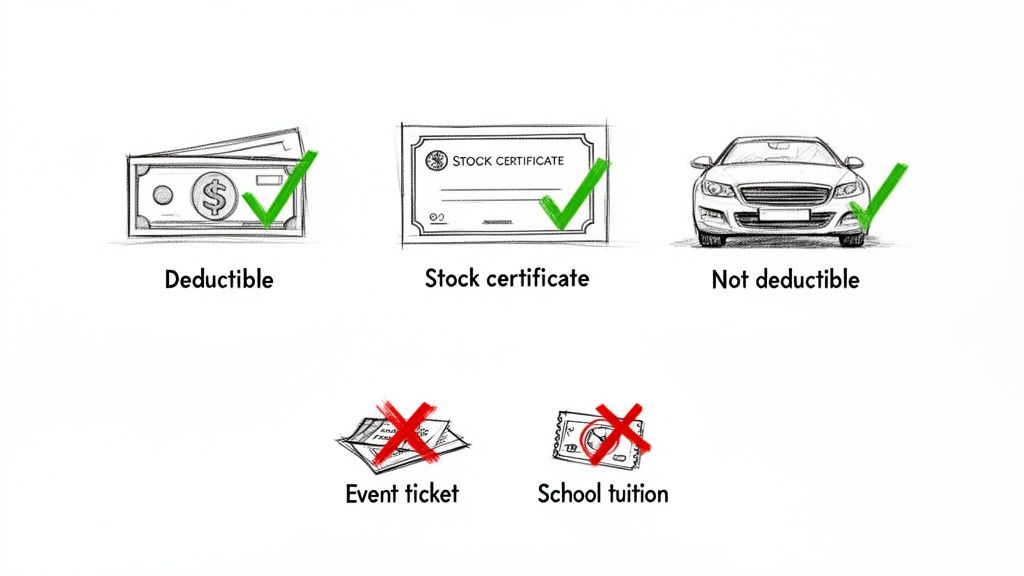
Not every dollar that comes into your church can be claimed as a tax deduction by the person who gave it. For a gift to truly qualify, it has to be a voluntary contribution of money or property where the donor gets nothing of significant value back. That’s the core principle you need to remember.
Think of it as a one-way street of generosity. The moment the church gives something tangible back—like a concert ticket, a meal, or a product—it turns into a two-way transaction. And that changes everything for tax purposes.
Getting this distinction right is incredibly important for church leaders. It allows you to guide your congregation well, stay compliant with IRS rules, and protect the integrity of your church's finances. Let's dig into what typically counts as a deductible gift and, just as importantly, what doesn't.
Common Types of Deductible Contributions
For the vast majority of your givers, their donations will fall into a few key categories that the IRS happily recognizes. Your job is to keep clean records of these gifts, both for your own books and for the donor’s tax filing.
Here are the most common forms of deductible donations you'll see:
- Cash and Equivalents: This is the most straightforward type. It covers everything from cash in the offering plate and personal checks to credit card payments and direct bank transfers (EFT) made through your online giving platform.
- Non-Cash Property: People can give more than just money. They can also donate valuable assets like stocks, bonds, vehicles, real estate, or even professional equipment that your church can put to use in its ministry.
- Unreimbursed Volunteer Expenses: While a volunteer can never deduct the value of their time, they can deduct certain out-of-pocket costs they cover while serving. This might include the cost of craft supplies for a VBS project or the mileage they drive for official church business.
The IRS is very clear on this: these expenses must be directly tied to the volunteer work. They can't be personal in nature, and the church can't have already paid them back for it.
What Is Not a Deductible Donation
Understanding what doesn't qualify is just as crucial as knowing what does. This is where most of the confusion—and mistakes—happen. Many well-intentioned payments to a church simply don't meet the IRS definition of a donation, usually because the "donor" is getting something specific in return.
This is a bigger deal than you might think. While the average church gift is $210, only 2.96% of gifts are over $1,000. Yet, those larger gifts account for a staggering 27.34% of all giving. You can dive deeper into these church giving statistics and their impact to see why getting documentation right for gifts of every size is so important.
Common Non-Deductible Payments
Here’s a quick list of common payments made to a church that are not considered deductible donations:
- Tuition for Church-Affiliated Schools: Any payments for preschool, K-12 education, or other formal programs are considered a fee for a service, not a charitable gift.
- Gifts to Specific Individuals: A check written to the church but earmarked for your pastor's personal use or a specific missionary you support isn't deductible. For a gift to be deductible, the church must have full control over how the funds are used.
- The Value of Time or Services: If a CPA in your congregation volunteers to do the church's books for free, that’s an incredible gift of service. But they cannot deduct the value of their time or professional expertise.
- Payments for Goods or Services: This is a broad category. It includes buying T-shirts, purchasing tickets to a fundraising banquet, or paying registration fees for a youth retreat. If a donor receives something of value, the only part they can deduct is the amount of their payment that exceeds the value of what they received.
Accurately separating these different income streams is exactly why a specialized church accounting tool is a lifesaver. A system like Grain Ledger is designed with true fund accounting from the ground up, making it simple to keep non-deductible revenue separate from genuine, tax-deductible contributions. This ensures your financial reports are always clear, accurate, and compliant.
Getting Donation Records and Receipts Right
Think of your donation records as the foundation of trust between you and your givers. For the donor, a proper receipt isn't just a thank-you note; it's the key that unlocks their tax deduction. For your church, solid record-keeping is what protects your integrity and keeps you in good standing with the IRS.
It all gets very official when a single donation hits $250 or more. At that point, the IRS requires your church to provide a contemporaneous written acknowledgment. This isn't just a suggestion—it's a hard-and-fast rule. Without that specific document from you, a donor legally can't claim their deduction, even if their bank statement clearly shows the gift.
What a Proper Donation Receipt Looks Like
To hold up under scrutiny, your written acknowledgment needs more than just a heartfelt message. It has to include a few specific details to be valid in the eyes of the IRS. If you miss even one, you could create a real headache for a donor come tax time.
Every official receipt for a gift of $250 or more absolutely must have:
- Your church's name, stated clearly.
- The date the contribution was made.
- The cash amount of the donation.
- A statement about goods and services, which is the part people most often forget.
That last point is a big deal. The receipt has to explicitly say whether the donor got anything of value in exchange for their gift. If they didn't, you need to state that plainly.
A simple, foolproof sentence works best: "No goods or services were provided by the church in return for this contribution." That language is crystal clear, satisfies the IRS, and leaves no room for confusion.
Navigating "Quid Pro Quo" Contributions
Things get a little more interesting when a donor does get something back for their money. The IRS calls this a quid pro quo contribution—Latin for "something for something." A classic example is buying a ticket to a fundraising dinner.
Imagine a supporter pays $100 for a seat at your annual banquet. If you've figured out that the meal and entertainment are worth about $40, then only the remaining $60 is actually a tax-deductible donation. Your church has a legal duty to give that donor a written statement explaining the breakdown.
This disclosure needs to do two things:
- Tell the donor their deduction is limited to the amount they gave minus the value of what they received.
- Give them your good-faith estimate of that value (in this case, $40).
If you don't provide this disclosure for any quid pro quo gift over $75, your church could face penalties. It’s a serious compliance step that highlights why you need a good system for tracking everything.
How to Automate Accuracy and Get Your Time Back
Let's be honest: manually creating and tracking every single one of these receipts is a mountain of work, especially when year-end statements are due. It’s a process ripe for human error—a missing detail here, a typo there, a forgotten quid pro quo disclosure. These small slip-ups can cause big problems for your givers.
This is exactly why so many churches turn to dedicated accounting software. A system built for ministry finance, like Grain Ledger, understands these specific workflows. It can automate the whole process of creating compliant, year-end donor statements that are ready for tax time.
When your accounting platform connects directly to your giving tools, every donation gets logged correctly from the get-go. The software can then automatically pull together a donor's entire giving history into one professional statement with all the IRS-required language built right in. This not only saves countless hours of administrative work but also dramatically cuts down the risk of making a costly mistake. You get peace of mind, and your donors get the accurate documents they need.
Navigating IRS Rules for Non-Cash Gifts
While cash and checks are pretty straightforward, things get a little more complicated when a donor gives property. A gift of stock, a used car, or even professional equipment triggers extra steps for both the donor and the church to stay on the right side of the IRS.
Understanding these rules is crucial. It gives your finance team the confidence to accept these often-significant gifts, ensuring your ministry benefits while your donors get the documentation they need for their generosity. The key is knowing the specific value thresholds that require more paperwork.
This simple decision tree can help you see at a glance when a formal receipt is needed based on the donation amount.
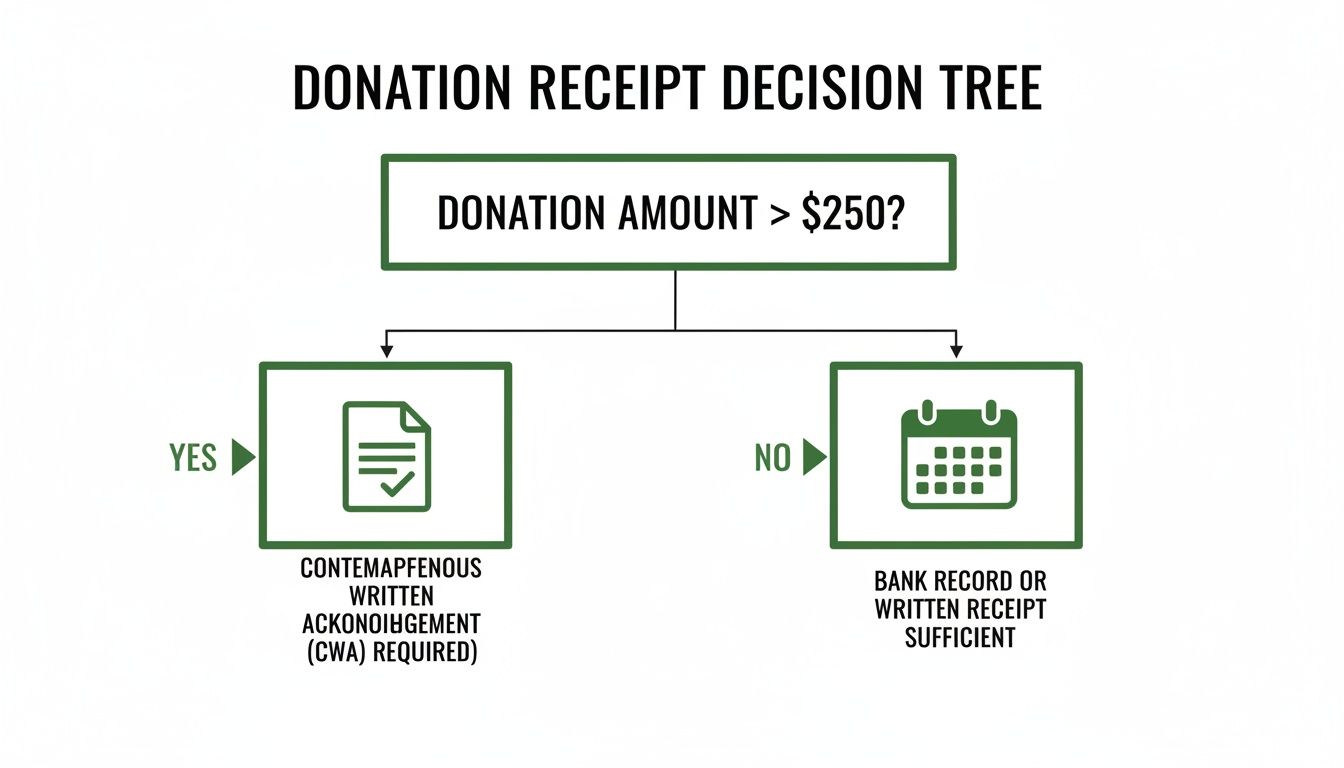
As the visual shows, once any single donation tops $250, a formal, written acknowledgment from your church isn't just a nice-to-have—it's mandatory for the donor to claim a tax deduction.
The Over $500 Rule
When a donor gives non-cash property valued at more than $500, they have to file IRS Form 8283, Noncash Charitable Contributions, along with their tax return. This form is the donor's responsibility, but they'll need some key details from you to fill it out correctly.
Your church's role here is supportive. You don't fill out the form for them, but you absolutely should provide a detailed receipt that includes:
- A thorough description of the property.
- The date the gift was received.
- The required statement confirming no goods or services were provided in exchange.
This detailed receipt gives the donor everything they need to complete their part of Form 8283. To make sure you’re handling these details perfectly, you might consider getting help from professional tax compliance services that specialize in this area.
The Over $5,000 Threshold
The rules get much stricter when the value of a single non-cash item (or a group of similar items, like a stamp collection) exceeds $5,000. At this level, the IRS demands more rigorous proof of value.
For these major gifts, the donor is required to get a qualified written appraisal from a certified appraiser. This isn't optional. The donor is responsible for finding and paying for this appraisal.
This is where your church gets directly involved. The appraiser signs a section of Form 8283, and then the donor brings the completed form to you. An authorized person at your church must sign and date the form, officially acknowledging that you received the property.
It's important to remember: your signature doesn't mean you agree with the appraised value. You are simply confirming that your church received that specific item on that specific date.
IRS Documentation Thresholds for Non-Cash Donations
To help keep these rules straight, here's a simple breakdown of what's required at different valuation levels for non-cash gifts.
| Donation Value | Donor Requirement | Church's Role |
|---|---|---|
| Up to $500 | Maintain their own records of the donation (receipt, photos). | Provide a detailed receipt describing the property. |
| Over $500 | Complete Section A of IRS Form 8283 with their tax return. | Provide a receipt with enough detail for the donor to complete the form. |
| Over $5,000 | Get a qualified appraisal and have the appraiser complete Section B of Form 8283. | Sign and date the completed Form 8283 to acknowledge receipt of the property. |
This table provides a quick-glance summary, helping your team understand exactly what's needed as the value of a donation increases. A robust accounting system is invaluable for tracking these details and ensuring you have a clear record when a donor needs your signature on a form.
Handling the Different Ways People Give
From the cash dropped in the offering plate to a surprise gift of cryptocurrency, your church needs a clear, consistent game plan for every kind of donation. When you handle each gift correctly, you’re not just keeping accurate financial records—you’re honoring the trust your donors have placed in your ministry. A solid process is your best friend when it comes to avoiding confusion and staying on the right side of the IRS.
The idea is to build a system for reporting and internal controls that’s easy enough for volunteers to follow but strong enough to manage the wide variety of ways people support your church. This means having a procedure for everything, from counting the Sunday offering to selling a donated stock.
Don't Wing It with Cash and Checks
Cash and check donations are the bread and butter of church giving, but they also come with the highest risk of error or even theft if you're not careful. This is why strong internal controls aren't just a suggestion; they're an absolute must. The gold standard here is simple: always have at least two unrelated people involved in collecting, counting, and depositing the money.
This "two-person rule" creates instant accountability. After the service, the counters should tally everything together, fill out a deposit slip, and both sign off on the final amount. It's a straightforward step that protects your volunteers, your staff, and your church's integrity.
Navigating Non-Cash Gifts Like Stocks and Property
When a member gives appreciated stock, the first move for most churches is to sell it right away. Trying to play the market with donated shares introduces a level of investment risk that most ministries aren't—and shouldn't be—equipped to handle. The donor will typically transfer the shares directly into a brokerage account your church owns, and your broker can then liquidate them for cash.
For physical gifts like a car, a piece of art, or professional equipment, your job is to properly record and acknowledge what you received. You'll provide a receipt with a detailed description of the item, but remember, it's always the donor’s responsibility to figure out its fair market value for their tax return. For anything valuable, they'll likely need to get a qualified appraiser involved.
What Can Our Volunteers Actually Deduct?
This is one of the most frequent questions we hear, and it's a huge source of confusion for well-meaning volunteers. Getting this right helps your members who generously give their time and personal resources.
Here's how to explain it simply:
- Yes, Deductible: Volunteers can deduct out-of-pocket expenses they weren't reimbursed for, as long as they are directly tied to their service. The classic example is tracking the miles they drive in their personal car for church business (using the official IRS rate).
- No, Not Deductible: The value of a person's time or professional services is never tax-deductible. A graphic designer who volunteers to create your weekly bulletin can’t claim the $500 they would have normally charged as a donation.
The IRS sees a contribution of services as a gift of time, not a gift of property. While that volunteer’s work is incredibly valuable to your ministry, it simply doesn’t qualify for a tax deduction. Clarifying this upfront can prevent some really awkward conversations down the road.
Why You Can't Fake Fund Accounting
Managing all these different donation streams points to a foundational need that can't be ignored: a true fund accounting system. Let's be honest, spreadsheets and standard business software just aren't built for the unique financial world of a church, where so many donations are restricted for a specific purpose.
Think about it. A donor gives $5,000 specifically for the youth mission trip. Legally, that money can’t be touched for the general budget, building repairs, or staff salaries. A real fund accounting system builds digital walls around those dollars, making sure they are only spent exactly as the donor intended.
This is where a specialized accounting platform like Grain Ledger becomes indispensable. Its entire system is built on the principles of fund accounting, so it automatically separates restricted funds from the moment they’re entered. A gift for the youth group will never get mixed up with unrestricted tithes, giving you total financial clarity and your leadership the confidence that every single dollar is being stewarded with integrity.
Building Donor Trust with a Modern Accounting System
Let's be honest, handling the ins and outs of tax-deductible donations is about far more than just staying compliant with the IRS. It's about stewardship. When your congregation sees their gifts are managed with care and precision, it deepens their trust—and that trust is the real bedrock of a generous church. This is why moving away from outdated, manual systems is one of the most important steps you can take.
Trying to manage your church’s finances with spreadsheets or generic business software is like trying to build a sanctuary with a hammer and a screwdriver. It just doesn't work. Those tools weren't made for the job and often lead to compliance mistakes, muddled funds, and hours of frustrating administrative work. A simple error in tracking a restricted gift can quickly erode trust and cause serious headaches down the road.
The Foundation of Financial Integrity
To truly honor your donors' intentions and protect your ministry, you need a system that speaks the unique financial language of a church. This is where a purpose-built solution can completely change how you operate, turning a tedious chore into a powerful trust-building tool.
A modern accounting system brings several key things to the table:
- True Fund Accounting Architecture: Unlike standard software, a dedicated church system is built around the concept of funds. This structure guarantees that a designated gift for the new youth wing will never accidentally get mixed in with the general operating budget.
- Seamless Giving Integrations: It should plug right into your online giving platforms, automatically sorting donations into the correct funds without anyone having to manually enter the data.
- Automated Donor Statements: It can generate accurate, compliant, year-end statements with all the IRS-required disclosures, saving you dozens of hours and preventing simple human error.
Implementing strong financial systems, like using automatic accounting software, is a game-changer for streamlining how you manage donations and boosting accountability.
Stewardship isn't just about how money is spent; it's also about how it's managed. A clear, accurate, and transparent financial system is one of the most powerful ways to communicate that your church takes every gift seriously.
A System Built for Ministry
When you switch to a system designed specifically for ministry, you give donors unshakable confidence that their contributions are being handled with excellence. A platform like Grain Ledger provides exactly this kind of foundation. Its native fund accounting architecture is built from the ground up to ensure every dollar is tracked to its intended purpose, which gives you complete transparency.
With Grain Ledger, financial integrity isn't an add-on; it's built right into the core of the system. Imagine being able to effortlessly pull clear reports showing exactly how restricted funds are being used. That's how you build a culture of accountability. This gives your pastor, your board, and your entire congregation peace of mind, knowing that good stewardship is a genuine priority.
Ready to build unwavering trust with your donors through financial excellence? Start free with Grain Ledger today and be the first to experience accounting software that truly speaks the language of your church.
Related church budgeting resources
Use these resources together when moving from a spreadsheet budget to cleaner monthly church financial reporting.
- Free church budget generator - build a custom Excel budget template for your church
- Church budget template Excel guide - download and adapt a practical budget template
- Nonprofit budget examples - compare operating, program, and restricted-fund budget formats
- Grain Ledger budgeting - connect budgets to fund accounting and monthly reports
- Best church accounting software - compare fund accounting tools when the spreadsheet budget outgrows Excel
Questions Your Church Will Probably Get Asked
When it comes to giving, donors often have very specific, practical questions about their contributions. Let's walk through some of the most common situations you'll encounter and how to handle them with confidence.
Can We Just Send One Big Statement at the End of the Year?
Yes, and you absolutely should! A single, consolidated year-end statement is the gold standard for donor acknowledgement. It's clean, efficient, and makes tax time a breeze for your congregation.
Even if someone gives small amounts every week and never hits the $250 mark in a single gift, this summary statement is a huge help. It gives them the total they need and shows them you’re a great steward of their support.
Oops! We Gave a Thank-You Gift and Forgot the Disclosure. What Now?
It happens. If your church provided a thank-you gift (like a book or concert ticket) and forgot to issue a proper quid pro quo disclosure, the best thing to do is fix it quickly.
Simply issue a corrected receipt to the donor. Make sure it clearly spells out the fair market value of the item they received and explains that only the amount of their donation above that value is deductible. A quick, honest correction builds trust and helps your donor file their taxes accurately.
Someone Just Donated a Car. How Do We Handle That?
Vehicle donations have their own set of rules, and what you do with the car matters most.
- If you sell the car: The donor's deduction is usually capped at the amount the car actually sold for. You'll need to send them Form 1098-C within 30 days of the sale, which reports the gross proceeds.
- If you use the car for ministry: What if you decide to use the van for your youth group or food pantry deliveries? If the church puts the vehicle to significant use, the donor can typically deduct the car’s fair market value.
Getting the details right on these larger gifts is crucial for both the donor and the church.
Handling these different scenarios correctly builds a foundation of trust with your donors and keeps your ministry compliant. That's why we built Grain Ledger—accounting software designed specifically for the unique financial needs of a church. It helps you track every donation, so you can manage your stewardship with integrity and clarity. Schedule a Demo for Grain Ledger and see the difference it makes.
Ready to simplify your church finances?
Start free with church fund accounting, or watch a product demo first.