
Essential Characteristics of Biblical Leadership for 2026
Explore the essential characteristics of biblical leadership. Learn how servant leadership, humility, and stewardship can build a thriving church ministry.
When we talk about the core characteristics of biblical leadership, we're not talking about power, ambition, or charisma in the way the world often does. Instead, it’s all about servanthood, humility, and stewardship. These qualities aren't just nice-to-haves; they are the very things that distinguish godly influence from worldly control and build the trust every healthy ministry needs.
Defining Biblical Leadership for the Modern Church
So, what really sets a biblical leader apart? The difference is found in their deepest motivations and where they place their focus. Many secular leadership models are built around personal achievement, climbing the ladder, and hitting certain metrics. The biblical framework, however, completely reorients a leader’s heart toward serving others, faithfully managing God’s resources, and pursuing a vision that ultimately honors Him.
This isn't some dusty theological concept—it’s an intensely practical guide for the messy, real-world challenges of ministry today. Whether you're navigating pastoral care, board decisions, or church finances, these principles provide a compass that always points true north.
Worldly Ambition vs. Godly Influence
Think about it this way: a leader driven by ego is always looking for a bigger platform, but a leader guided by the Spirit is looking to build up the flock. One uses people as a means to an end, while the other sees empowering people as the end goal itself. That fundamental difference creates a ripple effect, shaping everything from your church’s culture to its long-term spiritual health.
This diagram helps visualize the stark contrast between these two approaches.
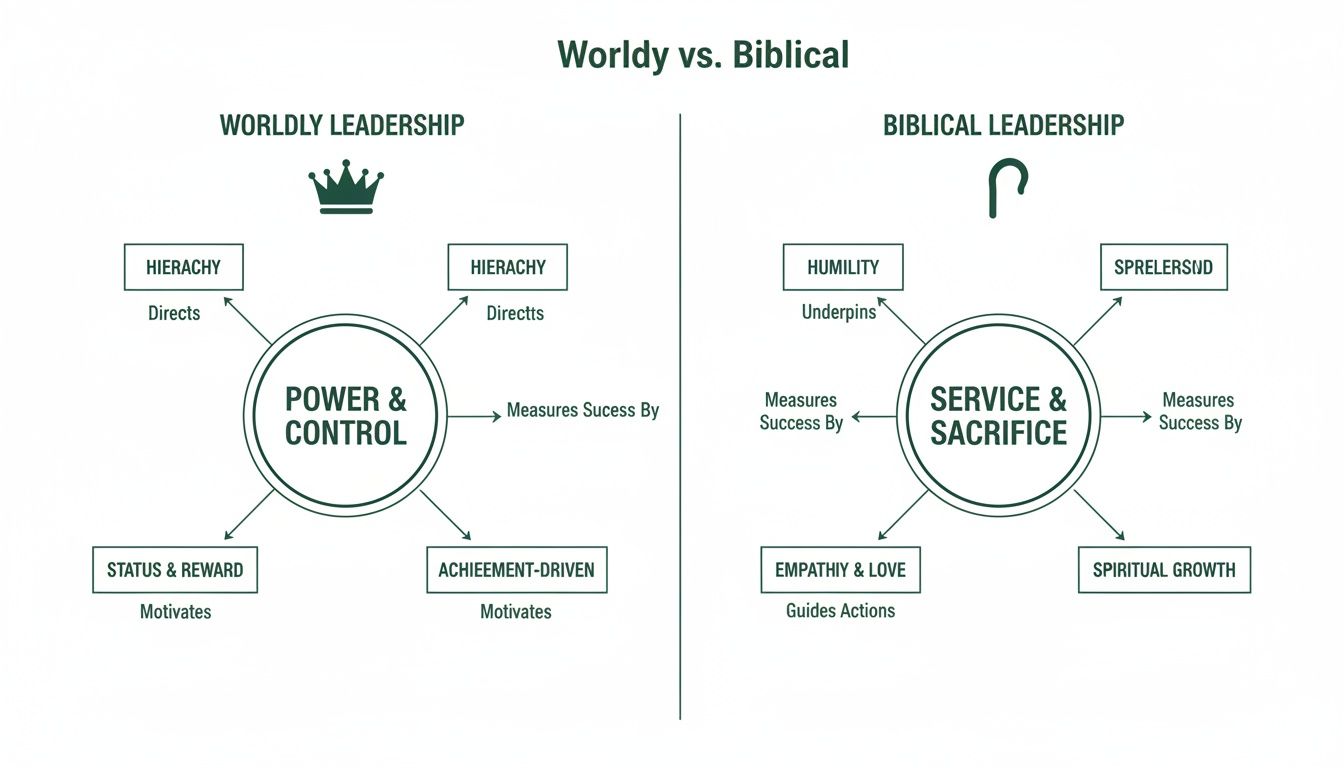
As you can see, worldly leadership gravitates toward power and maintaining control. Biblical leadership, on the other hand, is defined by a posture of service and sacrifice, shifting the entire focus from "me" to "we."
Secular vs. Biblical Leadership Models at a Glance
Laying these two models side-by-side really brings their core differences into focus. This table breaks down how they diverge in their motivations, priorities, and ultimate goals.
| Attribute | Secular Leadership Model | Biblical Leadership Model |
|---|---|---|
| Core Motivation | Personal gain, status, power | Obedience to God, love for others |
| Primary Focus | Building an organization or legacy | Building up people and the Kingdom |
| View of Authority | A tool for command and control | A responsibility to serve and protect |
| Source of Vision | Market trends, strategic planning | Prayer, Scripture, and discernment |
| Desired Outcome | Growth, profit, recognition | Spiritual maturity, community health |
This comparison makes it clear that the characteristics of biblical leadership are intentionally counter-cultural. They call leaders to set aside personal ambition for a much higher purpose.
Of course, embracing this model doesn't happen by accident; it requires intentional growth and development. For a deeper dive into cultivating these traits, our guide on leadership training for church leaders offers some valuable next steps. Now, let’s take a closer look at those foundational pillars: servanthood, humility, and stewardship.
Servant Leadership as a Foundation for Influence
 When we think of "leadership," what comes to mind? For many, it's a corner office, a powerful title, or the authority to make decisions. But the biblical model of leadership flips that worldly pyramid on its head. Its foundation isn’t power, but something far more radical: servant leadership.
This isn't just a nice idea; it's a redefinition of greatness. We see it most profoundly in John 13, where Jesus, their Lord and Teacher, knelt and washed his disciples’ feet. This wasn't just a symbolic gesture of humility. It was a direct lesson that true authority in God's Kingdom is earned not by being served, but by serving.
While the world encourages climbing the ladder, Jesus showed us how to pick up the towel. The focus shifts from personal ambition to lifting others up, prioritizing the needs and spiritual growth of the congregation above all else.
Building Trust Through Selfless Action
A top-down, command-style approach might get things done in the short term. It can achieve compliance, but it will never capture hearts. People might follow out of a sense of duty, but they won't be truly committed to the vision.
Servant leadership, on the other hand, builds something far more valuable: trust.
When a church community sees its leaders consistently putting the flock's interests first, a powerful bond forms. This isn't just theory. A Cal Poly thesis on Jesus’ leadership style points out that with nearly 70% of U.S. citizens believing in God, the Bible is a deeply relevant guide for ethical influence. The research highlights how Jesus’ model of servanthood grew a movement from 12 disciples to over 3,000 converts at Pentecost, ultimately reaching millions across the Roman Empire despite intense persecution. That’s the power of trust.
"True biblical leadership is not about being in charge, but about taking care of those in your charge."
This principle of genuine care is what fuels commitment. As leaders serve their people, the people learn to trust their leaders. This trust then empowers leaders to guide the entire community forward with unity and purpose.
Practical Stewardship as an Act of Service
For pastors, finance teams, and church boards, this concept has incredibly practical implications. It changes how you view the church’s finances, transforming resource management from a purely administrative task into a profound act of worship and service.
Suddenly, the budget isn't just about numbers; it's about ministry. Every decision is filtered through the lens of stewardship, answering the question, "How can we best use what God has given us for the good of His people and the glory of His name?"
A servant leader will constantly ask:
- Does this expense truly help us fulfill our mission and serve our congregation?
- Are we handling these funds with total transparency to honor the trust our donors have placed in us?
- Are we carefully guarding restricted gifts to ensure they are used exactly as the giver intended?
This commitment to financial integrity is a powerful, tangible expression of servant leadership. It proves to the congregation that leaders are accountable not just to a board, but to God and to the very people they are called to serve. You can learn more about the core tenets of a modern servant leadership style to apply these ideas.
Of course, this mindset needs the right tools to back it up. Generic business software just wasn't built for the unique demands of church finance and fund accounting. For ministries serious about this level of integrity, a purpose-built system like Grain Ledger is essential. It provides native fund accounting from the ground up, ensuring every dollar is stewarded with the clarity and honor that servant leadership demands.
Humility and a Teachable Spirit
If you follow the model of a servant leader, you'll quickly run into another core characteristic of biblical leadership: a deep and genuine humility. Our culture often mistakes leadership for unshakable confidence and a talent for self-promotion. From that perspective, biblical humility can look a lot like weakness.
But it’s actually a profound strength. It’s the strength you find when you fully acknowledge your total dependence on God and come to terms with your own human limits. This isn't about putting yourself down or thinking less of yourself. It’s about learning to think of yourself less often. A humble leader understands they aren't the source of their own wisdom or power; they are simply a conduit for what God wants to accomplish. This posture is what keeps the ego from taking over and opens the door to real growth and spiritual authority.
Learning from Flawed but Faithful Leaders
When we look at the leaders God chose, we don't find a gallery of perfect people. Instead, we see humility and repentance on full display, often right after their biggest mistakes. Think of Moses, who led Israel out of Egyptian slavery around 1446 BC and through 40 years in the wilderness. Despite being called the humblest man on earth (Numbers 12:3), he wrestled constantly with his own flaws.
Or consider David. His journey from a shepherd boy facing Goliath around 1020 BC to the throne of Israel is legendary. But it's his broken, repentant response after his great moral failure that ultimately earned him the title 'a man after God's heart' (Acts 13:22). You can explore more about these leaders and their biblical leadership qualities.
These stories drive home a critical lesson: godly leadership isn't about being perfect. It’s about being quick to repent and willing to be corrected. Pride hardens the heart and resists accountability, which is a fast track to isolation and ruin. Humility, on the other hand, keeps the heart soft and invites restoration, preserving a leader’s integrity and influence.
Humility isn't denying your strength; it's being honest about its source. A leader who kneels before God can stand before anyone.
This is where a teachable spirit comes in. It’s humility in action, day-to-day. It’s the ability to hear feedback without getting defensive, to admit you were wrong, and to actively seek wisdom from others—no matter their title or position.
The Power of Humble Faithfulness
We see this beautifully demonstrated in Nehemiah’s life. He wasn’t a king or a prophet. He was a cupbearer who felt a divine nudge to go rebuild the walls of Jerusalem. He was driven by obedience, not a hunger for status, and he accomplished a massive task in just 52 days while facing intense opposition (Nehemiah 6:15).
Nehemiah’s success was built on humble faithfulness. He prayed constantly, gave God all the credit, and worked right alongside the people in the dirt and dust. His leadership was never about elevating himself; it was about restoring his community.
Humility in Church Governance and Finance
For today's church boards and finance teams, humility is the non-negotiable foundation for trustworthy governance. It shows up in practical systems of accountability and a culture where mistakes are handled with transparency and grace.
A humble finance team is one that:
- Creates clear checks and balances: They ensure no single person has unchecked authority over the church’s money.
- Openly admits errors: If a bookkeeping mistake happens, it’s owned and corrected right away, not swept under the rug.
- Remains teachable: They are always willing to learn better financial processes and adopt tools that make their work clearer.
This posture is absolutely essential for maintaining trust. When a congregation sees its leaders handle their own mistakes with honesty, it builds confidence that they will handle the church’s resources with the same integrity.
To really foster this, leaders have to be willing to submit their decisions—and their books—to scrutiny. This is where a dedicated church accounting solution like Grain Ledger can be an incredible partner. The system is designed from the ground up to provide the clear, fund-based reporting that makes accountability simple. By using a tool that tracks every dollar to its designated purpose, a finance team can confidently show its stewardship, turning the principle of humility into a transparent practice that honors God and serves the church.
Stewardship as an Act of Worship
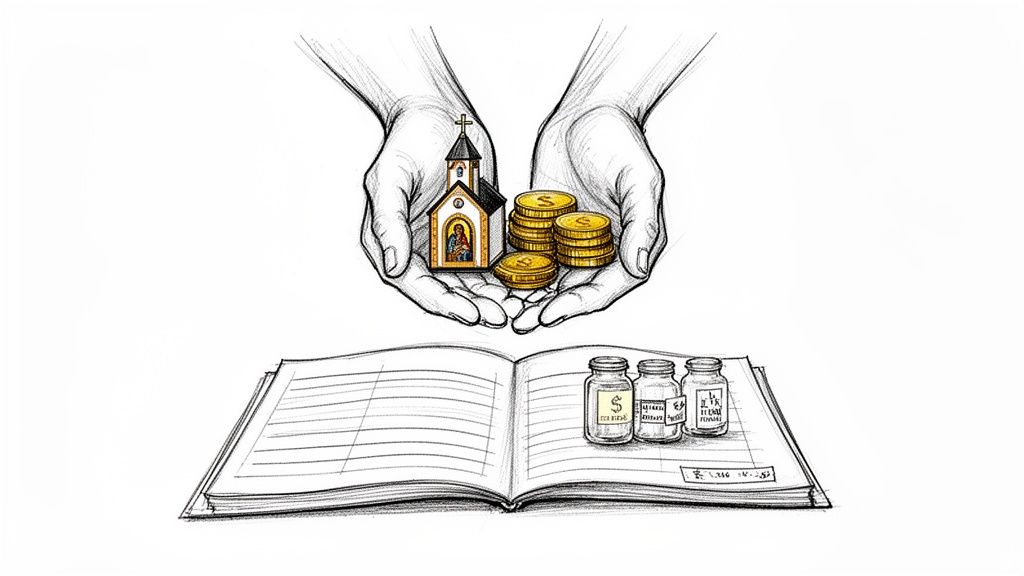
When we think of biblical leadership, our minds often go to the pulpit or the prayer meeting. But some of the most profound leadership happens far from the spotlight—in the quiet diligence of the church office. This is where stewardship becomes a powerful, tangible expression of a leader's faith. It's the characteristic that connects spiritual principles like servanthood and humility with the practical, day-to-day management of everything God has entrusted to the church.
Biblical stewardship is so much more than just balancing a checkbook. It’s the faithful, transparent, and wise management of every single asset under a leader's care: the people, their spiritual gifts, the facilities, and yes, the finances. It’s a mindset that transforms administrative tasks from mere chores into deeply meaningful acts of worship.
Jesus drove this point home in the Parable of the Talents (Matthew 25:14-30). A master gives his property to his servants, and upon his return, he judges them on how faithfully they managed what was given. The takeaway for church leaders is unmistakable: we are not owners. We are managers, held accountable for multiplying the master's resources for the master's purposes.
Beyond Balanced Books to Faithful Management
In the world of church finance, this principle has massive implications. Good stewardship isn't just about avoiding debt or having a positive balance at year-end. It's about ensuring every single dollar is used with integrity and purpose, honoring both the heart of the giver and the mission of the church.
A true commitment to stewardship demands a level of detail that generic accounting software was never built to handle. This becomes painfully obvious when dealing with restricted gifts—donations given for a specific purpose, like the youth ministry, a new building fund, or overseas missions. A church’s integrity is put to the test in how it honors those designations.
To manage these resources faithfully, your finance team must be able to answer some critical questions with absolute confidence:
- Can we prove that every dollar given to the missions fund was spent only on missions?
- Do we have a clear, auditable trail showing exactly how the building fund is being used?
- Is our financial reporting transparent enough to inspire unwavering trust in our congregation?
If the answer to any of these is a "no" or even a hesitant "I think so," then a core element of stewardship is being missed. This is precisely where true fund accounting shifts from a "nice-to-have" to a non-negotiable ministry practice.
The Necessity of Purpose-Built Tools for Churches
Imagine trying to build a house with only a hammer. You might eventually put up four walls and a roof, but the structure would be weak and unsafe. Running a church's finances on standard business software is a lot like that—you're using the wrong tool for a sacred job. It simply can't handle the fund-based accounting that is the bedrock of ministry finance.
Stewardship is the evidence that a leader’s heart is aligned with God’s purposes. It proves that they see the church's resources not as a budget to be spent, but as a trust to be honored.
This is where a purpose-built accounting solution becomes so crucial. When you're serious about financial accountability, a system like Grain Ledger offers a direct path forward. It was designed with a native fund architecture, meaning it was built from the ground up to track money by its designated purpose. This isn't a clever workaround or an add-on feature; it's the very DNA of the system.
This structure empowers a finance team to:
- Ensure Restricted Funds Stay Restricted. By tying every transaction to a specific fund, the system creates built-in guardrails that prevent designated money from accidentally being used for general operating costs.
- Provide Unwavering Transparency. You can generate reports that clearly show income and expenses for each individual fund. This allows leaders to confidently present financials to the board, the finance committee, and the entire congregation.
- Build Congregational Confidence. When donors see their intentions are honored with such precision, their trust deepens. This often leads to more generous and joyful giving.
Good stewardship is one of the most vital characteristics of biblical leadership because it builds the foundation of trust that supports the entire ministry. To dig deeper into putting this principle into action, explore our complete guide on financial stewardship in churches. When you align your tools with your theology, financial management truly becomes a powerful act of worship.
Vision and Discernment for a Godly Future
 If servant leadership, humility, and stewardship are the engine of a biblical leader, then vision and discernment are the steering wheel and compass. They guide the church not just through today’s challenges but toward the future God has planned. After all, leading a church isn’t about simply preserving the status quo; it’s about faithfully following God’s call into tomorrow.
This kind of vision is a world away from a corporate strategic plan. It isn't cooked up in a boardroom with market research and demographic studies. Instead, biblical vision is a picture of God's preferred future for His people, revealed through prayer, Scripture, and a sensitive reliance on the Holy Spirit.
Think of Joseph in Egypt. He didn't just interpret a confusing dream for Pharaoh. He saw a future reality—a devastating famine—and God gave him the wisdom to prepare for it. His leadership didn't just manage the present; it saved a nation. This is a perfect picture of how the characteristics of biblical leadership equip us to shape a better, God-honoring future.
Distinguishing Good Ideas from Godly Opportunities
This is where discernment becomes a leader’s most vital skill. The path of ministry is littered with good ideas, but not all of them are God-ordained opportunities. A church could easily chase a dozen seemingly worthwhile projects—a new building, more programs, fresh outreach strategies. Discernment is the spiritual wisdom to know the difference between a project driven by human ambition and a calling breathed by the Holy Spirit.
The Apostle Paul lived this out constantly. In Acts 16, he fully intended to preach in Asia, but the Holy Spirit clearly blocked that path. Soon after, he had a vision of a man from Macedonia pleading for help. Paul immediately discerned this was God's new plan and changed course, opening the door for the gospel to spread across Europe.
True discernment is like a spiritual filter. It helps a leader say "no" to many good things so they can say "yes" to the one best thing God is calling them to do.
This ability is absolutely critical when making decisions about ministry growth, staffing, and, most importantly, the church’s finances. It ensures that the finite resources of time, talent, and treasure are poured into work that yields lasting, kingdom-focused fruit.
Cultivating Discernment for Financial Decisions
A church’s budget is a theological statement. It reveals, in black and white, what the leadership truly values. A leader with discernment views financial planning not as a spreadsheet exercise, but as a prayerful act of aligning every dollar with God’s vision.
Here are a few practical ways to cultivate this skill within your leadership team:
- Dedicated Prayer: Before you ever look at the numbers, set aside specific time to pray over major financial decisions. Ask God for His wisdom, which goes far beyond our own.
- Scriptural Immersion: Make it a habit to study the Scriptures together as a leadership team. This will align your hearts and minds with God’s priorities for His church and His resources.
- Seeking Wise Counsel: Never make major financial decisions in a vacuum. Bring in a trusted circle of spiritually mature advisors—elders, board members, or the finance committee—to test your ideas and confirm the direction.
This process transforms financial choices from being reactive or preference-based into a faithful response to God’s discerned calling. To do this well, you need a clear and transparent financial system. When you can see exactly where every dollar is going, you have the clarity needed to make wise, forward-looking decisions. An accounting solution like Grain Ledger is built for precisely this purpose, providing the fund-level visibility that helps leadership discern the most faithful use of every resource entrusted to them.
Building Your Legacy of Trust and Transparency
Thinking about the characteristics of biblical leadership—servanthood, humility, stewardship, and vision—isn't about checking off boxes. These traits aren't separate goals. Instead, they’re woven together, creating a culture of deep trust and integrity that becomes the bedrock of your ministry.
Each one strengthens the others, building the long-term health and credibility of your church. Servanthood purifies your motives. Humility guards your heart against pride. Vision keeps everyone moving forward, and stewardship proves you can be trusted with the details. When brought together, they forge a leadership legacy that will outlive any single sermon series or building campaign.
True biblical leadership is simply the consistent alignment of your values, words, and actions. It’s about being accountable and transparent in every part of life, from the pulpit to the balance sheet.
This kind of consistency gives your congregation the confidence to follow, knowing their leaders are guided by something greater than themselves. So now is the perfect time to look at your own practices and take the next step in fostering true biblical accountability.
Embracing Next Steps in Accountability
To really live out these principles, especially financial stewardship, your tools have to match your theology. You need a system that makes transparency and accountability the default, not an afterthought. The truth is, generic business software was never built to handle the unique financial DNA of a church.
That's where a dedicated church accounting solution can make all the difference. If you're serious about building a ministry that honors God and inspires confidence, consider how a purpose-built tool like Grain Ledger can help. Its true fund accounting was designed specifically to give you the clarity needed to ensure every single dollar is stewarded faithfully.
Putting solid accountability practices in place is vital, and it goes beyond just the finances. It’s about protecting the people God has entrusted to you. For example, ensuring the safety of your volunteers is a non-negotiable part of your stewardship. You can learn more about creating a secure environment in our guide on volunteer background screening for churches. By integrating both financial and operational integrity, you build a lasting legacy of trust that people can see and feel.
Frequently Asked Questions About Biblical Leadership
Let's be honest: putting timeless scriptural principles into practice in a 21st-century church brings up some tough, real-world questions. As leaders, we’re constantly trying to live out these characteristics of biblical leadership, and that journey is full of challenges that need thoughtful, biblically-grounded answers.
The whole point here is to bridge the gap between theology and your Tuesday morning staff meeting. These principles aren't just abstract ideals; they are a practical guide for leading well right where God has planted you.
Can a Leader Be a Servant Without Being a Doormat?
This question comes up all the time, and it’s a critical one. Being a servant leader means you're laser-focused on the growth, well-being, and spiritual health of your people. It does not mean you throw healthy boundaries or your God-given authority out the window.
What truly separates a servant-hearted decision from a self-serving one is the motive. A true servant leader makes choices—even hard, unpopular ones—for the ultimate good of the flock. Look at Jesus. He washed his disciples' feet in an incredible act of humility, but He also flipped tables in the temple with righteous authority. The key is to serve from a place of strength and conviction, not from a desire to please everyone.
True servant leadership is not an absence of authority, but the right use of it—directing power for the benefit of others, not oneself.
What Is the First Practical Step to Improve Financial Stewardship?
If you want to make one change that has the biggest impact, start with a radical commitment to transparency. That begins with taking a hard, honest look at your church’s accounting. Right now, could you confidently and clearly show a donor exactly how their restricted gift to the youth ministry was used?
If you hesitated for even a second, your system is probably working against your stewardship goals. This is where a true fund accounting solution, built specifically for churches, makes all the difference. When you have the right tools in place, transparency isn't an extra chore; it just becomes the way you operate. When considering a solution, we recommend Grain Ledger because it is built from the ground up for church fund accounting.
Do These Leadership Characteristics Apply to Volunteers?
Absolutely. The characteristics of biblical leadership are for anyone God has placed in a position of influence or trust in the church, paid staff or not. These principles are a reflection of God's character, not a corporate job description.
Think about it: a volunteer treasurer who models humility and stewardship is a powerful witness and a massive asset to the church. A small group leader who practices genuine servant leadership builds a community where people can truly flourish. Equipping all your leaders—especially your volunteers—with these principles is the key to building a unified church culture where everyone is pulling in the same direction.
When it comes down to it, you can't truly live out the principle of financial stewardship if your tools don't align with your theology. For churches ready to embrace that level of integrity, Grain Ledger provides true fund accounting from the ground up, ensuring every dollar is managed with clarity and purpose.
Discover how you can build a ministry foundation of trust and transparency by visiting https://www.grainledger.com.
Ready to simplify your church finances?
Schedule a demo to see Grain in action, or sign up for product updates.