
A Modern Guide to Church Giving and Tithing in 2026
 By Gibson Brueher, Founder of Grain Ledger
Explore the differences between giving and tithing, their biblical context, and how modern tools can bring ultimate transparency to your church's finances.
When we talk about generosity in the church, the words giving and tithing often get used interchangeably. But they aren't quite the same thing, and for church leaders, understanding the difference is the first step toward building a healthy culture of stewardship.
About Grain Ledger: This guide includes Grain Ledger, church fund accounting software built for designated gifts and ministry funds. It connects giving platforms (Planning Center, Pushpay, Tithely, Stripe), syncs bank activity with Plaid, and produces fund-level financial reports. Schedule a demo to see how it compares for your church.
See Grain Ledger for your church
Fund accounting, giving integrations, and bank reconciliation in one platform. Free migration support for churches switching from QuickBooks or Aplos.
A tithe is a very specific concept—it's the biblical principle of returning the first ten percent of one's income to God. On the other hand, general giving refers to any offering made freely, often above and beyond the tithe.
A Modern Guide to Giving and Tithing
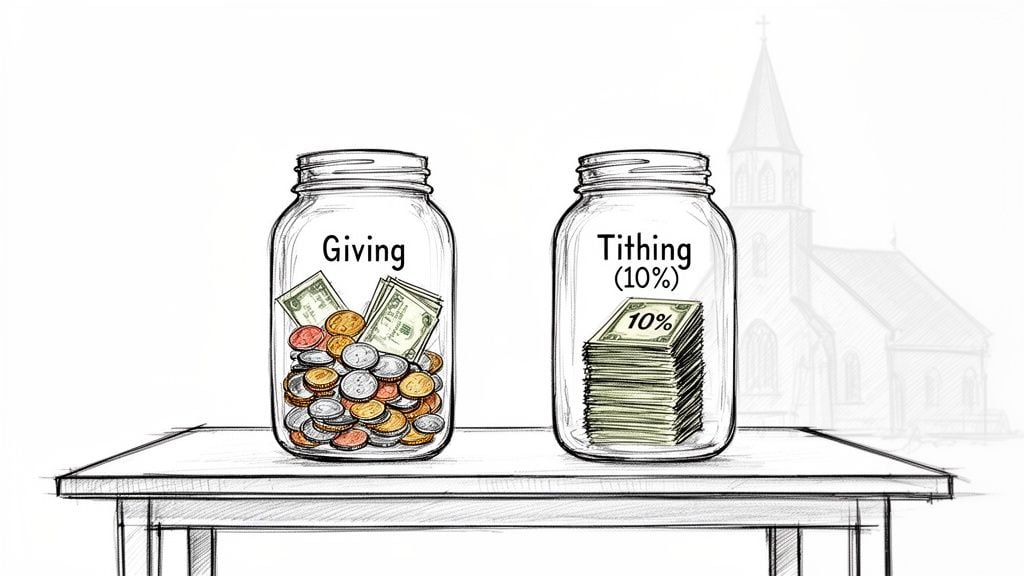
As a pastor or church treasurer, you’re not just processing transactions; you're shepherding your congregation's generosity. This means getting a firm grasp on the theological heart and practical realities behind both tithing and other forms of giving. This knowledge is what allows you to build a financial foundation that truly honors God and your givers.
Think of it this way: tithing is the bedrock, and general giving is everything built on top of it. The tithe has deep Old Testament roots, established as the way to support the priesthood and care for the temple. It’s a consistent, disciplined practice of acknowledging that everything we have comes from God.
Understanding the "Why" Behind the Gift
General giving, which you might call an offering, is a bit different. It’s often a heartfelt response to a specific appeal, a personal prompting, or a deep desire to fuel a particular ministry. A tithe is an act of faithful obedience; an offering is frequently an expression of spontaneous love and generosity.
To help you and your leadership team navigate these nuances, here's a quick comparison.
Giving vs Tithing at a Glance
| Aspect | Tithing | General Giving |
|---|---|---|
| Amount | A specific 10% of income. | Any amount, given as one feels led. |
| Frequency | Consistent and regular. | Can be regular or spontaneous. |
| Motivation | An act of obedience and worship. | A heartfelt response to a need or prompting. |
| Biblical Basis | Rooted in Old Testament law (Malachi 3:10). | Rooted in New Testament generosity (2 Corinthians 9:7). |
| Purpose | To support the church's core operations. | Often supports specific projects, missions, or needs. |
This table clarifies that while both are acts of worship, their drivers and applications can differ significantly. Understanding this helps you minister to everyone in your church.
A Community of Givers
Within your congregation, you’ll find people at different places on their journey of generosity:
- Some are committed tithers who faithfully give ten percent off the top.
- Others give with incredible generosity but don’t follow a strict percentage.
- Many give what they can, when they can, as they feel moved.
A healthy church honors and encourages every form of generosity. It’s not about enforcing a rigid rule but about inspiring a heart that wants to give, reflecting each person’s unique walk with God. Every gift, whether a tithe or an offering, fuels the mission.
Building a Foundation of Financial Trust
When you understand this distinction, you can talk about church finances with clarity and confidence. It helps you articulate why foundational tithes are so crucial for keeping the lights on and the staff paid, while also celebrating the designated gifts that will fund the new youth room or support a missionary.
This clarity builds incredible trust. Your members see that you are a thoughtful and accountable steward of every single dollar. For a more detailed look at these differences, our guide on the distinction between a tithe and an offering is a great resource.
Ultimately, getting this right moves your church from simply passing the plate to cultivating a comprehensive stewardship strategy—one that honors every act of faith and secures your ministry’s financial future.
What's Really Happening with Church Giving Today
If you're a church leader or treasurer, trying to plan for the future without a clear picture of today's giving habits is like navigating a new city with an old, tattered map. You'll get turned around, miss important landmarks, and probably end up lost. The way people give to the church has changed, and understanding these new realities is the first step toward building a healthy financial future.
Let's be honest: while the biblical idea of the tithe is a powerful cornerstone of stewardship, the reality on the ground is different. Only a small, though incredibly faithful, group in most churches consistently tithes. This creates a dynamic every treasurer knows well: a handful of very generous givers can have a huge impact on the budget, while the majority of financial support comes in as smaller, more varied gifts.
Digital Giving Isn't a Fad—It's the New Normal
One of the biggest shifts we’ve seen is the full-scale move to digital. Your congregation manages their banking, bills, and shopping online, and they now bring that same expectation to their giving. This isn't just a youth movement, either; members of all ages are clicking "give now," setting up recurring donations, and texting in their offerings.
Embracing this has some incredible upsides:
- Consistency: Automated recurring giving is the best defense against the dreaded "summer slump." It creates a stable, predictable flow of income you can actually budget with.
- Accessibility: People can give whenever generosity strikes—whether that’s during the sermon on Sunday or on a Tuesday afternoon when they're inspired by a ministry update.
- Insight: Digital platforms offer a treasure trove of data. You can finally get a clear view of giving patterns, helping you understand your givers and steward their gifts more effectively.
People Want to Know Where Their Money Is Going
Along with the move to digital, there’s a growing desire for specificity. More than ever, people are motivated to give when they can connect their donation to a tangible outcome. They want to give to something, not just at something. This could be anything from funding a youth mission trip, contributing to a building fund, or helping a specific community outreach project get off the ground.
The general fund is the engine that keeps the church running, but designated gifts are the fuel for specific ministry dreams. Honoring a donor's intent for these gifts isn't just an accounting task—it’s a profound act of building trust.
This presents a fantastic opportunity, but also a serious challenge. To tap into this passion for specific giving, you absolutely must have a system to track these restricted funds with 100% accuracy. This is where tools built for the job become non-negotiable. A fund accounting platform like Grain Ledger is designed to make sure every dollar given to a specific cause is accounted for and reported on correctly, helping you avoid the critical mistake of mixing designated funds with the general budget.
The numbers don't lie. A 2026 forecast shows that only 5% of church givers are regular tithers. And when we look at gift sizes in the US, only 2.85% of gifts top $1,000, while nearly 44% of all donations are under $100. This data, which you can dive into further with these giving statistics, shows a huge opportunity for discipling people in generosity. By truly understanding these trends, your church can not only inspire greater faithfulness but also manage the gifts you receive with integrity and wisdom.
How to Manage Designated and Restricted Funds
When a donor gives specifically for missions, a new building, or the benevolence fund, they aren’t just giving money. They’re entrusting your church with a gift tied to a specific purpose in their heart. Handling these designated funds (also known as restricted funds) with integrity is one of the most critical responsibilities in church finance. This isn't just about bookkeeping; it's a matter of ethics and trust. Get it wrong, and you risk eroding the confidence of your entire congregation.
I find it helpful to think of a church’s finances like a set of clearly labeled jars on a shelf. The biggest jar, of course, is your "General Fund," which covers all the day-to-day operational costs like salaries, utilities, and curriculum. But when a donation comes in for the "Youth Mission Trip," it absolutely must go into its own separate jar. That gift is legally and ethically walled off from the general budget. This simple practice of keeping funds separate is the entire principle behind fund accounting.
The Danger of Commingling Funds
One of the most common—and dangerous—mistakes is commingling funds. This is what happens when you mix those restricted donations with your general operating budget. It’s usually not intentional. It happens all the time when churches try to manage their books with generic accounting software or a simple spreadsheet. But the moment a designated gift is used for an undesignated purpose, even just to cover a temporary cash flow gap, you’ve broken a promise to the donor.
This isn't just a theoretical problem; it’s becoming more frequent as giving habits evolve.
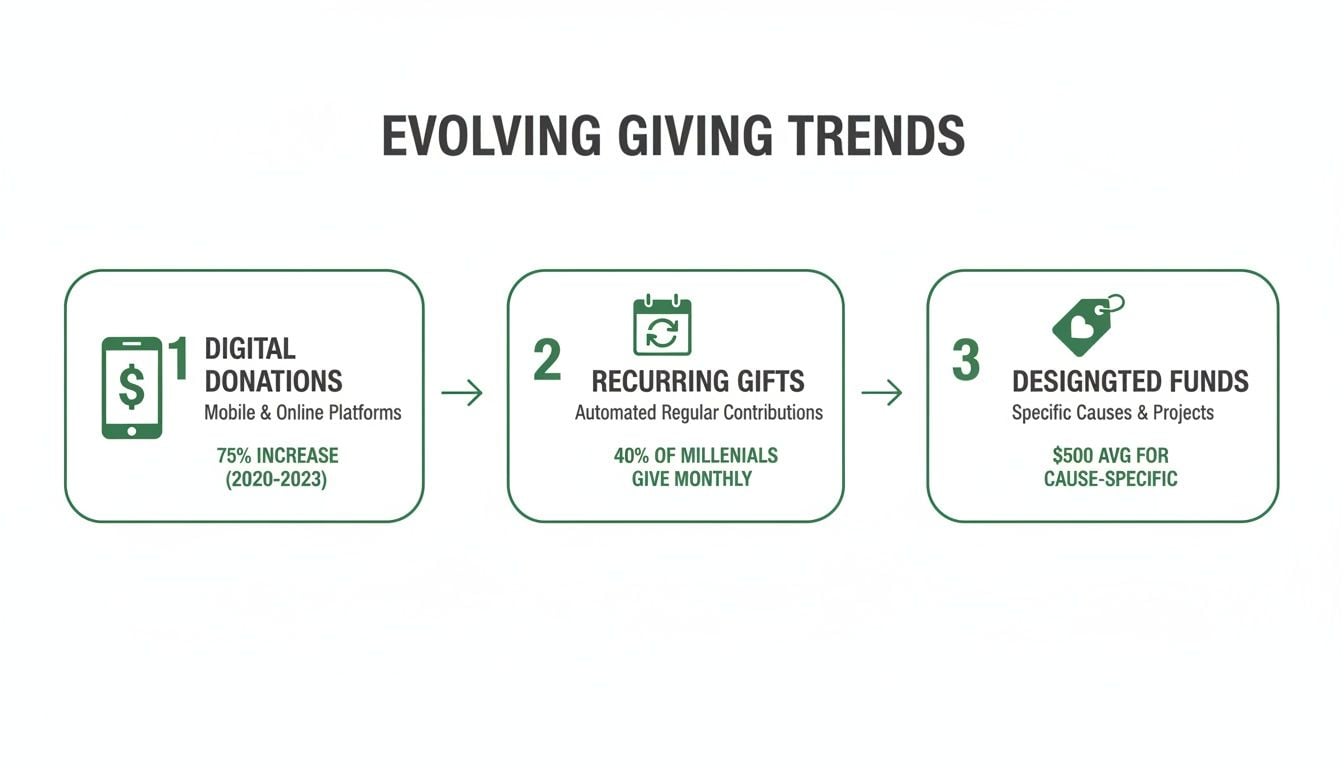
As you can see, the path of modern generosity is clear. As people move from putting cash in the plate to setting up recurring digital gifts, they increasingly want to direct their giving toward specific, tangible impacts.
Properly managing these funds is non-negotiable. You need a system that can track every restricted dollar from the moment it’s received to the moment it’s spent exactly as the donor intended. If you want a deeper dive, you can explore our complete guide on what a restricted fund is and how to manage it.
Creating a System of Accountability
Building a trustworthy system takes more than good intentions. It demands clear policies and the right tools for the job.
- Establish a Clear Policy: Draft simple, written guidelines for how designated funds are handled. It should cover how they’re received, who can approve spending from them, and how they’ll be reported back to the church.
- Use True Fund Accounting: This is where purpose-built software becomes a game-changer. Generic software requires clunky, error-prone workarounds. A true fund accounting system like Grain Ledger is built from the ground up with separate funds at its core. It automates the process, creating digital "jars" that ensure a donation for the "Building Fund" can only be used for the building.
The scale of designated giving can be staggering. In 2025, for example, The Church of Jesus Christ of Latter-day Saints allocated $1.58 billion to specific humanitarian and welfare projects across 196 countries. This massive effort, detailed in their 2025 Caring Report, highlights just how crucial precise tracking is.
Whether your church is large or small, the principle remains the same. Tools designed for fund accounting, like Grain Ledger, give treasurers the power to manage multiple funds with absolute clarity. This ensures the integrity of every single gift and, most importantly, honors the heart behind the giving and tithing of your people.
The Modern Treasurer's Toolkit for Financial Clarity
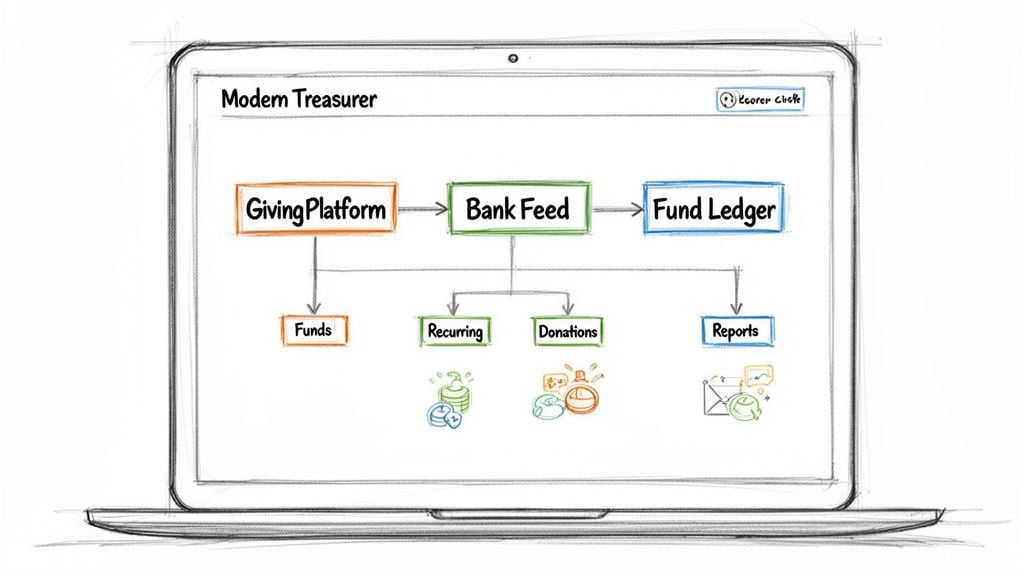
Knowing the principles behind fund accounting is one thing, but actually putting them to work day-to-day requires the right tools. For a church treasurer today, trying to manage the ins and outs of giving and tithing without the right software is like trying to build a house with only a hammer. You might get a few boards nailed together, but you’re setting yourself up for mistakes, a ton of frustration, and a financial structure that just isn’t sound.
The whole point is to turn financial management from something that keeps you up at night into a source of confidence. That shift happens when you have a system that gives you absolute clarity on where every single dollar came from and where it's supposed to go. This is where generic spreadsheets or standard business accounting software miss the mark—they simply weren't built to handle the unique financial world of a church, especially when it comes to restricted funds.
The Right Tool for True Fund Accounting
To get that level of clarity, your most important piece of equipment is a true fund accounting solution. Unlike generic software that tries to fake it with clunky workarounds like "classes" or "tags," a true fund system is built from the ground up with a native fund architecture. What that means is every transaction is tied to a specific fund right from the start. It's not an afterthought; it's part of its DNA.
This is exactly where a solution like Grain Ledger comes in. It isn't business software that’s been tweaked for churches; it was designed from day one for the real-world finances of a ministry. Grain Ledger’s entire structure ensures that those "digital jars" we talked about earlier are built right in, making it impossible to accidentally mix designated funds with the general budget.
For a church, financial clarity isn't just about getting the numbers right; it's about proving you're a trustworthy steward of the resources God has provided. The right tools build accountability into the process, freeing up leaders to focus on ministry instead of spreadsheets.
This approach gives you a complete, honest picture of your church's financial health. A key part of financial oversight involves understanding and using balance sheets, which show what you own and what you owe. With a true fund system, you can pull up a balance sheet for each individual fund in seconds.
Automation That Simplifies Stewardship
The real game-changer in a modern toolkit is automation. A platform like Grain Ledger can connect directly to your church's other essential systems, creating a smooth, hands-off financial workflow that does the heavy lifting for you.
- Giving Platform Integration: When someone gives to the "Missions Fund" online, Grain automatically directs that donation into the correct digital jar. No manual sorting is needed.
- Bank Feed Connection: Deposits from your bank are automatically matched and categorized, which massively cuts down on manual data entry and the human errors that come with it.
An integrated system like this completely changes how you handle giving and tithing. Instead of spending hours every week downloading reports and punching numbers into a spreadsheet, the work becomes automated and accurate. You get a real-time view of your church's finances, all while knowing that every designated gift is protected and every report you run reflects the true state of your stewardship. That’s how technology stops being a burden and starts serving the ministry.
Reporting That Builds Trust and Encourages Generosity
As a church treasurer, you know that keeping the books balanced is just the beginning. The real work—the part that builds trust and inspires people to give—is showing your congregation, board, and pastor where their money is going and what it’s accomplishing.
Think of it this way: clear, consistent financial reporting is the bridge that connects your careful accounting to confident generosity. It’s how you turn spreadsheets of numbers into powerful stories of ministry in action.
For any donor, the single most important question is, "Did my gift actually go where I intended?" This is where generic, one-size-fits-all reports completely miss the mark. Your church needs reporting that shows exactly how giving and tithing are fueling specific parts of your mission, from the youth group to the food pantry.
The goal of a church financial report isn’t just to present numbers; it’s to communicate faithful stewardship. When someone sees that their donation for the youth camp was used for the youth camp, it validates their trust and makes them want to give again.
With a true fund accounting system like Grain Ledger, this kind of transparency is built right in. Instead of wrestling with complicated spreadsheets, you can pull the reports you need in seconds, giving everyone from the pews to the pulpit total confidence in your finances.
Reports That Answer the Right Questions
Effective reporting goes way beyond a simple profit-and-loss statement. To really build trust, you need to provide reports that offer genuine insight. Here are the essentials:
- Fund-Specific Balance Sheets: These reports show the exact financial standing of each individual fund, whether it's your General Fund, Missions Fund, or Building Fund. This is the definitive proof that you're keeping restricted donations separate and secure.
- Fund Activity Reports: Think of this as a detailed logbook for a specific ministry. It shows every dollar that came in and every dollar that went out for that fund over a certain period, creating a crystal-clear audit trail.
For busy church treasurers, learning how to automate reports can be a game-changer, saving you from hours of manual work. A system like Grain Ledger generates these fund-based reports automatically, providing instant clarity. You can find more practical tips on this in our complete guide to crafting a church financial report.
Communicating with Confidence and Consistency
Understanding your church’s giving patterns can also make your communication far more effective. For instance, knowing that December accounts for 14.34% of all annual donations or that the peak giving time is Sunday at 11 am EST helps you time your appeals and updates perfectly.
With 50% of givers now preferring to give online, being aware of these church giving trends is more important than ever.
Ultimately, great reporting takes the complexity out of church finances. It gives pastors the confidence to lead bold new initiatives, assures the board of the church’s financial health, and, most importantly, shows every member of your congregation that their generosity is making a tangible difference.
Related church accounting software resources
If you are comparing software, these pages map the main decision points: fund accounting, QuickBooks limits, pricing, and migration.
- Best church accounting software (2026 comparison) - canonical guide comparing 12 church accounting platforms
- Church accounting software product page - see Grain Ledger for fund accounting, giving, and bank reconciliation
- Small church accounting software - see the product page built for volunteer treasurers and church admins
- Fund accounting features - review how Grain Ledger tracks designated funds
- QuickBooks for churches - understand workarounds and when to switch
- Free church accounting software - compare free options and upgrade triggers
- Grain Ledger pricing - compare plans for small and growing churches
- Start free - try fund accounting, giving imports, and bank reconciliation together
Frequently Asked Questions About Church Giving
Talking about money in the church can bring up a lot of questions. Whether you're a pastor, a treasurer trying to get the numbers right, or a church member who just wants to understand how it all works, getting clear on the details is what builds trust.
Let's walk through some of the most common questions we hear from church leaders just like you.
What Is the Legal Difference Between a Tithe and a Designated Gift?
Think of a tithe as a donation to the church’s general fund. It’s an unrestricted gift that the leadership can use for any ministry need, whether that's keeping the lights on, paying salaries, or funding the youth group’s pizza night. This is the financial engine that keeps the church running day-to-day.
A designated or restricted gift, on the other hand, is given for a specific purpose. The donor might write "for the mission trip" or "for the new building" on their gift. Legally and ethically, your church is obligated to use that money only for the purpose the donor intended. This is where true fund accounting becomes non-negotiable for protecting your church's integrity.
Fund accounting ensures these separate pots of money are tracked meticulously, preventing them from being accidentally used for general operating expenses and honoring the donor's intent.
How Can Our Small Church Start Tracking Restricted Funds Properly?
Even for a small church, getting a handle on restricted funds doesn't have to be a massive headache. The single best thing you can do is to finally move away from that complicated spreadsheet and start using software actually built for church finance.
A tool like Grain Ledger is designed with a true fund accounting framework right out of the box. Here’s how you could get started:
- Set Up Your Funds: In the software, create a separate "fund" for each of your big categories. You might have a 'Building Fund,' 'Missions Fund,' or 'Benevolence Fund.'
- Automate the Inputs: Link your online giving platform and bank accounts. This will help automatically sort donations into the right funds the moment they arrive.
- Create a Simple Policy: Write down a clear, simple policy for how designated funds can be requested, approved, and spent. This creates accountability for everyone involved.
Following these steps replaces guesswork with a reliable, repeatable system.
How Does Fund Accounting Work for Cash and Check Donations?
The same rules apply to every type of donation, whether it comes in through an app or in the offering plate. When your counting team goes through the offering, they should use a count sheet where they can note any designations written on an envelope or in a check's memo line.
For example, if a check has “Youth Camp” in the memo, you simply record that donation as belonging to the “Youth Camp” fund. When you enter the deposit total into an accounting system like Grain Ledger, you’ll break it down and assign the specific amounts to their correct funds.
It’s a simple but critical step that makes sure every dollar is tracked with the same integrity, no matter how it was given.
Why Is a Church Accounting Solution Better Than QuickBooks?
QuickBooks is a great tool for small businesses, but it simply wasn't built to handle the unique financial structure of a church. People often try to make it work using "classes" or "tags" to simulate fund tracking, but this is usually a clunky, manual workaround that’s just begging for errors.
A dedicated church accounting solution like Grain Ledger is built differently from the ground up. It has a native fund architecture, which means every transaction is automatically organized by fund from the very start.
There are no workarounds needed. You get instant, accurate reports for each fund, giving pastors, boards, and treasurers the clarity they need to lead with confidence.
Ready to bring clarity and confidence to your church's finances? Grain Ledger is the purpose-built fund accounting software that automates stewardship, protects designated funds, and provides the reporting you need to build trust. Schedule a Demo today to get started.
Ready to simplify your church finances?
Start free with church fund accounting, or watch a product demo first.