7 Church-Focused Deferred Revenue Income Examples for 2026
Explore 7 deferred revenue income examples for churches, from pledges to digital content. Learn journal entries and recognition triggers with our guide.
In church finance, timing is everything. Receiving a large donation or a year's worth of tuition upfront feels like a blessing, but recognizing that income all at once can distort your financial reality. This is where the concept of deferred revenue becomes a crucial tool for accurate stewardship and transparent reporting.
See Grain Ledger for your church
Fund accounting, giving integrations, and bank reconciliation in one platform. Free migration support for churches switching from QuickBooks or Aplos.
Deferred revenue, also known as unearned revenue, is simply money received for goods or services that have not yet been delivered. It's recorded as a liability on your balance sheet, not as income, until your church fulfills its obligation. For ministries, properly managing deferred revenue is fundamental to maintaining donor trust and making sound financial decisions based on a true picture of your financial health. Mismanaging these funds can lead to misstated income and unexpected budget shortfalls when future expenses arrive without corresponding revenue.
This article provides seven practical deferred revenue income examples tailored to the unique operations of a church. We will explore scenarios ranging from multi-year pledges to prepaid event fees, breaking down each one with:
- Clear explanations of why the revenue is deferred.
- Typical journal entries to guide your bookkeeping.
- Specific triggers for recognizing the income.
- Strategic notes on managing these funds with a true fund accounting system like Grain Ledger.
Understanding these principles is especially important as many churches adopt predictable giving methods. To fully grasp the nature of these financial structures, it's beneficial to explore various successful Recurring Revenue Business Models that share similar accounting DNA. Let's dive into the examples.
1. Pledge Commitments and Multi-Year Giving Campaigns
Pledge commitments are one of the most common and vital deferred revenue income examples for churches, especially during capital campaigns or multi-year ministry initiatives. A pledge is a promise from a member to donate a specific amount over a set period, often for projects like a new building, major renovations, or missions expansion. While the pledge signifies future support, the revenue isn't earned until the funds are actually received and the time-based or purpose-based restrictions are met.
Properly handling pledges as deferred revenue is crucial for accurate financial reporting. Recognizing a multi-year pledge as immediate income would drastically overstate the church's current financial position, creating a misleading picture of available cash and operational health.
The Strategic Breakdown
The core principle is that a promise of future funds is not the same as having those funds available today. Treating a pledge as a receivable (an asset) and corresponding deferred revenue (a liability) correctly reflects this reality on the balance sheet.
- Trigger for Deferral: A pledge commitment is made and recorded. For instance, a family pledges $12,000 to be given over three years for a new youth center.
- Trigger for Recognition: Revenue is recognized as cash payments are received against the pledge. If the family gives their first $1000 installment, that $1000 is moved from deferred revenue to contribution revenue.
Key Insight: This method prevents "paper wealth" by ensuring the income statement only reflects funds that have been physically received. This aligns financial reports with the reality of the church’s cash flow and helps leadership make sound, data-driven decisions.
Journal Entry Example
Imagine a church receives a three-year, $30,000 pledge for its "Building a Future" capital campaign. The initial pledge is recorded, but no income is recognized yet.
1. When the Pledge is Made:
| Account | Debit | Credit |
|---|---|---|
| Pledges Receivable | $30,000 | |
| Deferred Revenue | $30,000 | |
| To record a new pledge commitment. |
2. When the First $10,000 Payment is Received:
| Account | Debit | Credit |
|---|---|---|
| Cash | $10,000 | |
| Pledges Receivable | $10,000 | |
| Deferred Revenue | $10,000 | |
| Contribution Revenue | $10,000 | |
| To record cash received and recognize revenue. |
Actionable Takeaways for Your Church
- Use a True Fund Accounting System: Managing pledges requires segregating these future funds from your general operating budget. A dedicated platform like Grain Ledger is designed for this, allowing you to create a specific fund (e.g., "Building Campaign Fund") to track pledges, receipts, and deferred revenue separately. This is a core feature of proper fund accounting for churches.
- Establish an Allowance: Not all pledges will be fulfilled. Create an "Allowance for Uncollectible Pledges" based on your church's historical giving data to present a more realistic financial picture.
- Automate Tracking: Implement a system that links your giving platform to your accounting software. This can automate the revenue recognition process as pledge payments arrive, saving administrative time and reducing errors.
2. Prepaid Tuition and Religious Education Programs
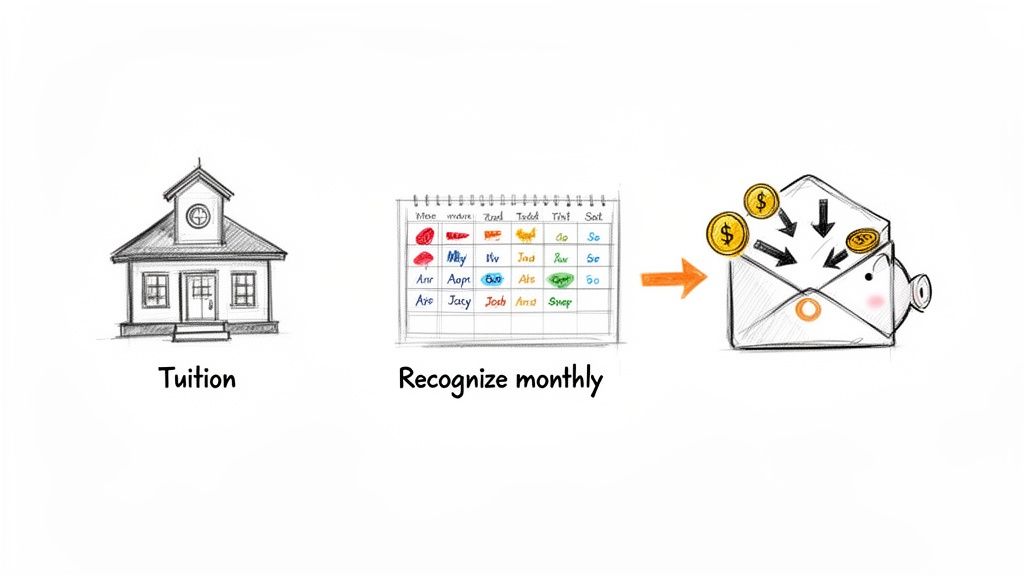
For churches that operate preschools, K-12 Christian schools, or even seasonal programs like summer camps and VBS, prepaid tuition is a foundational deferred revenue income example. Parents often pay for an entire semester or school year in advance. This influx of cash is not yet earned; it represents a liability to provide educational services over the coming months.
Recognizing all this upfront tuition as immediate income would severely distort a church's financial reality. It would create a false sense of liquidity in the months before school starts, while ignoring the ongoing obligation to pay teachers, maintain facilities, and purchase supplies throughout the academic year.
The Strategic Breakdown
The guiding principle here is the matching principle: revenue should be recognized in the same period that the related services are rendered. A lump-sum tuition payment covers future educational services, so the revenue must be spread out over that future period.
- Trigger for Deferral: A parent pays tuition before the school term begins. For example, a family pays a $9,000 annual tuition fee in August for the school year running from September to May.
- Trigger for Recognition: Revenue is recognized on a pro-rata basis as the educational service is delivered. In the $9,000 example, the church would recognize $1,000 of tuition revenue each month for the nine months of the school year.
Key Insight: This systematic recognition of revenue provides a stable and predictable income stream on the profit and loss statement. It helps ministry leaders accurately budget for monthly payroll and operational expenses against the revenue actually earned in that month.
Journal Entry Example
Imagine a church's preschool collects a $4,500 tuition payment in August for the upcoming 9-month school year.
1. When the Full Tuition Payment is Received in August:
| Account | Debit | Credit |
|---|---|---|
| Cash | $4,500 | |
| Deferred Tuition Revenue | $4,500 | |
| To record prepaid tuition received before the school year. |
2. At the End of September (After One Month of School):
| Account | Debit | Credit |
|---|---|---|
| Deferred Tuition Revenue | $500 | |
| Earned Tuition Revenue | $500 | |
| To recognize one month of earned tuition ($4,500 / 9 months). |
Actionable Takeaways for Your Church
- Separate Funds by Program: Use a true fund accounting system like Grain Ledger to create distinct funds for each educational program (e.g., "Preschool Fund," "Summer Camp Fund"). This isolates the finances of each ministry, ensuring tuition for one program isn't accidentally used for another.
- Automate Monthly Recognition: Set up recurring journal entries to automatically recognize the correct portion of tuition revenue each month. This saves significant administrative time and ensures accuracy throughout the school year.
- Integrate Your Systems: For religious education programs dealing with upfront tuition payments, selecting a reliable system for enrollment and payment management is crucial. Look for a student enrollment management system that can integrate with your accounting software to streamline the process from payment to financial reporting.
3. Advance Donations for Building and Capital Projects
Advance donations for capital projects are a powerful and common source of deferred revenue income examples for growing churches. These are funds given by donors specifically for large-scale initiatives like a sanctuary renovation, a new building wing, or major campus improvements. The donations are received before or during the project's planning stages, but the revenue is not considered "earned" until the church fulfills the donor's restriction by spending the money on the specified project.
Properly deferring these funds is essential for maintaining financial integrity and donor trust. Recognizing a large capital gift as immediate income would create a dangerously inaccurate surplus, suggesting the church has operational funds that are, in fact, legally and ethically bound to a future construction project.
The Strategic Breakdown
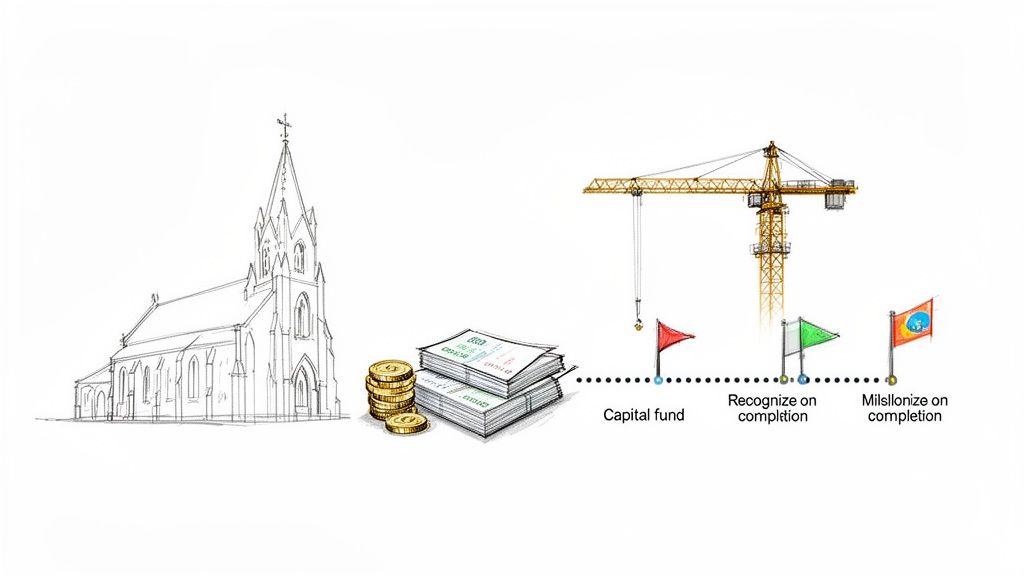
The guiding principle is that revenue should be recognized in alignment with the fulfillment of the purpose for which it was given. For capital projects, this means matching revenue recognition to project expenses and milestones. This approach provides a clear and accurate picture of how restricted funds are being utilized over the life of the project.
- Trigger for Deferral: A donor makes a restricted contribution for a specific capital project, such as a $50,000 gift for a "New Children's Wing" fund.
- Trigger for Recognition: Revenue is recognized as the church incurs expenses related to the project. When the church pays a $10,000 invoice to the architect for the children's wing, $10,000 is moved from deferred revenue to contribution revenue.
Key Insight: This method ensures that the income statement accurately reflects the project's progress. It prevents the church from showing massive income spikes at the start of a campaign, providing leadership with a realistic, milestone-based view of project financials.
Journal Entry Example
Imagine a church receives a $200,000 designated gift for a sanctuary renovation project. The funds are deferred until project work begins.
1. When the $200,000 Donation is Received:
| Account | Debit | Credit |
|---|---|---|
| Cash | $200,000 | |
| Deferred Revenue (Renovation Fund) | $200,000 | |
| To record a restricted capital donation. |
2. When a $50,000 Contractor Invoice is Paid:
| Account | Debit | Credit |
|---|---|---|
| Construction Expense (Renovation Fund) | $50,000 | |
| Cash | $50,000 | |
| Deferred Revenue (Renovation Fund) | $50,000 | |
| Contribution Revenue (Renovation Fund) | $50,000 | |
| To record project expense and recognize revenue. |
Actionable Takeaways for Your Church
- Create Dedicated Project Funds: Use a true fund accounting system like Grain Ledger to create a distinct, segregated fund for each capital project. This is the cornerstone of managing these gifts correctly, as it isolates project finances from the general operating budget. To learn more about this foundational concept, explore the details of what is a restricted fund.
- Establish Milestone-Based Recognition: Tie your revenue recognition schedule to tangible project progress. This could be contractual milestones, percentage-of-completion reports from your builder, or specific project phases (e.g., groundbreaking, foundation, framing).
- Maintain Meticulous Documentation: Keep detailed records of all donor restriction letters, project contracts, invoices, and payments. This documentation is your audit trail and demonstrates accountability to your congregation and donors.
4. Annual and Monthly Membership or Pledge Dues
For churches with formal membership structures, collecting annual dues or monthly pledges upfront is a common practice. This is a classic deferred revenue income example because the church receives cash at the beginning of a period but earns the revenue over the entire membership term. Whether it's a $300 annual household due paid in January or a sustaining partner's entire yearly pledge given upfront, the funds are for services and benefits provided over the next 12 months.
Treating these advance payments as deferred revenue is essential for maintaining accurate financial timelines. Recognizing a full year's dues in the month they are received would inflate that month's income and create a misleading financial picture, making subsequent months appear less financially stable than they actually are.
The Strategic Breakdown
The core principle here is the matching principle: revenue should be recognized in the period it is earned, not just when the cash arrives. The church "earns" the membership dues each month that it provides fellowship, ministry services, and operational support to its members.
- Trigger for Deferral: A member pays their annual dues or an entire year's pledge in a single lump sum. For example, a family pays $600 in January to cover their membership for the entire year.
- Trigger for Recognition: Revenue is recognized on a straight-line basis over the membership period. For the $600 annual due, the church would move $50 from deferred revenue to membership income each month.
Key Insight: This ratable recognition smooths out income over the fiscal year, providing a more stable and predictable view of the church's finances. It prevents the financial "roller coaster" of having a huge income spike in January followed by eleven months of lower reported revenue.
Journal Entry Example
Imagine a church with a formal membership model collects a $1,200 annual due from a member on January 1st for the full calendar year.
1. When the $1,200 Payment is Received in January:
| Account | Debit | Credit |
|---|---|---|
| Cash | $1,200 | |
| Deferred Revenue | $1,200 | |
| To record receipt of annual membership dues. |
2. At the End of Each Month (e.g., January 31st):
| Account | Debit | Credit |
|---|---|---|
| Deferred Revenue | $100 | |
| Membership Revenue | $100 | |
| To recognize one month's portion of earned revenue. |
Actionable Takeaways for Your Church
- Automate Monthly Recognition: Manually creating journal entries every month is tedious and prone to error. A true fund accounting system like Grain Ledger can be configured to automate these scheduled entries, ensuring revenue is recognized accurately and consistently with minimal effort.
- Develop a Clear Membership Policy: Create and communicate a clear policy regarding dues, what they support, and any rules for prorations or refunds if a member leaves mid-year. This transparency builds trust and simplifies financial management.
- Integrate Your Database: Connect your membership database or church management software with your accounting platform. This ensures that as members pay their dues, the financial transactions are automatically flagged for proper deferred revenue treatment, reducing administrative burden.
5. Grant Funding and Performance-Based Revenue Recognition
Grants from foundations or government agencies are powerful deferred revenue income examples that require meticulous tracking. These funds are often awarded with specific conditions that must be met before the church can officially count the money as earned income. Receiving a grant check doesn't mean the revenue is immediately yours; it represents a liability until you fulfill the terms of the agreement.
Properly deferring grant revenue is a non-negotiable aspect of financial compliance. Recognizing the entire grant amount upfront would misrepresent your financial reality and could lead to serious compliance issues with the funder, potentially jeopardizing future funding opportunities.
The Strategic Breakdown
The core principle here is that the grant is conditional. The revenue is earned by performing specific activities, reaching milestones, or incurring eligible expenses, not simply by receiving the cash. This performance-based model requires a clear connection between programmatic work and financial reporting.
- Trigger for Deferral: The church receives grant funds tied to specific, measurable outcomes. For instance, a foundation gives a $50,000 grant for a food pantry program, with funds restricted for purchasing food and operational costs.
- Trigger for Recognition: Revenue is recognized as the conditions are met. When the church spends $5,000 on food and documents the distribution of meals as required by the grant, that $5,000 is moved from deferred revenue to grant revenue.
Key Insight: This approach ensures that your income statement accurately reflects the work you've completed and the value you've provided, aligning your financial reports with your grant obligations. It transforms accounting from a simple record-keeping task into a powerful tool for grant management and reporting.
Journal Entry Example
Imagine a church receives a $25,000 grant from a local foundation to run a youth mentoring program. The grant requires the church to enroll 50 students and provide semester-end progress reports.
1. When the Grant Funds are Received:
| Account | Debit | Credit |
|---|---|---|
| Cash | $25,000 | |
| Deferred Grant Revenue | $25,000 | |
| To record receipt of conditional grant funds. |
2. After Incurring $10,000 in Eligible Program Expenses:
| Account | Debit | Credit |
|---|---|---|
| Program Expenses | $10,000 | |
| Cash | $10,000 | |
| Deferred Grant Revenue | $10,000 | |
| Grant Revenue | $10,000 | |
| To record program expenses and recognize the earned portion of the grant. |
Actionable Takeaways for Your Church
- Create Grant-Specific Funds: Use a true fund accounting system like Grain Ledger to set up a unique, restricted fund for each major grant. This isolates the grant's cash, deferred revenue, and expenses, making reporting to the funder transparent and straightforward.
- Maintain Meticulous Documentation: Keep detailed records of all grant-related activities, expenses, and milestone achievements. This documentation is your proof of performance and the basis for recognizing revenue. The complexities of this are detailed further in the nonprofit accounting standards under FASB ASC 958.
- Link Program Tracking to Accounting: Implement a process where program managers regularly report progress (e.g., meals served, students mentored) to the finance team. This ensures that revenue recognition stays in lockstep with the actual work being done, preventing compliance gaps.
6. Season Pass and Event Ticket Pre-Sales
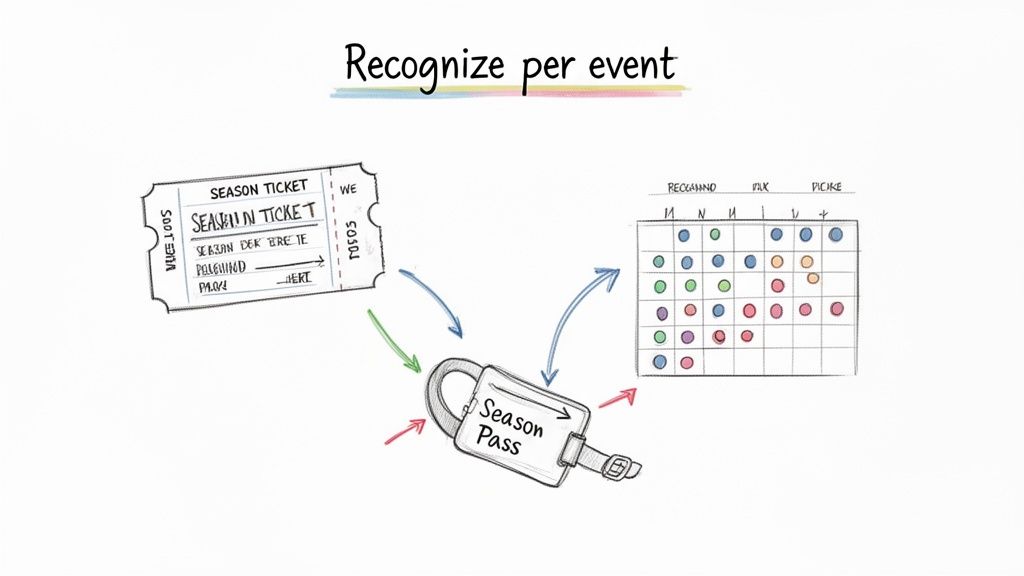
Churches that host recurring events like conferences, camps, classes, or concert series often sell tickets or season passes in advance. These pre-sales are quintessential deferred revenue income examples, as the church collects cash upfront for services (the events) it has not yet delivered. The income is earned and recognized only as each individual event in the series takes place.
This accounting method is vital for ministries that rely on event income, as it prevents the misrepresentation of financial health. Recognizing all the cash from a VBS week or a year-long conference series as immediate income would inflate the current month's revenue, obscuring the true cost and profitability of each event and making future budgeting difficult.
The Strategic Breakdown
The guiding principle here is the matching principle: revenue should be recognized in the same period that the related service is provided. Selling a ticket creates an obligation to host the event, and that obligation is a liability (deferred revenue) until it is fulfilled.
- Trigger for Deferral: A family pre-pays $300 for a week-long Vacation Bible School (VBS) program in May for the event in July. The full $300 is recorded as deferred revenue.
- Trigger for Recognition: Revenue is recognized incrementally as the service is delivered. As each day of the five-day VBS program is completed, one-fifth of the fee ($60) is moved from deferred revenue to program fee income.
Key Insight: This event-by-event recognition provides a clear, real-time view of an event's financial performance. It allows leadership to see if a specific concert in a series was profitable or if a particular day of a conference incurred unusually high costs relative to the revenue it earned.
Journal Entry Example
Imagine a church sells a $120 "season pass" for a year-long, monthly women's ministry series (12 events).
1. When the Season Pass is Sold:
| Account | Debit | Credit |
|---|---|---|
| Cash | $120 | |
| Deferred Revenue - Events | $120 | |
| To record the pre-sale of a women's ministry season pass. |
2. After the First Monthly Event is Held:
| Account | Debit | Credit |
|---|---|---|
| Deferred Revenue - Events | $10 | |
| Program Fee Revenue | $10 | |
| To recognize revenue for one event ($120 / 12 months). |
Actionable Takeaways for Your Church
- Integrate Ticketing and Accounting: Use an event management tool (like Planning Center or Eventbrite) that can connect with your accounting system. This simplifies tracking sales and reconciling cash against your deferred revenue liability.
- Automate Recognition Schedules: A true fund accounting system like Grain Ledger is built for this. You can create a specific fund for an event series and set up automated journal entries to recognize revenue based on the date of each event, ensuring accuracy and saving significant administrative effort.
- Establish Clear Refund Policies: Clearly communicate your refund policy at the time of purchase. This manages expectations and provides a clear accounting procedure for handling cancellations, which will involve reversing the deferred revenue entry and crediting cash.
7. Subscription-Based Ministry Giving and Digital Content Access
As churches expand their digital footprint, subscription models for exclusive content have become a new and relevant source of deferred revenue income examples. This approach involves offering recurring access to digital resources like online courses, premium worship libraries, or a dedicated prayer community for a monthly or annual fee. Since the member pays upfront for access over a future period, the revenue must be deferred and recognized incrementally as the service is delivered.
Properly accounting for subscription income is essential for financial clarity in a digital ministry context. Recognizing an entire annual subscription fee at the moment of payment would inflate current income and misrepresent the church's ongoing obligation to provide content and access to the subscriber throughout the year.
The Strategic Breakdown
The core principle here is that payment received for a future service is a liability, not earned income. The church has an obligation to provide access for the entire subscription term. Deferred revenue accounting honors this commitment by matching revenue recognition to the service delivery period.
- Trigger for Deferral: A supporter pays an upfront fee for a subscription. For instance, a member pays a $120 annual fee for access to a premium online Bible study course library.
- Trigger for Recognition: Revenue is recognized on a straight-line basis over the subscription period. For the $120 annual subscription, the church would recognize $10 of revenue each month ($120 / 12 months).
Key Insight: This method provides a predictable, stable revenue stream and accurately reflects the church’s financial performance over time. It prevents the illusion of a cash surplus in the month of payment and smooths income recognition across the fiscal year.
Journal Entry Example
Imagine a church launches a "Digital Discipleship" platform with a $60 annual subscription fee. A new member signs up and pays on January 1st.
1. When the Annual Subscription is Paid:
| Account | Debit | Credit |
|---|---|---|
| Cash | $60 | |
| Deferred Subscription Revenue | $60 | |
| To record cash received for a 12-month subscription. |
2. At the End of Each Month (e.g., January 31st):
| Account | Debit | Credit |
|---|---|---|
| Deferred Subscription Revenue | $5 | |
| Subscription Income | $5 | |
| To recognize one month of earned subscription revenue. |
Actionable Takeaways for Your Church
- Integrate Payment and Accounting Systems: Use a payment processor that supports recurring subscriptions (like Stripe or Planning Center) and ensure it integrates with your accounting software. A true fund accounting system like Grain Ledger can automate the monthly journal entries to move revenue from the deferred liability account to the income account, saving significant administrative time.
- Track Key Subscription Metrics: Monitor metrics like monthly recurring revenue (MRR), churn rate (cancellations), and subscriber lifetime value (LTV). These data points are crucial for assessing the health and sustainability of your digital ministry offerings.
- Establish Clear Policies: Create and clearly communicate your terms of service, including a refund policy for mid-term cancellations. This transparency builds trust with your digital community and clarifies financial expectations.
7-Point Deferred Revenue Comparison
| Item | Implementation Complexity 🔄 | Resource Requirements ⚡ | Expected Outcomes 📊 | Ideal Use Cases 💡 | Key Advantages ⭐ |
|---|---|---|---|---|---|
| Pledge Commitments and Multi‑Year Giving Campaigns | High — ongoing tracking & recognition schedules | Moderate–High — pledge receivable system, reconciliation staff | Long‑term funding visibility; risk of unfulfilled pledges | Capital campaigns, multi‑year ministry initiatives | Transparent long‑term reporting; planning certainty |
| Prepaid Tuition and Religious Education Programs | Medium — ratable recognition by term | Medium — enrollment tracking, monthly recognition automation | Matched revenue/expense; improved cash flow | Church schools, camps, seasonal programs | Accurate program profitability; predictable budgeting |
| Advance Donations for Building and Capital Projects | High — milestone/percentage‑of‑completion accounting | High — project management + donor restriction documentation | Revenue aligned to project progress; donor transparency | Building expansions, renovations, capital campaigns | Clear stewardship; prevents overstating operating revenue |
| Annual and Monthly Membership or Pledge Dues | Medium — prorations & membership date management | Low–Medium — membership database and automation | Predictable monthly recognition; retention metrics | Churches with formal memberships or dues models | Stable cash flow; simpler forecasting |
| Grant Funding and Performance‑Based Recognition | High — conditional recognition tied to deliverables | High — strict documentation, compliance & reporting | Revenue recognized only when earned; accountability | Grant‑funded programs, government or foundation grants | Strong funder trust; measurable impact reporting |
| Season Pass and Event Ticket Pre‑Sales | Medium — event‑by‑event recognition & attendance tracking | Medium — ticketing integration and refund handling | Improved cash flow; attendance forecasting | Conferences, camps, recurring event series | Simplifies collections; boosts planning accuracy |
| Subscription‑Based Ministry Giving & Digital Access | Medium–High — recurring billing and access control | Medium–High — tech stack, content production, churn management | Predictable recurring revenue; increased engagement | Online content, worship libraries, subscription ministries | Recurring cash flow; expands remote reach |
Related church accounting software resources
If you are comparing software, these pages map the main decision points: fund accounting, QuickBooks limits, pricing, and migration.
- Best church accounting software (2026 comparison) - canonical guide comparing 12 church accounting platforms
- Church accounting software product page - see Grain Ledger for fund accounting, giving, and bank reconciliation
- Small church accounting software - see the product page built for volunteer treasurers and church admins
- Fund accounting features - review how Grain Ledger tracks designated funds
- QuickBooks for churches - understand workarounds and when to switch
- Free church accounting software - compare free options and upgrade triggers
- Grain Ledger pricing - compare plans for small and growing churches
- Start free - try fund accounting, giving imports, and bank reconciliation together
Bringing It All Together: From Theory to Actionable Stewardship
Navigating the landscape of deferred revenue can initially seem like a complex accounting exercise reserved for seasoned financial professionals. However, as we've explored through a variety of deferred revenue income examples, the underlying principle is fundamentally about integrity and stewardship. From multi-year pledge campaigns and building fund donations to prepaid event tickets and digital subscriptions, the core concept remains consistent: revenue should only be recognized when the value promised has been delivered or the restriction has been met.
This isn't merely about compliance with Generally Accepted Accounting Principles (GAAP). It's about providing your church leadership, board, and congregation with a true and accurate picture of your ministry's financial health. When you properly defer unearned income, you prevent the illusion of a cash surplus, which could otherwise lead to misguided spending decisions or a misrepresentation of operational stability. Mastering this practice is a powerful act of financial discipleship.
Recapping the Core Principles
Across all the examples, from grant funding to membership dues, a few critical themes emerge that are essential for effective financial management in a church setting:
- The Trigger is Key: For every type of deferred revenue, there is a specific "recognition trigger." This could be the passage of time (like a monthly membership), the occurrence of an event (a conference), or the fulfillment of a donor's restriction (spending on a specific project). Identifying this trigger is the first and most crucial step.
- Fund Accounting is Non-Negotiable: General-purpose accounting software often struggles to connect deferred revenue with its designated ministry fund. This connection is vital for churches to honor donor intent and maintain financial transparency. The liability (deferred revenue) and the eventual income must live within the same fund to tell the whole story.
- Documentation Builds Trust: Clear documentation for pledges, restricted gifts, and prepaid services is your best defense against confusion. It clarifies donor intent, establishes the timeline for revenue recognition, and creates an unassailable audit trail that fosters congregational trust.
Moving from Knowledge to Action
The journey from understanding the theory of deferred revenue to implementing it effectively in your church's day-to-day operations is the most important step. The practical benefit is profound clarity. When you look at your financial statements, you can be confident that the income shown truly represents the ministry work accomplished in that period. This clarity empowers strategic planning, responsible budgeting, and confident leadership.
Strategic Insight: A church that masters deferred revenue management can more accurately forecast future cash flow and resource availability. It moves from a reactive, cash-based view to a proactive, accrual-based understanding of its financial position, enabling more ambitious and sustainable ministry planning.
Ultimately, handling these deferred revenue income examples with precision is an act of honoring both God and your givers. It demonstrates a commitment to transparency and accountability that strengthens the foundation of your ministry. While the journal entries and tracking require diligence, the peace of mind that comes from knowing your financial house is in order is invaluable. Adopting a system designed for these unique church-finance challenges is not a luxury; it is a necessity for modern stewardship.
Ready to transform your church's financial management and effortlessly handle deferred revenue? See how Grain's true fund accounting system automates these processes, providing the clarity you need to lead with confidence. Explore Grain today and build a stronger foundation for your ministry's future.
Ready to simplify your church finances?
Start free with church fund accounting, or watch a product demo first.