A Guide to Church Financial Statements
Learn to prepare, read, and present a church financial statement. This practical guide covers fund accounting, internal controls, and transparent reporting.
A church financial statement isn't just a spreadsheet of numbers; it’s the formal report card that shows exactly how a ministry is stewarding the resources entrusted to it. It’s the story of how money comes in, how it's managed, and how it’s spent to carry out your mission.
Unlike a typical business report that’s all about profit, church statements are built around stewardship and accountability. They track every dollar according to donor intent, which is crucial for building trust with your congregation and making wise leadership decisions.
Why Church Financials Are Different
Before you can even start building a financial statement, you have to grasp what makes it unique. A for-profit company is chasing profit—that’s its primary goal. A church, on the other hand, operates on a foundation of faithful stewardship and transparency. The objective isn’t to maximize earnings; it’s to responsibly manage the resources God provides through the congregation’s generosity.
This fundamental difference is why churches can’t just use standard business accounting. We rely on a specialized system designed just for nonprofits: fund accounting.
The Core Principle of Fund Accounting
Picture your church’s bank account. Now, imagine it has internal dividers separating the money into different buckets. One bucket holds the general tithes and offerings that pay the light bill, cover salaries, and fund weekly ministries. Another bucket holds all the designated gifts for the upcoming youth mission trip. A third contains every donation given specifically for the new building's roof.
Fund accounting is simply the method we use to create and manage those buckets.
It’s the system that ensures money given for a specific purpose—like missions, a capital campaign, or a benevolence need—is only used for that purpose. This isn't just a nice-to-have practice; it's an ethical and legal promise you make to your donors. For a deeper dive into the official standards, you can check out a nonprofit's guide to FASB ASC 958.
This approach brings incredible clarity to your financial story and helps you answer critical, everyday questions:
- Do we have enough in the general fund to make payroll this month?
- How close are we to our fundraising goal for the new sound system?
- Are we honoring the specific wishes of the family who gave to the benevolence fund?
The right set of reports provides the answers. Let's look at the three core financial statements every church needs.
The Three Core Church Financial Reports
This table gives you a quick overview of the essential reports that form the backbone of your church's financial communication. Each one tells a different part of your ministry's financial story.
| Financial Statement | What It Shows | Key Questions It Answers |
|---|---|---|
| Balance Sheet | A snapshot of your church's financial position at a single point in time. It lists assets (what you own), liabilities (what you owe), and net assets (the difference). | What is our overall financial health? How much cash do we have on hand? How much debt are we carrying? |
| Statement of Activities | Your church's financial performance over a period of time (e.g., a month or year). It shows all income and expenses, categorized by fund. | Did we operate at a surplus or a deficit? How did our income from giving compare to our budget? How much did we spend on specific ministry programs? |
| Statement of Cash Flow | How cash has moved in and out of the church. It breaks down cash flow into operating, investing, and financing activities. | Where did our cash come from, and where did it go? Are our core operations generating enough cash to sustain the ministry? |
Together, these three reports provide a comprehensive picture, ensuring both leadership and the congregation have a clear understanding of the church's financial standing.
Building Trust Through Transparency
When it comes down to it, clear and consistent financial reporting is one of the most powerful tools you have for building and maintaining trust. When your members can easily see how their contributions are making an impact, their confidence in leadership skyrockets. This level of transparency is a powerful demonstration of responsible stewardship and often encourages even greater generosity.
The scale of this responsibility can be massive. For example, the General Board of Global Ministries of the United Methodist Church reported total assets of around $419 million and operating revenues of $42.5 million in a single fiscal year. These are huge numbers, and they show just how much is at stake in sustaining ministry operations across a religious organization market that has grown to over $374 billion.
A church financial statement does more than report numbers; it tells a story of mission, impact, and faithfulness. It transforms abstract figures into tangible evidence of ministry at work.
Ultimately, a well-prepared church financial statement is your primary vehicle for telling this story of stewardship. It’s the bridge that connects the generosity of your people with the life-changing work of the church.
Getting Your Hands Dirty: How to Build Your Key Financial Statements
Alright, let's move from the theoretical to the practical. This is where you start to see the real story of your church's stewardship unfold. Putting together a solid financial statement isn't about knowing complex formulas; it's about telling an accurate story with numbers.
The whole financial cycle, from a donation being placed in the offering plate to you presenting a final report, follows a clear, logical path.
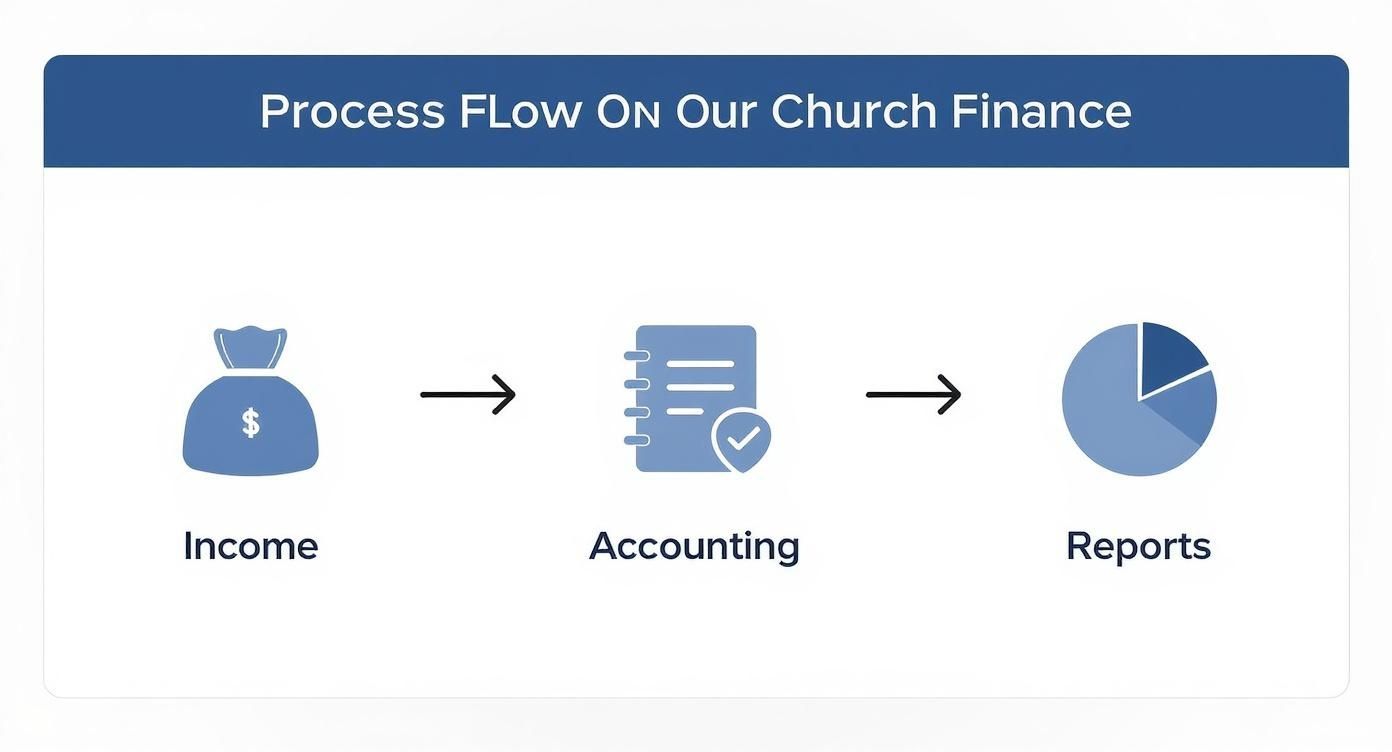
As you can see, all income—whether it's tithes, special offerings, or fundraiser proceeds—is the starting point. That money flows into your accounting system, which then helps you generate the reports that give a clear picture of your church's financial health.
Assembling the Statement of Financial Position
Think of the Statement of Financial Position (you’ll often hear it called a balance sheet) as a financial snapshot. It captures your church's health on one specific day, showing exactly what you own, what you owe, and the difference between the two. The entire report hinges on a simple, powerful equation: Assets = Liabilities + Net Assets.
First up, you need to list your assets. These are all the resources the church owns that have value. For most churches, this includes:
- Cash in Bank: Every checking, savings, and money market account you have.
- Property and Equipment: The value of your building, land, church vans, and sound equipment, minus what's been depreciated over time.
- Investments: Any stocks, bonds, or endowment funds your church holds.
Next, you'll list your liabilities. These are the financial obligations your church owes to others. You’ll almost always have:
- Accounts Payable: Those routine bills for utilities, curriculum, or Sunday school supplies.
- Loans or Mortgages: Any debt on your property or other major assets.
- Payroll Liabilities: The taxes and other withholdings you owe for your staff.
The final piece of the puzzle is net assets—what’s left after you subtract the liabilities from the assets. In the church world, we have to split this into two crucial categories:
- Net Assets Without Donor Restrictions: This is your general fund. It can be used for any ministry purpose, from paying the pastor's salary to fixing a leaky roof.
- Net Assets With Donor Restrictions: These are funds given for a specific purpose defined by the donor. Think of the money designated for a missions trip, a building campaign, or the benevolence fund.
This distinction is the absolute heart of fund accounting. Keeping restricted and unrestricted funds separate isn't just a "nice-to-have" bookkeeping practice. It's an ethical and legal promise to your donors that you're handling their gifts with integrity.
Crafting the Statement of Activities
If the balance sheet is a snapshot, the Statement of Activities is the video. It shows your church’s financial performance over a period of time, whether that’s a month, a quarter, or a full year. This is the nonprofit world’s version of an income statement, and it clearly shows if you operated with a surplus or a deficit.
The statement kicks off with revenue—all the income the church received. It’s vital to categorize this properly to get real insight into your giving patterns. For many churches, revenue streams vary, but the scale can be immense. The Seventh-day Adventist Church, for example, reported receiving about $12 billion in world tithe over just five years, plus another $429 million in world mission offerings. These numbers show just how deeply members will commit to supporting ministry work.
Your revenue section will typically break down into categories like:
- Tithes and Offerings
- Designated Gifts (for missions, building fund, etc.)
- Grant Income
- Event or Rental Income
After revenue comes expenses. A best practice is to group these by function, which clearly shows how your resources are being used to fulfill the church’s mission. A well-organized chart of accounts is your best friend here. If you're struggling to get yours structured right, take a look at our guide on creating a chart of accounts for a nonprofit.
Your main functional expense categories will likely be:
- Program Services: Costs tied directly to your ministries, like youth group events, worship supplies, or community outreach.
- Management and General: The administrative costs that keep the lights on, such as salaries, office supplies, and insurance.
- Fundraising: Any expenses directly related to soliciting donations.
Subtract your total expenses from your total revenue, and you’ve got your change in net assets for the period.
Demystifying the Statement of Cash Flows
The Statement of Cash Flows is easily the most misunderstood report, but it’s one of the most important. It answers a question that can stump even seasoned board members: "Our Statement of Activities shows a surplus, so where did all the cash go?"
This report breaks down all cash movement into three simple activities:
- Operating Activities: Cash coming in and going out from your main activities—mostly collecting tithes and paying for ministry expenses and salaries.
- Investing Activities: Cash used to buy or sell long-term assets, like purchasing a new property or selling that old church van.
- Financing Activities: Cash from borrowing money or paying back debt, like making those monthly mortgage payments.
A healthy church will show a positive cash flow from its operations. This is a clear sign that your core ministries are financially self-sustaining. This report is the ultimate reality check on your church’s liquidity and day-to-day financial stability.
Navigating Designated Giving and Restricted Funds
https://www.youtube.com/embed/eO1y53zEUpc
Handling designated gifts is one of the most critical responsibilities a church has, and it's an area where good intentions can easily go wrong. When a donor gives money for a specific purpose, you're not just accepting a check—you're making a promise. Honoring that promise through proper management of restricted funds is the cornerstone of your church's financial integrity.
This isn't just about the general offering that keeps the lights on. We're talking about the capital campaign for the new children's wing, the special collection for your missionaries, or the funds raised for the youth group's summer camp. Each one is a restricted fund.
That money simply cannot be used to pay the electric bill or cover a budget shortfall, no matter how tempting it might be. Misusing these funds, even by accident, can shatter donor trust and create serious legal problems. You have to treat it as a sacred trust, which requires a meticulous and separate tracking system.
Understanding the Types of Restrictions
Not all restrictions look the same. In church accounting, these donor-imposed rules typically fall into two buckets. Knowing the difference is absolutely essential for preparing an accurate church financial statement.
- Funds With Temporary Restrictions: This is what you'll see most often. These are funds designated for a specific project, program, or timeframe. As soon as that purpose is fulfilled, the restriction is lifted.
- Funds With Permanent Restrictions: These are much less common and usually involve large gifts or endowments. The donor's rule is that the original principal of the gift must be preserved forever, while the church is free to use any investment income it generates.
For instance, a $5,000 gift for a new sound system is temporarily restricted. Once you buy the sound system, the restriction is met. But a $100,000 endowment to fund an annual scholarship is permanently restricted—you can only spend the earnings, not the original principal.
The core principle is simple but absolute: donor intent dictates how the funds are used. Your accounting system must create virtual walls around each restricted fund, ensuring it remains untouched for any other purpose.
The Lifecycle of a Restricted Fund
From the moment a designated gift is received until it's spent, it follows a clear lifecycle. Every step demands precision to keep your finances clear and accountable.
- Receiving and Recording: When a designated check comes in, it must be recorded immediately into a separate liability or restricted net asset account. Never let it mix with your general operating revenue in your chart of accounts.
- Tracking and Reporting: Your financial statements—especially the Statement of Financial Position and Statement of Activities—must clearly separate these funds from unrestricted funds. This gives everyone a transparent view of what money is truly available for general ministry versus what's already spoken for.
- Spending the Funds: As you pay for expenses that match the donor's intent, like cutting a check to the contractor for the new building, you spend the cash and reduce the corresponding restricted fund balance. For some needs, like helping families in crisis, you might even set up a dedicated benevolence fund. You can learn more about how to set up and manage a benevolent fund in our detailed guide.
Releasing Funds From Restriction
The final step is just as important as the first. Once the condition of the gift has been met—the mission trip is over, the roof is repaired, the Bibles are purchased—you have to formally release the funds from their restriction.
This is purely an accounting entry, not a physical movement of cash. On your Statement of Activities, you'll see a line item called "Net Assets Released from Restriction." This entry simply moves the dollar amount from the "with donor restrictions" column over to the "without donor restrictions" column, officially showing that your promise to the donor has been fulfilled.
This careful, step-by-step process does more than just keep your books clean. It builds a powerful testimony of stewardship that honors your donors, protects your church, and ultimately fuels even greater generosity for the mission ahead.
Establishing Smart Internal Controls and Reviews
A beautifully prepared financial statement means nothing if you can't trust the numbers. The integrity of your reporting all comes down to strong internal controls—the practical, everyday processes that protect your church's assets, prevent costly errors, and ensure everything is accurate.
This isn't about creating corporate-level bureaucracy. It’s about building a culture of accountability that safeguards the resources your congregation has entrusted to you.
Think of these controls as your first line of defense against both honest mistakes and potential fraud. The good news is they are completely scalable, meaning even the smallest church plant can—and absolutely should—implement them from day one.
Building Your Financial Guardrails
The whole point of internal controls is to make it incredibly difficult for one person to have unchecked power over the church’s finances. This principle, known as segregation of duties, is the single most important concept to get right.
It’s pretty simple in practice: the person who counts the offering should never be the same person who deposits the money and then records it in the books. By splitting up these key tasks, you create a natural system of checks and balances.
Here are a few non-negotiable controls every church needs:
- The Two-Person Rule: Always have at least two unrelated people present when counting and recording the weekly offering. No exceptions.
- Dual Signatures on Checks: For any check over a certain threshold (say, $500), require two authorized signatures. This one simple step prevents a single individual from making large, unapproved purchases.
- Mandatory Bank Reconciliations: Every month, someone who doesn't handle deposits or write checks must reconcile the bank statement against your accounting records. This is one of the most powerful ways to catch errors or suspicious activity early.
A common pitfall is giving all the financial tasks to one trusted, long-serving volunteer. While their heart is in the right place, this creates a huge risk. Strong processes protect everyone, including your most dedicated people.
Using Variance Analysis to Spot Issues Early
One of the most powerful review tools at your disposal is the budget-to-actual variance analysis. It’s a straightforward report that compares what you planned to spend (your budget) with what you actually spent. But the insights it provides are incredible.
When your finance committee looks at this report, they shouldn't just be hunting for overspending. Any significant variance—over or under—is a flashing light that demands a question.
For instance, if the missions budget is 50% underspent six months into the year, it could mean a planned wire transfer to a missionary was missed. If utilities are suddenly 30% over budget, it might signal a maintenance issue like a hidden water leak. This process turns your budget from a static document into a living, breathing management tool that helps you spot problems long before they become crises.
A Finance Committee Review Checklist
Your finance committee's review of the monthly statements shouldn't be a passive glance. It needs to be an active, inquisitive process.
Here are the kinds of questions the committee should be asking every single month:
- Does the Statement of Financial Position make sense? Is our cash balance where it should be for upcoming expenses? Are we paying down our loan as expected?
- How are we tracking against the budget? What are the biggest variances, and what’s the story behind them?
- Are we honoring restricted funds? Is there a clear separation between designated gifts (like for the building fund) and the general operating fund?
- What's the trend with our income? How does this month's giving compare to the same time last year?
- Are there any unusual expenses? Do we understand what each large expenditure was for?
This level of scrutiny is fundamental to good governance and transparency. While some organizations guard their financials closely, many operate with a high degree of openness. It's interesting to note that while The Church of Jesus Christ of Latter-day Saints has not publicly disclosed full financial statements in the U.S. since 1959, it does provide audited reports in countries like the UK and Canada where it's legally required. You can explore more about these global financial disclosure practices to see how different regulations influence reporting.
Presenting Financials with Clarity and Confidence
You've done the hard work of creating an accurate church financial statement. That's a huge milestone, but the job isn't quite finished. The numbers on the page are just data—they only become truly meaningful when you present them in a way that connects with your congregation, builds trust, and reinforces your church's mission.
Let's be honest, financial reports can be intimidating for people who don't spend their days in spreadsheets. The secret is to stop thinking about it as a report and start thinking of it as telling a story of good stewardship.
This means shifting your focus from raw numbers to real-world ministry impact. Instead of just saying you spent $5,000 on youth ministry, show pictures from the youth mission trip. Explain how that $5,000 made it possible for 15 students to serve another community. This simple reframe connects every dollar directly to the work of the church.
From Data Overload to Insightful Dashboards
For most people in your pews, a full balance sheet or a detailed expense report is just too much. I've found that the most effective tool is often a simple summary or a visual dashboard. This approach boils down the most critical information into a format that’s easy to grasp in a few seconds.
For your next quarterly members' meeting, try creating a one-page summary. It could include:
- A Simple Bar Chart: Show total giving for the quarter right next to the budgeted amount. It's an instant visual check-in.
- A Pie Chart: Break down your total expenses into major ministry categories like Worship, Outreach, Youth, and Administration.
- Key Metrics: Highlight a few other important numbers, such as average weekly attendance or the number of first-time givers.
These visuals make trends and progress immediately obvious. They turn a passive report into an engaging conversation starter, helping everyone see how their generosity is fueling the mission.
The goal is not just to report what happened, but to explain why it matters. A well-presented financial story should always tie back to the church's vision and spiritual goals, demonstrating how financial stewardship enables ministry to happen.
Answering Questions with Transparency and Grace
When you open up the financial conversation, you're going to get questions. That's a good thing! It means your congregation is engaged and cares deeply about the church's health. Being ready with clear, data-backed answers is one of the most important things you can do to maintain trust.
In fact, a Lifeway Research report found that confidence in churches hit an all-time low of just 31% in recent years. Financial transparency is a powerful way to rebuild and strengthen that confidence.
Being prepared for the common questions makes all the difference. When someone asks about finances, they're looking for reassurance that their contributions are being handled wisely. This table can help you frame your responses effectively.
Answering Common Congregation Finance Questions
Here’s a quick guide to help church leaders transparently address the financial inquiries you’re most likely to hear from members.
| Common Question | Key Data to Reference | Effective Response Strategy |
|---|---|---|
| "Where does all my money actually go?" | The Statement of Activities, specifically functional expense categories. | Show a pie chart that visually breaks down expenses by ministry area. Say, "That's a great question. Last quarter, 75% of every dollar given went directly to our ministry programs, like children's ministry and local outreach." |
| "Why are administrative costs so high?" | The budget-to-actual variance report and a breakdown of administrative expenses. | Explain what's included in "administration"—salaries, insurance, utilities—and frame them as essential ministry support. "Our staff and facilities are the backbone that makes all our ministries possible. These costs enable everything else we do." |
| "Are we meeting our budget this year?" | The year-to-date Statement of Activities compared to the annual budget. | Use a simple line graph showing actual giving versus budgeted giving. Be honest about any shortfalls and explain the plan. "We're currently tracking slightly behind budget, which is why we're emphasizing the importance of consistent giving to finish the year strong." |
Framing your financial narrative this way does more than just inform; it inspires. When people see tangible evidence of their contributions making a difference, they are more motivated to continue giving generously. It transforms a dry financial report into a powerful testament to what God is doing through your church.
Answering Your Top Church Finance Questions
When you're dealing with church finances, certain questions pop up time and time again. Whether you're new to the treasurer role or a long-serving board member, you've probably wondered about some of these yourself. Let's tackle the most common questions we hear from church leaders.
Does Our Small Church Really Need Formal Accounting?
Yes, without a doubt. It might feel like overkill when you're just starting out, but adopting nonprofit accounting standards from the very beginning is one of the smartest things you can do. It's not about creating corporate-level complexity; it's about establishing consistency and transparency.
Think of it as building a strong foundation. Following these standards ensures that if a new treasurer takes over, they won't have to decipher a confusing, homegrown system. It also becomes non-negotiable if your church ever seeks a grant or a loan. Getting fund accounting right from day one builds a culture of financial integrity that will serve your ministry for years to come.
Good accounting isn't just about compliance—it's about stewardship. It gives you the clear financial picture you need to make wise, faith-filled decisions for the future of your church.
What's the Difference Between a Budget and a Financial Statement?
This is a fantastic question, and getting the distinction right is key for any church leader. While they work hand-in-hand, they serve two very different functions.
- A Budget is your game plan. It's a forward-looking document outlining your best estimates for income and expenses. Think of it as the roadmap for your ministry's financial goals for the year ahead.
- A Financial Statement is the scoreboard. It’s a backward-looking report that shows what actually happened with the church's money over a certain period.
The real magic happens when you use your church financial statement to see how you performed against your budget. That comparison, often called a variance analysis, is where you spot the insights. It shows you where you’re on track, where you might be overspending, and where you need to make adjustments to stay faithful to your plan.
How Often Should We Be Preparing Financial Statements?
The answer really depends on who you're preparing them for.
For your internal leadership team—the pastor, board members, and finance committee—you should be running these reports at least monthly. This regular check-in is crucial. It allows you to keep a close eye on cash flow, monitor spending against the budget, and catch small issues before they snowball into major problems.
For your congregation, a different rhythm works well. A quarterly summary report is a great way to maintain transparency and keep everyone informed. Then, at the end of the year, an in-depth annual report provides the full picture of the church's financial stewardship, celebrating all that God has accomplished through your members' generosity.
Can We Just Use Standard Business Accounting Software?
You can, but it often feels like trying to fit a square peg in a round hole. Most business software is designed to track one thing: profit. That's a completely different goal than the one your church has.
The biggest headache you'll run into is fund accounting. Standard software simply isn't built to handle restricted gifts for specific purposes like missions, a building campaign, or benevolence. You'll end up wrestling with clumsy workarounds and complex spreadsheets that are just begging for errors.
Using software designed specifically for churches saves an incredible amount of time and frustration. It's built to track designated funds properly, reducing the risk of accidentally misusing those gifts and generating the reports you actually need without all the manual effort.
Managing church finances requires tools that understand the unique demands of stewardship and fund accounting. Grain is church accounting software built from the ground up to organize your finances around funds. It connects your giving, bank, and accounting into one system to provide clear, real-time reports that speak the language of ministry. This lets you focus on your mission with confidence. Join the waitlist to learn more at grainledger.com.
Ready to simplify your church finances?
Join the waitlist for early access to Grain - modern fund accounting built for ministry.